Palazzo Corsini al Parione: A Baroque Family Palace in Florence
Site at a Glance
- Popularity
- High
- Country
- Italy
- Primary era
- Early Modern
- Eras represented
- Early Modern
- Civilizations
- Grand Duchy of Tuscany
- Site type
- Domestic
- Remains
- Elite Residence
On this page13 sections
History
The Corsini and the pre-palace site
Palazzo Corsini al Parione is a late Baroque palace on Lungarno Corsini in Florence, Italy. Its construction began in 1656, and it became the Corsini family’s principal palace in the city. Baroque architecture is associated with dramatic composition and elaborate ornament.
The Corsini family rose to prominence as bankers from the late Middle Ages. Their business, which included operations in London, brought wealth that they invested in land, particularly in the Papal States, territories in Italy ruled by the pope. Filippo Corsini held the title of marquis, a noble rank below duke. Pope Urban VIII later raised the head of the family to princely rank.
Several properties occupied the site before the palace. The most prominent was the Casino del Parione, a small pleasure house with a park, built on houses confiscated from the Florentine banker and art patron Bindo Altoviti in 1555. The property passed first to the Marquis of Marignano and then to Giovanni de’ Medici, a son of Cosimo I de’ Medici and Eleonora degli Albizzi. In 1621 it went to Cardinal Giovan Carlo de’ Medici, a senior official of the Roman Catholic Church. Maddalena Machiavelli, Bartolomeo Corsini’s mother, bought it in 1640. Bartolomeo inherited the property in 1650, and the Corsini acquired additional properties on the site through 1728.
Construction and unrealized plans
Several architects successively shaped the palace, with Antonio Maria Ferri responsible for much of its present architectural form. Work on the side facing the Arno began in 1687, followed by the façade in 1690. Construction was completed in 1737, although the full design was never carried out.
The uncompleted scheme proposed a larger extension toward Piazza Goldoni and a new road to form a monumental approach to the city. The planned road would have run from Via del Parione to Via della Vigna Nuova, near Palazzo Rucellai.
The collection and continuing use
Lorenzo Corsini became Pope Clement XII in 1730. In 1765, the pope’s nephew Don Lorenzo Corsini began the palace’s art collection. The palace remains in Corsini family ownership, with some descendants living there. It is also used for exhibitions and events, including the Antiquarian Biennale, an exhibition of antiques that was previously held at Palazzo Strozzi.
Remains
Exterior and courtyard
River façade and plan
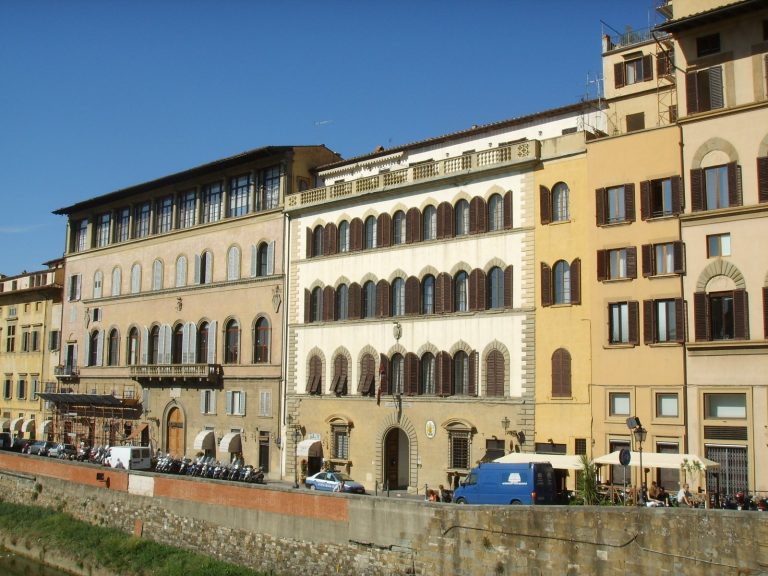
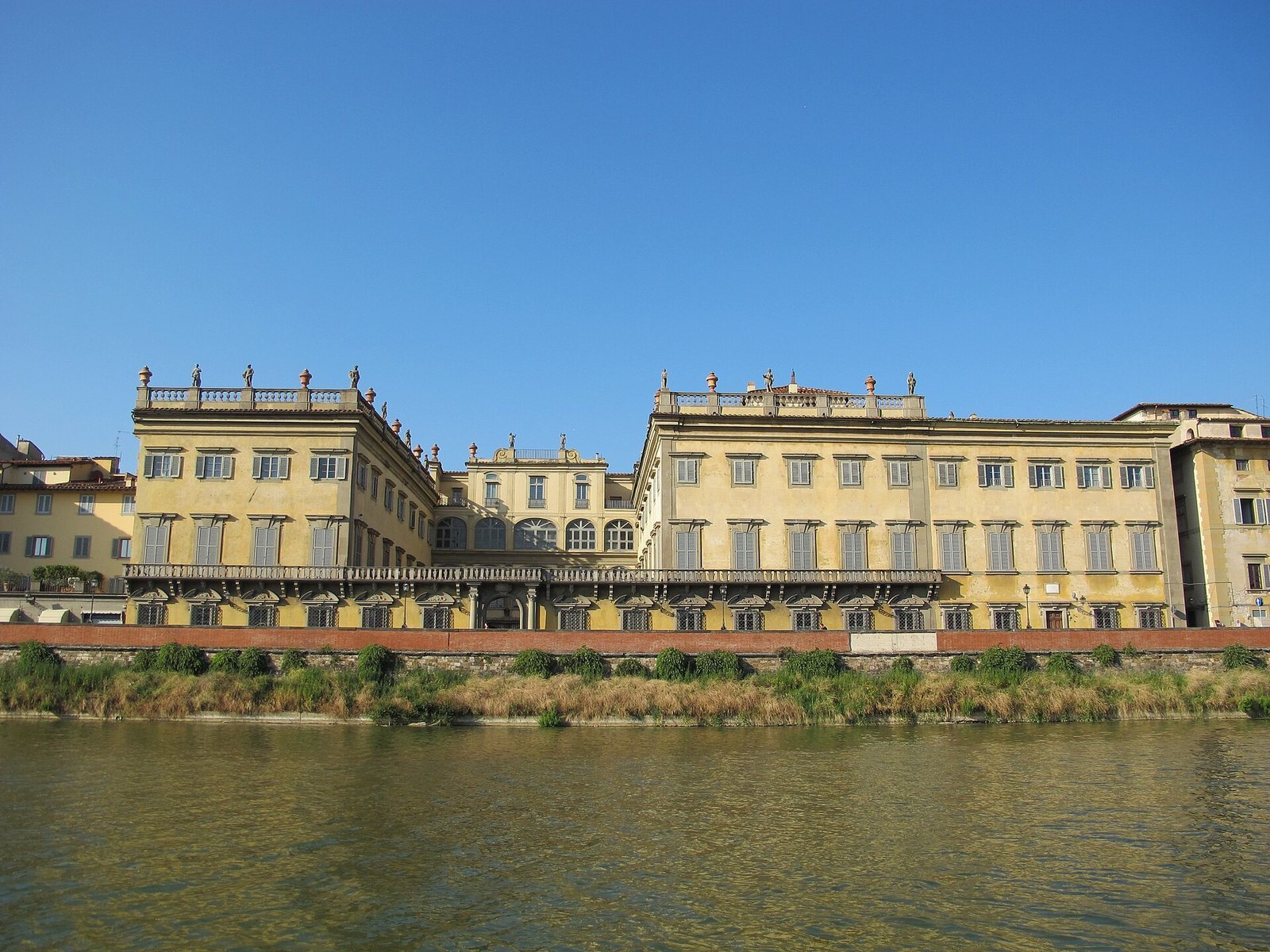
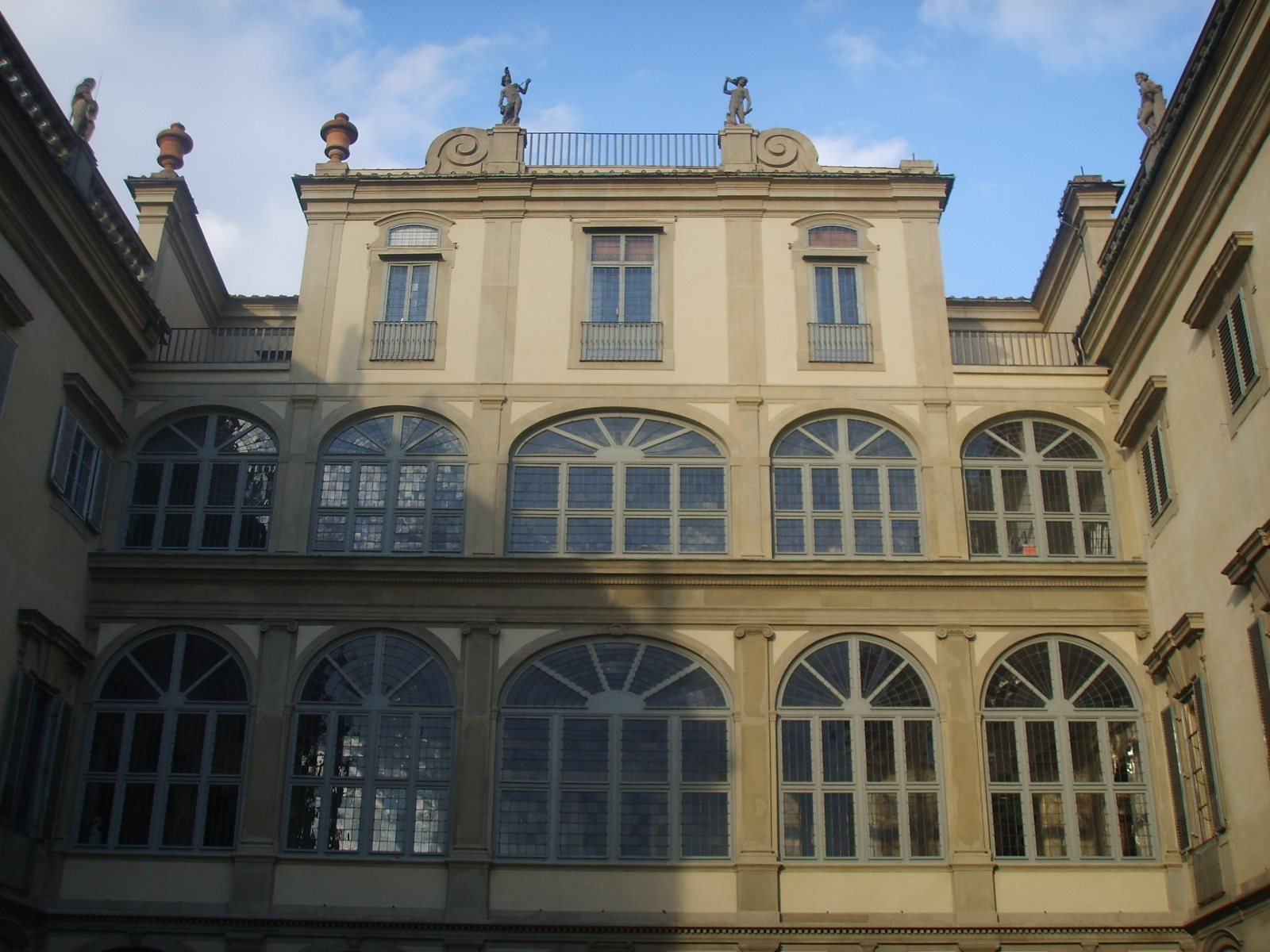
The palace’s three main sections form a U-shaped plan around a large central courtyard. Its principal façade faces the Arno. The two river-facing wings connect through a central terrace with a stone railing. The right wing is twice the size of the left, giving the façade an asymmetrical arrangement. Its central section is set back between projecting side sections, contrasting recessed and solid surfaces. Shallow elliptical arches crown the windows.
A balcony with a stone railing runs beside the entrance and continues across the façade at the principal-floor level. At roof level, another terrace has a stone railing decorated with statues and terracotta vessels shaped like ancient kraters, vessels used to mix wine and water. The upper façades also feature railings ornamented with statues and terracotta vases. The palace’s design departed from traditional Florentine architecture and was later imitated in suburban villas and country houses.
Courtyard entrance and stairs
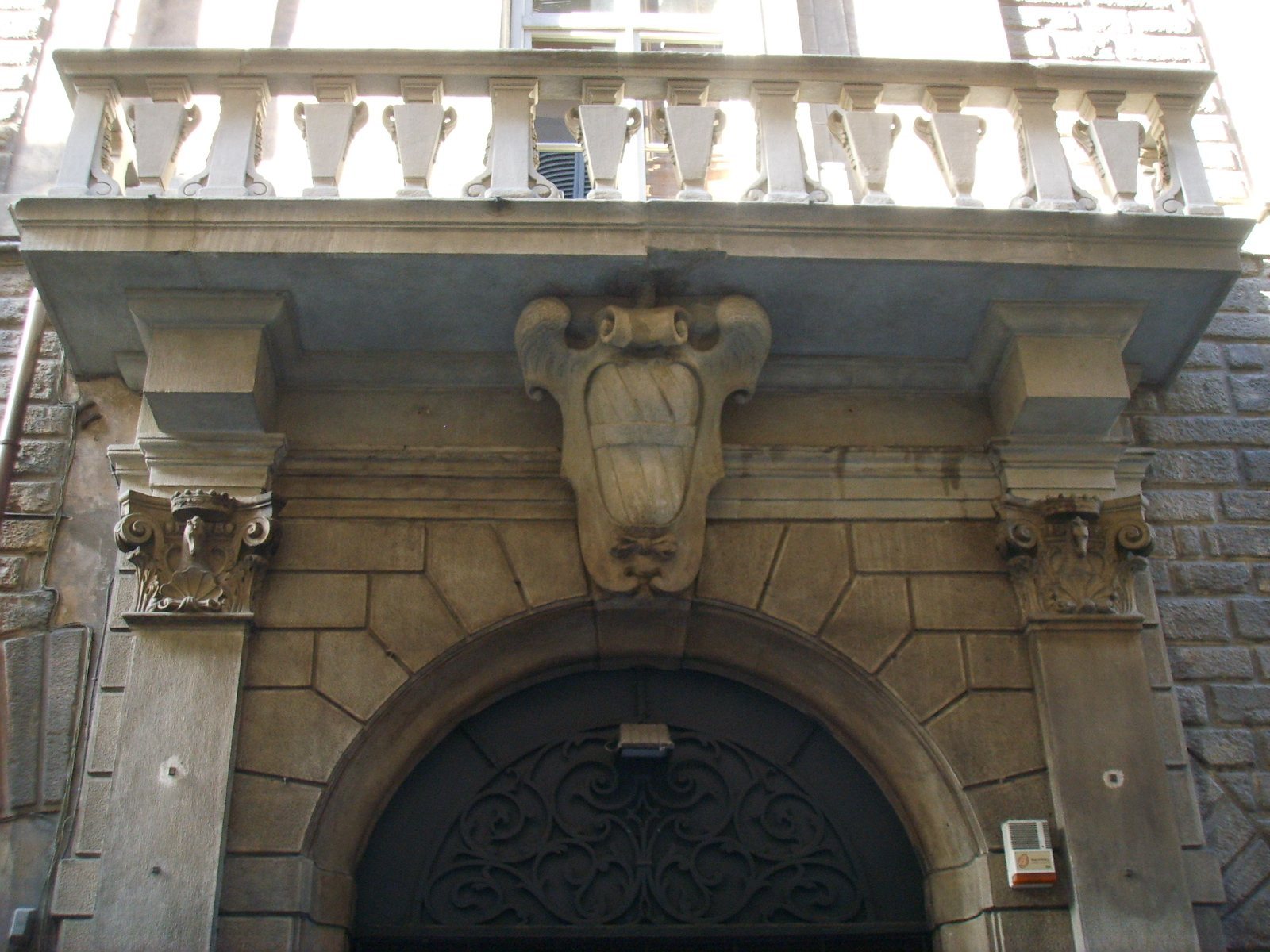
A doorway flanked by columns leads into the courtyard, and a carved Corsini coat of arms sits above its entrance. From the courtyard, a spiral staircase and a monumental staircase provide access to the upper levels. The spiral staircase is attributed to Pierfrancesco Silvani, though Gherardo Silvani has also been proposed. The monumental staircase is attributed to Ferri and decorated with Neoclassical statues, which draw on Greek and Roman forms. On the first floor, Carlo Monaldi’s statue of Pope Clement XII crowns the staircase; Girolamo Ticciati installed it there in 1737.
Interior rooms and decoration
Grotto and summer apartments
On the ground floor, an artificial grotto, a constructed cave-like feature, was made by Ferri between 1692 and 1698. Carlo Marcellini contributed stucco work, while Rinaldo Botti and Alessandro Gherardini painted it. The Summer Apartments and Nymphaeum Hall form a distinct section of the palace.
Loggia, Throne Room, and Ballroom
A loggia, or open-sided gallery, has frescoes painted by Alessandro Rosi and Bartolomeo Neri between 1650 and 1653. In the nearby Throne Room, columns and flat wall supports frame the walls; an upper gallery holds ancient statues, and busts of eighteenth-century artists stand above the doors and windows. Anton Domenico Gabbiani and his assistants painted the ceiling fresco, Apotheosis of the Corsini House, in 1696. Two flying figures carry a model of the palace into the sky. The adjoining Ballroom has an arched ceiling painted by Alessandro Gherardini.
Frescoed rooms
Further rooms contain frescoes painted between 1692 and 1700 by Anton Domenico Gabbiani, Cosimo Ulivelli, Pier Dandini, Giovanni Passanti, Rinaldo Botti, Andrea Landini, and Atanasio Bimbacci. Stucco decorates the door and window frames, and the rooms retain the appearance of their decoration from this period. The Hall of Eleonora degli Albizzi features quadratura, illusionistic painting that makes a flat surface appear to extend into architectural space.
Galleria Corsini
The first floor houses the Galleria Corsini, a private collection focused on Italian and European paintings of the seventeenth and eighteenth centuries, alongside Renaissance works. Artists represented include Filippo Lippi, Antonello da Messina, Giovanni Bellini, Luca Signorelli, Pontormo, Caravaggio, Salvator Rosa, and Luca Giordano. Among the collection’s paintings are Signorelli’s Madonna and Child between Saints Jerome and Bernard and Caravaggio’s Portrait of Maffeo Barberini.