Church of the Transfiguration of the Lord: Pezinok’s Baroque Parish Church
Site at a Glance
- Popularity
- Low
- Country
- Slovakia
- Primary era
- Early Modern
- Eras represented
- Early Modern, Modern
- Civilizations
- Habsburg, Hungarian
- Site type
- Religious
- Remains
- Church
On this page13 sections
History
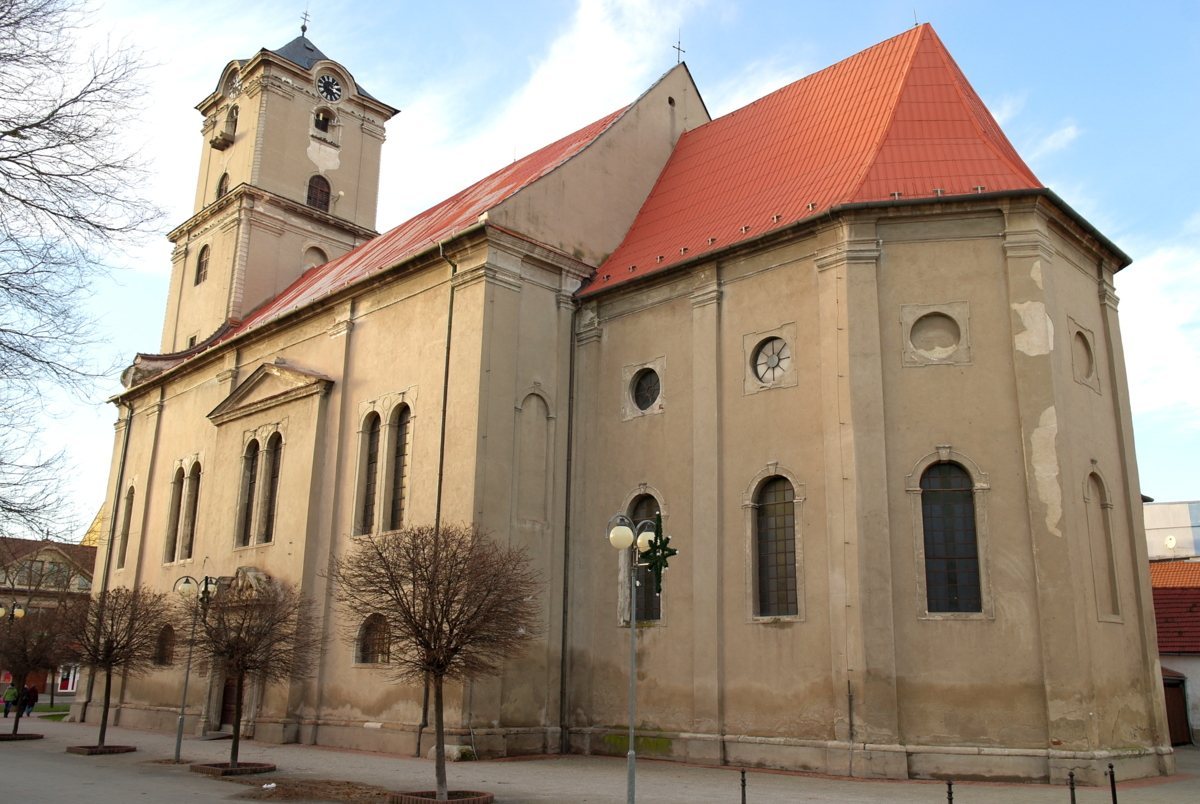
The Church of the Transfiguration of the Lord stands in Pezinok, Slovakia, in a Baroque form, a richly expressive European artistic and architectural style. Its construction began in 1655 under the town’s Evangelical, or Protestant, community. The dedication refers to the Gospel account of Jesus appearing in divine glory before selected disciples. Also known as the Lower Church, the building was formerly called the Church of the Most Holy Savior or the Church of Saint Salvator. Repeated transfers between Protestant and Catholic control made it a focus of religious disputes in Pezinok.
Evangelical foundation and Catholic takeover
In 1655, Pezinok’s municipal government was entirely Evangelical. It decided to build the church on municipal land where the old town hall had stood. The town supplied stone, lime, bricks and carts originally intended for work on the town walls. Donations did not cover the costs, so municipal funds and continuing income from Catholic church properties also supported construction. Although Evangelical churches were then prohibited from resembling Catholic ones, this building was an exception. Its foundation stone was laid on 12 August 1655, and the German preacher Teodor Puchner consecrated it on 27 March 1659.
On 6 October 1659, Pezinok’s Catholics petitioned the king, claiming that their rights had been violated. Leopold I, the Habsburg monarch who was also Holy Roman Emperor and king of Hungary, could not address the complaint while occupied with wars against the Ottoman Turks. During later uprisings, György Szelepcsényi, Archbishop of Esztergom and Hungarian chancellor, reported the killing of priests and other insurgent actions, including events in Pezinok. Leopold ordered the seizure of churches built contrary to a 1647 decision made in Vienna, including those in Pezinok, Svätý Jur and Modra, and the removal of their Evangelical preachers.
On 28 February 1674, representatives of the three towns handed the church keys to Szelepcsényi, then royal governor. They pledged that their preachers would remain only until Easter and would hold no services in the meantime. Szelepcsényi took possession of the churches on 1 March. The Lower Church became royal-treasury property, then was bought by Catholics at a price fixed by the emperor and paid in annual instalments. Capuchin friars, a reform branch of the Franciscan order, arrived in Pezinok that year and took over the Parish Church of the Blessed Virgin Mary. The Lower Church became the town’s parish church.
Repeated changes of control, 1681–1709
After the Diet of Sopron, a Hungarian assembly of the kingdom’s estates, Evangelicals briefly regained the church. They were ordered to return it to Catholics in June 1681. In 1683, the Hungarian nobleman Imre Thököly, who led an uprising against Habsburg rule, took Pezinok, ordered the Capuchins to leave and handed the Lower Church to Evangelicals. The original parish church again served as the parish church. After the imperial victory later that year, Evangelicals locked the Lower Church and their preachers left Pezinok. They had used it for only two months. Bratislava cathedral canon Jelenffy, a member of a cathedral chapter, and the Pezinok parish priest Mathias Nemeček then opened it for Catholic use.
Evangelicals took the church again in July 1705 during the uprising led by Francis II Rákóczi, another Hungarian nobleman opposing Habsburg rule. After imperial General Heister defeated Rákóczi, he ordered the church’s return. It was handed back in 1709, and the Evangelical preachers left Pezinok. The Lower Church again became the parish church.
Jesuit administration and parish use
Jesuits, members of the Society of Jesus, arrived in Pezinok in 1753. They established a mission house on the site of the present municipal office on Radničné námestie and took charge of the church on 1 January, following its transfer by Jozef Szent-Ilonay, a general vicar and titular bishop. On 26 April 1760, Anton Révay, Auxiliary Bishop of Esztergom, consecrated the church; the ceremony also included confirmation and the blessing of its bells.
The Society of Jesus was suppressed in 1773, and the decree was read in Pezinok on 9 October by Ján Galgóczy, a general vicar and titular bishop. Former Jesuit Andrej Bertaffi continued as the church’s Sunday preacher. The church passed into parish administration and has remained under it. Today it is a Roman Catholic parish church within the Archdiocese of Bratislava and the Pezinok deanery.
Renewal and heritage status
The exterior and roof were renewed in 1933. Pezinok painter Augustín Barta painted the church between 1943 and 1949. A further consecration took place on 29 June 1949, led by Ambróz Lazík, the temporary governor of the Trnava diocese. Ján Pöstényi of the Society of Saint Adalbert preached, and Lazík and auxiliary bishop Michal Buzalka administered confirmation. The church is a Slovak National Cultural Monument, entered in the Central List of Monuments on 17 July 1963. Its last restoration took place in 1965.
Remains
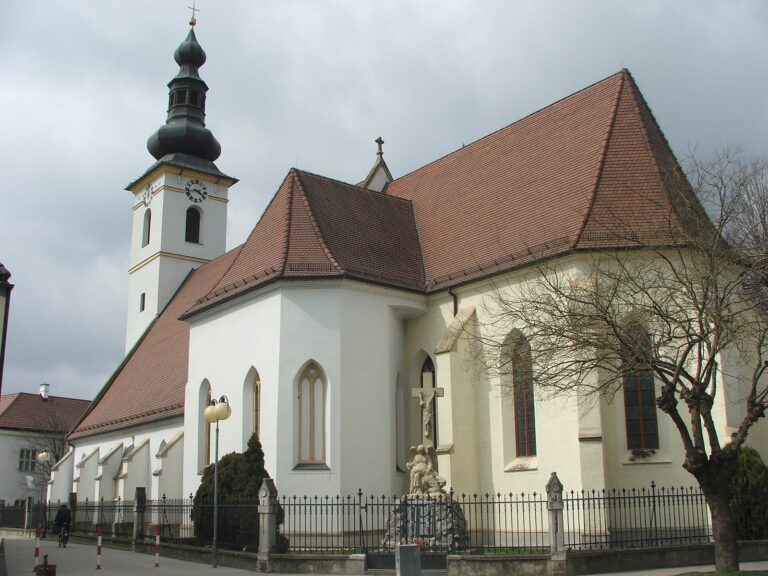
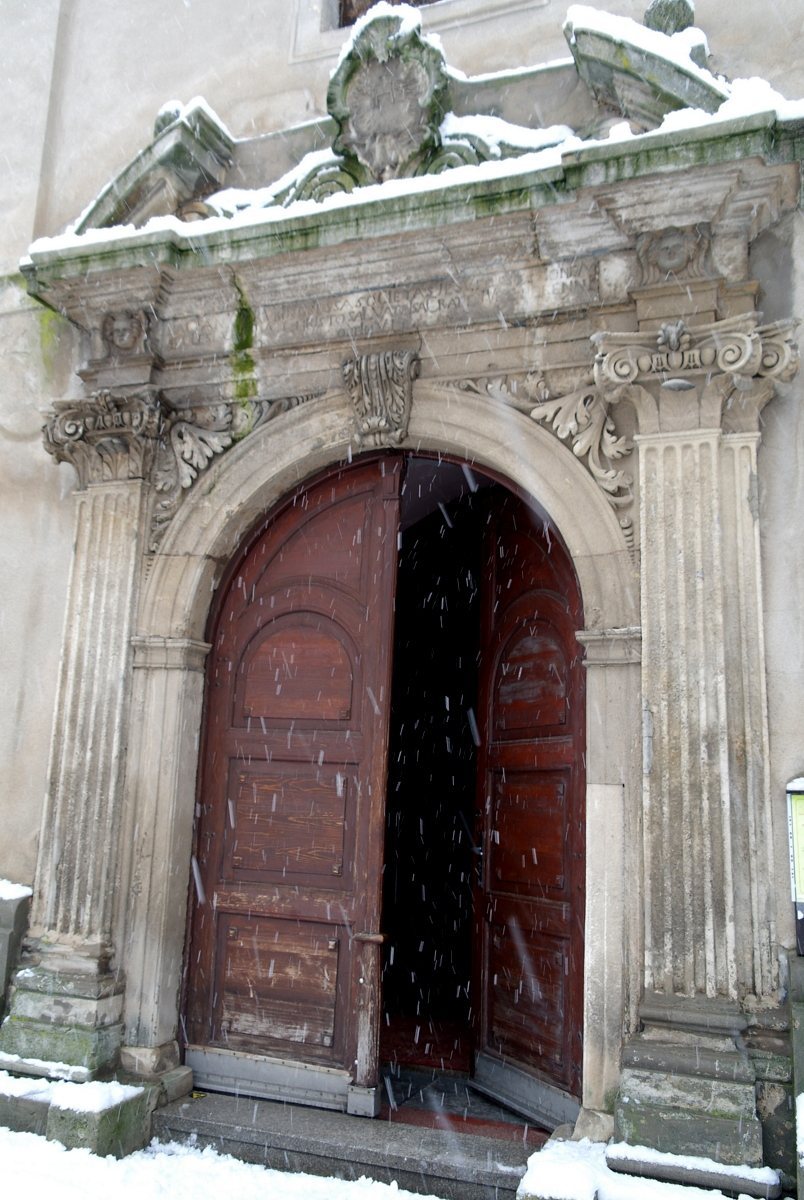
The Baroque building has three naves, a sanctuary and one tower. Its main entrance is on Holubyho Street, with another entrance from Town Hall Square, known locally as Radničné námestie. Inner entrance doors lie beneath the tower.
Interior
Nave and galleries
Galleries run along three sides of the church, and men gathered there. Their presence recalls the building’s Protestant beginnings. The main nave has a cross-vaulted ceiling, formed by intersecting barrel-shaped vaults.
Altars and devotional works
The earlier interior was white, contrasting with a black altar, pulpit and organ. The furnishings now include a main altar with images of the Transfiguration of the Lord and the Holy Trinity, and side altars dedicated to Saint Joseph, the Sacred Heart devotion to Jesus, and Mary Help of Christians, a title for Mary. Statues of Saint Anthony and Saint Thaddeus, along with reliefs depicting events in Jesus’ final journey to crucifixion, complete the interior decoration.
Organ
The church retains an organ made in Nuremberg in 1663 at a cost of 1,000 imperial thalers, silver coins. Its original folding panels carried paintings of Saint Cecilia, King David and the Annunciation, the Gospel account of the angel Gabriel announcing Jesus’ birth to Mary. The panels were removed for structural reasons. A coat of arms associated with Johann Wiser appears on the organ.
Tower and bells
Tower
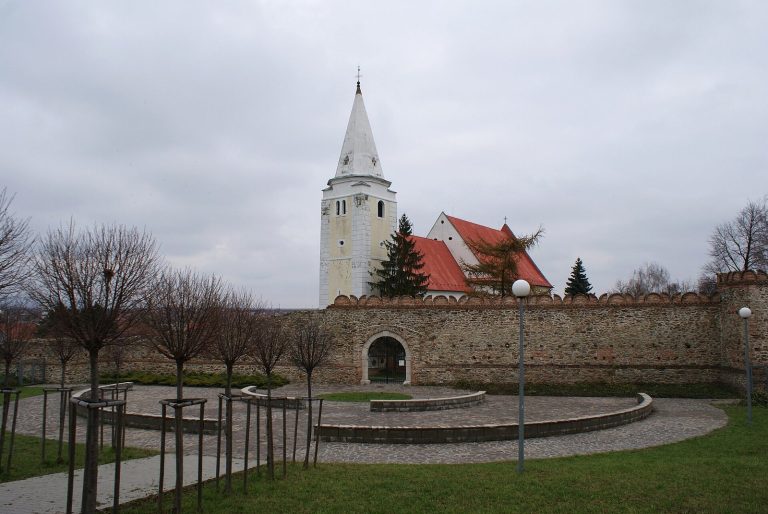
The tower was originally intended for municipal watch and alarm duties. It remained unfinished when the church changed hands in 1674. A small provisional pyramidal roof was added after the transfer and remains in place, contrasting with the church’s Baroque design. The church bought the tower from the town in 1942 for one crown.
Bells
Five bells hang in the tower. Three were cast in 1985 and 1988 by Josef Tkadlec in Halenkov; another was cast by A. Kurbel in Trnava. The fifth bell dates to 1922.