Tron Kirk: A Seventeenth-Century Parish Church in Edinburgh
Site at a Glance
- Popularity
- High
- Country
- United Kingdom
- Primary era
- Early Modern
- Eras represented
- Early Modern, Modern
- Civilizations
- British, Kingdom of Scotland
- Site type
- Religious
- Remains
- Church
On this page9 sections
History
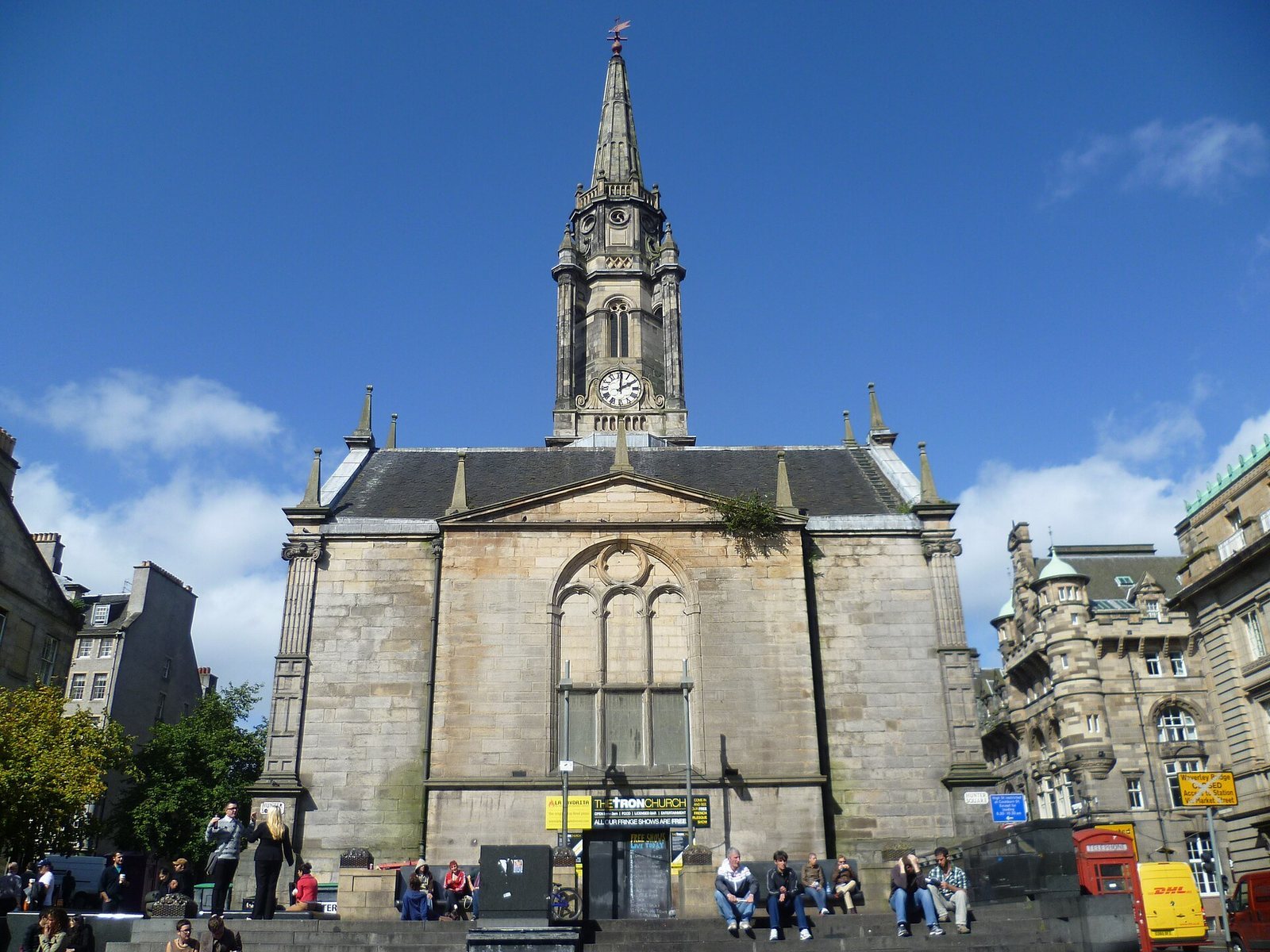
Tron Kirk is a seventeenth-century church in Edinburgh, Scotland, United Kingdom, built for the city’s South-East parish. Its design combined Palladian and Gothic elements with influences from contemporary Dutch architecture. It served one of Edinburgh’s four parishes established after the Scottish Reformation of 1560, when Protestant church structures took shape in Scotland.
Foundation and parish life
Before construction, tenements occupied the site. Their buildings, apparently dating from the fifteenth and sixteenth centuries, removed traces of earlier medieval settlement. Records identify residents there from the late fifteenth century. King Charles I ordered a new church after deciding that St Giles’ should become the cathedral of a new bishop’s jurisdiction, or see, in Edinburgh. The parish bought the land from Dr. William Scott for £1,000 Scots.
The foundation stone was laid on 4 March 1637. Citizens opened and dedicated the church to Christ in 1641, when it was called “Christ’s Kirk at the Tron”; construction was completed in 1647. The later name refers to a public weighing beam, called a tron in Scots, which stood outside on the Royal Mile until around 1800. Before the church opened, people from the North-West parish had worshipped at St Giles’.
The Town Council allotted pews to noblemen, judges of the College of Justice, Old Town residents, and University principals and professors. Lists of those holding seats survive for 1650 and 1745. The church’s congregation also included members of Edinburgh’s elite. Among the marriages held there were those of jurist John Lauder, Lord Fountainhall, and Janet Ramsay on 21 January 1669, and Helen Ogilvy and Agnes Falconer on 25 April 1694. Janet was the daughter of Sir Andrew Ramsay, Edinburgh’s first Lord Provost and a judge; Helen and Agnes were daughters of the Lords Banff and Falconer, respectively.
Ministers and public events
The Tron is noted as the only church in Scotland where five successive ministers each served at least once as Moderator, the presiding officer of the Church of Scotland’s General Assembly, its principal governing gathering. Counting ministers who held an additional charge brings the number to eight. William Wishart served five times as Moderator; his son George Wishart was the church’s longest-serving minister and held the office in 1748. John Drysdale was Moderator in 1773 and 1784. Other ministers who held the office included William Crichton, George Meldrum, Andrew Hunter, Alexander Brunton, and a second-charge minister also named William Wishart.
An additional ministerial post, known as a second charge, was created to provide more services for the large congregation. It ended in 1860 after the Annuity Tax Act, which concerned a tax used to support Edinburgh’s clergy. The church also became the setting for a major legal case: in 1697, 18-year-old student Thomas Aikenhead was executed for blasphemy, the last person in Scotland to be put to death for that offence. A fellow student accused him of making a remark about wishing he could be in the hell described by Ezra to warm himself. The prosecution concerned the reported comment, allegedly made as Aikenhead passed the church after drinking with classmates.
Elisabeth West, a memoirist, worshipped at the Tron while William Erskine was minister. After Erskine died in May 1692, his successor George Meldrum encouraged West to keep a record; her diary describes the church’s history. From 1830 to 1840, the Church of Scotland’s General Assembly met at the Tron during the Ten Years’ Conflict, a major dispute over church governance and the relationship between the church and civil authority. The church also became a traditional gathering place for Edinburgh’s Hogmanay, or New Year’s Eve celebrations, in part because its spire clock could be seen and heard across a wide area.
Closure and preservation
The last service took place on 21 September 1952. The clergy and congregation then processed to St Giles’ with communion cups dating to 1633 and a baptismal basin and laver, a washing vessel, dating to 1682. The congregation joined that of Tron Kirk in Moredun.
The Town Council agreed in 1953 to buy the building from the Church of Scotland, but the purchase did not go ahead. In 1960, Tronsite Ltd took it over with plans to clear the site for shops and offices. Edinburgh Corporation, the city’s municipal authority, protected the church with a Preservation Order, and the building was offered for sale in 1962. After a period of decay and the removal of its interior, the Corporation acquired it in 1969 and planned a civic display centre. Work began in 1974, but rising costs curtailed much of the project; the building opened to the public in June 1987. Tron Kirk is a Category A listed building, Scotland’s highest category for buildings of national or international importance.
Remains
Church fabric and alterations
Church plan
The building’s surviving form reflects changes made to its original plan. In 1785, both side aisles were removed to make room for South Bridge and Blair Street, which leads to Hunter Square.
Spire and clock
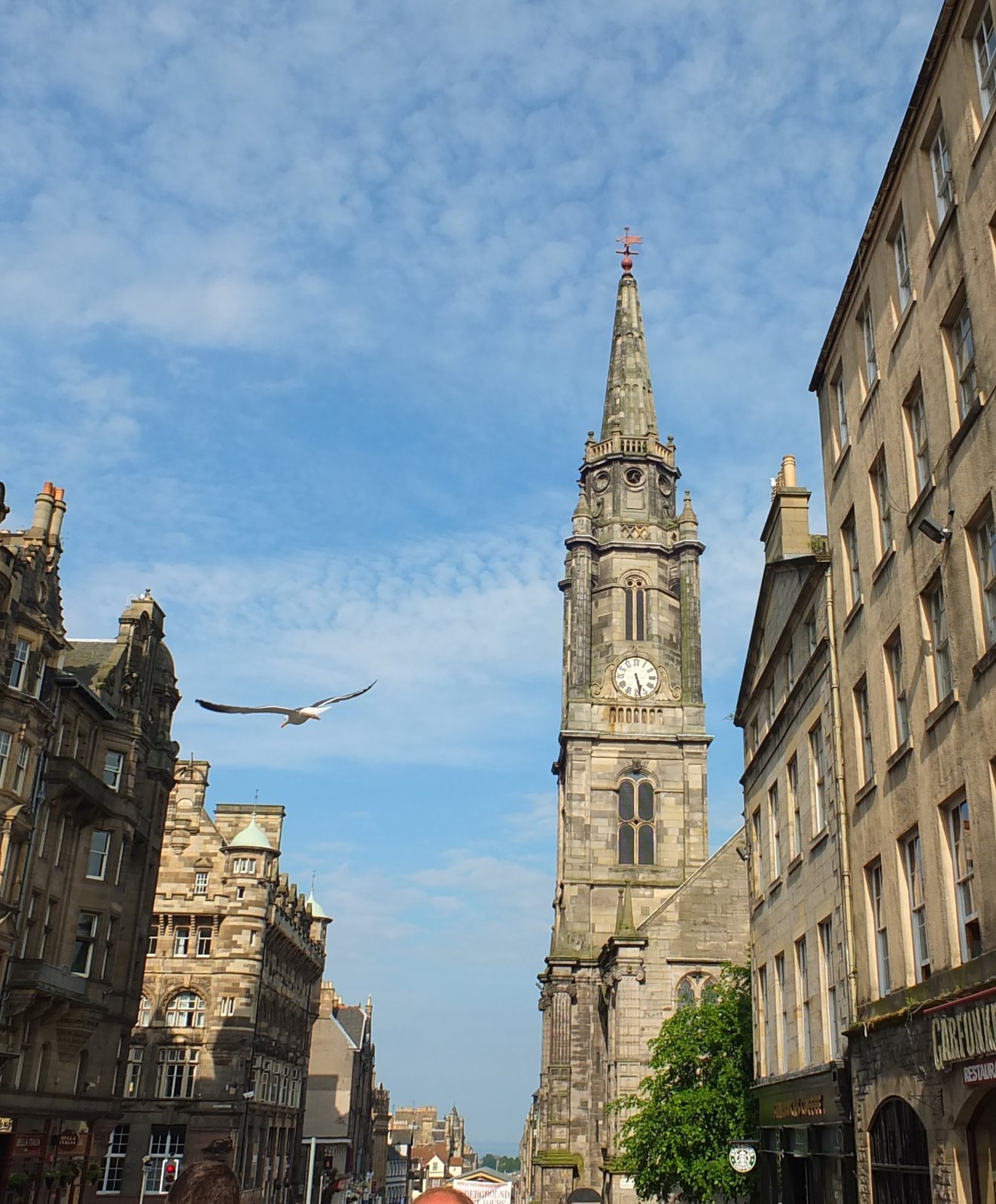
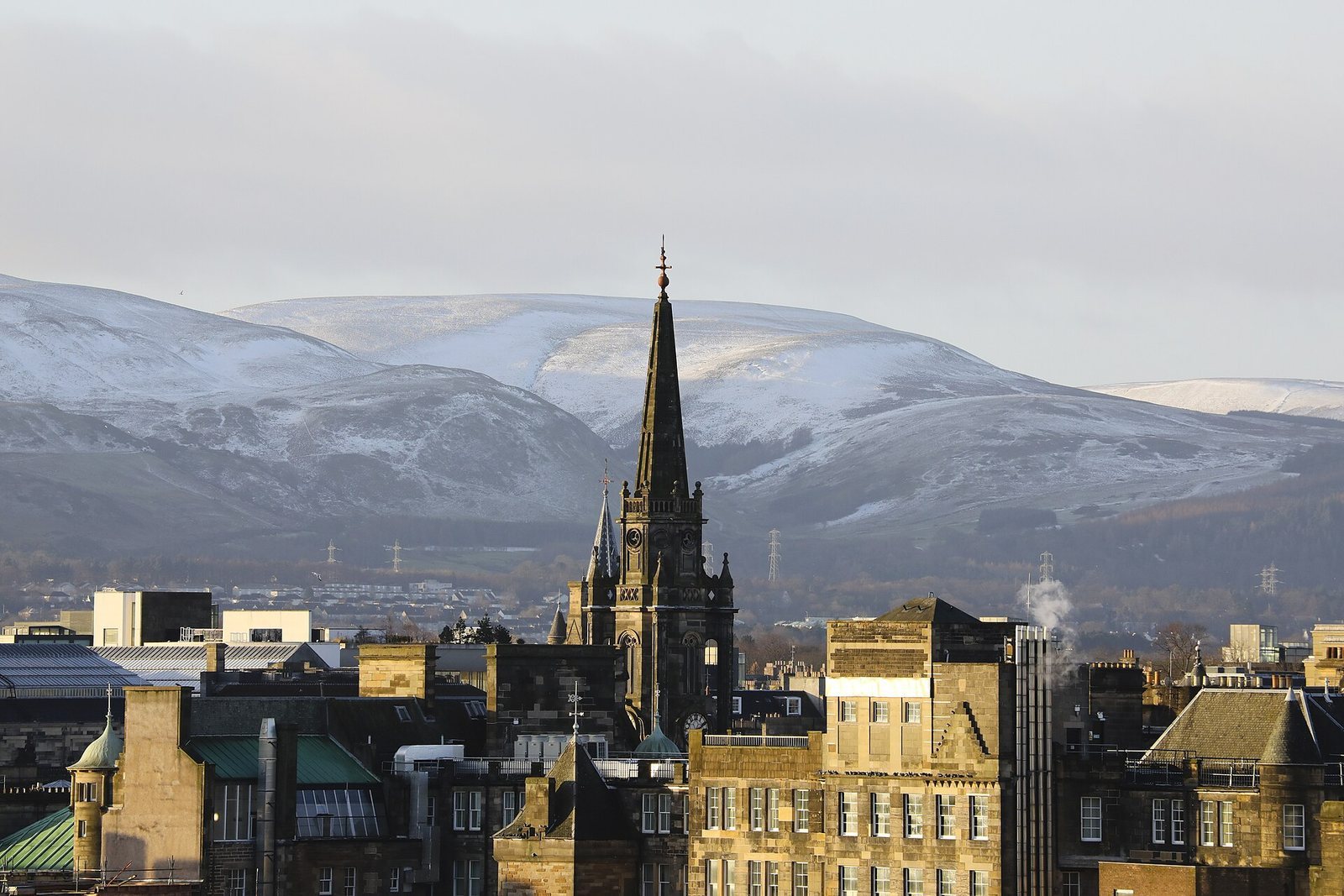
The original spire, described as Dutch in style, was destroyed in the Great Edinburgh Fire of November 1824. R. & R. Dickson designed its replacement, built in 1828. A clock installed in 1658 had previously stood in the Weigh House at the head of West Bow; the fire destroyed it as well. An eight-day clock made by Edinburgh clockmaker James Clark replaced it in 1828.
Earlier buildings beneath the church
Excavations in 1974 uncovered foundations of sixteenth-century buildings on Marlins Wynd, a long-vanished close, or narrow lane, associated with stonemason Walter Merlioun, who lived there in 1500. The remains included basements, paved lanes and drainage channels. Investigators also found a cobbled street laid in 1532, pottery and oyster shells. Excavations and three-dimensional surveys took place in 1974, 1983 and 2006. A walkway around the church’s inner perimeter once allowed the archaeological remains to be seen; the floor was relaid in 2004.