Schiggendorf: A Probable Early Medieval Earthwork Fortification
Site at a Glance
- Popularity
- Very Low
- Country
- Germany
- Primary era
- Medieval
- Eras represented
- Medieval
- Civilizations
- Unclassified
- Site type
- Military
- Remains
- Fort
On this page6 sections
History
Schiggendorf is a probable early medieval earthwork fortification near the present-day settlement of Schiggendorf in Meersburg, Germany. The early Middle Ages is conventionally placed around the fifth to tenth centuries in Europe. The fortification’s purpose is unknown, and its scale is unusually large for a conventional noble residence. An interpretation as a prehistoric defensive enclosure has been rejected because the earthworks are steep and partly well preserved.
A local legend tells that a robber knight of Schiggendorf, aided by the knight of Baitenhausen, abducted the daughter of Ittendorf’s cupbearer, a household official who served drinks. The knight married her in the Heidenhöhle cave at Bermatingen, then left his homeland. In the tale, the castle subsequently fell into ruin.
Remains
Earthwork defenses
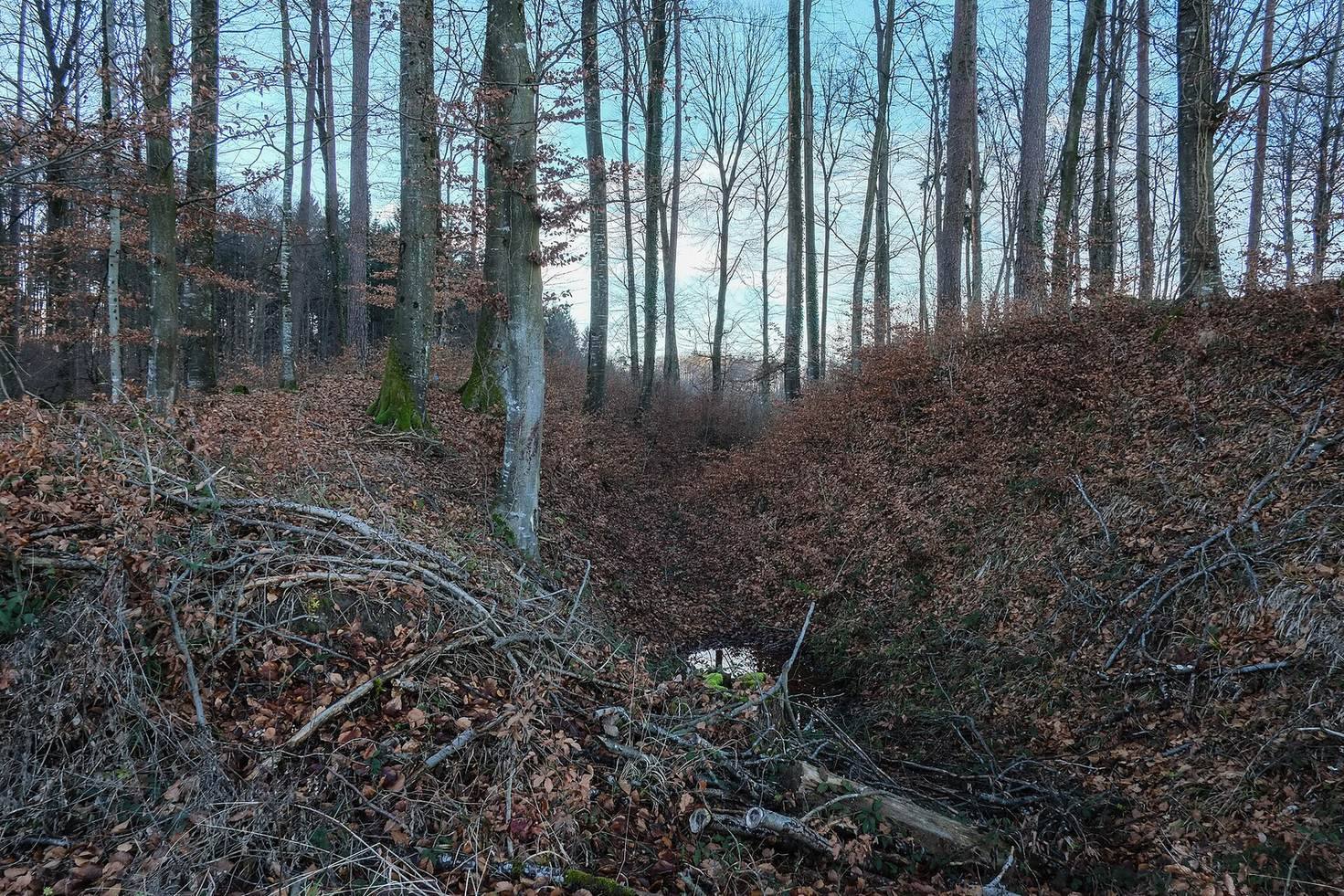
The remains cover about half a hectare on a wooded spur called Schloßberg, roughly 400 metres south-southwest of present-day Schiggendorf. The spur projects northwest and is bounded by two deep ravines. Steep slopes provide natural protection from the northwest to the southeast, while the main earthwork defenses face the approach from the plateau on the southwest.
Inner rampart
An approximately arc-shaped earthen rampart and a ditch in front of it defend the southwestern approach. Terrain suggests that, at least in the southeast, the rampart continued down the slope to a berm, a level shelf along a hillside. A narrow gap interrupts the southwestern section of the rampart. It may belong to the original construction or have been made later.
Outer rampart and entrances
A second rampart and ditch stand in front of the inner defenses. In the southeast, the outer rampart meets the inner ditch, and an opening in it aligns with the gap in the inner rampart. This outer entrance is considerably wider and is probably original. From there, the outer rampart runs northwest, roughly parallel to the inner one and about 5 to 8 metres farther out. The differing spacing between the ramparts in the southeastern and northwestern sections has no established explanation.
If the gap in the inner rampart was cut later, the space between the two lines, entered through the probably original outer opening, may have served as an approach. On that interpretation, the only plausible route into the inner area would pass beneath the present forest track.
Outer approach defenses
A further, slightly curved rampart and ditch, about 30 to 50 metres long, protected the outer entrance. This section has been heavily worn down but remains recognizable. It lies more than 15 metres from the entrance, a separation whose purpose is unclear; wooden defenses may have occupied the intervening space. Some earthworks reach about five metres in height, and forest tracks have disturbed parts of the site.