Schönau Castle in Bad Säckingen: A Historic Residence and Museum
Site at a Glance
- Popularity
- Medium
- Country
- Germany
- Primary era
- Early Modern
- Eras represented
- Early Modern
- Civilizations
- Habsburg, Holy Roman Empire
- Site type
- Domestic
- Remains
- Castle
On this page14 sections
History
Schönau Castle is a historic residence in Bad Säckingen, Germany, built by Hans Kaspar von Schönau between 1600 and 1680. Late-seventeenth-century alterations changed the building, and nineteenth-century renovations during its use as a brewery destroyed part of its historic fabric.
Scheffel and the literary association
The poet and novelist Joseph Victor von Scheffel stayed in Säckingen in 1850/51. His first published work followed three years later. The castle and its park feature as settings in his verse epic The Trumpeter of Säckingen, an association recalled by trumpet-player figures on the grounds.
From 1901 to 1940, a bust of Scheffel and a trumpet-player figure stood together on Münsterplatz. During the Second World War, the bronze companion figure was taken for a wartime metal collection.
From residence to museum
Emil Gersbach founded the Hochrheinmuseum in 1925 to present the history of Bad Säckingen and the Hochrhein-Hotzenwald region. The city acquired the castle in 1928 and arranged for a museum to be established there in the following years. The museum has occupied the building since 1938 and is run by the city.
In 1985, the city established a trumpet museum around the collection of Swiss trumpet collector Ernst W. Buser. After acquiring the collection, the city expanded it and arranged for its systematic scholarly documentation.
Remains
The castle’s altered tower plan, museum spaces spread across several floors, and park along its south side define the surviving site. The building has retained much of its overall character despite changes to its historic fabric.
Castle and museum interiors
Castle structure
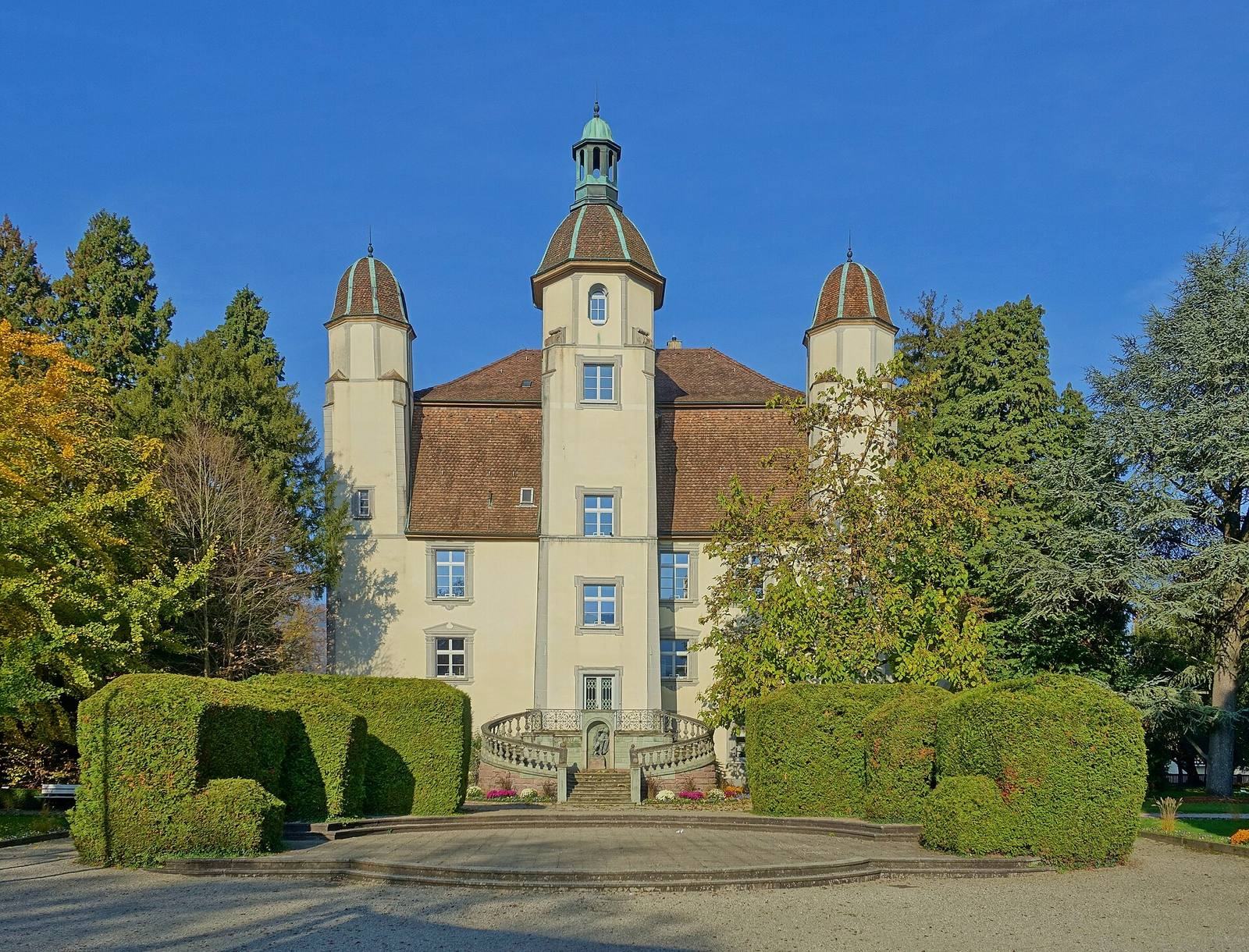
The castle originally had a tower at each of its four corners. Late-seventeenth-century changes removed the two towers on the northeast side and added a tower at the centre of the southwest side.
Hochrheinmuseum
The Hochrheinmuseum occupies several floors. On the ground floor, rooms devoted to Scheffel have displayed around 40 objects from the Karlsruhe Literary Society’s collections since 2016, focusing on his stay in Säckingen and his first work. The ground-floor city and regional history displays include paintings and other works from periods up to the dissolution of the women’s collegiate foundation, an institution for women that was not necessarily cloistered. Among them is a portrait of its last abbess, Marianna Franziska von Hornstein. A room presenting rural culture includes a tiled stove and a bench.
Trumpet museum
The trumpet museum is on the first upper floor. Its oldest displayed instrument is a natural trumpet dated 1664. This type of trumpet has no valves, and its notes are produced by the player’s lips and the instrument’s natural harmonics.
Prehistory and early history museum
The museum of prehistory and early history occupies the third and fourth floors. Its regional archaeological collections include a human skullcap from the Paleolithic, the earliest period of the Stone Age. The skullcap was found in 1920 at Röthekopf, north of the city.
Hall and exhibition rooms
A large hall on the second upper floor is used for receptions, lectures, concerts, and formal events. Three connected rooms host changing special exhibitions.
Park and memorials
Castle park
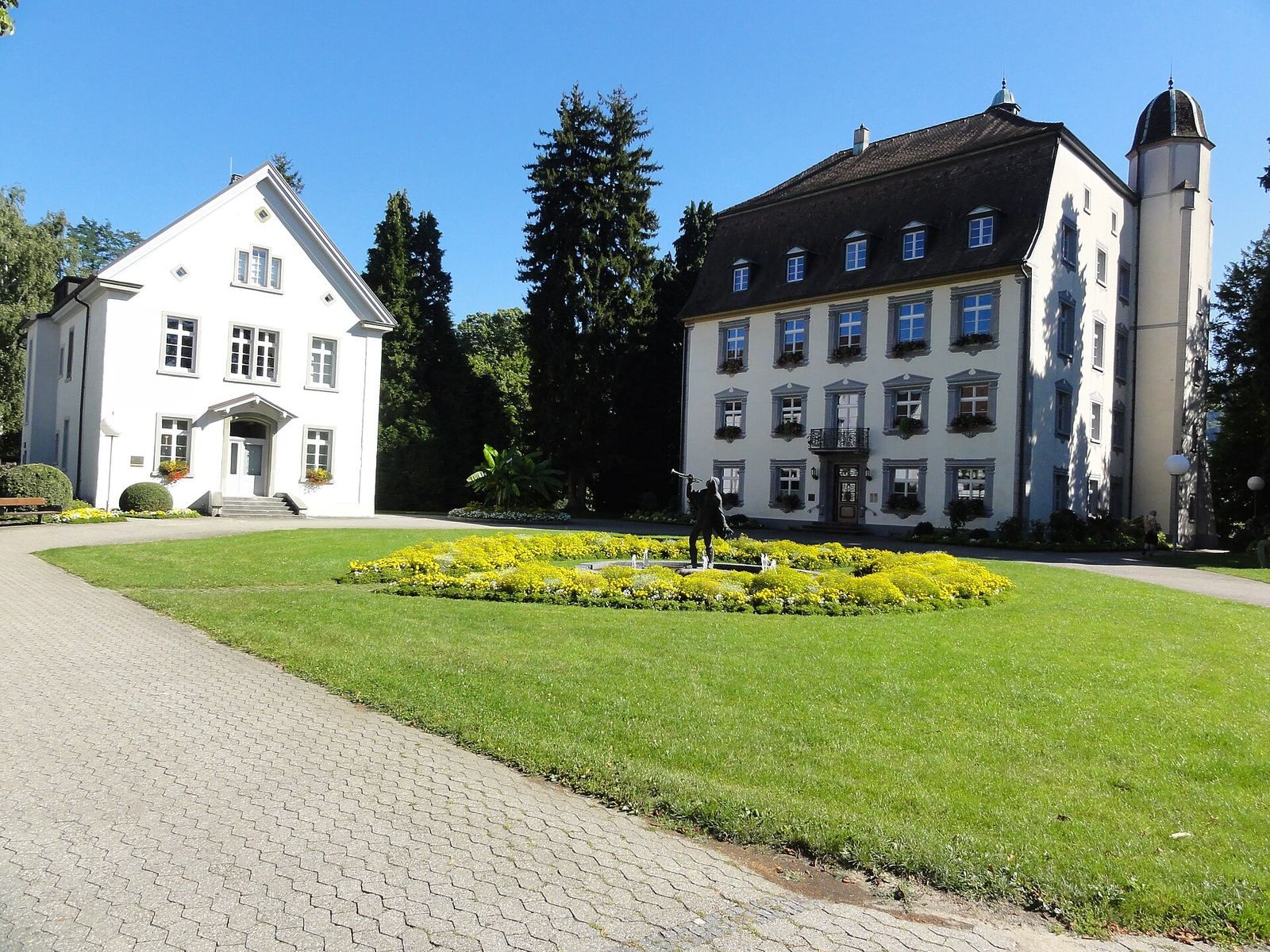
The park stretches along the south side of the castle. Its features include mature trees, a fountain, a concert stage, a small cactus garden, and an aviary. A tea pavilion houses a café. Near the Rhine embankment wall, a gate leads to the historic Au Cemetery.
Trumpet-player statues
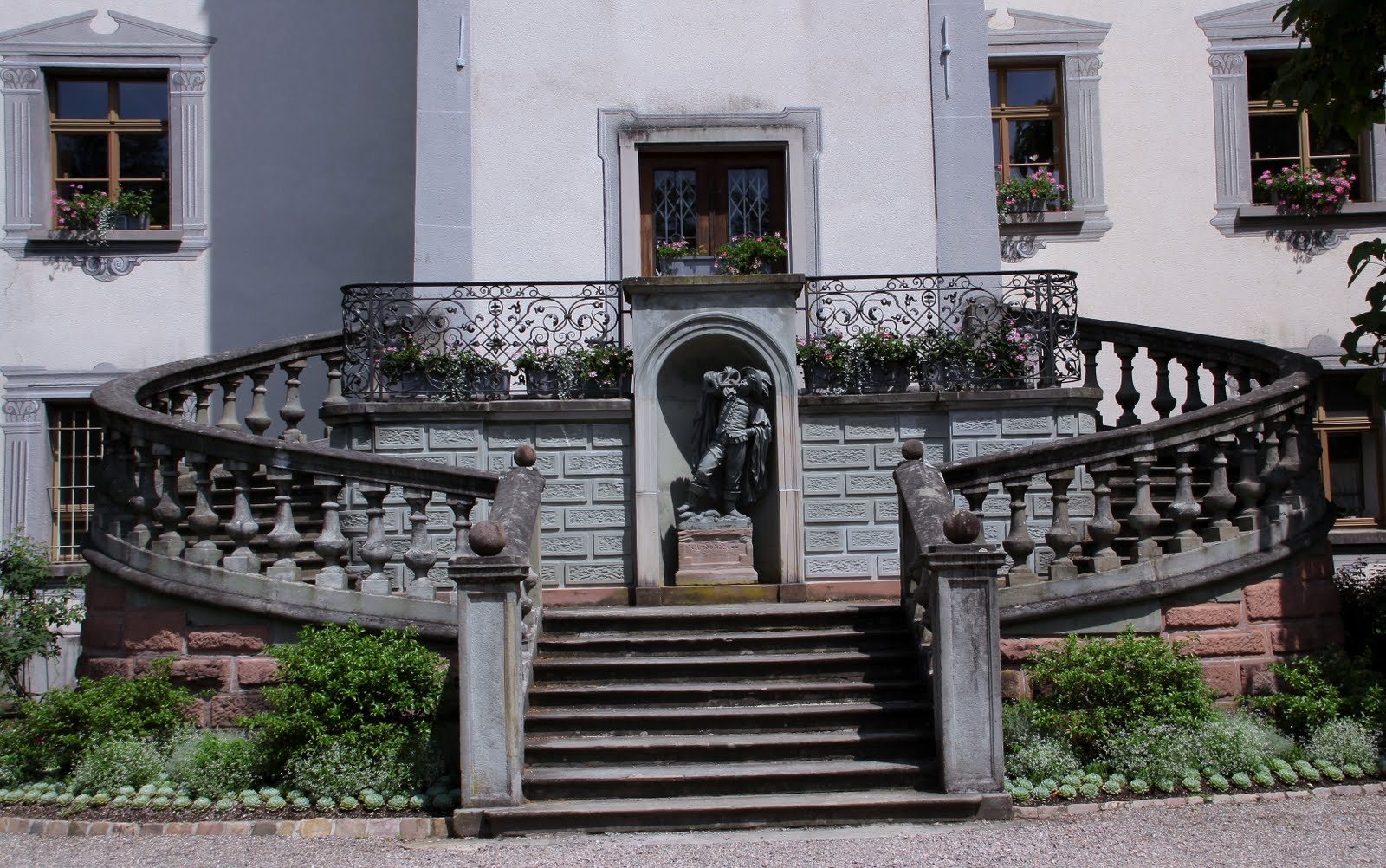
Two trumpet-player statues stand in the grounds. The newer, made by Josef Henselmann in 1976, occupies a circular area at the entrance. The older statue, created by Heinrich Ruf in 1876, has Neo-Baroque features, meaning it revives forms associated with the Baroque. A bronze replica stands in a niche beneath the exterior staircase leading to the park, while the original is inside the castle.
Scheffel memorial
A bust of Scheffel by Munich sculptor Joseph Menges stands in the park on the side away from the Rhine, before tall trees. In 2026, Freiburg sculptor Matthias Dämpfle placed a small sculpture group in front of it, depicting Hiddigeigei, the cat character in Scheffel’s poem. The work comments on the history of Scheffel’s monument.