Laufenburg Ruin: A Habsburg Castle on the Rhine in Switzerland


Site at a Glance
- Rating
- 4.5
- Popularity
- Low
- Country
- Switzerland
- Primary era
- Medieval
- External website
- Open
- Eras represented
- Medieval
- Civilizations
- Habsburg
- Site type
- Military
- Remains
- Castle
On this page9 sections
History
Laufenburg ruin is the remains of a medieval Habsburg hilltop castle in Laufenburg, Switzerland, developed as a fortified and residential complex on the southern bank of the Rhine. Around 1180, the Habsburgs acquired the surrounding area and established fortifications on both banks of the river. The castle became associated with the Habsburg-Laufenburg branch and later endured warfare, neglect, quarrying, and restoration.
Habsburg foundations and the residential castle
The first Laufenburg stood on the northern bank of the Rhine. Parts of that earlier fortification were probably later incorporated into the southern castle complex represented by the ruin. Count Rudolf II of Habsburg tried to establish a town beside the fortifications, but the abbess of Säckingen Abbey prevented the project through an arbitration ruling. A settlement nevertheless grew around the castle hill and received town rights during the thirteenth century. Those rights were renewed in 1328.
Rudolf II’s son, Rudolf III, moved his residence to the southern castle complex and transformed it into a residential castle. He also founded the Habsburg-Laufenburg dynasty, a branch of the wider Habsburg ruling house associated with the Laufenburg area. The surviving keep was built during this period.
War, sale, and decline
Financial problems led Count Hans IV of the Habsburg-Laufenburg line to sell the castle and lordship to Duke Leopold III of Austria for 12,000 gulden in 1386. Troops from Basel and Bern heavily damaged Laufenburg during the Old Zurich War, a fifteenth-century conflict in the Swiss region, in 1443. During the Burgundian Wars, late-fifteenth-century conflicts involving the Burgundian state and the Swiss Confederation, the town temporarily came under Duke Charles the Bold of Burgundy. After his defeat, Kaspar von Schönau took control and arranged repairs to the siege damage in 1486.
Swedish forces captured the town and castle three times during the Thirty Years’ War, the major European conflict fought from 1618 to 1648. Austria regained the lordship in 1648, but the castle was then in poor condition. In 1687, Italian experts concluded that it no longer had military value. The complex was subsequently neglected.
Clearance and preservation
The castle was cleared in 1787 and later served as a quarry. The town of Laufenburg purchased the remaining ruin in 1803 for 2,815 francs. A park was established on the site in 1908, and the surviving structures were restored in 1986. Laufenburg ruin is classified as a class A Swiss cultural property of national significance.
Remains
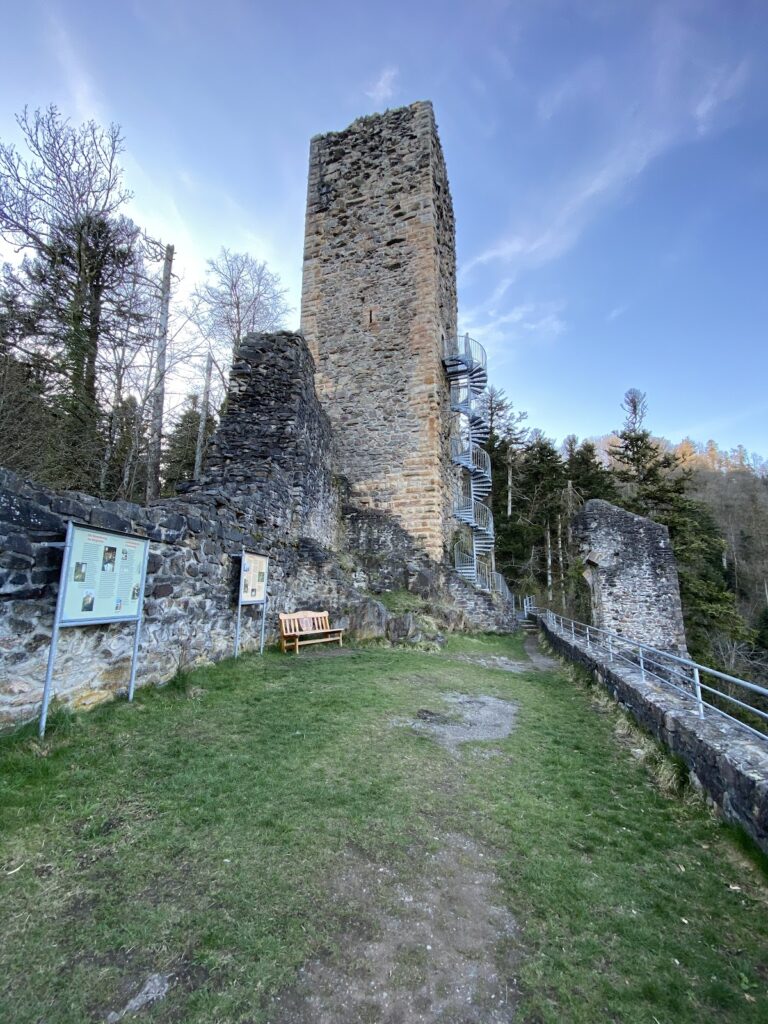
The ruin occupies a hilltop elevation south of the Rhine, at about 341 metres above sea level, within the town of Laufenburg. It formerly marked the southern edge of the old town. The surviving complex is organized around an almost complete keep and fortification walls that remain standing to approximately the level of the inner courtyard.
Keep and defensive walls
Keep
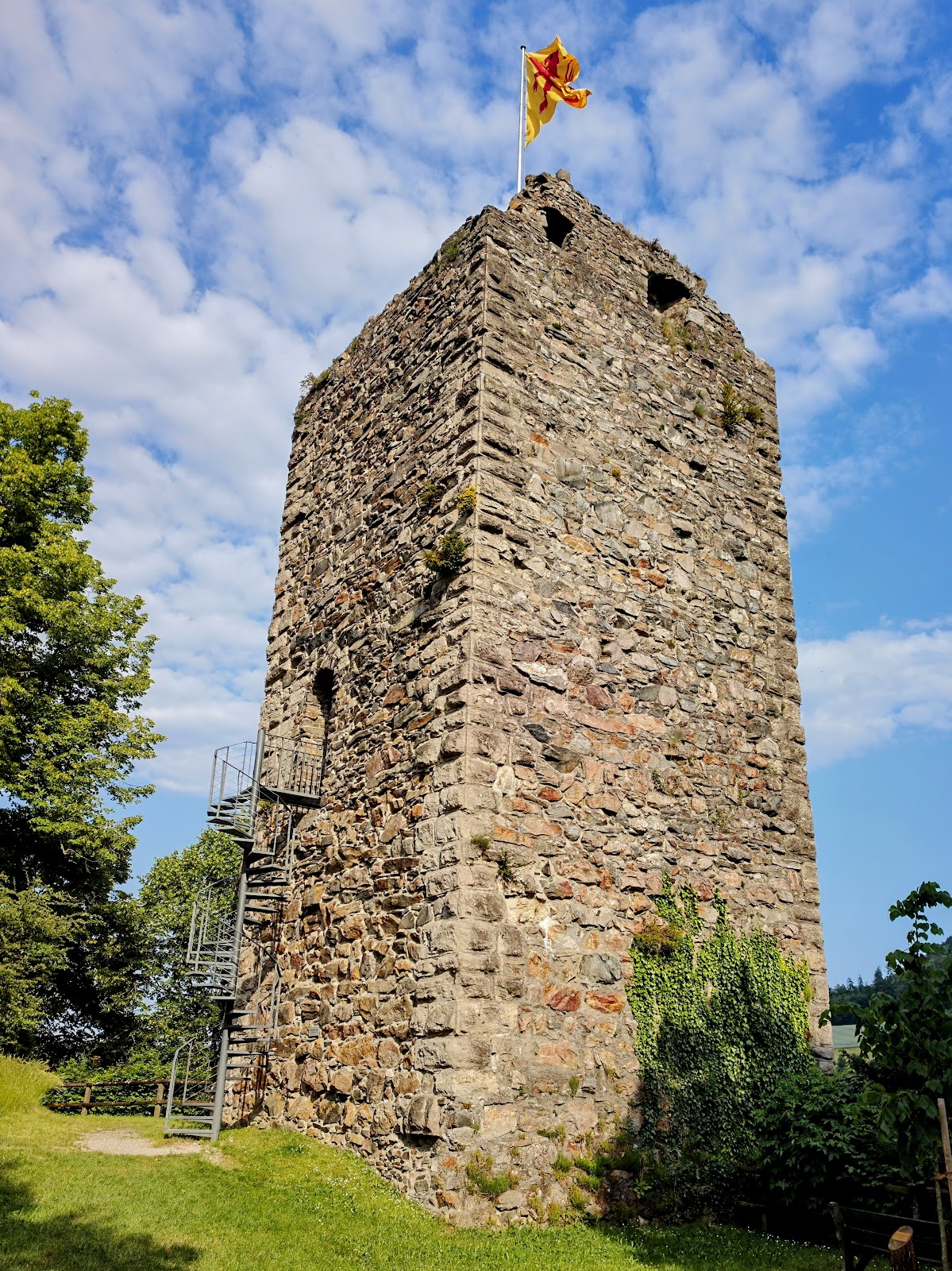
The keep, the castle’s principal fortified tower, is almost completely preserved. It was constructed during Rudolf III’s conversion of the southern complex into a residential castle. The tower now functions as an observation tower. Seventy-two steps lead to a viewing platform 13 metres above the ground. Access begins at an entrance in the north wall, about 4 metres above the courtyard, and continues by an exterior steel spiral staircase and an interior staircase within the tower. A metal enclosure marks the top of the interior staircase, while a door leads to the platform.
Fortification walls
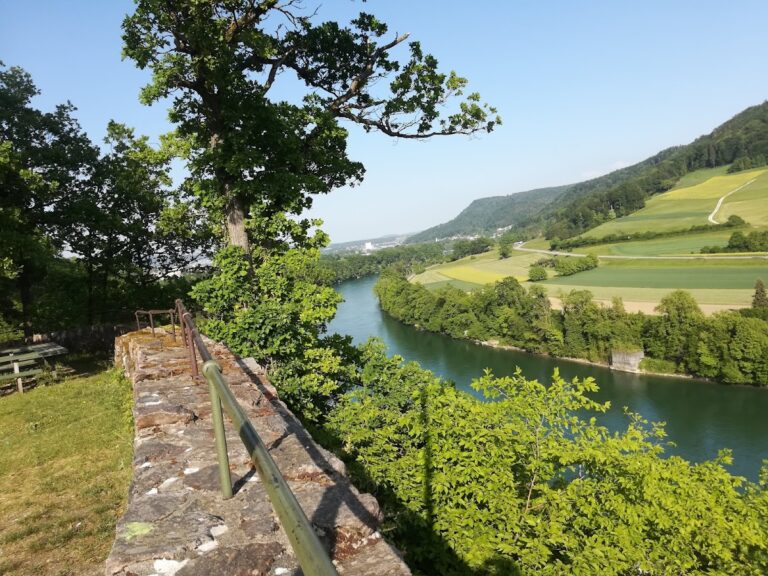
The fortification walls survive relatively well up to the level of the inner courtyard. In 1648, the enclosing ring wall, a defensive wall surrounding the castle complex, included defensive towers and stood nearly as high as the keep. The Rhine-facing side has several viewpoints protected by railings.
Former castle complex
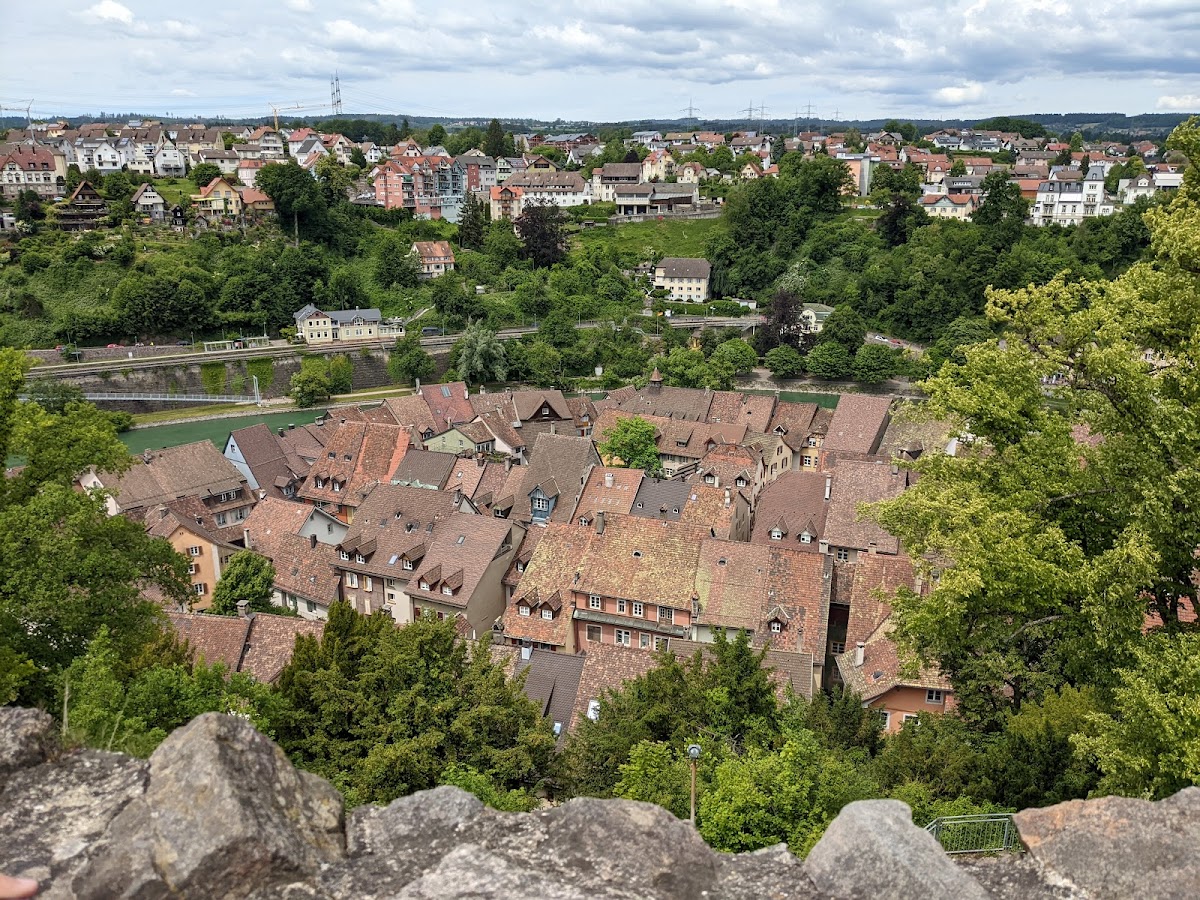
The historical castle contained numerous rooms, a castle garden, and a castle chapel. These elements formed part of the larger residential and fortified complex, while the surviving site is now a ruin. The viewing platform and Rhine-facing viewpoints look across the old town of Laufenburg on the Aargau side and toward Laufenburg (Baden) on the opposite bank. From the platform, the Baden settlement can be seen along the river toward the Laufenburg bridge and railway station, with the Laufenburg power station and High Rhine Bridge also visible.