Loggas Castle: A Byzantine Fortress in Greece
Site at a Glance
- Popularity
- Very Low
- Country
- Greece
- Primary era
- Unclassified
- Eras represented
- Unclassified
- Civilizations
- Unclassified
- Site type
- Military
- Remains
- Castle
On this page9 sections
History
Roman enclosure and Byzantine defenses
Loggas Castle is a Byzantine fortress in Greece, built in the sixth century over an enclosure belonging to a small Roman settlement. The Byzantine Empire, the medieval eastern continuation of the Roman Empire, strengthened its fortifications under Emperor Justinian. During his reign, from 527 to 565, a tower was added to the Roman wall as part of a wider program intended to protect inhabitants from northern raiders. The sixth-century historian Procopius listed an unnamed fortress among Justinian’s Macedonian defenses; Loggas may have been that fortress, but the identification is uncertain. A preliminary survey by Professor Nikolaos Moutsopoulos identified the earlier enclosure beneath the castle.
Raids, rebuilding, and destruction in 1017
Slavic raids destroyed the castle in the seventh century, and it remained abandoned until the tenth century. It was then rebuilt, probably by the Bulgarians. The first historical reference to Loggas appears in John Skylitzes’ account of the campaigns of Basil II, a Byzantine emperor, against Samuel, the Bulgarian ruler. In 1017, during a campaign against Samuel in western Macedonia, Basil took Loggas by siege and advanced toward Kastoria, which the Bulgarians still held. He failed to overcome Kastoria’s defenses. Loggas was completely destroyed, and its inhabitants dispersed through the surrounding region.
The Battle of Pelagonia and Lakka
A mid-thirteenth-century account by George Akropolites may refer to the area during conflict between the Empire of Nicaea, a Byzantine successor state established after Constantinople fell to the Fourth Crusade, and Michael II Komnenos Doukas, ruler of the Despotate of Epirus, another Byzantine successor state in northwestern Greece. Michael had allied with the Normans, a medieval people whose political and military power extended beyond Normandy. After his withdrawal, Byzantine and Norman forces fought the decisive Battle of Pelagonia in 1259, also sometimes called the Battle of Kastoria. Although Pelagonia is associated with the Florina region, most researchers place the battle near Kastoria, probably in the small valley north of the lake near Loggas. Its precise location remains uncertain.
At the transition from Byzantine to Ottoman rule, the settlement of Lakka developed at the foot of the hill, possibly founded by descendants of the castle’s inhabitants. Three kilometres southwest of Toichio, it was gradually abandoned by 1880. Landslides, flooding from a torrent descending from Vissinia, and plundering by Turco-Albanian groups passing through the nearby pass contributed to its decline.
Remains
Enclosure and defenses
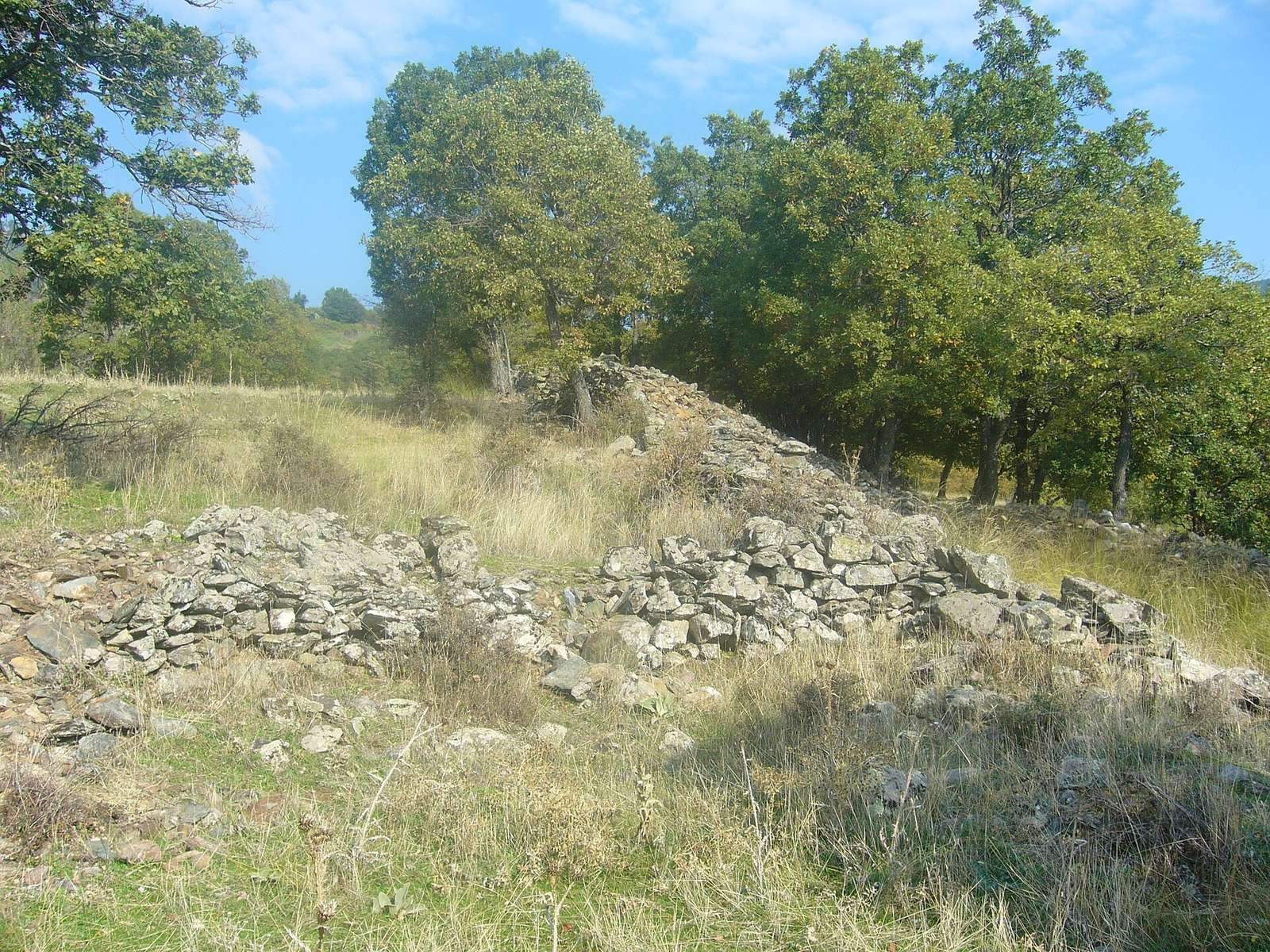
The castle stands east of Sidirochori at an elevation of about 900 metres and encloses approximately 7,000 square metres. Access is difficult and possible only through a passage on the north side. Its surviving dry-laid stone wall, built without mortar, reaches about 1.7 metres in height. The wall is estimated to have originally stood 2.5 to 3 metres high, measured about 2.2 metres thick, and sloped inward. The entrance formed part of a defensive arrangement with a single tower. Internal cross walls divide the enclosed area into two levels.
Church and archaeological finds
Church and enclosure
Traces of a small basilica, a church typically arranged around a long central nave, lie at the southeastern end of the castle. An enclosure stands behind it.
Finds
Finds from the site include pottery fragments, square Roman bricks, vessels and large storage jars, water pipes, and two tombs. Metal objects include knives, arrows, and jewelry.