Birkholz Manor: A Historic Estate in Saxony-Anhalt
Site at a Glance
- Popularity
- Very Low
- Country
- Germany
- Primary era
- Early Modern
- Eras represented
- Early Modern, Modern
- Civilizations
- Holy Roman Empire, Kingdom of Prussia, Margraviate of Brandenburg
- Site type
- Domestic
- Remains
- Manor House
On this page7 sections
History
Birkholz Manor is a historic estate in Birkholz, a district of Tangerhütte in Saxony-Anhalt, Germany. The von der Schulenburg family established an outlying farm here in the 16th century, on the site of an abandoned village in the area of an earlier moated castle. The present manor house is attributed to the building period of the von Bismarck family, which acquired the estate in 1739.
From the Schulenburgs to the Bismarcks
The estate was severely damaged during the Thirty Years’ War (1618–1648), a major conflict fought across much of Central Europe. In 1739 it passed to Levin-Friedrich II von Bismarck of Briest (1703–1774). He established the nearby settlement of Sophienhof and named it for his wife, Sophie Amelie, born von der Schulenburg.
Levin-Friedrich II was succeeded by Achatz Christoph von Bismarck (1737–1796). His son, Heinrich Friedrich Wilhelm Achatz von Bismarck (1786–1856), sold the estate in 1856, the year he died in Magdeburg. The property included the outlying farm of Scheeren, 1,000 Morgen of arable and meadow land, and 1,800 Morgen of forest. A Morgen was a historical German land measure whose size varied by region.
Private ownership and fire
The estate later passed to Emil Ballerstedt, who was a lieutenant and became a member of the district council in 1888. A fire in 1907 destroyed most of the outbuildings. Peter Ballerstedt owned the property in 1931.
Postwar uses and renewal
The Ballerstedt family lost the estate during the 1945 land reform in the Soviet Occupation Zone, the part of postwar Germany administered by the Soviet Union. The manor house then provided accommodation for refugees. In 1949, rooms were converted for school use, and public bathing rooms were set up for local residents. The elementary school, kindergarten, and nursery remained in the building until 1967.
During later decades of the German Democratic Republic, or East Germany, the estate housed the Tangerhütte forestry office. From the mid-1970s, its premises also accommodated a post office, municipal and mayor’s offices, a community nurse, a public library, and an office for an agricultural cooperative. Since 2008, the complex has been privately owned, renovated, and occupied by its owners. It is also associated with the Altmark Festspiele, a regional cultural festival.
Remains
The estate brought together a manor house, several dwellings, livestock yards, and sheep farms. Its working yard was enclosed by a water-filled moat, while the house formed part of this larger agricultural complex.
Estate Yard
The yard was formerly surrounded on every side by a moat about four metres wide. Bridges provided access across the water. The enclosed grounds served the estate’s buildings and farming activities.
Manor House
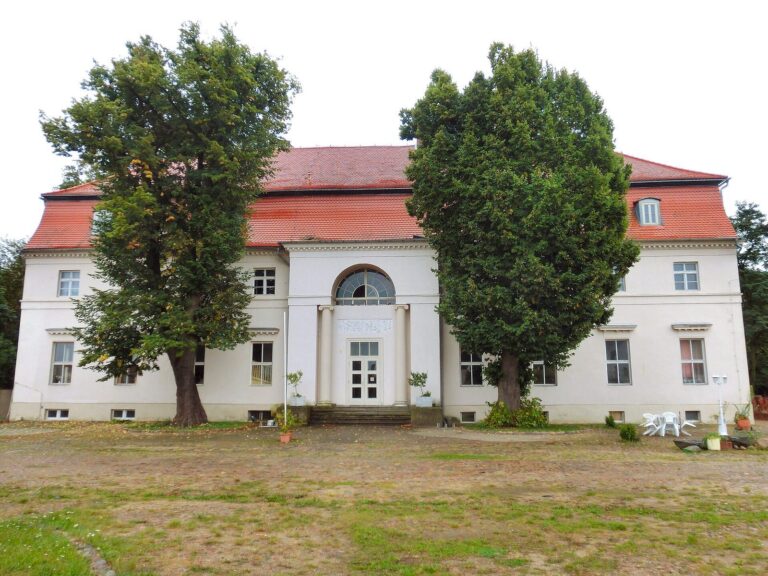
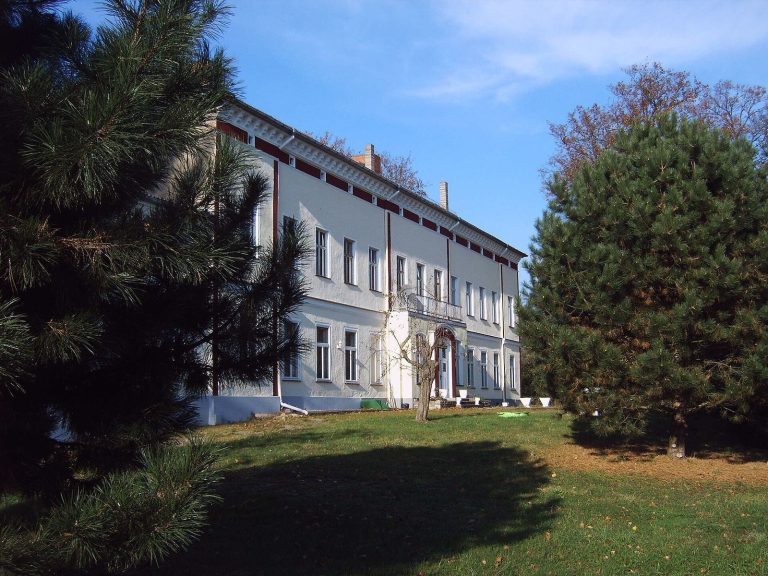
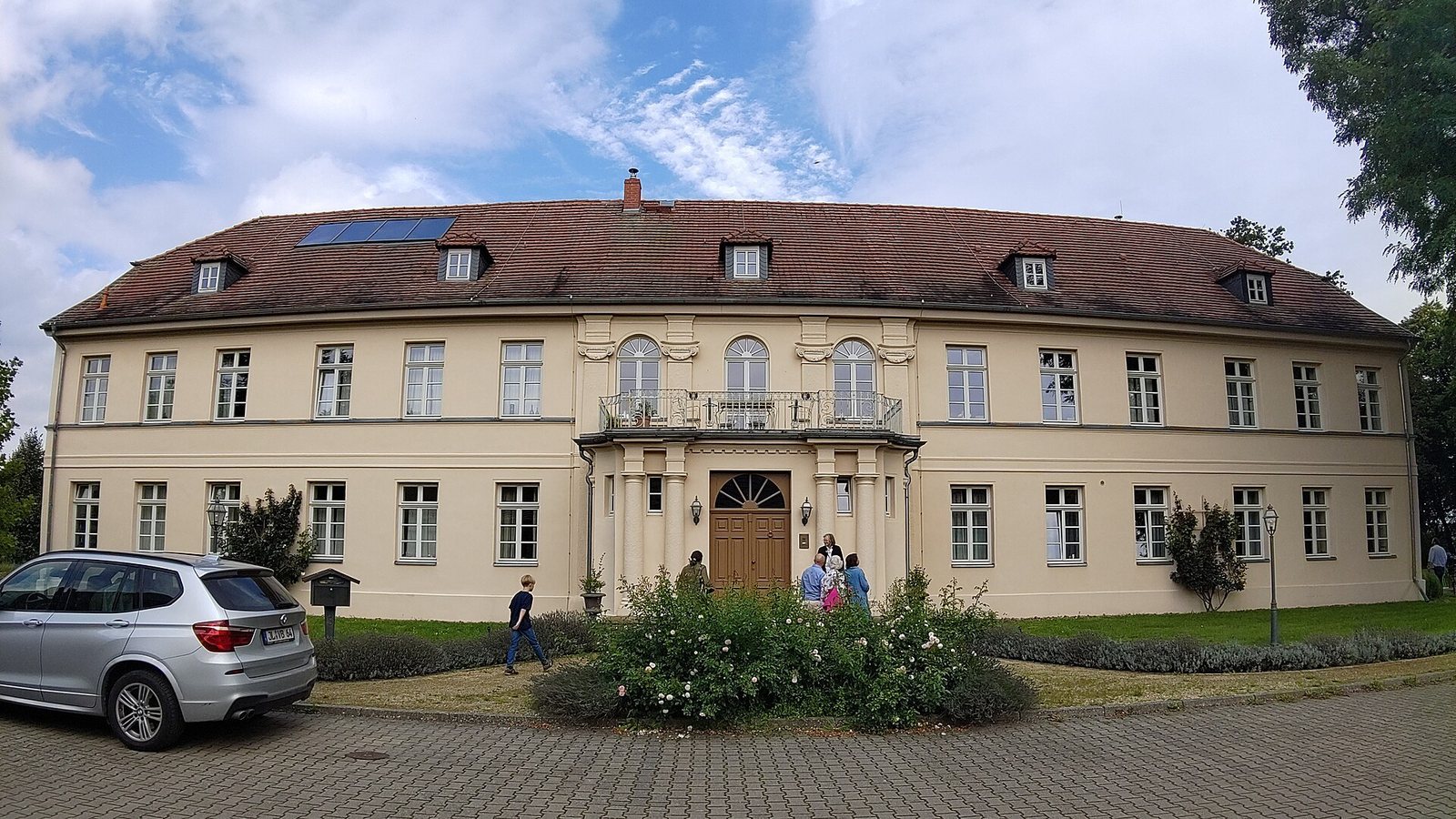
The manor house is an elongated, two-storey building with plastered walls and a half-hipped roof. Its front has 15 bays, with ornamental dormers topped by hipped roofs. A projecting entrance porch, framed by half-columns, was probably added around 1850.