Cowdray House: The Ruins of a Tudor Country House
Site at a Glance
- Popularity
- High
- Country
- United Kingdom
- Primary era
- Early Modern
- Eras represented
- Early Modern
- Civilizations
- British, English
- Site type
- Domestic
- Remains
- Elite Residence
On this page10 sections
History
Cowdray House is the ruin of a major house of the Tudor period, the English dynasty that ruled from 1485 to 1603, in the parish of Easebourne, just east of Midhurst in the United Kingdom. Sir David Owen began building it in the 1520s, and it became an important early example of Tudor architecture.
Estate origins and Tudor construction
The estate’s history reaches back to 1106, when Henry I granted land around Midhurst and Easebourne to the Norman lord Savaric. Savaric’s son, Geldwin, established a manor at St Ann’s Hill. Between 1273 and 1284, Sir John Bohun built a fortified manor at Coudreye as his family took up residence there. The name Coudreye came from a Norman word for the hazel woods nearby.
Sir David Owen acquired the estate through his marriage to Mary Bohun, daughter of the last male Bohun heir, in the early 1490s. After Mary’s death in 1496, he took possession of the earlier Bohun manor. Owen demolished it and began Cowdray House on its site. His son Henry sold the estate to Sir William Fitzwilliam in 1529. In 1533, Henry VIII authorized Fitzwilliam’s trustees to enclose 600 acres of meadow, pasture, and woodland as a park and to fortify Cowdray.
The Brownes and the Tudor court
In 1536, following the Dissolution of the Monasteries, Henry VIII’s suppression of religious houses and redistribution of their property, Fitzwilliam received Easebourne Priory and other nearby lands. In 1538, his half-brother Anthony Browne received Battle Abbey. A later tradition held that the abbey’s dispossessed monks cursed the Browne family and Cowdray to end in fire and water. After Fitzwilliam died in battle, his half-brother inherited the estate. In 1548, it passed to the half-brother’s son, Sir Anthony Browne, who became the 1st Viscount Montagu, a rank in the British peerage.
Henry VIII visited Cowdray in August 1538, July 1539, and August 1545. Margaret Pole, Countess of Salisbury and a member of the Plantagenet royal family, was held there from November 1538 until September 1539, when she was transferred to the Tower of London. She was executed in May 1541. Mary of Guise stayed at Cowdray for one night in October 1551, and Edward VI visited in July 1552, praising the household’s food and hospitality. In 1558, Elizabeth I ordered Sir Anthony Browne’s arrest on suspicion that he supported Spain.
Henry Wriothesley, 3rd Earl of Southampton, was born at Cowdray on 6 October 1573. The third child and only surviving son of Henry Wriothesley, 2nd Earl of Southampton, and Mary Browne, he later became a courtier and literary patron. Shakespeare dedicated Venus and Adonis and The Rape of Lucrece to him. He has also been proposed as one possible inspiration for the ‘fair youth’ in Shakespeare’s sonnets.
Elizabeth I visited on 14 August 1591. Her welcome included a figure in armor presenting the house keys, and an actor dressed as a pilgrim who showed her an oak decorated with local knights’ heraldic shields. A ‘wild man’ declared that treachery could not uproot the oak, while a fisherman and a netter performed a dialogue at the fishponds. The speeches and entertainments were printed later that year. Anthony-Maria Browne inherited Cowdray in 1592. Guy Fawkes briefly worked there as a footman during his ownership.
The Gunpowder Plot and Civil War
After a warning led the 2nd Viscount Montagu to stay away from Parliament on 5 November 1605, he was briefly imprisoned on suspicion of involvement in the Gunpowder Plot, a plan to blow up Parliament. During the English Civil War (1642–1651), fought between supporters of the king and Parliament, Parliamentary forces occupied Cowdray House as a garrison. Two-thirds of the estate was confiscated from Francis Browne, 3rd Viscount Montagu, who supported the Crown, but the main house survived.
Fire, decline, and preservation
In 1770, Anthony Browne, 7th Viscount Montagu, hired landscape architect Capability Brown to modernize the gardens. On 24 September 1793, a fire began in a carpenters’ workshop in the North Gallery during restoration work. Smouldering charcoal fell onto sawdust and wood shavings. Furniture and valuables had been moved into the gallery during redecoration; only three paintings and a few small items of furniture were saved. The blaze destroyed much of the house, along with the other stored possessions, including objects from Battle Abbey.
Less than three weeks later, George Browne, 8th Viscount Montagu, died while attempting to ride the Rhine Falls. The title passed to Mark Browne, a descendant of the 2nd Viscount, who later died without children, ending the peerage. The estate went to George’s sister and, through her marriage, to William Stephen Poyntz. These events were later associated with the alleged curse. The house remained a ruin in the early nineteenth century, while spreading ivy hastened its decay. After Poyntz’s death, his three daughters could not agree on dividing the estate, and it was sold in 1843 to George Perceval, 6th Earl of Egmont.
In 1908, the 8th Earl of Egmont sold the estate to Sir Weetman Dickinson Pearson, later Baron Cowdray of Midhurst and, from 1917, 1st Viscount Cowdray. Between 1909 and 1914, he arranged for ivy to be carefully removed, unsafe structures to be restored, and the ruins surveyed. A major preservation and conservation project followed in 2006. The estate remains with the Viscount Cowdray; Michael Pearson, 4th Viscount Cowdray, inherited it in 1995. The ruins are Grade I listed, a status for buildings of exceptional national architectural or historic interest.
Remains
Layout and approach
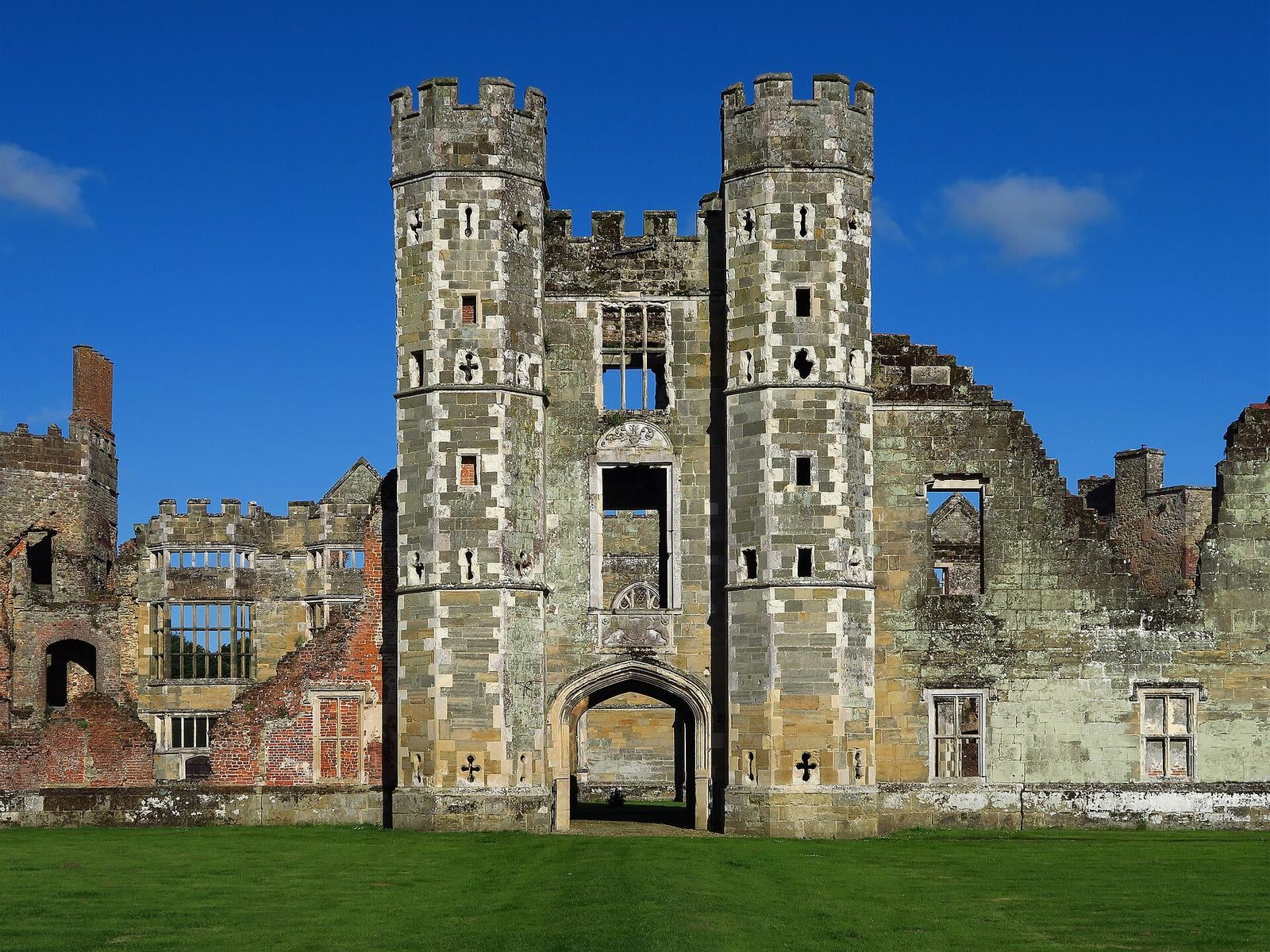
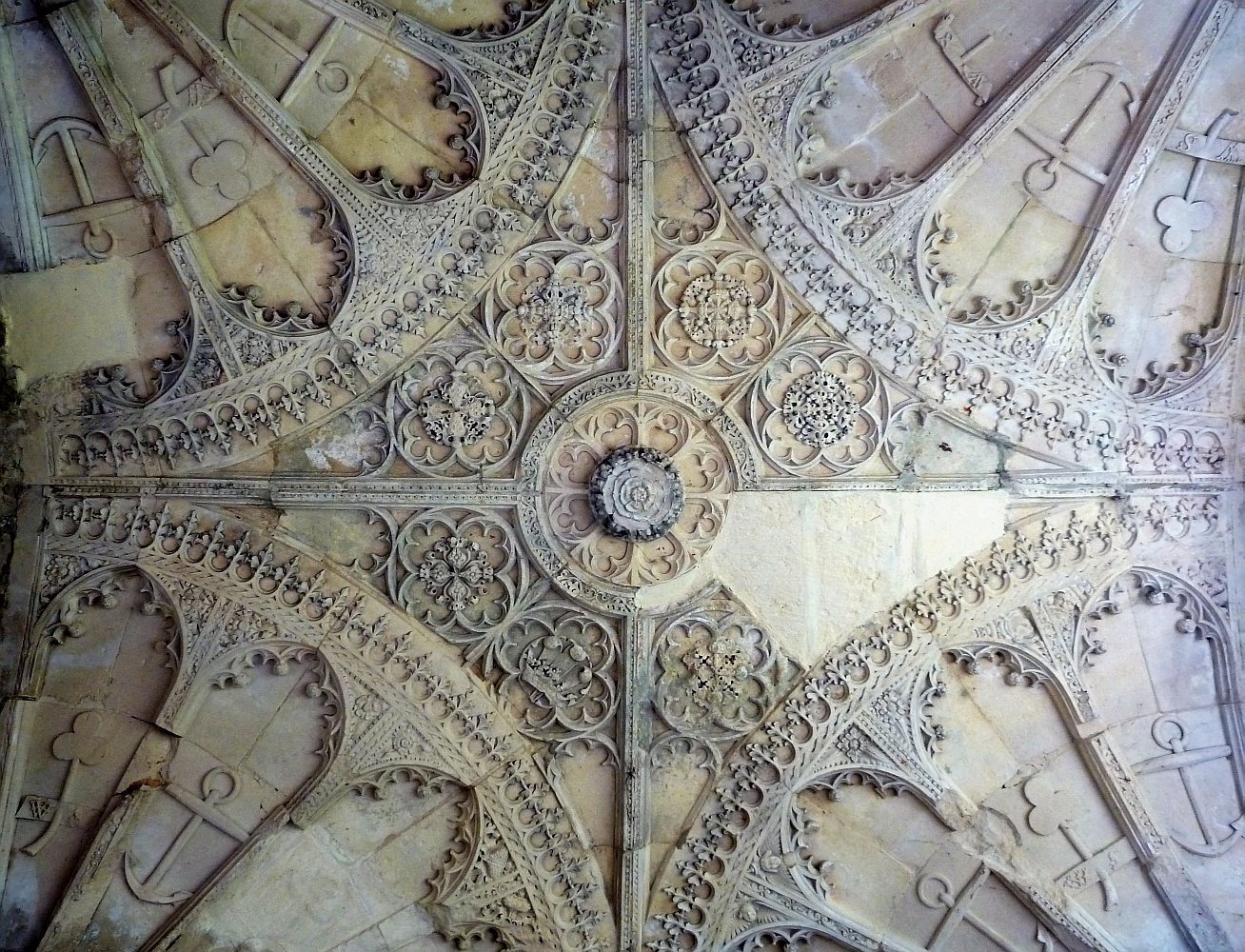
The ruins stand on the north bank of the River Rother, within the South Downs National Park. The estate covers 16,500 acres. The house was organized around a main courtyard, with north and east wings built under Sir David Owen and south and west wings added under Sir William Fitzwilliam. Fitzwilliam also had the facade fitted with battlements. The principal entrance was a three-storey gatehouse, approached across marshy ground on a raised roadway. The courtyard retains marks thought to have been made by musket balls during the Civil War.
Surviving architectural features
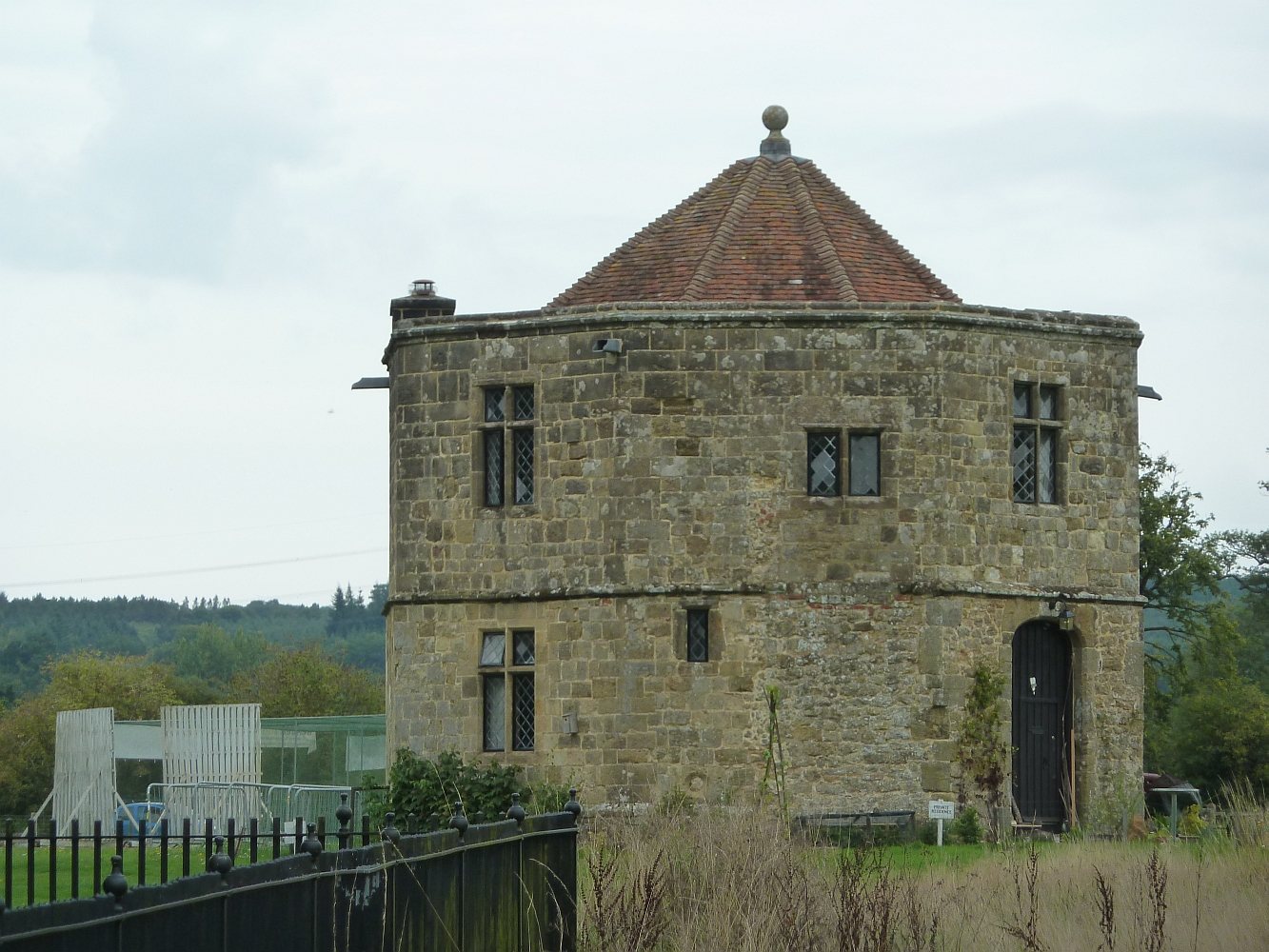
Kitchen Tower
The Kitchen Tower is the only part of the house that remains nearly intact. After the fire, a new floor was inserted above the kitchens. The tower was not inhabited, and the surrounding ruins became overgrown, particularly with ivy, which accelerated their deterioration.
Browne’s Hall paintings
Sixteenth-century wall paintings commissioned by Sir Anthony Browne once decorated Browne’s Hall. They showed scenes from the events of 1544, including the English encampment near Portsmouth, English and French fleets at the beginning of an engagement on 19 July, Henry VIII’s departure from Calais on 25 July, his encampment at Marquise, and the siege of Boulogne. Another scene depicted Edward VI’s 1547 coronation procession from the Tower of London to Westminster. The fire destroyed the paintings, but etchings published while they still existed preserve their appearance.