Comitium: Rome’s Original Public Assembly Place
Site at a Glance
- Popularity
- High
- Country
- Italy
- Primary era
- Classical
- Eras represented
- Iron Age, Classical
- Civilizations
- Roman
- Site type
- Civic
- Remains
- Forum
On this page19 sections
History
Early assemblies and foundation traditions
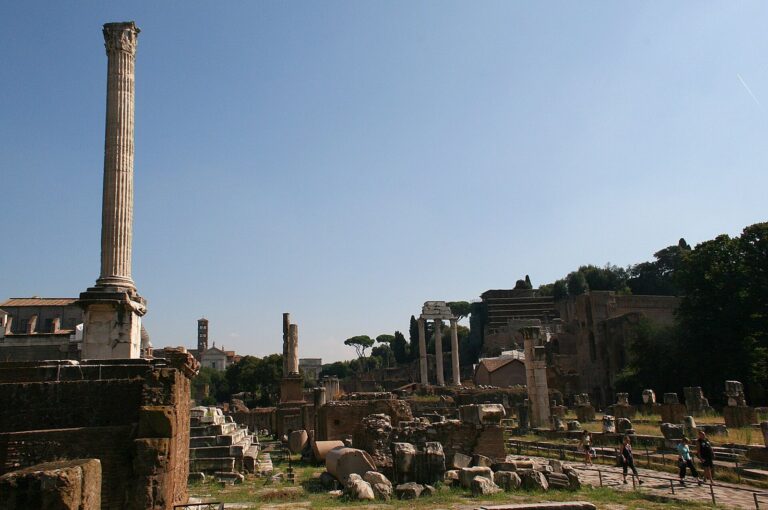
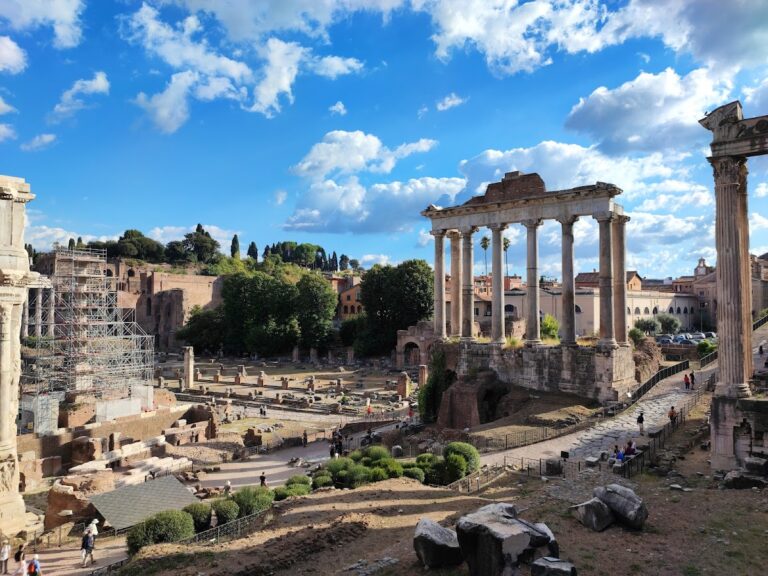
The Comitium was Rome’s original open-air public meeting place, in the northwest of the Roman Forum in Rome, Italy. Its development is broadly dated to the seventh through fourth centuries BCE. It served as a center for political and judicial business and also held religious and divinatory importance.
During the Roman Republic, the period of government before the empire, several popular assemblies met there. The Curiate Assembly gathered at the Comitium first, followed by the Tribal Assembly and the Plebeian Assembly. Courts also convened in the space. As trials increasingly moved to public halls called basilicas or elsewhere in the Forum, the Comitium continued to hear more complex cases.
The earliest traditions about the assemblies are closely entangled with stories of Rome’s foundation. Romulus and Servius Tullius were each associated with Vulcan and the organization of the assemblies, and both were portrayed as founders of Rome. Some interpretations treated Romulus as a reflection of Servius Tullius. One legend placed Romulus’s supposed grave beneath the Vulcanal, a sanctuary of Vulcan, after conflict with the Sabines. Another version said Romulus was wounded and Faustulus died at the spot while trying to separate the twins.
Other stories linking the Comitium with the nearby Palatine concerned the sacred boundary of Rome, Remus, the she-wolf who suckled the twins, and the settlement called Roma quadrata. That settlement was said to have held Romulus’s relics, while the Septimontium represented its growth toward the original seven hills. In another legend, Tarpeia was drawing water from a spring at the Comitium when she first saw the Sabine king Tatius.
The Senate and Republican public life
The Senate probably first met in an old Etruscan temple at the Comitium. Tradition credited the early king Tullus Hostilius with building or refurbishing it. As the Senate grew in size and authority, its meeting house was enlarged. Roman law required proposed bills to be approved in a formally consecrated place, so Senate meeting places were treated as sacred public spaces.
The Comitium could not accommodate everyone as Rome’s population increased. Speakers in the later Republic therefore addressed crowds gathered in the Forum, turning away from the Senate house and the people who remained inside the Comitium. The Centuriate Assembly, a major citizen assembly, moved outside the city walls to the Campus Martius, but the Comitium remained a setting for some formal elections. Its importance diminished after the Republic.
Sulla, factional violence, and Caesar’s changes
In 80 BCE, the general and dictator Sulla enlarged the Senate house and installed heating there for the first time. He also reduced the size of the Comitium, which Julius Caesar later diminished further. In 55 BCE, violent conflict between the supporters of Clodius and his rival Milo turned the Rostra, Rome’s public speaking platform, into a strongpoint from which deadly missiles were thrown.
Clodius was killed near Bovillae on January 2, 52 BCE. His followers carried his body to the Comitium and burned it on a makeshift pyre of seating taken from the Curia Hostilia, the Senate house. The fire destroyed the building and damaged the Basilica Porcia. The Senate commissioned Faustus Cornelius Sulla, the dictator’s son, to rebuild it; Caesar replaced that building only seven years later.
Caesar’s rise as a general and his successful campaigns helped bring about the First Triumvirate, an informal power-sharing alliance among Caesar, Pompey, and Crassus. The alliance broke down, and Caesar eventually became dictator for life. His building program dismantled and realigned the Senate house, levelled the Comitium, and removed or replaced the old Rostra, known as the Rostra Vetera.
Political conflict and the end of the Republic
A ceremony during Lupercalia, an ancient February festival, may have helped fuel the conspiracy against Caesar. As Caesar stood at the Rostra, Mark Antony repeatedly tried to place a laurel wreath on him. Caesar refused in a theatrical display that drew applause from the crowd. The wreath was eventually put on a statue of Caesar, which his opponents immediately pulled down.
Cicero had spoken from the Rostra while serving as praetor, a senior magistrate with judicial duties. In 43 BCE, after a long withdrawal from public life, he returned to politics with the Philippics, speeches attacking Mark Antony and defending the liberties Cicero believed had been lost under Caesar. At least one was delivered from the Rostra. Octavian tried unsuccessfully to keep Cicero off the proscription list, which named people for execution and confiscation of property. Mark Antony prevailed, and Cicero’s head and hands were displayed at the platform.
Medieval use and archaeological work
During the Middle Ages, the Comitium became a Christian cemetery, and part of the Senate house was converted into a catacomb. Later excavations uncovered more than 400 bodies, which were moved during the work.
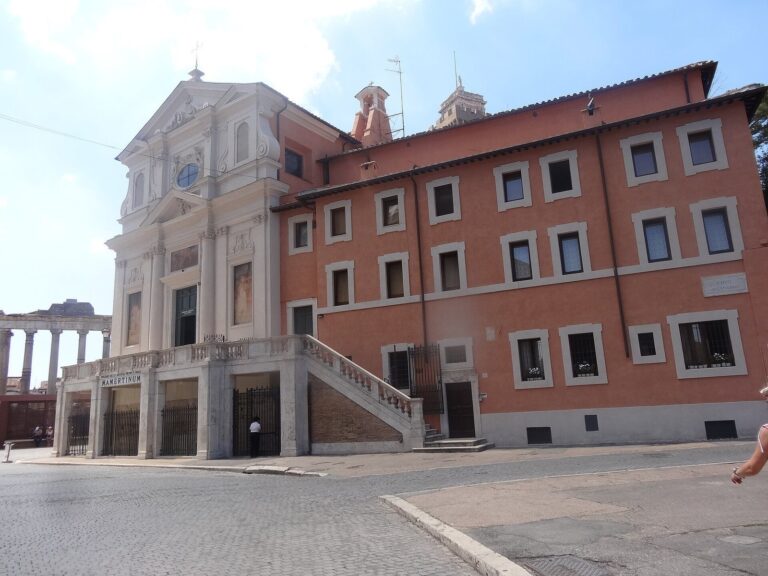
Archaeological study in Rome developed during the nineteenth century, initially through the examination and cataloguing of existing collections. Excavations in 1870 revealed later pavements or structures but stopped without resuming. In 1898, a committee reviewing architectural fragments called for more detailed investigation. That year, Giacomo Boni secured the removal of the tramway in front of Sant’Adriano al Foro, and excavation began in December. Boni and his collaborators worked at the Comitium from 1899 to 1903, uncovering the Lapis Niger and other objects.
In 1953, an American excavation at Cosa identified that colony’s Comitium and the rounded steps in front of its Senate house. The discovery prompted further excavation at Rome’s Comitium in 1957.
Remains
Layout and pavement
Open space and boundaries
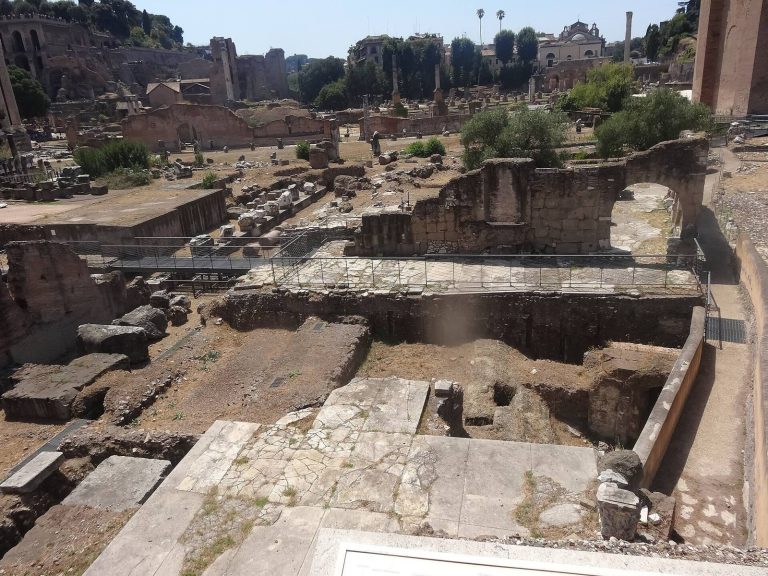
The Comitium was an open space adjoining the Forum, with monuments and statues along its boundary. It lay in front of the Senate house, the Curia Julia and its predecessor, the Curia Hostilia. Livy and Cicero also associated the Curia Julia with the Comitium. A royal complex may have stood near the House of the Vestal Virgins at one end of the Forum.
Paving and the Lapis Niger
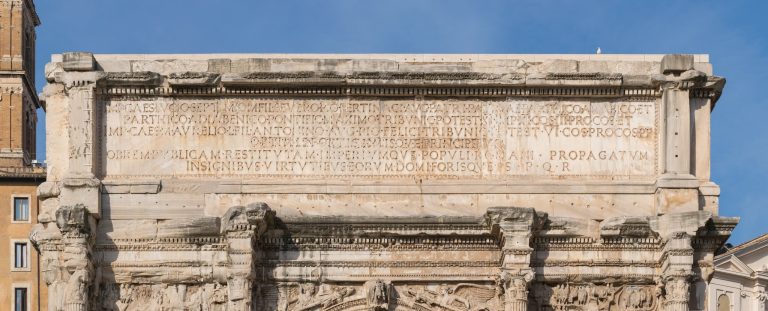
Travertine blocks paved the Comitium, extending to and around the Lapis Niger, or Black Stone, an archaic sacred monument and area. The pavement and the monument were at the same level, and a curb protected the stone on at least two sides. The paved area reached a point opposite the middle of the Arch of Septimius Severus, then continued just beyond the Lapis Niger to a curved front wall built over an older tufa pavement. Farther back, sections rested on earlier structures. A later phase covered part of the Comitium in a way compared with the Basilica Aemilia.
Early forms and civic markers
Interpretations of the Comitium’s early shape differ. In 1912, Francis Macdonald Cornford described it as a square, temple-like space aligned with the four quarters of the sky. Plutarch’s account of Rome’s foundation instead describes Romulus marking out a circular sacred place through divination, with a trench, offerings, and soil brought from the men’s homelands. In that story, the city wall’s circuit was then laid out and ploughed from the center. The account presents this place as Rome’s traditional center, and a similar sacred center was associated with the first Palatine settlement.
The Umbilicus urbis Romae, or Navel of the City of Rome, marked the city’s center. A stone cippus, meaning a marker or pedestal, dated to 450 BCE was found on the Comitium’s second level. Its inscription set out citizens’ civic duties.
The Senate precinct
Curia Hostilia and its shrine
The old Etruscan temple on the north side of the Comitium is identified with the Curia Hostilia. The Senate house may have originated around 600 BCE, with a shrine added about twenty years later. Tradition credited Tullus Hostilius with building or refurbishing the Curia and connected the shrine with a miraculous shower of milk and blood.
Platforms and public monuments
The Rostra and associated platforms
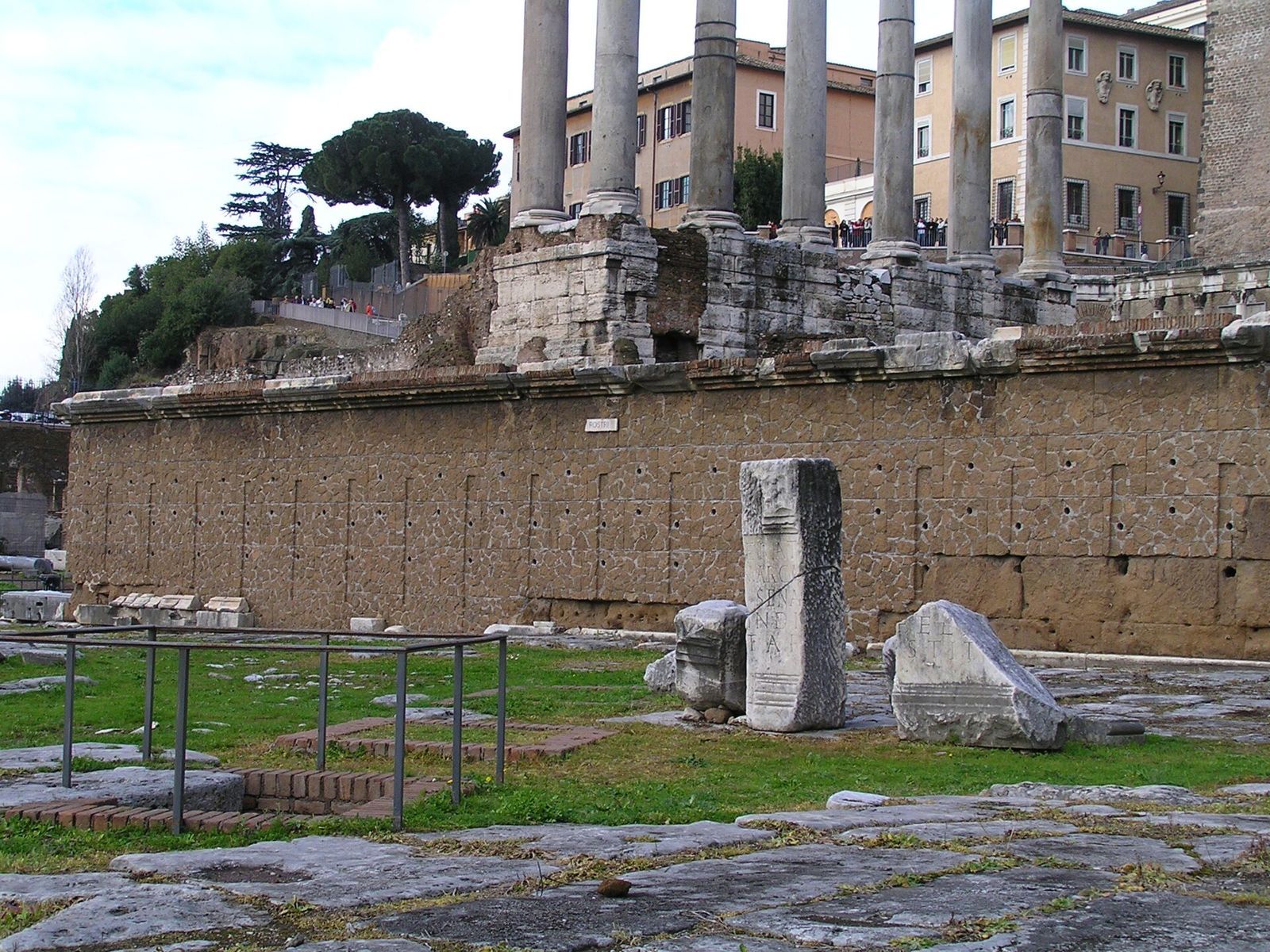
The first structure called the Rostra stood in the southeast part of the Curia Hostilia’s forecourt, at the edge of the Comitium. Another raised platform was beside it, with steps rising and descending on either side. The Comitium’s original altar and shrine of Vulcan may also have served as a speaking platform for senators or their political opponents. Temporary wooden structures could be dismantled during the flood season. The Rostra Vetera served as a permanent tribunal before becoming a war monument, and the Rostra itself may have been treated as consecrated ground. A sundial stood there for a time before newer devices replaced it.
The Graecostasis and Columna Maenia
The Graecostasis, a platform associated with foreign envoys, stood on the northwest side of the Forum. A second platform within the Comitium was beside the Rostra, and the Columna Maenia stood near both. Consul Gaius Maenius erected the column in 338 BCE. It may have come from the atrium of his house, which was sold to Cato and Flaccus. Its position is described either as south of an observation point or along a line passing through the Rostra and Graecostasis.
The column also helped mark time. As the sun descended from it toward the Carcer, the Roman prison, Maenius’s attendant announced the final hour. The announcement, like the midday call, was made from the Curia.
Memorials and sacred features
The Tabula Valeria and wall paintings
In 263 BCE, consul Manius Valerius Maximus Corvinus Messalla placed the Tabula Valeria on the side of the old Curia. It may have been a painting of his victory over Hiero and the Carthaginians in Sicily. Another interpretation identifies it as a bronze or marble inscription setting out the Valerio-Horatian laws on the rights of plebeian tribunes, perhaps displayed near their benches.
Vitruvius described paintings removed from walls in Sparta by cutting through the brickwork. They were mounted in wooden frames and brought to the Comitium to decorate the aedileships of C. Visellius Varro and C. Licinius Murena. An aedile was a public official responsible for aspects of civic administration.
Statues and the sacred fig
A statue of Publius Horatius Cocles stood in the Comitium, and a statue of the augur Attus Navia stood near a sacred fig tree. Roman legend said Navia split a wet stone with a razor at the assembly place and transferred the Ficus Ruminalis, or its sacred significance, from the Palatine to the Comitium. The tree was also called the Ficus Navia. Of four sacred fig trees associated with Rome, three were linked to the Forum: one near the Temple of Saturn, one in the Forum’s middle beside an olive tree and a grapevine, and the Comitium tree. The tree near Saturn was removed after its roots began undermining a valued statue.