Arch of Septimius Severus: A Roman Triumphal Arch in the Roman Forum
Site at a Glance
- Rating
- 4.8
- Popularity
- Low
- Country
- Italy
- Primary era
- Classical
- Eras represented
- Classical, Medieval
- Civilizations
- Roman
- Site type
- Civic
- Remains
- Arch
On this page7 sections
History
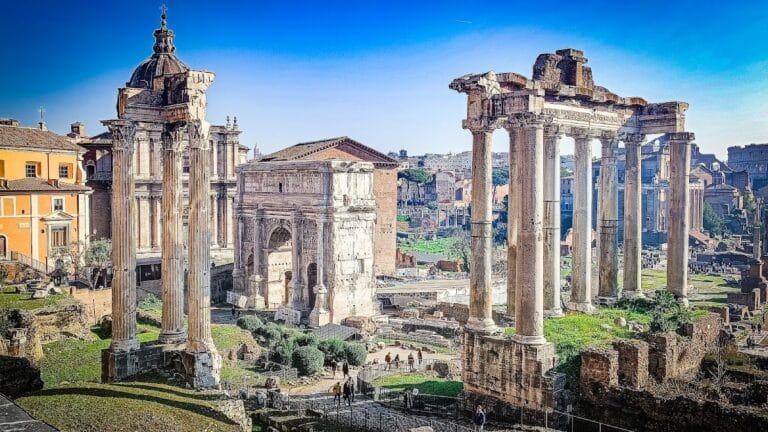
The Arch of Septimius Severus is a Roman triumphal arch in Rome, Italy, built between 202 and 203 and dedicated in 203 during the imperial period. It stands at the northwestern end of the Roman Forum, near the foot of the Capitoline Hill, and commemorated victories over the Parthian Empire in Mesopotamia. Commissioned by the Senate for Emperor Septimius Severus and his sons Caracalla and Geta, it celebrated military success while presenting the Severan dynasty as a legitimate ruling house.
The Severan victories
The monument marked campaigns fought in 194–195 and 197–198. The Parthians, rulers of a major Iranian empire that repeatedly contested Roman control in Mesopotamia, had been defeated in campaigns that restored Roman authority over Nisibis and brought Roman forces through Babylonia to Seleucia and Ctesiphon. The first campaign also defeated the Osrhoenians and Adiabenians. The later campaign followed a Parthian attack on Nisibis and led to the capture or subjugation of important eastern cities.
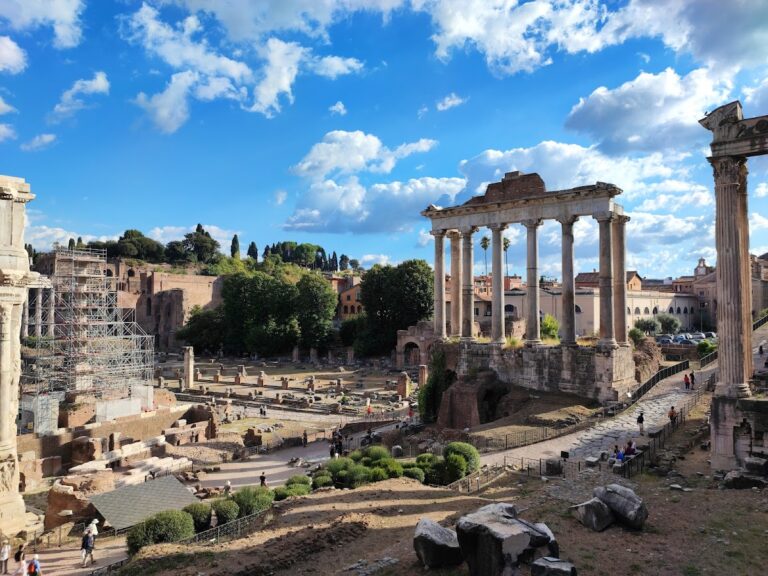
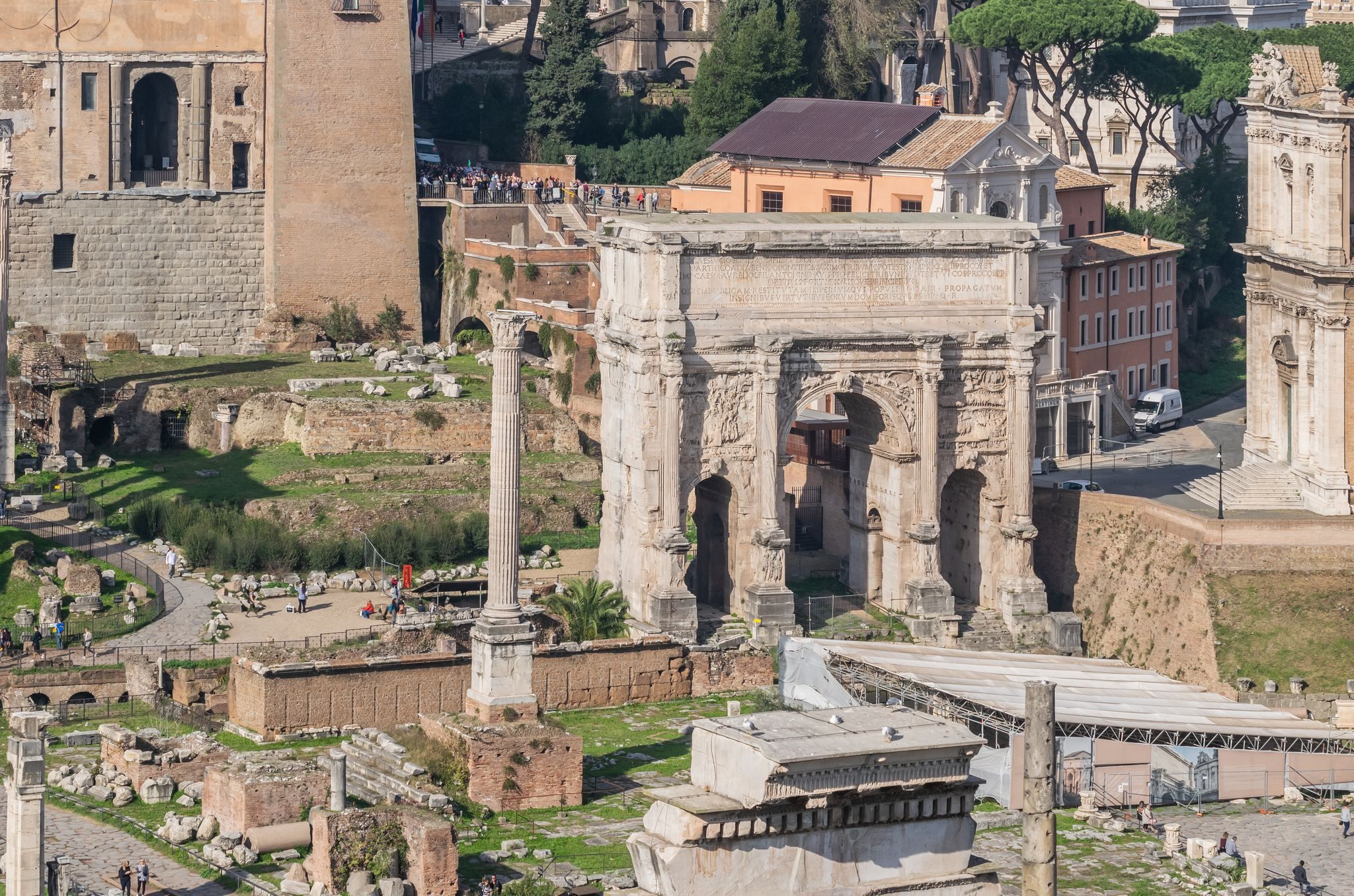
The arch occupied a carefully chosen position between the Rostra Augusti, a public speaking platform, and the Comitium, a civic meeting area associated with Rome’s political institutions. It stood in front of the Temple of Concord and near the Curia Julia, forming one of the monumental entrances to the historic Forum area. Unlike monuments aligned with the Sacra Via, the Forum’s principal ceremonial street, it addressed people moving through the Forum on foot and functioned as an independent imperial statement. Its imagery linked military achievement with the emperor’s relationship to the Senate.
Septimius Severus initially designated Caracalla and Geta as joint emperors. After Severus died, Caracalla had Geta assassinated. Geta was then subjected to damnatio memoriae, the Roman practice of publicly erasing a condemned person’s name, portraits, and honors. His name and images were removed from the arch, and the surviving inscription replaces the original reference to him with additional praise for Septimius Severus and Caracalla.
A triumph for Septimius Severus followed the victories, but it was postponed and never held. Images of the completed arch nevertheless appeared on coins associated with Septimius Severus and Caracalla, extending the monument’s political message beyond the Forum.
Medieval preservation and modern recovery
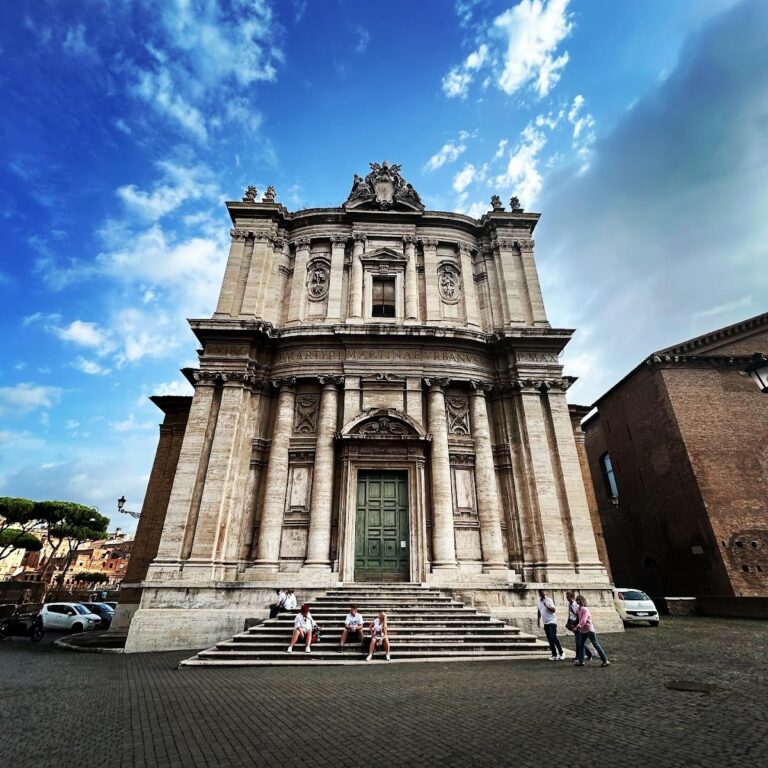
During the Middle Ages, the Forum was abandoned and gradually accumulated sediment and debris. The arch was incorporated into the Christian church of Saints Sergius and Bacchus, which Pope Innocent III granted to the church in 1199. A medieval stronghold associated with the Cimini family included a tower or campanile built on the arch. Its ecclesiastical ownership and incorporation into later structures helped preserve the monument through a period when much of the surrounding Forum was buried.
Between the ninth and twelfth centuries, the arch was fortified during conflicts between Roman factions. By the eighteenth century, much of the structure lay below accumulated ground. A 1742 painting by Canaletto shows its upper half rising above the surrounding level. Pope Pius VII initiated the complete uncovering of the arch in 1804, while the central Forum area, including the buried bases, was cleared between 1870 and 1885.
Major conservation work took place during the 1980s and 1990s. The reliefs have suffered erosion, dark crusting, chemical deterioration associated with hydrocarbon fumes, and localized fire damage. Traffic also damaged the column bases during the medieval and early-modern periods. The arch forms part of Rome’s protected historic centre and is administered within the archaeological area of the Roman Forum by the Colosseum Archaeological Park.
Remains
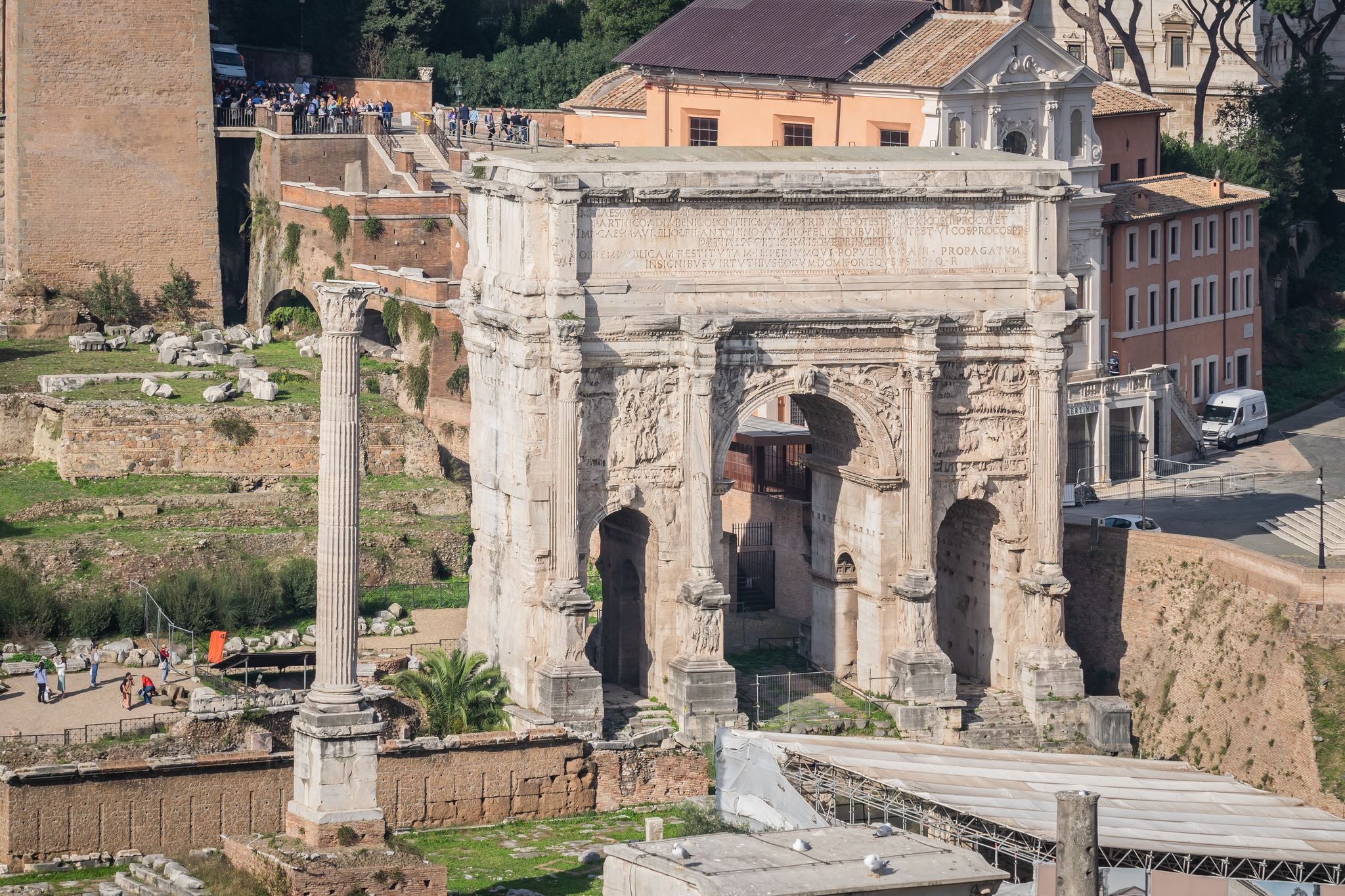
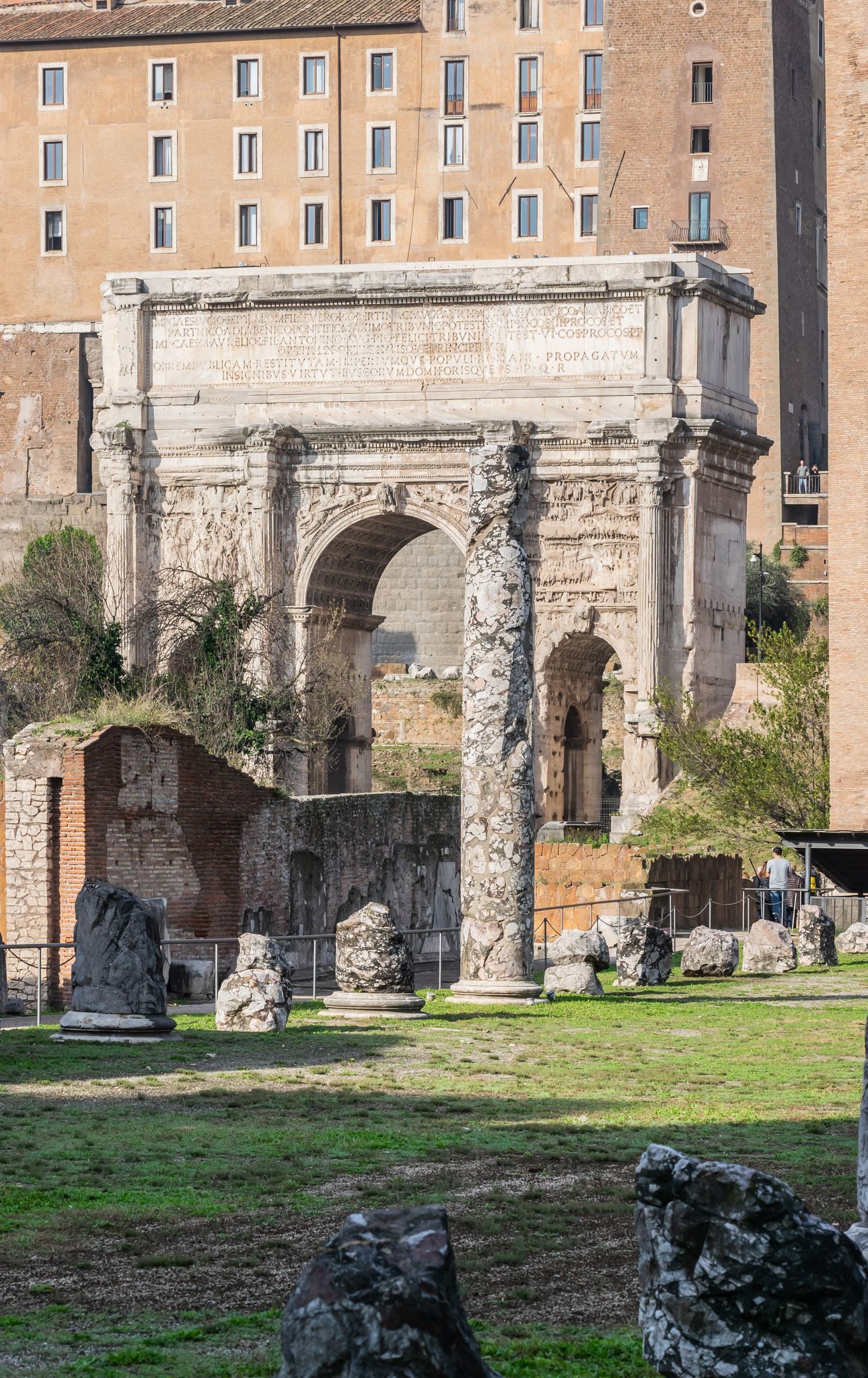
The monument is a white-marble, three-bay arch on a travertine base. One large central passage is flanked by two smaller arched passages, which connect with the central opening through additional small arches. The structure is approximately 26 metres high and 23 to 25 metres wide, with a recorded depth of 11.2 metres. Steps originally led up from the ancient Forum level, controlling movement through the monument and preventing wheeled traffic from passing through its openings.
Structure and architectural decoration
The three passages rest on piers faced with free-standing composite columns set on tall pedestals. A staircase in the southern pier leads to the upper platform. The facade uses a tetrastyle arrangement, with four columns creating the appearance of a porch without a deep porch-like space behind them. Travertine, marble, concrete, and brick form the structure. Proconnesian marble was used for the columns, Pentelic marble for masonry, and Luna marble for the larger relief columns. Precisely cut rectangular blocks were closely fitted, with much of the carving roughly prepared at ground level and its final details completed after installation.
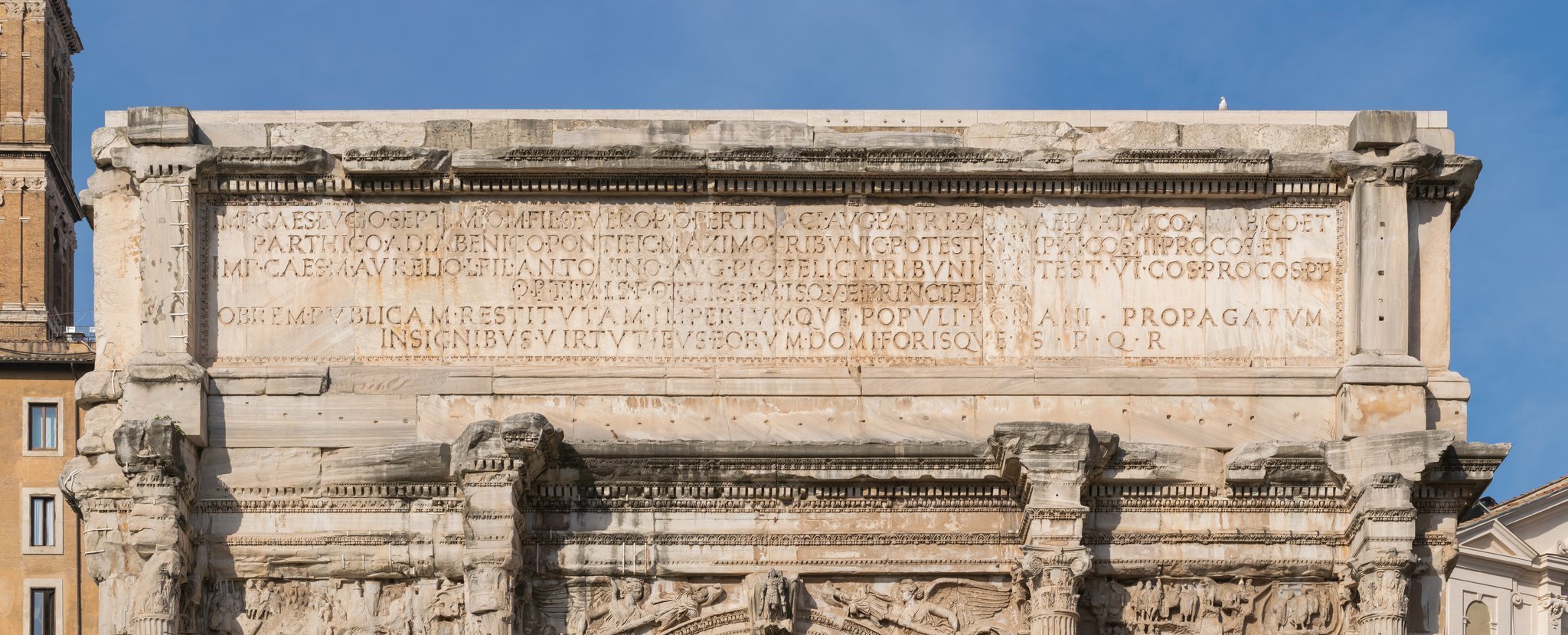
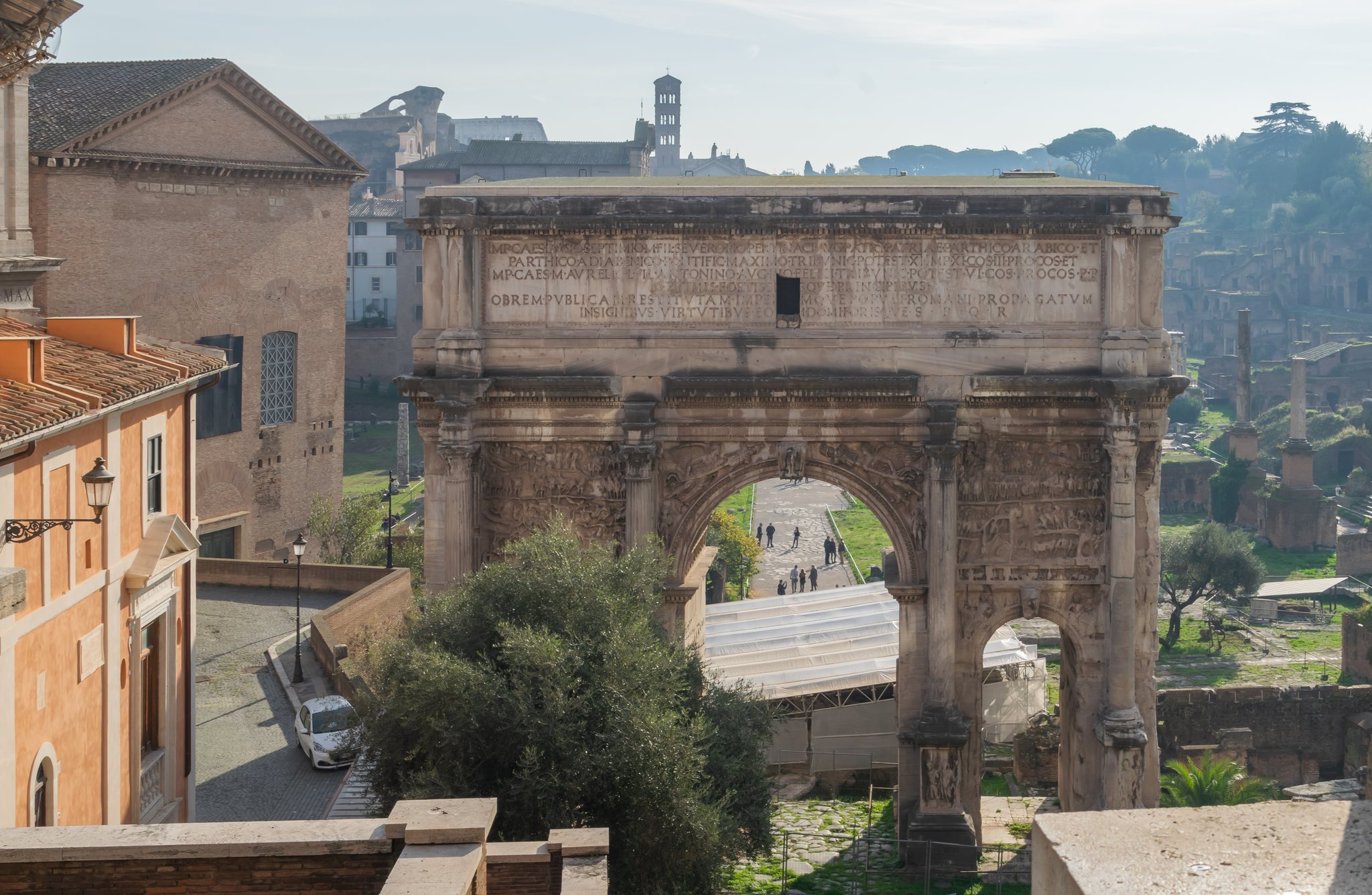
The central passage contains a richly coffered semicircular vault, with recessed panels carrying rosette decoration. The facades combine columns, entablatures, projecting cornices, double moldings, acanthus bands, and Lesbian cymation. Their deep shadows and strongly projecting three-dimensional elements intensify the relief of the architecture. The attic carries large dedicatory inscriptions on both principal facades. Bronze letters were originally inserted into recessed lettering; the surviving text honors Septimius Severus and Caracalla for restoring the state and extending Roman power.
Dowel holes in the attic indicate additional metal ornament, probably floral or trophy motifs. Coins and surviving structural evidence indicate that a gilded-bronze imperial quadriga, a chariot drawn by four horses, once stood on the summit. The group included Septimius Severus and his sons, with accompanying soldiers or other statues possibly forming part of the composition. The spandrels, the roughly triangular spaces between the arches and their frames, contain winged Victories holding trophies. Figures beneath them represent the four seasons, while the pedestals show Roman soldiers with captive barbarians or Parthians.
The smaller passages contain representations of rivers, and a high-relief frieze depicts a triumphal procession. Mars, Hercules, Liber, Fortuna, and possibly Virtus appear in the archivolts or keystones. The sculpture combines classical ornament with deep drilling, undercutting, and pronounced planar surfaces. Differences in carving technique and detail have been associated with the participation of several workshops and sculptors, although the reliefs and frieze maintain an overall unity.
Scenes of the Parthian campaigns
Four large relief panels on the facade piers narrate the Parthian campaigns in horizontal registers read from bottom to top. Their scenes include Roman departures and marches, battles, sieges, imperial addresses to the army, negotiations, submissions, and the capture of eastern cities. The compositions probably drew on war paintings sent from Mesopotamia as well as the narrative approaches of Trajan’s Column and the Column of Marcus Aurelius. Their rich Antonine ornament and use of Proconnesian marble belong to an established imperial tradition, while the flattened mass scenes and deep undercutting anticipate developments in late Roman art.
The first major panel includes Roman troops, fighting, Nisibis, the flight of a Parthian ruler, and an address by Septimius Severus to the army, accompanied by his sons and officers. Its precise identification and date remain uncertain. It has been associated with the first campaign of 195, while another interpretation places the depicted flight in the second campaign of 197–198.
The second panel shows Roman siege operations, a fortified eastern settlement, delegations, and the submission of eastern rulers or populations. It has been interpreted as the submission of the rulers of Osrhoene and Armenia, including Abgar VIII, and as an episode involving Edessa. Another interpretation associates the scene with an agreement involving Hatra.
The third panel depicts Roman forces approaching or attacking a fortified city, Parthians fleeing or surrendering, and the emperor entering or addressing troops at the conquered settlement. It is commonly associated with Seleucia, although another interpretation identifies it with the Roman attack on Hatra. The fourth panel depicts the siege and capture of Ctesiphon and the submission of its population. A siege engine appears in the scene, while other elements may refer to Caracalla’s elevation or to an imperial address.
The reliefs are heavily worn, with erosion, dark surface crusts, and localized fire damage, especially on the first large panel on the left. The outward-projecting cornices and upper areas also show damage. Despite these losses, the surviving scenes preserve the monument’s connection between imperial authority, military action, and the eastern campaigns commemorated by the arch.
Structures beside the arch
Three Corinthian columns standing slightly east of the arch are identified as remains of the Temple of Jupiter Tonans. They belong to the arch’s immediate surroundings rather than to its structure, adding another surviving element to the monumental setting at the northwestern end of the Roman Forum.