Mont Lassois: A Celtic Oppidum and Medieval Center in France
Site at a Glance
- Popularity
- Medium
- Country
- France
- Primary era
- Iron Age
- Eras represented
- Iron Age, Classical, Medieval
- Civilizations
- Carolingian, Celtic, Duchy of Burgundy, Roman
- Site type
- City
On this page15 sections
History
Mont Lassois is an archaeological hilltop site at Vix in France, occupied from the Neolithic and developed as a Celtic oppidum, or fortified settlement, during the Hallstatt period, an Early Iron Age culture of central Europe. A fortified community and the Vix Palace mark this phase. Toward its end, the settlement may have controlled movement along an ancient tin route between Britain and Italy.
Hallstatt settlement
In the sixth century BC, a female aristocracy governed the local population. Its members probably gained wealth by taxing passing convoys. Rich burials associated with a chariot-tomb rite, a tradition linked to burial with a chariot or other vehicle, reflect this prosperity. The Vix burial has also been interpreted as evidence of women’s standing in Celtic society.
Occupation appears to have declined for a time as the Lingones, a Celtic people of eastern Gaul, developed Vertillum about 20 kilometres away. A gap between the Hallstatt and Gallo-Roman eras, the period of Roman Gaul and its inhabitants, left the earlier Celtic remains more accessible for excavation than at sites where successive layers overlap.
Gallo-Roman and late antique phases
By the end of the Gallo-Roman period, a small Roman settlement in the lower part of the hillfort and on the plain may have encouraged renewed occupation of the hill. The settlement of Latiscum reused the Hallstatt walls. Tradition holds that, near the end of the fourth century, Vandals under Crocus besieged and destroyed it. The town was soon rebuilt.
Latiscum seems to have adopted Christianity early. Around 451, Saint Loup, bishop of Troyes, took refuge there while threatened by the Huns. Around 519, Saint Valentin, founder of Griselle Abbey, was born in the town.
Merovingian and Carolingian phases
The settlement continued to develop during the Early Middle Ages, the centuries following the end of Roman rule in the West. It became an important center under the Merovingians, the Frankish ruling dynasty that preceded the Carolingians. The hill’s name appears as Latiscune in the seventh century and in a form ending in Latiscone in the eighth. The settlement was called Latiscum or Latisco; coins carry the form Lasticum, while Latss was the vernacular form of Latisco.
During the Carolingian period, named for the Frankish dynasty prominent from the eighth to the tenth centuries, settlement shifted toward Mont Roussillon. An oratory dedicated to Saint Marcel was established there in the ninth century. Latisco was described as a castle within a fortified stronghold. Lassois formed a territorial district and an important archdeaconry, an administrative division of the church, in the diocese of Langres. Its area included Bar-sur-Seine and Châtillon.
Count Palatine Girart de Roussillon, a high-ranking count with authority associated with a ruler’s court, built a castle at Lassois. In May 859, a provincial council led by Rémy, archbishop of Lyon, removed Girart from his offices, including control of the fortress, which was then razed to its foundations. Around 887, a small monastery on Mont Roussillon, dependent on the abbey of Saint-Marcel-lès-Chalon, passed to Geilon, bishop of Langres. An abbey dedicated to Saint Marcel is also recorded on the summit by that year.
Later medieval decline
A Viking raid a few years later brought the site to ruin, and the ducal castle at Châtillon became the center of the Lassois territory. By 1068, that territory extended north of Bar to Bourguignons. In 1111 or 1112, Beatrix, wife of Guy III of Vignory, gave the church of Saint-Marcel to Molesme Abbey, a Benedictine house in Burgundy, which established a priory, a religious community headed by a prior, on Mont Roussillon. From 1163, Bar and Châtillon belonged to separate deaneries, or church districts administered by deans. The priory did not last through the Middle Ages: its prior is mentioned in 1227, and occupation of the hill seems to have ended during the fourteenth century.
Archaeological investigations
Saint-Marcel church received historic-monument classification in 1914. Excavations on the middle and lower parts of the hill began in 1930 under archaeologist Jean Lagorgette, assisted by Maurice Moisson, and recovered Gallo-Roman material. Work resumed after the Second World War. In January 1953, Moisson and René Joffroy found the Vix vessel and princely tomb in a bend of the Seine below the hill, renewing interest in the site’s archaeological potential.
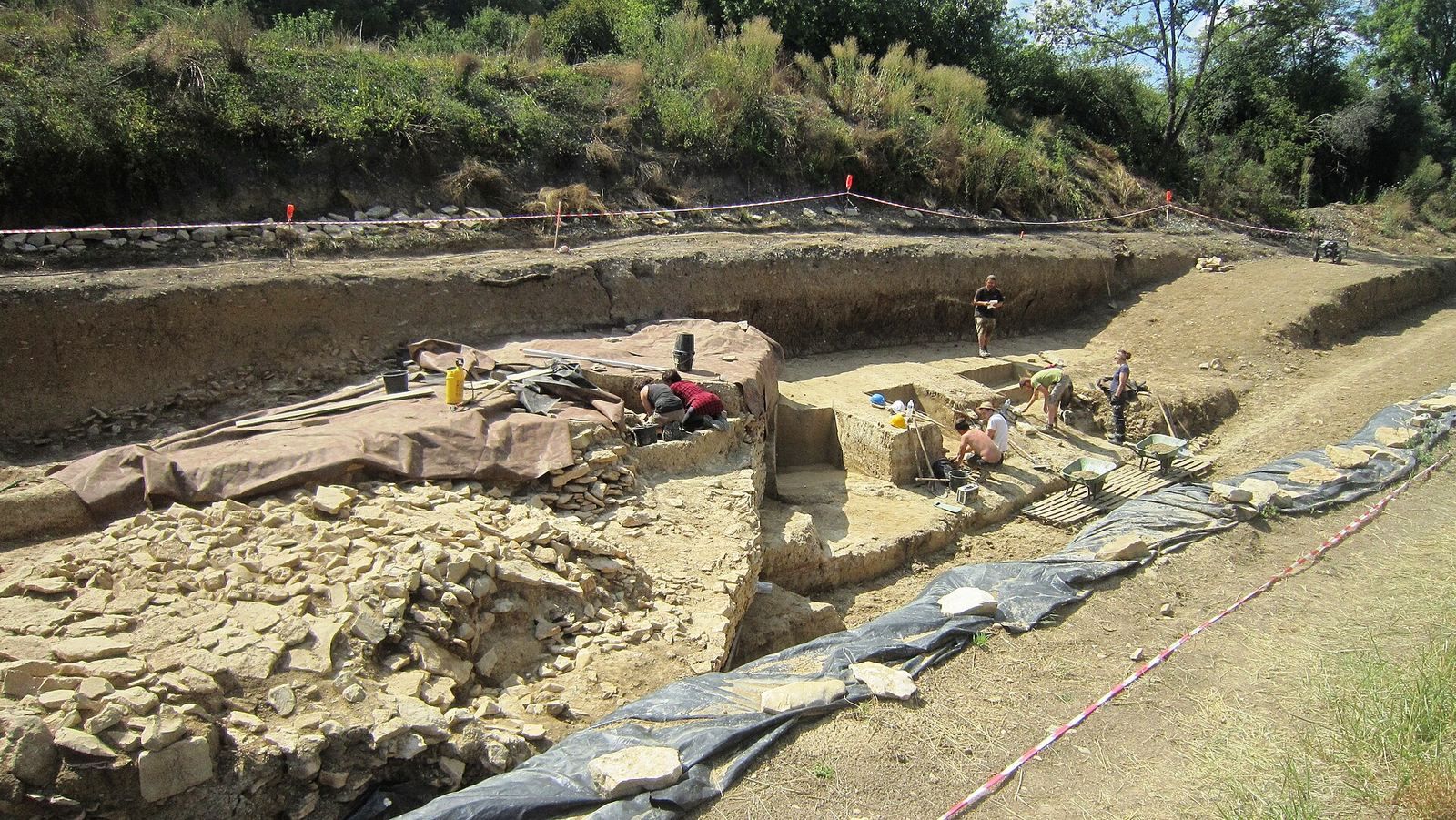
Excavation of the summit plateau began in 2002 and brought the Vix Palace into focus. Teams from the universities of Kiel, Stuttgart, Vienna, Burgundy, and Zurich worked under archaeologist Bruno Chaume’s coordination.
Remains
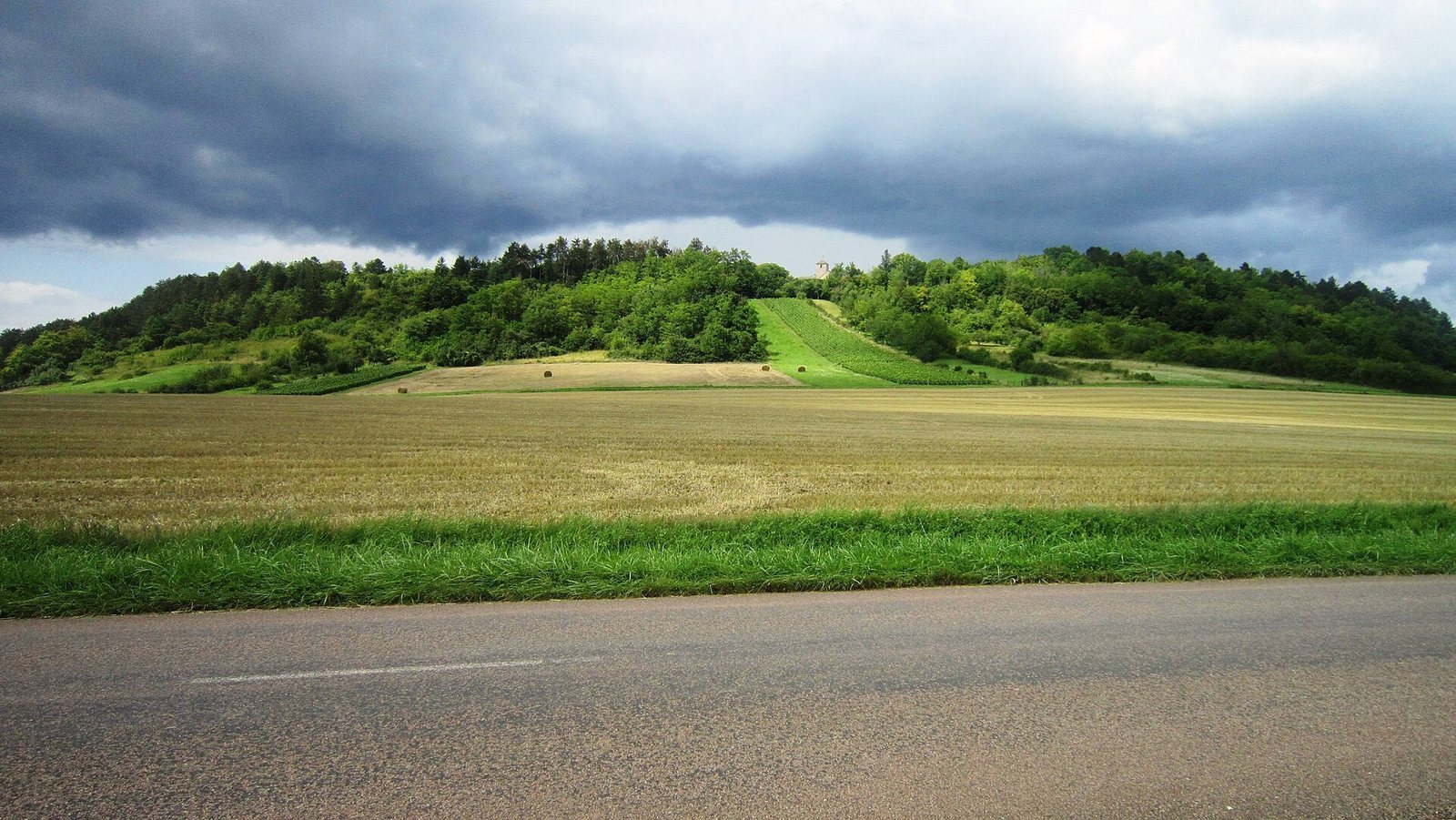
Mont Lassois rises about 100 metres above the upper Seine valley and has an overall J-shaped plan oriented from south to north. Its main branch, Mont Saint-Marcel, reaches 306.4 metres; the secondary branch, Mont Roussillon, reaches 280 metres and runs from east to west. Coppice and woodland cover the mount, with broad grassy clearings on its upper slopes and cereal and forage cultivation on the lower ground.
Hallstatt defenses and buildings
Peripheral rampart
A substantial rampart encircles the base of the mount, marking the outer boundary of the Hallstatt-period fortified settlement. An opening on its northern side faces the bed of the Seine.
Vix Palace
The Vix Palace remains lie on the summit plateau. They include a very large building within a broader complex whose scale has been compared to a town, an unusual arrangement in the Celtic world of the period.
Structures on the plain
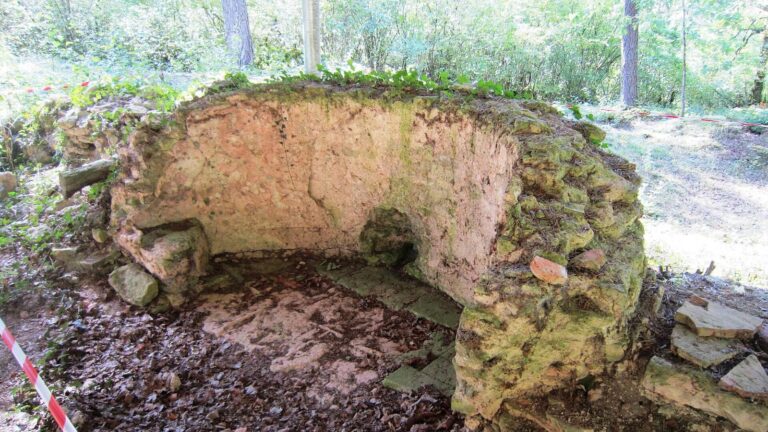
On the plain, near the place where the Vix vessel was found, excavators identified a probable agricultural establishment and a sanctuary that had already been excavated.
Burial remains and finds
Vix princely burial
The princely tomb lay in a bend of the Seine at the base of Mont Lassois. Its rich furnishings accompanied the remains of a woman, possibly a queen or priestess, and included the large vessel known as the Vix vessel. The burial is associated with the chariot-tomb tradition.
Merovingian cemetery and small finds
A Merovingian cemetery lies near the summit. Finds from the site include Merovingian and Carolingian coins inscribed Lasticum, as well as pottery sherds decorated with Christian motifs. The pottery came from workshops in Argonne.
Saint-Marcel church
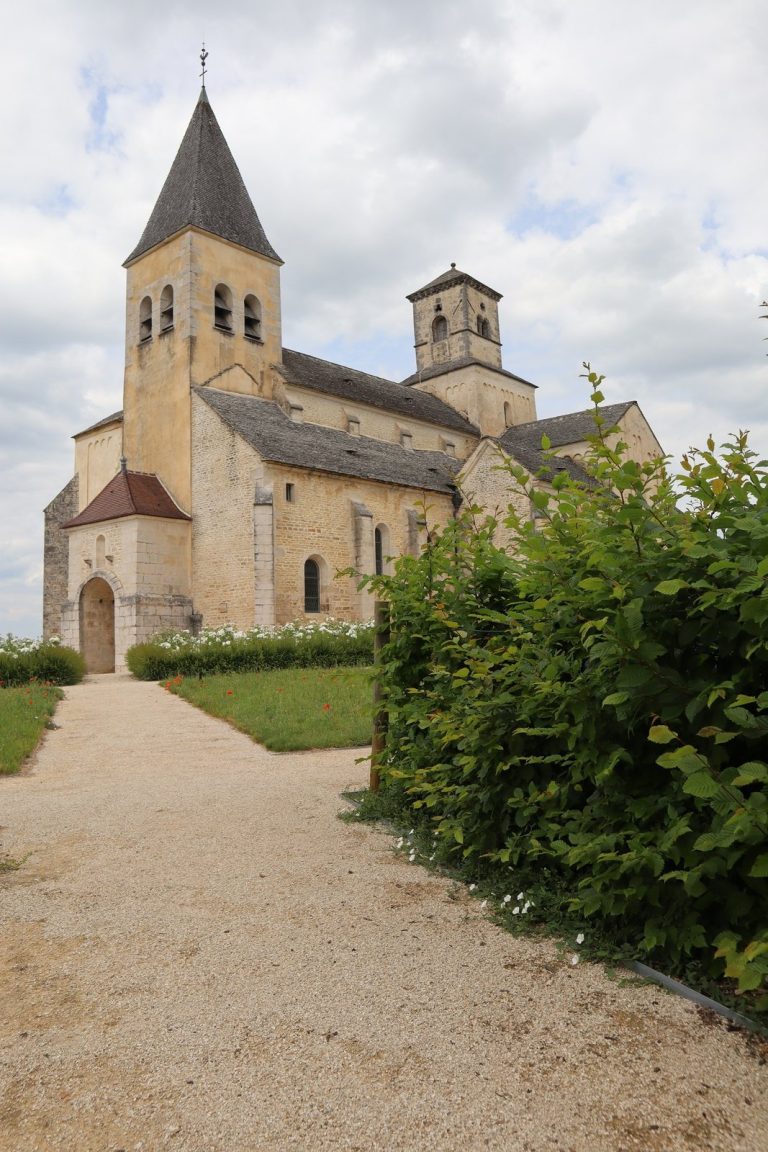
The Romanesque church of Saint-Marcel stands on Mont Roussillon, below the summit plateau, where the two branches of the mount meet. Built in the twelfth century to serve neighboring communities, it may have followed a chapel associated with a now-vanished ninth-century castle. Its walls partly incorporate sarcophagi reused from a nearby Merovingian cemetery, and one sarcophagus is displayed inside. The square bell tower and pentagonal choir date to the fifteenth century. A bell cast in 1824 has Marshal Marmont as its godfather. The church is well preserved, surrounded by its cemetery, and provides evidence of early stone construction along the northern borders of Burgundy and Champagne.