El Gallinero Roman Kiln: A Pottery Workshop in Puerto Real
Site at a Glance
- Popularity
- Very Low
- Country
- Spain
- Primary era
- Classical
- Eras represented
- Classical
- Civilizations
- Roman
- Site type
- Economic
- Remains
- Production Complex
On this page7 sections
History
The El Gallinero Roman Kiln is a Roman-period pottery kiln on the western edge of Puerto Real, in Cádiz, Spain. Its amphora production dates to the 1st century AD and connected the site to the Bay of Cádiz industry, which supplied containers for salted-fish products exported across the Roman Empire. The kiln is an important record of that regional pottery-production system.
Roman production
The kiln produced amphorae, large ceramic containers, in forms classified by the Dressel typology as 7B, 8, 10B, 10C and 10D. The range of forms links its output to the wider system of pottery production around the Bay of Cádiz.
Discovery and conservation
French archaeologist M. Ponsich first brought the kiln to attention. Housing construction prompted archaeological work in 1991, which identified four areas where ceramic waste had been discarded and established the kiln’s location. Excavation resumed in 1993 and revealed the kiln structure.
A later housing development led to the discovery of a second kiln, smaller structures and an associated discard area. The second kiln’s production was similar to that of the first, and its proposed date was comparable. The first kiln was cleaned and consolidated, with work to improve its presentation, in 2001. It was restored in 2005 and received further repairs before restoration and presentation work in 2011.
Remains
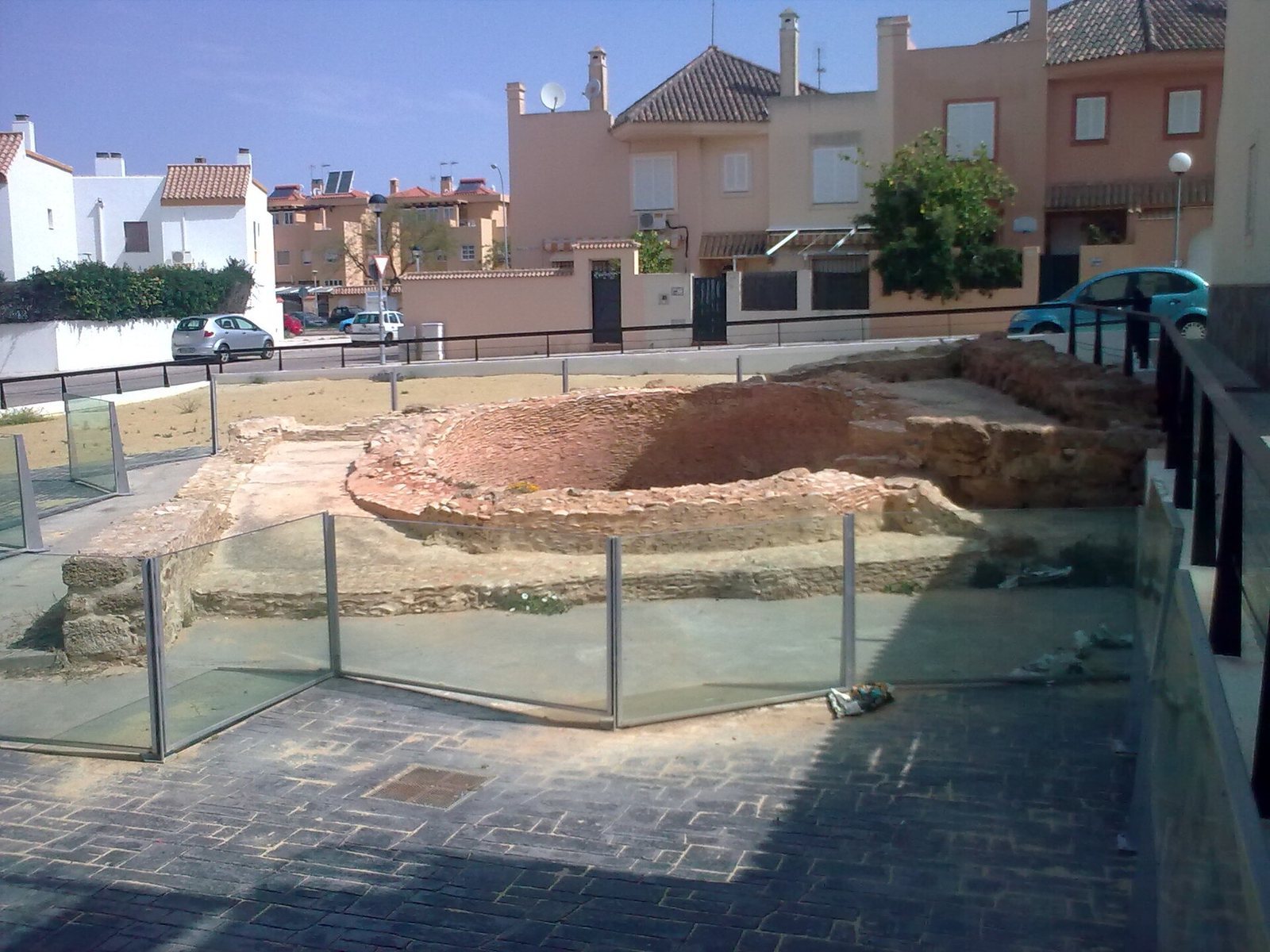
The remains lie near the coast, in an area connected to the El Trocadero tidal channel. At the western edge of Puerto Real’s urban area, the site includes two kiln locations, ceramic discard areas and small structures associated with pottery production. The kilns used circular designs with a grate supported from below.
The first kiln
The first kiln has a circular plan measuring 4.5 metres. Its combustion chamber lay below the firing chamber, with a perforated grate between them that allowed heat to reach the vessels without exposing them directly to the flames. A central pillar supported the grate, with arches extending from the pillar. About 15 centimetres of the pillar remains visible.
A southern passage provided access to the combustion chamber, while the firing chamber had a simple entrance on the east. Three surrounding walls or supports may have helped protect the kiln from wind and carry its structure. The kiln is classified as Cuomo I A, a type of circular kiln with a centrally supported grate. Ceramic fragments laid horizontally were reused in its walls, which also incorporated brick or rubble stonework in places. The structure may have been partly dug into the ground and then covered with ceramic fragments.
Second kiln and production area
The second kiln had a structure similar to the first, but survives only to the level of its grate. Nearby, small rectangular structures have an uncertain function, and discard areas are associated with pottery production.
Amphorae and marks
Numerous amphorae are associated with the kiln remains. Graffiti appear on the pointed bases of some vessels. One mark within a circular frame has been read as “OETR S”; “SPERTI” is an alternative reading.