Castillo de San Marcos: A Church-Fortress in El Puerto de Santa María


Site at a Glance
- Rating
- 4.4
- Popularity
- Medium
- Country
- Spain
- Primary era
- Medieval
- External website
- Open
- Eras represented
- Medieval
- Civilizations
- Almohad, Crown of Castile
- Site type
- Military
- Remains
- Castle
On this page8 sections
History
Castillo de San Marcos is a church-fortress in El Puerto de Santa María, Spain, developed from an Almohad mosque around 1264 after Alfonso X the Wise conquered the city. The thirteenth-century complex combined Christian worship with military defense, and Alfonso ordered the mosque converted into a church dedicated to the Virgin. Its foundations incorporated remains from a nearby Roman building.
Castilian conquest and religious foundation
Alfonso X, the thirteenth-century king of Castile and León known for supporting religious, legal, literary, and scholarly works, installed the military order of Santa María de España in the church. This order combined religious commitments with military functions, but it soon disappeared after merging with the Order of Santiago. The circumstances of the church-fortress’s creation were preserved in the Cantigas of Alfonso X, a medieval collection of songs that includes many poems about the Virgin Mary.
As a fortress, San Marcos helped defend the town against further invasions from North Africa. The city entered the Crown of Castile in 1264, while ownership of the castle remained with the House of Medinaceli, a major Spanish aristocratic lineage. Sancho IV later gave the castle and town to the Genoese admiral Benedetto Zaccaria. The property then passed to Alonso Pérez de Guzmán, known as Guzmán el Bueno, who gave it to his daughter Leonor de Guzmán in 1306 when she married Luis de España. This transfer began the House of Medinaceli’s lordship over the town, later represented by Isabel de la Cerda y Guzmán.
Expansion and changing importance
The complex was enlarged during the fifteenth century. During Luis de la Cerda’s tenure, Christopher Columbus, Juan de la Cosa, and other prominent mariners were associated with the church-fortress. Juan de la Cosa was a Spanish mariner and cartographer linked with Atlantic exploration at the end of the fifteenth and beginning of the sixteenth centuries.
San Marcos later lost importance both as a sanctuary and as a fortress. Its religious role declined after a new church was built, while its defensive function also diminished. Fernán Caballero described the condition of the old castle-sanctuary in detail in her novel Un servilón y un liberalito, set in 1823.
Closure, restoration, and protection
The castle closed in 1868 and remained abandoned until restoration work during the 1940s. It was declared an architectural-artistic monument on 9 May 1920 and is protected as a Spanish cultural asset of historical heritage in the monument category. It also forms part of the Archaeological Site of El Puerto de Santa María. The local winery Bodegas Caballero currently owns the castle, which hosts an academic chair devoted to studies of Alfonso X and festivals of medieval music.
Remains
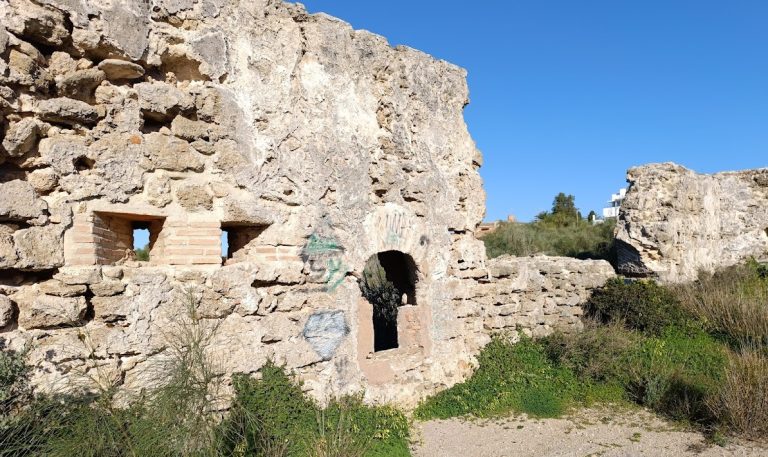
The surviving complex combines a church with a fortified enclosure built over the foundations of the former mosque. Its construction includes reinforced foundations, vaulted roofs, four defensive towers, and a terrace above the church vaults. This terrace functioned as the military courtyard, an open area used for movement and military activities, and connected with several other rooms in the castle.
Church and towers
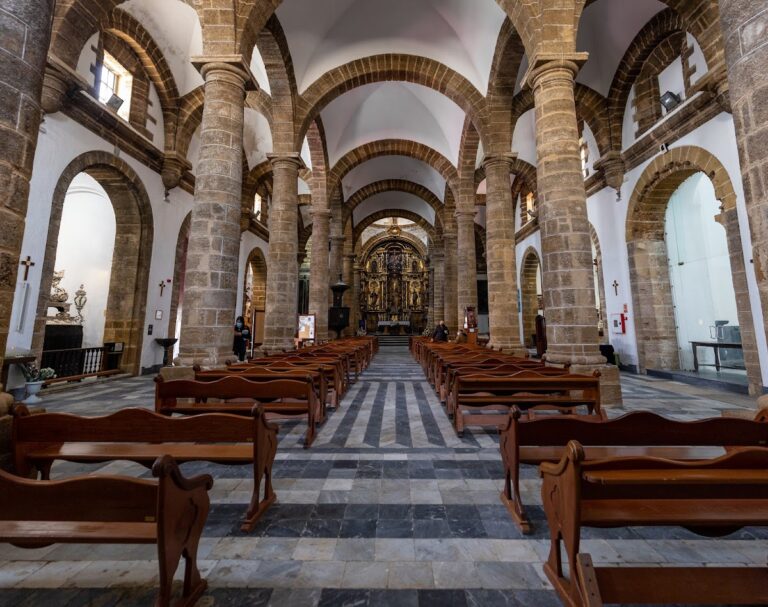
The four towers consist of two hexagonal towers and two square towers. The ground floors of the hexagonal towers formed the main chapel for the Virgin of Miracles, a Marian devotional title. The church retains four-sided esquifada vaults, which are formed by curved surfaces meeting above the space. The surviving qibla wall, the mosque wall oriented toward Mecca, contains the former mihrab, or prayer niche.
The building preserves an Almohad character in its smooth horizontal lines and in the projecting upper band that crowns the exterior of the hexagonal tower. These features remain integrated with the later Christian church and defensive arrangements, reflecting the transformation of the earlier Islamic structure into a fortified place of worship.
Fifteenth-century additions
The fifteenth-century work added a sacristy divided into three bays and covered by Gothic vaults. Additional rooms opened from the military courtyard, extending the internal organization of the complex beyond the original church and tower arrangement.
Setting and associated memorial
Castillo de San Marcos stands at approximately 13 metres above sea level in terrain described as flat and predominantly grassland, with the sea to the southwest. A nearby corner associated with the castle contains a bust of Juan de la Cosa and a small fountain displaying a replica of his map.