Claros: An Ancient Greek Sanctuary and Oracle in Ionia
Site at a Glance
- Popularity
- High
- Country
- Turkey
- Primary era
- Classical
- Eras represented
- Iron Age, Classical
- Civilizations
- Ancient Greek, Roman
- Site type
- Religious
- Remains
- Sanctuary
On this page16 sections
History
Claros was an ancient Greek sanctuary and oracle at Ahmetbeyli, Türkiye, in Ionia, within the territory of Colophon, one of the twelve Greek cities in the Ionian League, an association of Ionian cities. Dedicated to Apollo under his local title Apollo Clarius, it became a major center of prophecy. Its foundation date is unknown, but structures existed by the tenth century BC. The later Temple of Apollo was built in the Hellenistic period, the era of Greek cultural and political influence following Alexander’s conquests, in the Doric order, one of the principal styles of Greek architecture.
Origins and early traditions
Greek foundation stories connected Claros with Manto, the prophetic daughter of the Theban seer Teiresias. In one version, after the Epigoni, legendary conquerors of Thebes, defeated the city, Apollo directed Manto and the surviving Thebans to sail to Ionia. A group of Cretans led by Rhacius captured them; he married Manto and allowed the newcomers to settle. Their heir was Mopsus, a seer associated with the oracle. Another tradition places the arrival of Achaean migrants from Crete in the late thirteenth or early twelfth century BC and credits Manto with establishing the oracle. Some ancient writers said that the local spring was formed by her tears.
Classical Greeks described the oracle’s beginnings as Minoan-Mycenaean, linking its legendary origins to two Bronze Age Aegean civilizations. The earliest literary reference to Claros appears in the Homeric Hymns, ancient religious poems, dating to the seventh or sixth century BC. Myth also placed the seer Calchas, a figure in stories of the Trojan War, at Claros. One tradition says he died there after losing a contest in prophecy to Mopsus; others say he travelled to Perge or connect him with the founding of Perge or Selge.
The oracle and its visitors
Tradition says the oracle advised Smyrna’s people to leave Old Smyrna and establish New Smyrna on Mount Pagos, now called Kadifekale. A related story recounts that Alexander the Great, the Macedonian king whose conquests reshaped the eastern Mediterranean, consulted Claros about a dream and received an interpretation that prompted the move. New Smyrna became one of Asia’s prosperous cities. The oracle later answered personal questions as well as inquiries from civic delegations, and it received visitors who were not Greek.
The oracle’s early association with Manto as a woman gave way to a succession of male seers. Its rituals centered on sacred water: a priest drank from a well while seeking Apollo’s answers. The Roman writer Pliny the Elder said that water from the cave pool gave a drinker the power to speak remarkable prophecies, but shortened their life. The Greek philosopher Iamblichus described the seer as speaking in an ecstatic state, without control or awareness of his words and surroundings.
Apollo’s annual Little Claria and five-yearly Great Claria festivals included sacred contests and sacrifices. Large offerings of a hundred animals, especially bulls, drew crowds of Greek and non-Greek worshippers. Claros’s arrangements for these sacrifices also preserve unusually clear evidence for how such rites could be carried out.
Hellenistic and Roman authority
After Rome established the province of Asia, a Roman administrative territory in western Asia Minor, in the late second century BC, prominent citizens of Colophon helped strengthen Claros’s religious authority, contests, and oracle. Its importance continued through the Hellenistic and Roman periods, and its renown appears to have reached a high point in the second and third centuries AD. Roman-period monuments are associated with the Roman generals and statesmen Pompey and Lucullus, and with the statesman Quintus Tullius Cicero. Some stood on foundations from the Hellenistic era.
In AD 18, the Roman general and imperial family member Germanicus visited the oracle, a year before his death. Its obscure response was understood as predicting that he would die young. By the second century AD, Claros’s reputation extended from North Africa to Britain, and the sanctuary continued to attract many visitors into the fourth century.
A late Hellenistic ship carrying marble to Claros sank near Kizilburun, off Türkiye’s southwest coast. Found in 1993 and excavated from 2005 onward, the wreck yielded an estimated 50 tonnes of marble columns. Their description matches columns associated with the temple at Claros. Isotopic and meteorological evidence points to Proconnesos, in the Sea of Marmara, as the marble’s source. The ship failed to complete the roughly 350-kilometre journey.
Abandonment and rediscovery
Claros was abandoned in the fourth century as Christianity spread. Archaeologist T. Macridy uncovered its monumental entrance in 1905 and returned in 1913 with the French archaeologist Charles Picard. Excavations led by Louis Robert from 1950 to 1961 brought Roman dedicatory monuments and the Temple of Apollo to light. J. de La Genière directed work on the Sacred Way in 1988, and later excavation removed much of the river-borne deposit that had covered the site.
A museum and archaeological park displaying casts of works from Claros was established in 2010. It was the first archaeological park of its kind in Türkiye.
Remains
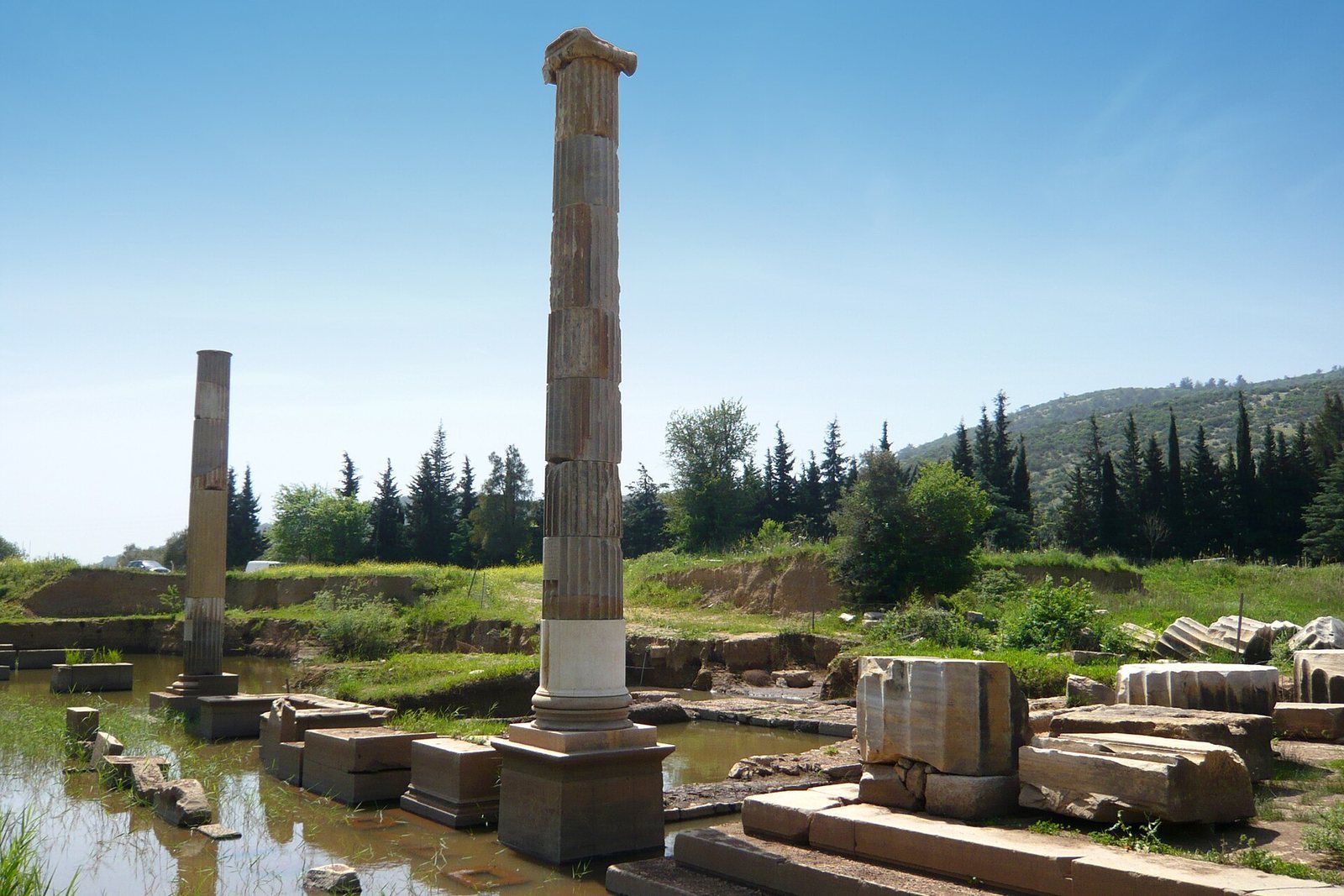
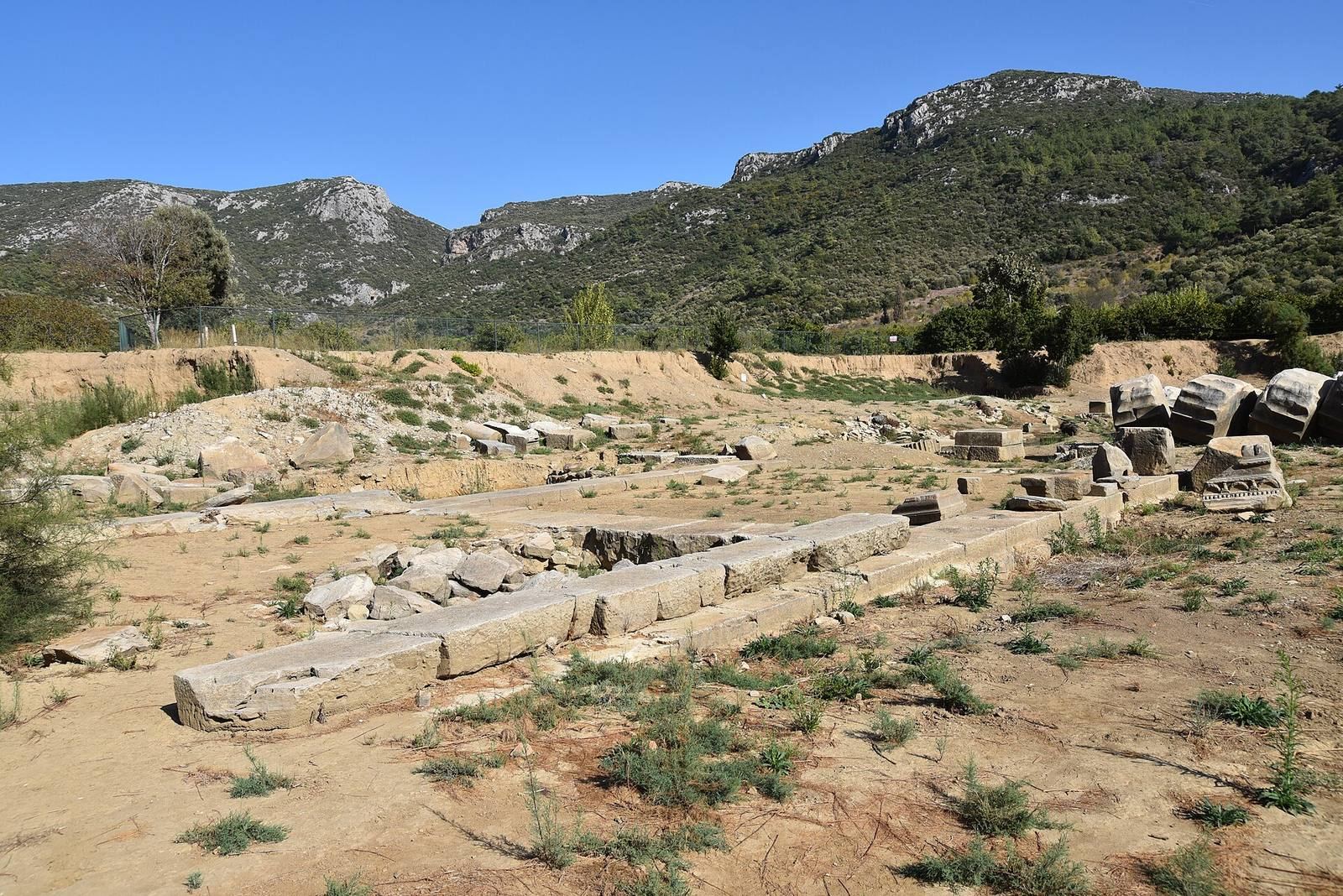
The sanctuary occupied the flat floor of the Ahmetbeyli valley, north of the modern town. Its religious area developed around a freshwater spring, with the Temple of Apollo and its altars among the principal structures. A small river carried silt across the valley, and deforestation in the hinterland during the first century BC contributed to deposits that buried Claros and affected the wider coastline.
Early cult area
Altars and spring temple
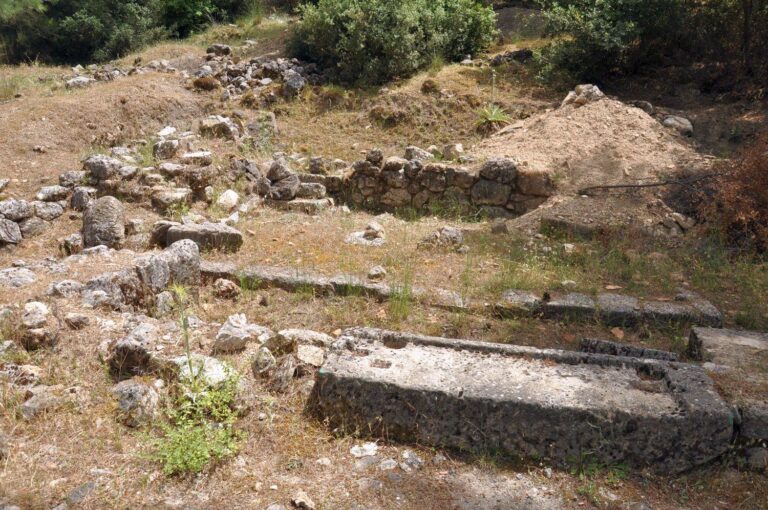
The earliest known construction is a circular altar from the second half of the seventh century BC. Around the middle of the sixth century BC, a large rectangular altar, measuring 14.85 by 6.05 metres, was built over it. A marble temple to Apollo was constructed around the spring at about the same time.
Artemis, the cave, and early statues
An early sanctuary area for Artemis, Apollo’s sister, included a small altar. Two bases for statues of young women were found beside it; one of the statues survives without its head. At least four statues of young men were dedicated to Apollo, and three incomplete examples were found. A cave near the Temple of Apollo is associated with an early cult of Cybele, a mother goddess worshipped in ancient Anatolia. The cave remained a feature of the sanctuary in Hellenistic and Roman times.
Hellenistic sanctuary
Temple and oracle chamber
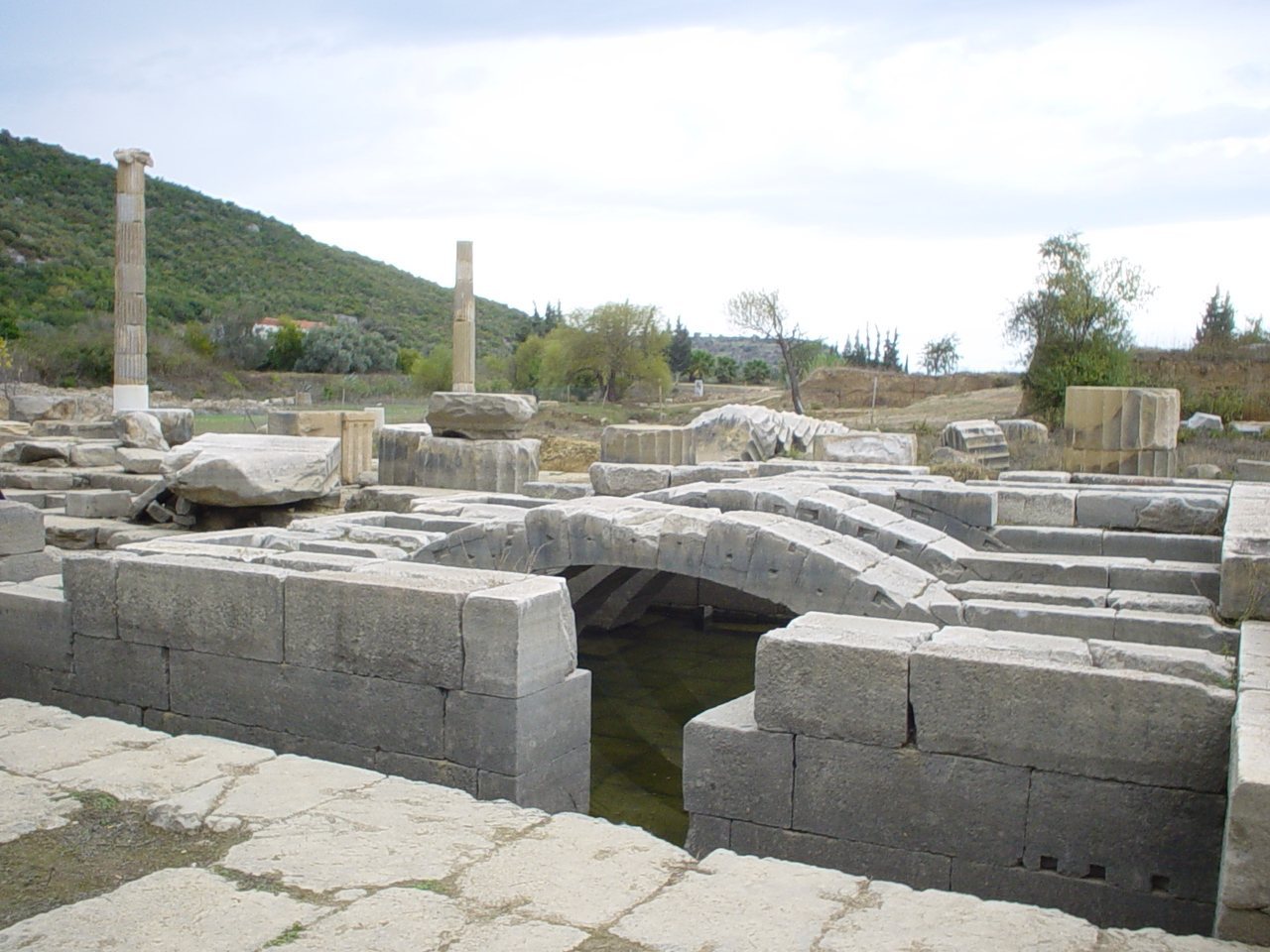
Little changed at Claros between the sixth and late fourth centuries BC. A large-scale redesign was planned, probably after the upheavals of the early third century BC, and construction of a new altar and Temple of Apollo began later in that century. The monumental temple served as the oracle’s seat, although its final Hellenistic phase remained unfinished. Its restricted inner chamber, where prophecies were delivered, was dark and crypt-like. Narrow, vaulted corridors with a winding layout survive in good condition.
Altar and animal-sacrifice installation
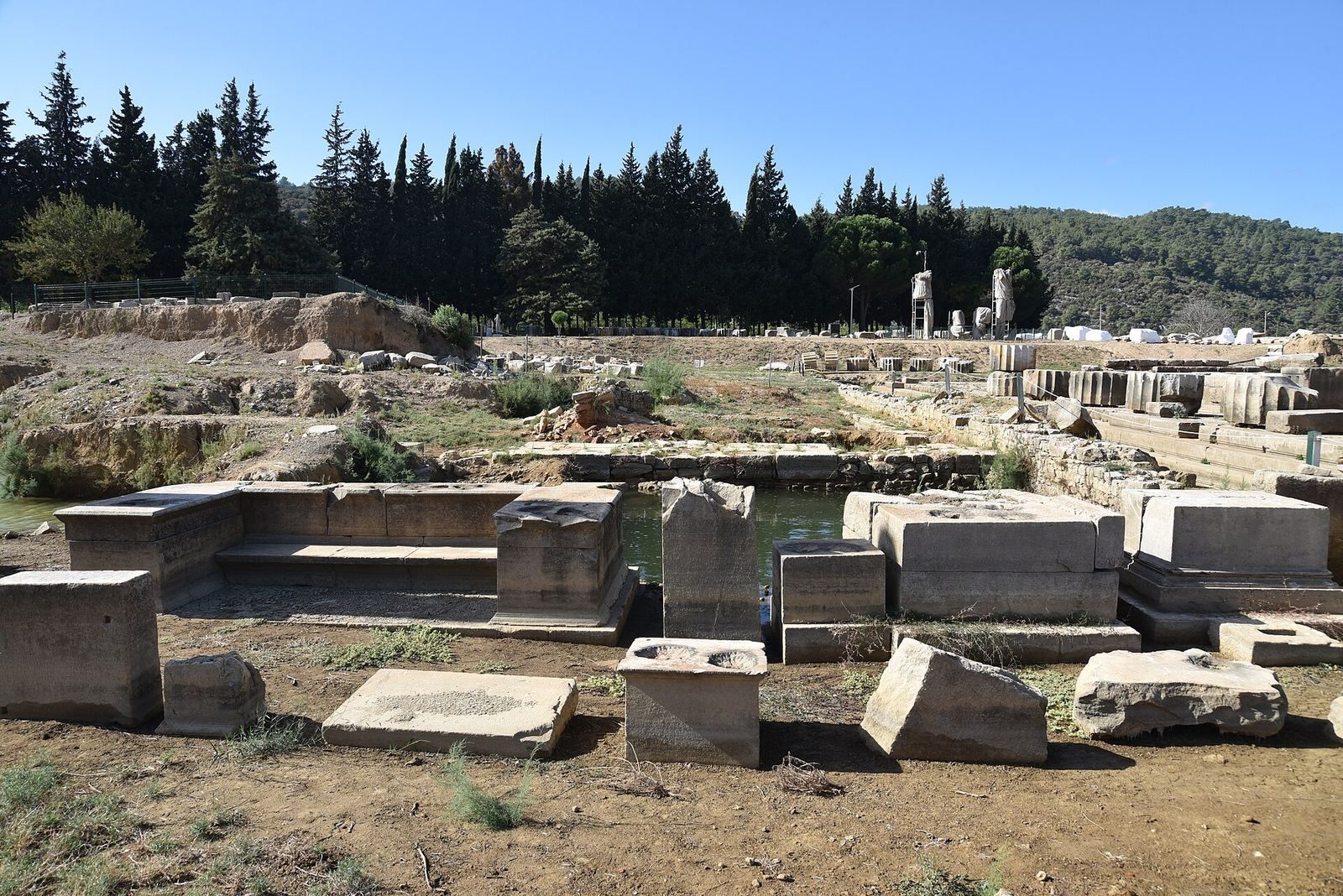
A separate altar measuring 9 by 18.45 metres stood 27 metres east of the Temple of Apollo. Between the temple and altar, 100 rectangular stone blocks were set in four rows running north to south. An iron ring on each block secured an animal, and the arrangement allowed a hundred victims to be sacrificed at once. Claros is the only sanctuary in the Greek world that provides a clear illustration of how priests could conduct a sacrifice of a hundred animals.
Roman-period structures, sculpture, and inscriptions
Temple of Artemis and entrance
The sanctuary also contains a Roman-period Temple of Artemis and its altar, a monumental entrance building, and several honorific monuments. These structures formed part of the sanctuary’s later built environment alongside the older religious buildings.
Colossal sculptural group
The surviving base and fragments of a colossal sculptural group show Apollo seated with a lyre, accompanied by his mother Leto and his sister Artemis, and facing east. The group is estimated to have stood more than seven metres tall. Some fragments have been partly reassembled at the site.
Inscriptions and excavated works
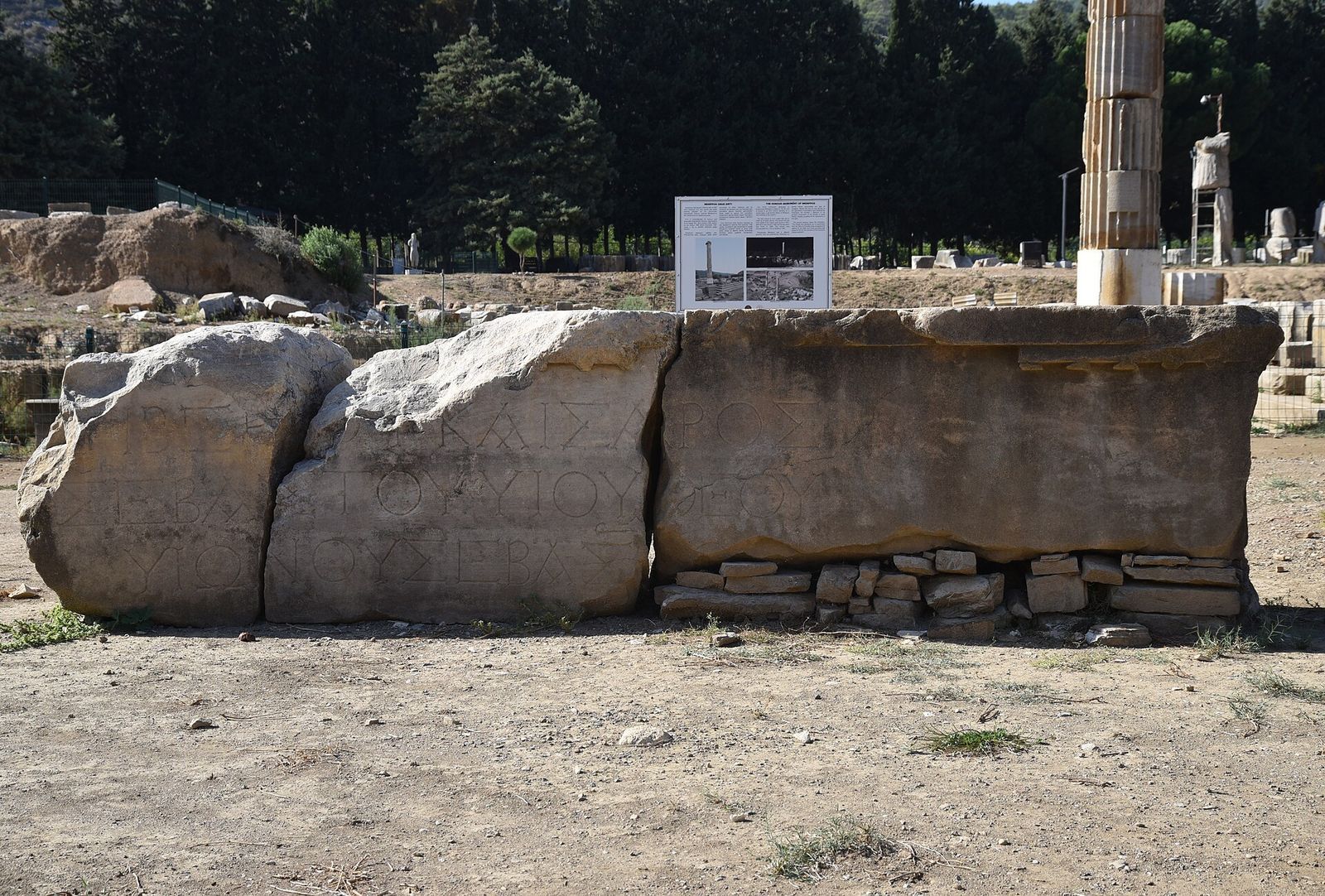
Dedication and memorial inscriptions naming visitors appear on columns, steps, walls, and a curved marble bench. Together, the inscriptions form the largest surviving assemblage of Greek inscriptions. The bench has serpent-shaped armrests, thought to evoke the underworld associations of oracles and possibly to recall the myth of Apollo’s defeat of Python, a serpent in Greek mythology. Claros is the only sanctuary whose temple steps are inscribed.
Excavations also recovered reliefs and statues now displayed at the İzmir Archaeology Museum. A statue of Homer, the traditional name associated with the Iliad and the Odyssey, supports the tradition that he came from Claros. The archaeological park’s displays include casts of 13 works from the sanctuary, made to correspond to the originals.