Latin Bridge: An Ottoman Stone Bridge in Sarajevo
Site at a Glance
- Popularity
- Very High
- Country
- Bosnia and Herzegovina
- Primary era
- Early Modern
- Eras represented
- Early Modern, Modern
- Civilizations
- Ottoman
- Site type
- Infrastructure
- Remains
- Bridge
On this page13 sections
History
The Latin Bridge is an Ottoman-era stone bridge over the Miljacka River in Sarajevo, Bosnia and Herzegovina. Its early history is tied to the city’s sixteenth-century growth under Ottoman rule, while its best-known historical association is the 1914 assassination of Archduke Franz Ferdinand and Sophie nearby.
The bridge and Sarajevo’s sixteenth-century growth
Sarajevo expanded rapidly in the early sixteenth century under local governors, including Mehmed-beg Minetović, Ajaz-beg, Firuz-beg and, especially, Gazi Husrev-beg, an Ottoman governor of Bosnia. New building in Latinluk and Bistrik created a need for a crossing between the districts. The Latin Bridge was the third known bridge built in Sarajevo, after the Careva and Skenderija bridges.
The bridge takes its name from Latinluk, a Catholic quarter whose name was associated with the Latin spoken by monks travelling to a nearby monastery. Ottoman records also called the quarter Frenklul and referred to the bridge as the Frenkluk Bridge. People arriving from Dubrovnik, including Croatian workers, craftsmen, merchants and artisans, settled in Latinluk, particularly during the nineteenth century. Later, most residents were Catholics from Sarajevo.
A 1541 census names Hussein, son of Sirmerd, a leatherworker who built a bridge in the neighbourhood of Mehmed-beg Minetović. The entry does not say whether it was wooden or stone, and its identification with the present bridge’s site is probable, not certain. A 1565 record indicates that Ali Ajni-beg had built a stone bridge there. Hadži Alija Turalić contributed 410 akçe, an Ottoman currency unit, toward its construction.
Damage and rebuilding in the eighteenth century
One of the arches beside the bank was destroyed in 1739. A Sarajevo judge requested repairs, and the Bosnian provincial governor approved funding. On 15 January 1789, another arch collapsed and killed a horse on the bridge. Repairs followed soon afterward.
A flood on 15 November 1791 badly damaged the crossing and left it unusable. Work did not begin for six years, probably in part because economic crisis and war had made materials and skilled workers scarce. The Sarajevo merchant Hadži Abdullah-aga Briga had left one-third of his estate to charity. On 13 December 1797, prominent Sarajevans proposed using this bequest to rebuild the bridge. The work in 1798 gave the crossing its basic present form. Two houses with shops were also built beside it, with their income intended to pay for future repairs. A numerical interpretation of Briga’s name has also been linked to a date of 1798 or 1799.
Widening and the 1914 assassination
Heavy traffic led to changes in 1886. At that time, a stone chronogram, an inscription whose letters can be read as numbers to express a date, was removed from the bridge and placed in the National Museum. It recorded the reconstruction and had been composed by Sarajevo judge Mehmed Emin Isević.
On 28 June 1914, Gavrilo Princip, a Bosnian Serb nationalist, shot and killed Archduke Franz Ferdinand, heir to the Austro-Hungarian throne, and his wife Sophie near the bridge’s northern end. The assassination precipitated the July Crisis, a diplomatic confrontation that led to the First World War. At his judicial hearing on 12 October 1914, Princip described going to the Latin Bridge after Nedeljko Čabrinović’s failed bomb attack near Ćumurija Bridge, about 200 metres downstream. He said he learned the attack had failed, later took up a position along the route and fired at Ferdinand from four or five paces.
Memorials, renaming and protection
The Austro-Hungarian government installed a plaque in 1916 that described Princip as a murderer. The following year, a memorial of two pillars, each 12.19 metres high, was erected on the river’s right bank near the bridge’s left end. It honoured Franz Ferdinand and a woman identified either as his mother, Maria Annunziata, or his wife, Sophie. A concrete bench stood opposite. The pillars disappeared around the fall of Austria-Hungary, either through the empire’s collapse or their removal by the Yugoslav government in autumn 1918. Fragments were held in a museum before being concealed in three locations in the 1960s or 1970s.
After 1918, the bridge was called Princip’s Bridge. The Serbian political elite of the Yugoslav kingdom, a South Slavic state that included Bosnia and Herzegovina, celebrated Princip as a hero of Greater Serbia. That national idea advocated a Serbian state extending into territories beyond Serbia’s borders where Serbs lived. German forces and the Croatian Ustaša movement, which governed the Independent State of Croatia during the Second World War, restored the name Latin Bridge during their occupation of Bosnia from 1941 to 1945. After the war, Yugoslavia’s socialist government again named the bridge for Princip.
During the 1930s, a black-marble plaque with gilded lettering stated that Princip had proclaimed freedom there on St. Vitus Day, 28 June 1914. German occupying forces and Ustaša members removed it on 20 April 1941 and sent it to Adolf Hitler as a birthday gift. It entered the war-booty collection at Berlin’s Zeughaus and later disappeared during the bombing of Berlin. A postwar plaque on a nearby building’s façade was destroyed or removed during the 1992–1996 siege of Sarajevo and later replaced by a more neutral version.
In the 1980s, the bridge gradually became associated with Serbian nationalist aspirations in Sarajevo. During a televised parliamentary debate in February 1991, a supporter of Bosnia and Herzegovina’s independence argued that an independent state should not name the bridge after a terrorist. The historic name returned in April 1992, during the first days of the siege, which also damaged the bridge. It was placed on Bosnia and Herzegovina’s provisional national-monument list on 2 July 1999 and declared a national monument in September 2004.
Remains
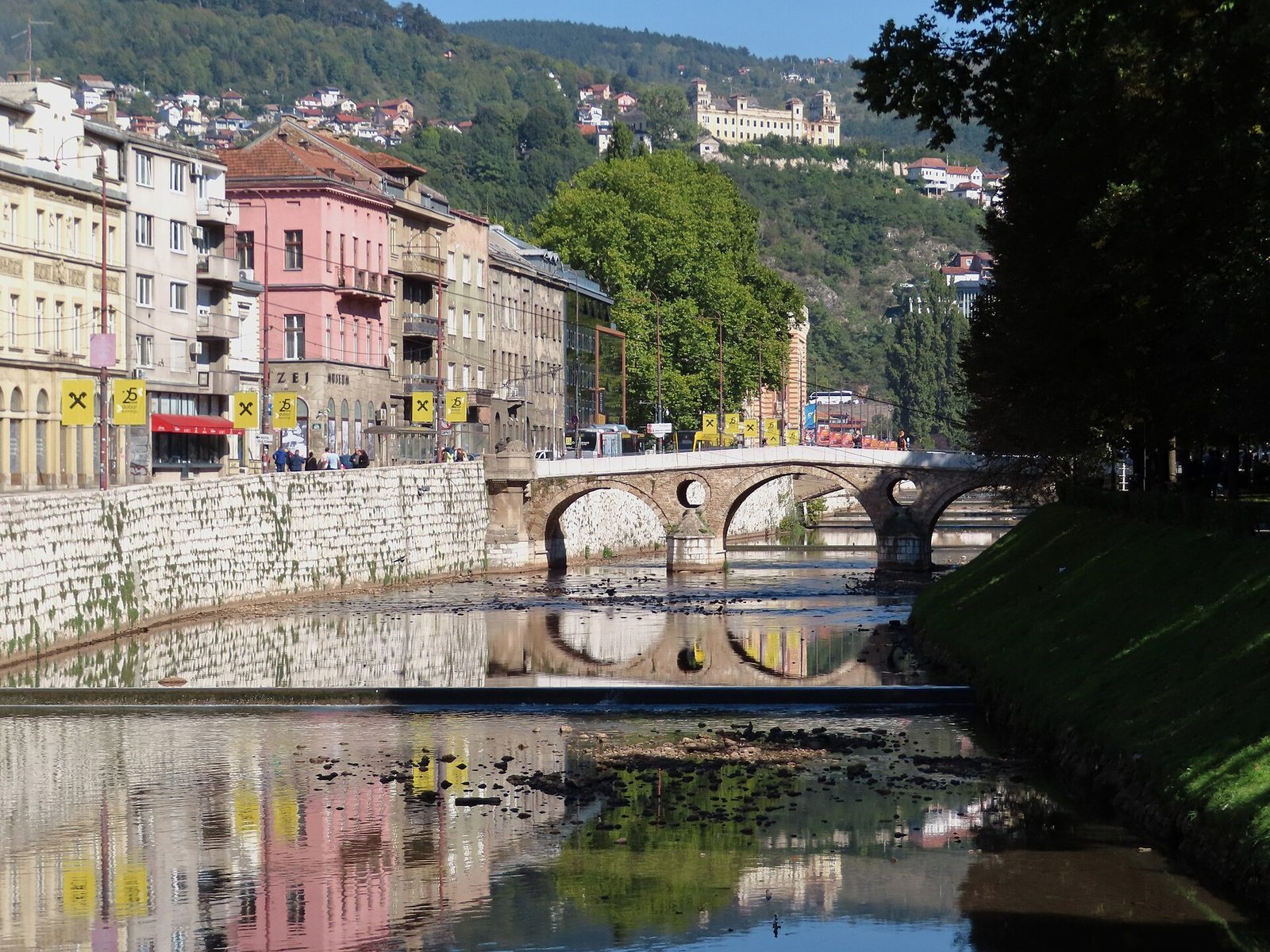
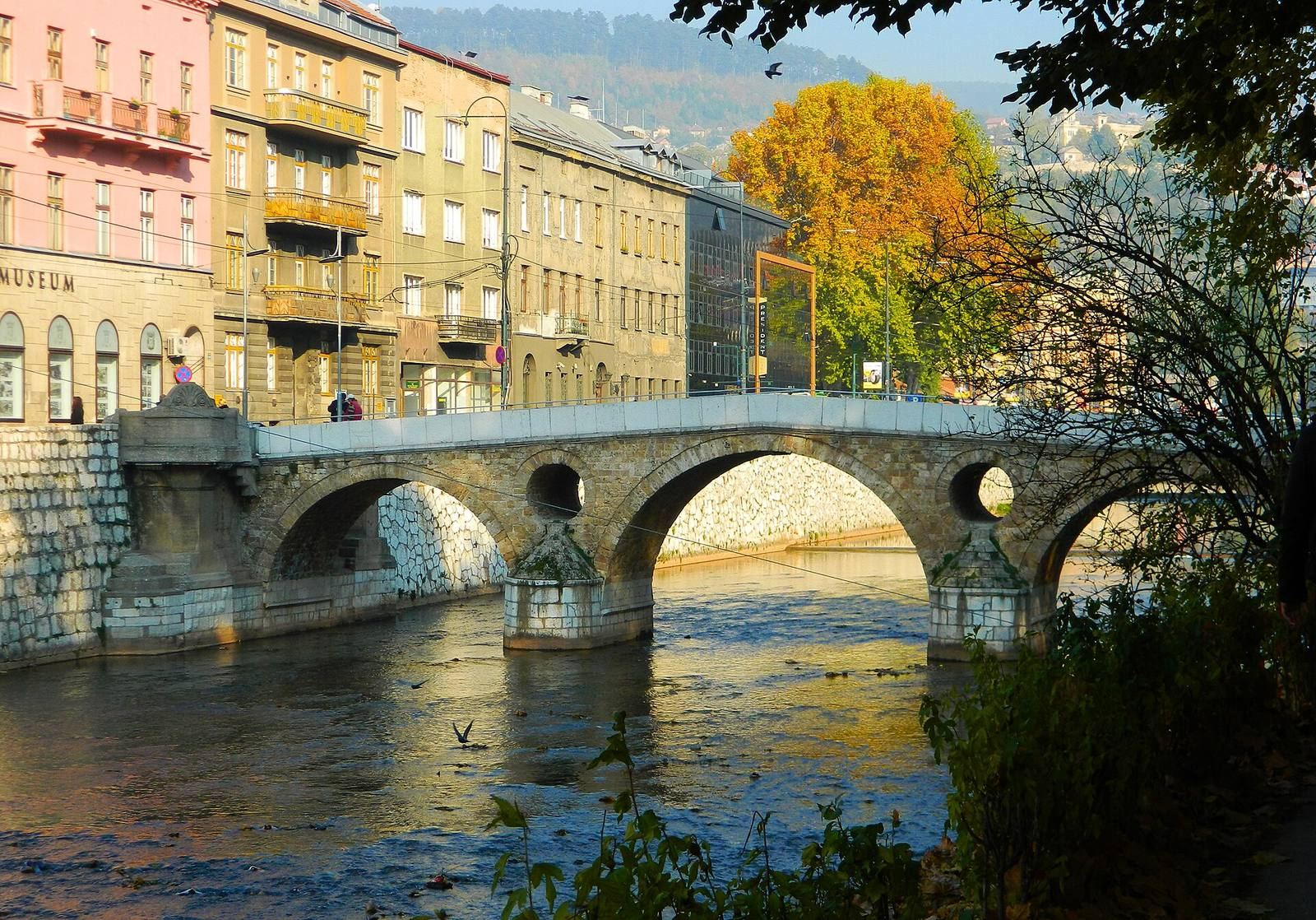
The bridge is a stone crossing in Sarajevo’s Stari Grad district, near the Baščaršija bazaar. Its surviving form has four semicircular arches carried by three piers in the river, with supports at the banks. It is Sarajevo’s oldest preserved bridge, one of the city’s twelve stone bridges and one of its three surviving multi-span bridges.
Bridge form and masonry
The surviving bridge is 39.2 metres long. Its layout, masonry and arch profiles give a clear picture of its Ottoman-era construction, while later changes are visible in its widened pedestrian surfaces.
Arches and dimensions
From left to right, the four arch spans measure 6.20, 6.80, 8.40 and 7.00 metres, making the third span the longest. The surviving structure on the left bank is 3.00 metres wide. The first pier is also 3.00 metres wide, while each of the other two is 2.40 metres wide. The vertical masonry between the arch bases and crowns measures 2.43, 2.61 and 2.76 metres in height from left to right.
The bridge now appears asymmetrical, with the highest point of its arches nearer the right bank. Its original arrangement was symmetrical, with five arches rising evenly toward the centre. Embankment work removed one arch, while the arch on the right was apparently covered by the bank to regulate river flow. If the earlier bridge also had an extra pier and longer approaches, its original length may have exceeded 50 metres.
Piers and openings
The river piers have pointed projections facing upstream and rounded ones downstream. The upstream projections end in pyramid-shaped caps of ordinary stone. Downstream, their ends are blunt and horizontal, built from small polygonal stones. Simple profiled stone edging marks the change between vertical and sloping faces, and rounded projections also appear on the piers’ vertical sides.
Two circular openings, each 1.60 metres in diameter, pass through the upper parts of the central and right-hand piers. Their inner surfaces are lined with travertine, a calcium-carbonate deposit, laid in a radial pattern. The openings are probably decorative rather than structural. Their form is represented by the white arch in Sarajevo’s coat of arms.
Materials and later fabric
White Sarajevo limestone forms the lower sections of the piers and arches. Tuff, a rock made from compacted volcanic material, was used for much of the masonry above water, including the pier heads and large areas of the arches and walls. Limestone was also used for the arch facings and cornices; stone and plaster are additional construction materials. The bridge’s architectural and structural character resembles that of the somewhat later Šeher-Ćehaja Bridge.
Traffic changes in the late nineteenth century widened the bridge and added pedestrian walks on projecting supports, along with granite paving and an iron railing. The crossing is now used by pedestrians.
Restoration and archaeological evidence
Conservation, restoration and partial rebuilding took place in 2003–2004. The work revealed evidence of the earlier five-arch arrangement, including nearly intact fragments of a rounded projection beneath asphalt, soil and embankment layers. An Ottoman-period cobbled surface lay below the present one, and fragments of a garland ornament were found along the bridge.
Riverbank setting
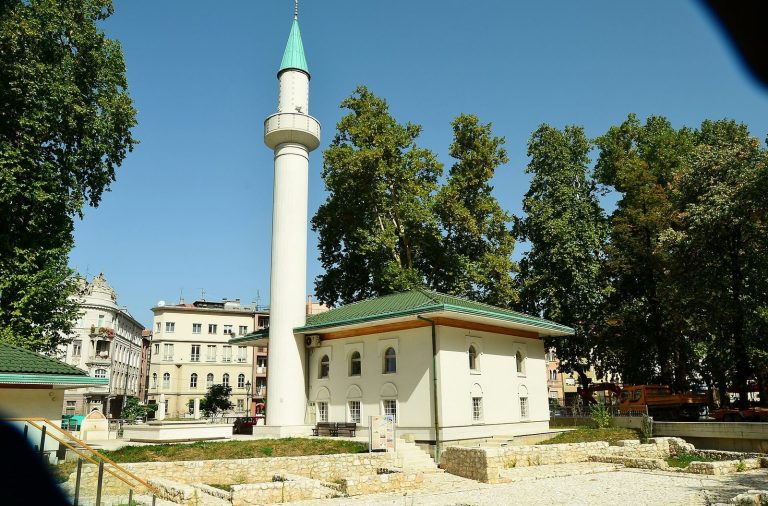
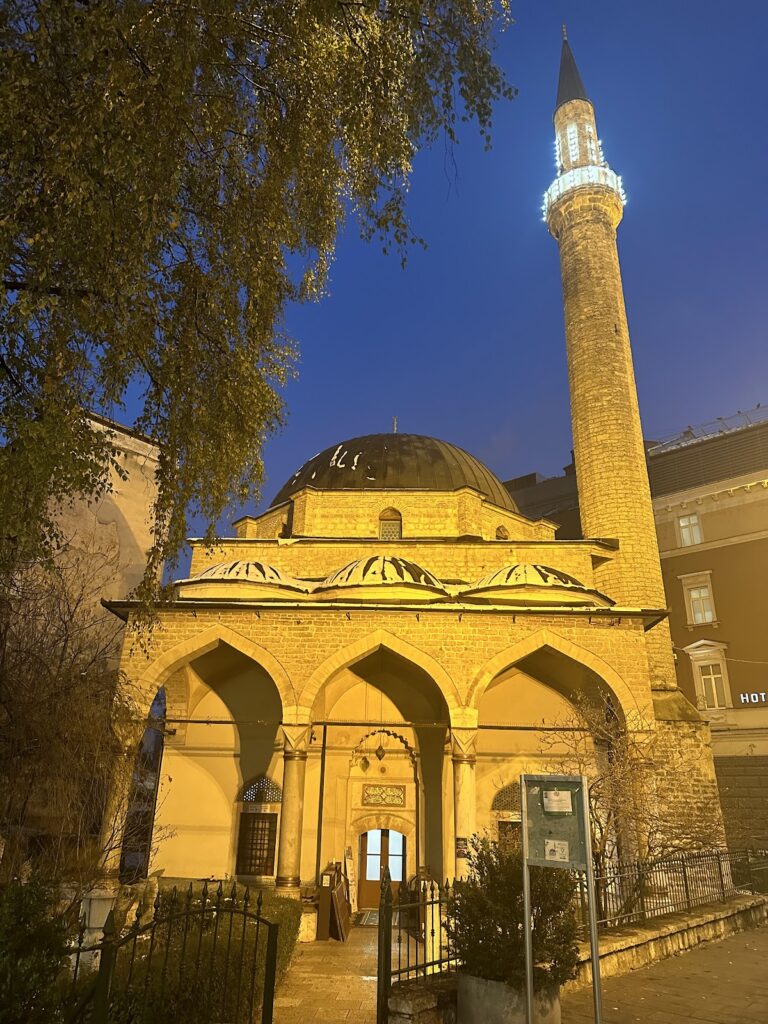
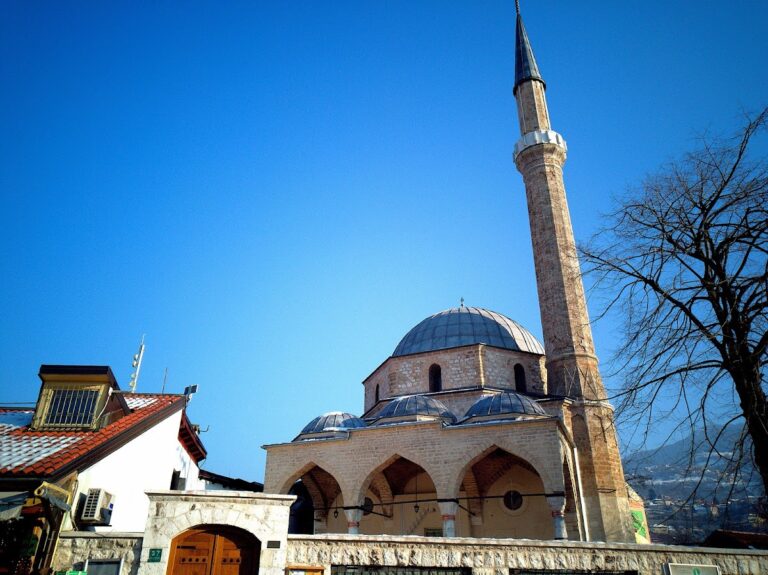
Latinluk lay on the Miljacka’s left bank between the Latin and Ćumurija bridges. Mejdan Park and its archaeological area are also on that bank, between the two crossings. The surrounding urban setting includes the Seven Brothers tomb sanctuary and Hadži Sulejman Čokadžija Mosque on the left bank, and Ferhat Pasha Mosque and the Dubrovnik merchants’ settlement on the right.
Assassination memorial remains
A nearby building’s façade carries the later, more neutral plaque commemorating the assassination. The base of the 1917 pillar memorial may remain at the bridge end, although its location is uncertain.