Gazi Husrev-beg Mosque: Sarajevo’s Principal Congregational Mosque


Site at a Glance
- Rating
- 4.8
- Popularity
- Medium
- Country
- Bosnia and Herzegovina
- Primary era
- Early Modern
- External website
- Open
- Eras represented
- Early Modern, Modern
- Civilizations
- Habsburg, Ottoman
- Site type
- Religious
- Remains
- Mosque
On this page9 sections
History
Gazi Husrev-beg Mosque is a Sunni mosque in Sarajevo, Bosnia and Herzegovina, built by the Ottoman administration in 1530–1531 in the Early Classical Ottoman period. It became Sarajevo’s central mosque after its completion and remains the principal congregational mosque for Muslims in Bosnia and Herzegovina. Regarded as one of the most representative Ottoman buildings in the Balkans and the largest historical mosque in Bosnia and Herzegovina, it continues to serve as an important religious and civic landmark.
Foundation and Ottoman development
Gazi Husrev-beg, the Ottoman governor of Bosnia, founded the mosque as the central building of his waqf, an Islamic charitable endowment whose property revenues support religious or public institutions. The endowment also included a maktab, an elementary Islamic school, a madrasa for advanced religious education, a bezistan or covered market, a hammam or public bath, shops, and inns. Together, these institutions contributed decisively to Sarajevo’s urban development.
The architect is uncertain. Most scholars regard Acem Esir Ali, also known as Alaüddin, an Ottoman architect of Persian ancestry, as the probable builder. Mimar Sinan, the chief Ottoman imperial architect of the sixteenth century, has also been proposed and may have inspected the work while he was in the region. Masons from the Republic of Ragusa took part after Gazi Husrev-beg requested their participation from the Ragusan government.
The mosque takes its name from Gazi Husrev-beg, whose burial lies in the adjoining mausoleum. Its religious traditions include reciting the call to prayer without loudspeakers and completing a Quran recitation each day after the noon prayer, following the founder’s instructions. During Ramadan, Quran-reading circles and evening Tarawih prayers continue to be held there.
Damage, restoration, and continued use
In 1697, Sarajevo was set on fire by forces led by Prince Eugene of Savoy, and the mosque was damaged in the destruction. Restoration followed in 1739. During the Siege of Sarajevo from 1992 to 1995, Serbian forces deliberately targeted cultural institutions, including mosques, and Gazi Husrev-beg Mosque suffered extensive damage. Reconstruction began in 1996 with foreign assistance, chiefly from Saudi sources.
During the Austro-Hungarian period, the mosque received electric lighting in 1898, becoming the first mosque in the world to do so. Its postwar reconstruction also changed the interior decoration. The former Austro-Hungarian decorative layer was removed, and a new interior was designed and applied in 2001–2002 by the Bosnian calligrapher Hazim Numanagic. The mosque is a National Monument of Bosnia and Herzegovina and remains active.
Remains
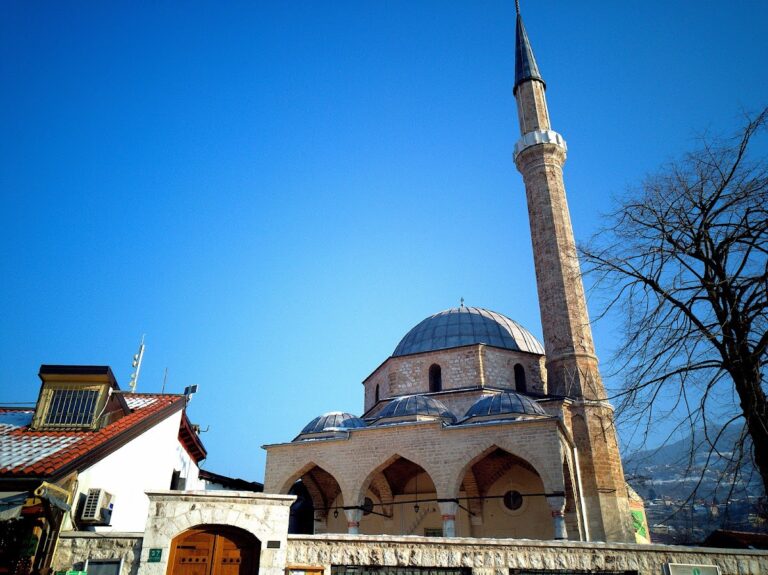
The mosque is an Ottoman multi-domed building in the Early Istanbul style. Its central rectangular prayer space is enclosed by high walls and covered by a dome carried on pendentives, curved structural elements that transfer the dome’s weight to the corners of a rectangular room. Lower extensions widen the interior around this central volume. The building has nine domes in all, with the main dome rising approximately 26 metres and measuring about 13 metres in diameter.
Prayer hall and qibla extension
The qibla, the direction of prayer toward Mecca, is marked by a rectangular extension on the far side of the central space. A semi-dome covers this area, supported by two elaborate muqarnas structures. Muqarnas is three-dimensional ornament made from tiered, niche-like forms that also helps shape architectural transitions. The arrangement narrows the rectangular plan toward an almost semicircular form beneath the semi-dome.
Within the qibla extension are the mihrab, which marks the direction of prayer, the minbar used for sermons, and the kursi, a stand or seat for religious instruction or Quran recitation. The extension opens into the central area through a large arch. At the opposite end, two smaller side spaces called tetima occupy the sides farthest from the qibla. Each is covered by a lower dome resting on pendentives.
Entrance and exterior features
Portal and portico
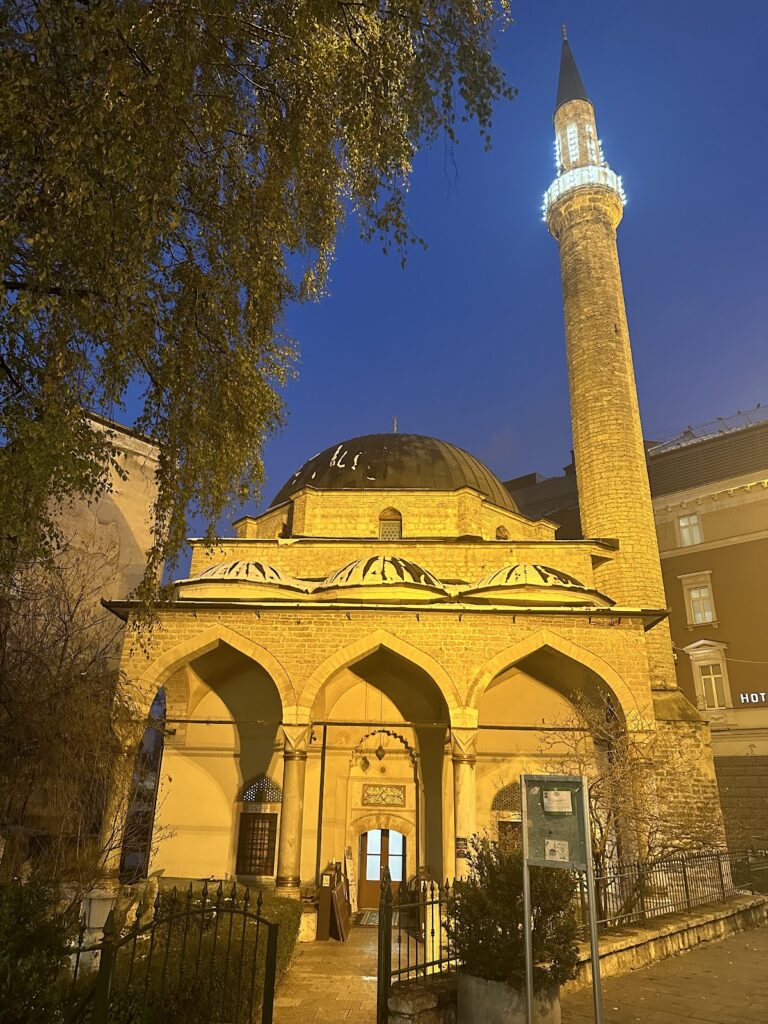
The entrance side has a portico supported by four broad columns and covered by small domes. The dome above the portal is slightly larger than the others and rests on pendentives decorated with muqarnas, while the remaining domes use plain pendentives. The monumental portal has rich muqarnas decoration, and its column capitals are ornamented as well. Austro-Hungarian decoration in a largely pseudo-Moorish style survives on the portal, while the later interior calligraphy belongs to the postwar reconstruction.
Minaret
A single monumental minaret dominates the exterior beside the principal dome. It rises approximately 47 metres and forms the mosque’s main vertical element.
Mausoleum and clock tower
The adjacent mausoleum contains the burial of Gazi Husrev-beg. A historic sixteenth-century clock tower also stands beside the mosque within Sarajevo’s principal market area, placing the religious complex among the structures of the city’s central commercial district.