First Ancient Theatre: A Hellenistic Theatre in Larissa, Greece
Site at a Glance
- Popularity
- High
- Country
- Greece
- Primary era
- Classical
- Eras represented
- Classical
- Civilizations
- Kingdom of Macedon, Roman
- Site type
- Entertainment
- Remains
- Theatre
On this page16 sections
History
Early Hellenistic theatre
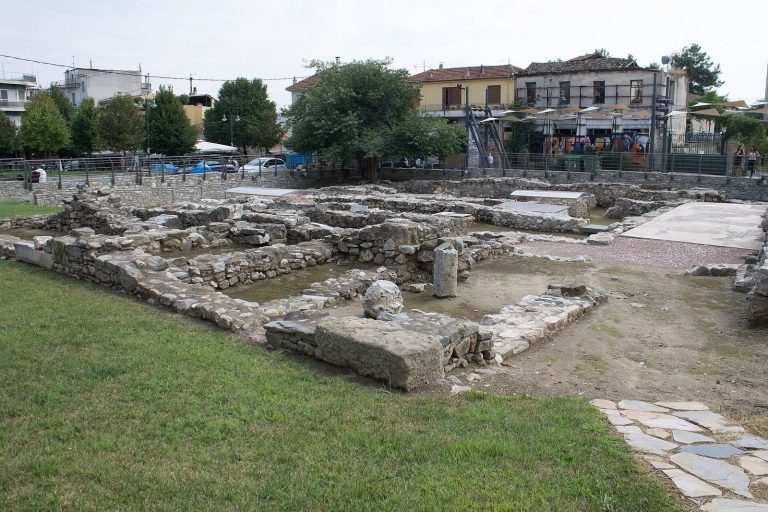
The First Ancient Theatre is an ancient Greek theatre on the southern slope of Frourio Hill in Larissa, Greece. Built around 300–250 BC in the early Hellenistic period, it served a city that was the central seat of the Thessalian League, a regional political federation.
The theatre hosted dramatic performances, musical activities, and meetings of the League. It also had a religious association with Dionysus, the Greek god of theatre, wine, and ecstatic rites. Alterations to the theatre, including its stage building, took place around 200–150 BC.
Roman use and decline
In the late first century BC, the theatre was converted into a Roman arena for spectacles that included gladiatorial contests and animal shows. An earthquake damaged the building in the late first or early second century AD, but it remained in use until about the third century, when performances had shifted to Larissa’s smaller Second Theatre.
Destruction and later burial
A later earthquake almost completely destroyed the theatre in the seventh century AD. Upper parts of the ruins were still visible in the nineteenth century, but the 1868 earthquake buried them beneath debris from newer buildings. Buildings were subsequently erected over the site.
Excavation and recognition
Excavations began in 1910, by which time parts of the stage had been found. Fragments of the upper theatre came to light in 1968. In 1985, modern buildings and two main streets still occupied the site. Some buildings were demolished in the late 1980s, and further buildings and streets were cleared during the 1990s to make excavation possible. A wider excavation campaign ran from 1990 to 2000, and the stage was fully exposed in 2004. Conservation work has taken place since 2010.
In 2014, the theatre was included on Greece’s UNESCO World Heritage Tentative List with 15 other ancient theatres. A Tentative List identifies places a country may consider nominating for the World Heritage List; inclusion does not itself confer World Heritage status.
Remains
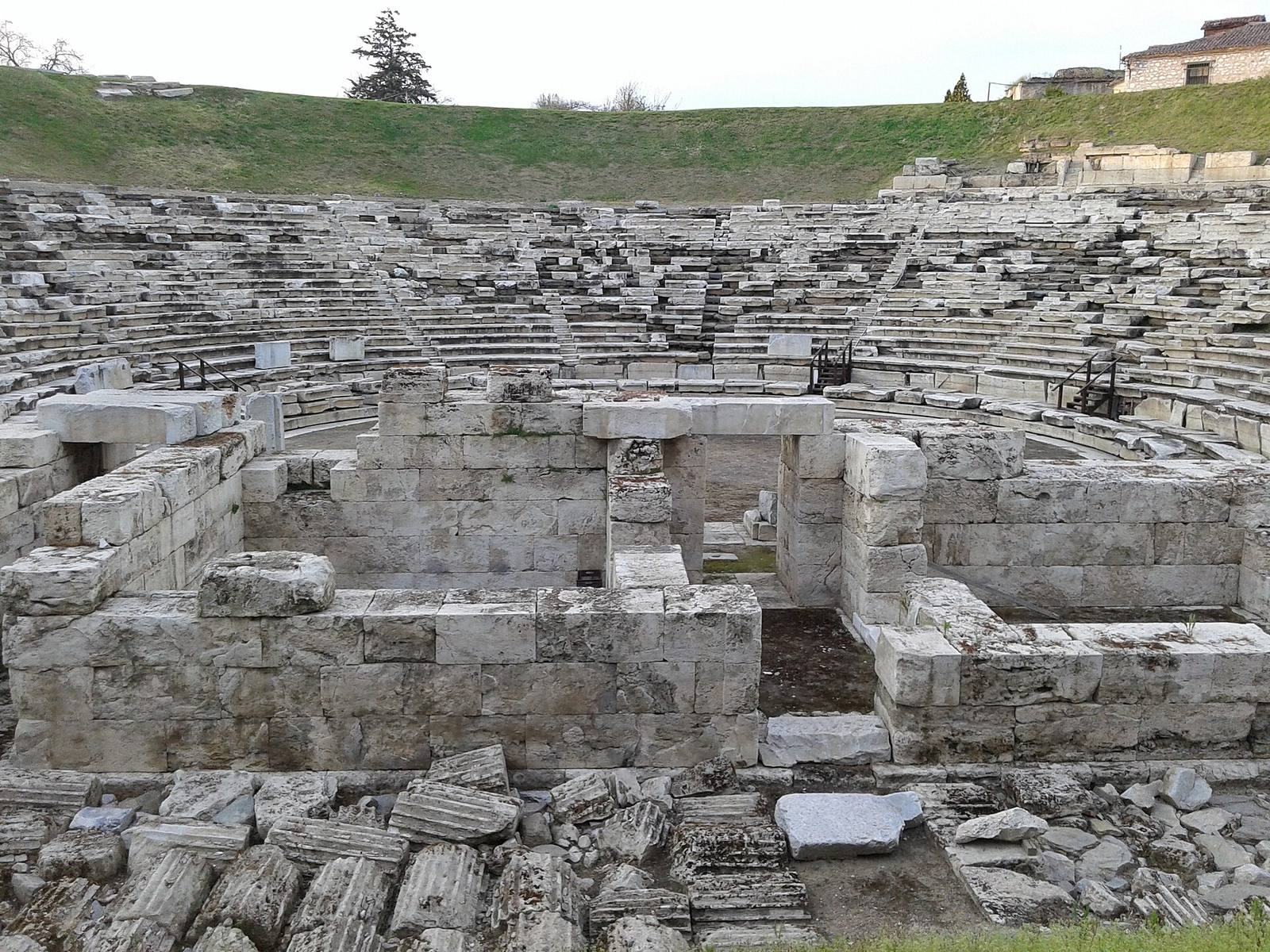
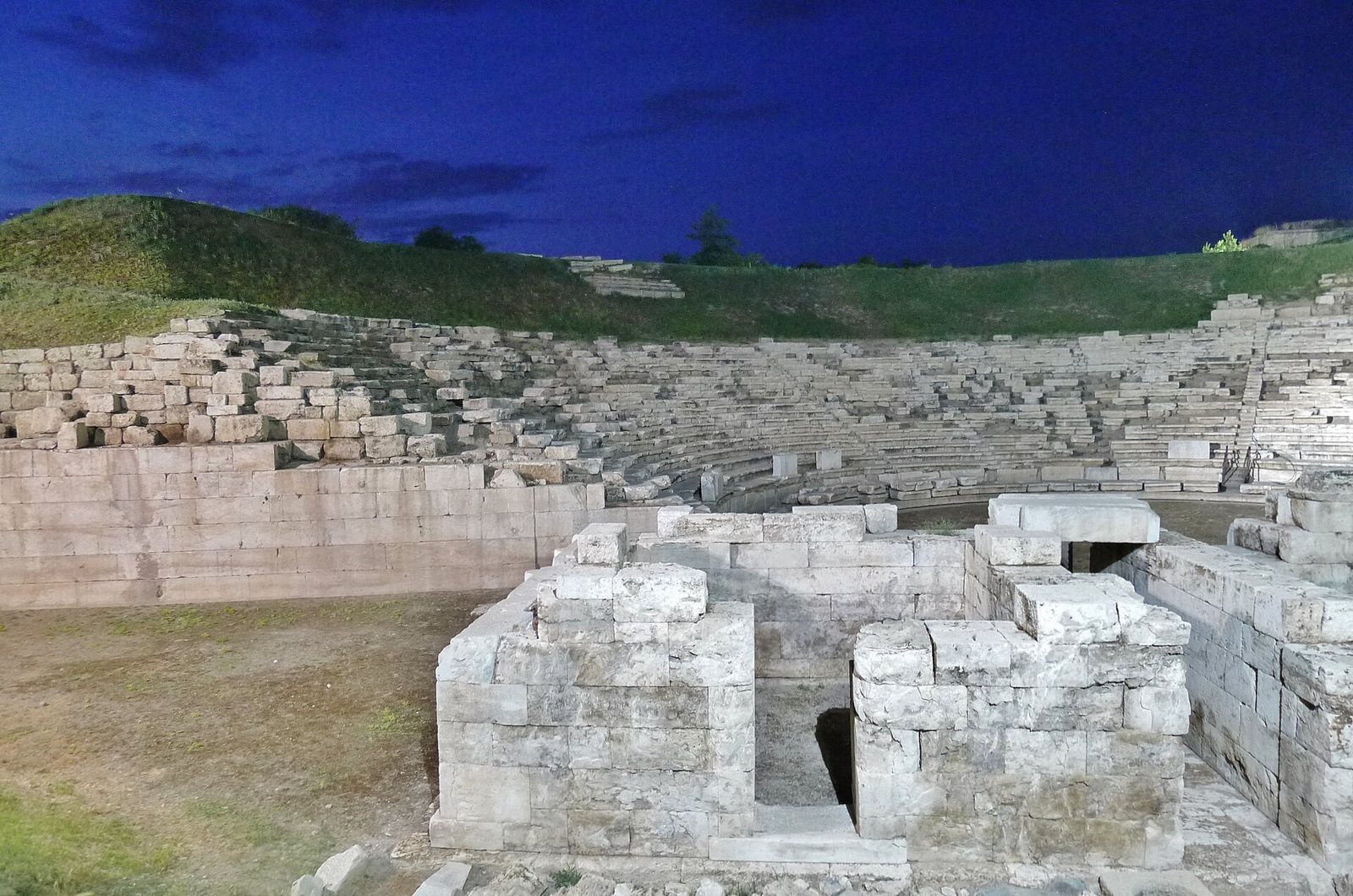
The theatre stands on the southern slope of Frourio Hill, the site of the ancient acropolis, and faced south toward the city agora. Its seating terraces were cut into the hillside. Built mainly of white marble and decorated with reliefs, the theatre had a semicircular seating area around a circular performance space and could accommodate about 10,000 people. It was the largest theatre in Thessaly.
Layout and audience areas
Seating tiers
A passage about two metres wide separated the lower and upper seating tiers. Ten stairways divided the lower tier into 11 blocks, each with 25 rows. The upper tier extended less far to the sides and was divided by 20 stairways into 22 blocks, each with 14 to 18 rows. Although the upper section has been destroyed, its arrangement is known.
Side passages
Two side passages served the chorus and spectators seated in the front rows. They were still in good condition in the twenty-first century.
Performance and stage structures
Performance space
The circular performance area measured about 25 to 25.5 metres across and was bordered by a drain. When the theatre was adapted as an arena, its four lowest seating rows were removed, widening the performance space by about four metres.
Stage building
The stage building, the theatre’s best-preserved part, measured about 37.5 metres long. It contained four rooms and three doorways. The two central rooms served as dressing rooms for actors, while the rooms were also used for storage. In the Roman period, the building gained a second storey, marble-finished facades, additional columns, and sculptural decoration.
Proscenium
A proscenium, or stage-front structure, was added in a later phase. It measured about 20 metres long and two metres wide, and was supported by six flat wall supports and six half-columns in the Doric style. Its horizontal upper structure rested on a colonnade.
Inscriptions and religious remains
Inscriptions
Inscriptions honouring Augustus, the first Roman emperor, and his successor Tiberius were found at the edges of the stage. The seats bear the names of representatives from city-states that took part in the Thessalian League.
Dionysian remains
A small votive altar dedicated to Dionysus was found near the theatre, where a sanctuary to the god also stood.