Harris Museum: Preston’s Public Library, Museum and Art Gallery
Site at a Glance
- Popularity
- High
- Country
- United Kingdom
- Primary era
- Modern
- Eras represented
- Stone Age, Bronze Age, Classical, Medieval, Early Modern, Modern
- Civilizations
- British, Egyptian, Norse, Roman
- Site type
- Museum
On this page16 sections
History
A civic campaign and a new institution
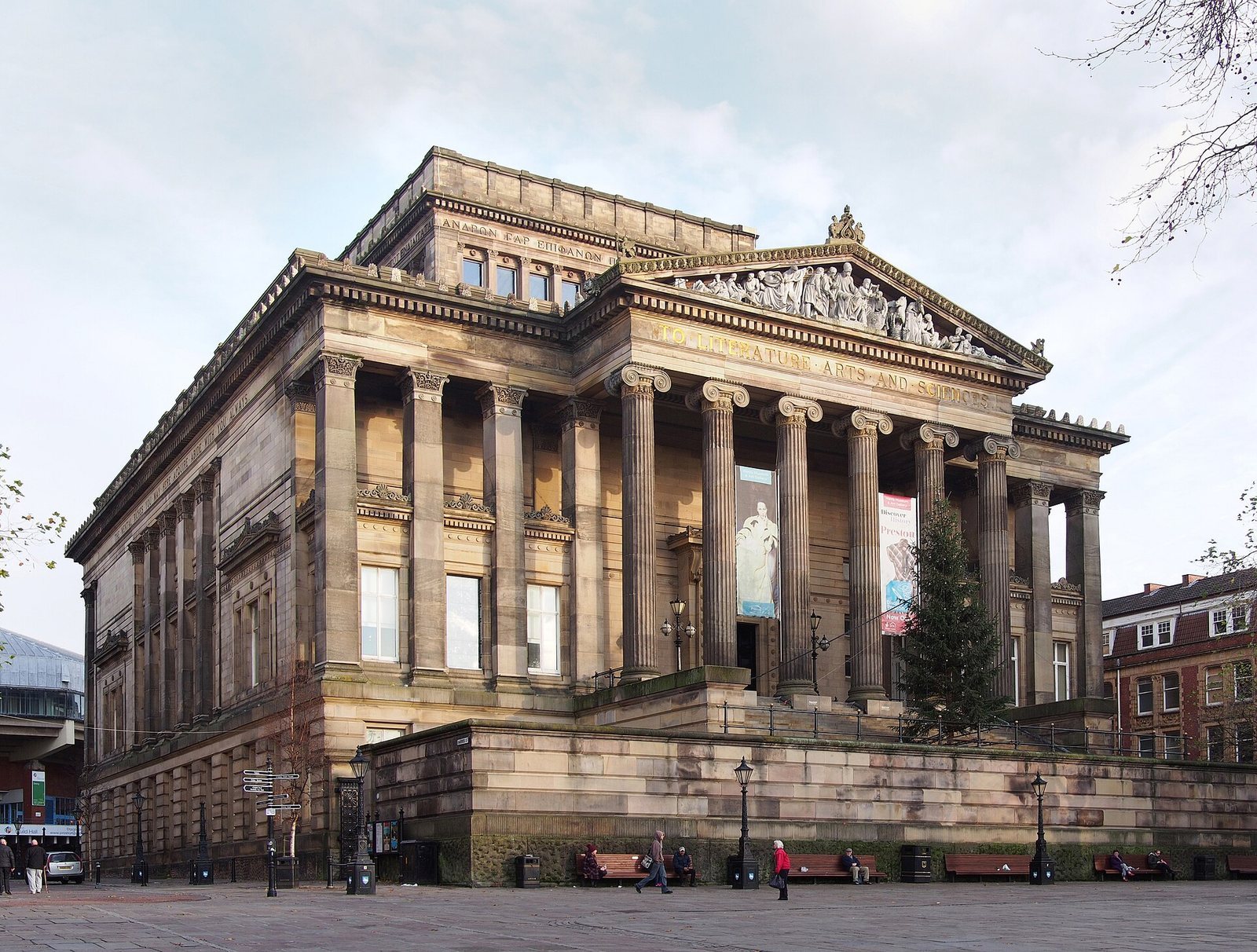
The Harris Museum is a Neo-Classical public library, museum and art gallery on Market Square in Preston, United Kingdom. Designed by James Hibbert, its building was begun in 1882 and opened in 1893 to bring the three public institutions together under one roof.
Preston’s campaign for a public library and museum took shape as nineteenth-century changes made it possible for libraries to receive local-tax funding. Fundraising began in 1850. In 1877, Preston lawyer Edmund Robert Harris left £300,000 to establish a trust supporting a library, museum and art gallery in partnership with Preston Corporation. The museum bears his name.
The town’s first lending library opened in the Town Hall basement in 1879, followed by a public museum on Cross Street on 1 May 1880. Their success led to plans for a shared building. The Preston Improvement Act of 1880 authorized the town to provide a site for it.
Construction and opening
Construction began during Preston Guild, the town’s traditional civic celebration, in 1882. Hibbert chose a classical design, in contrast to the Gothic Revival style then popular in Preston. The building’s position near the old Town Hall was intended to prevent the two contrasting styles from clashing. The Preston firm Cooper and Tullis carried out the construction.
The building opened in 1893 as the home of a public library, museum and art gallery. It was listed at Grade I on 12 June 1950. The art collection began to grow in 1883 with a bequest from collector Richard Newsham. During the twentieth century it was expanded by regular acquisitions from the Royal Academy and gifts from the Contemporary Art Society. From 1985, acquisitions placed increasing emphasis on contemporary British artists.
Libraries and collections
The Shepherd Collection had been given to Preston by Dr Richard Shepherd in 1761, with later additions supported by his bequest. Before moving to the Harris, it was kept in different buildings and institutions around the town. When the new building opened, William Bramwell served as librarian of both the Harris Free Public Library and the Dr Shepherd Library. He retired in 1916, aged 81.
The Harris now also goes by the name The Harris and is formally called Harris Public Library, Museum and Art Gallery. Its art holdings continued to develop through support from Preston City Council, the Friends of the Harris, the Contemporary Art Society, the Art Fund and Arts Council England.
Remains
Architecture
Exterior and sculptural scheme
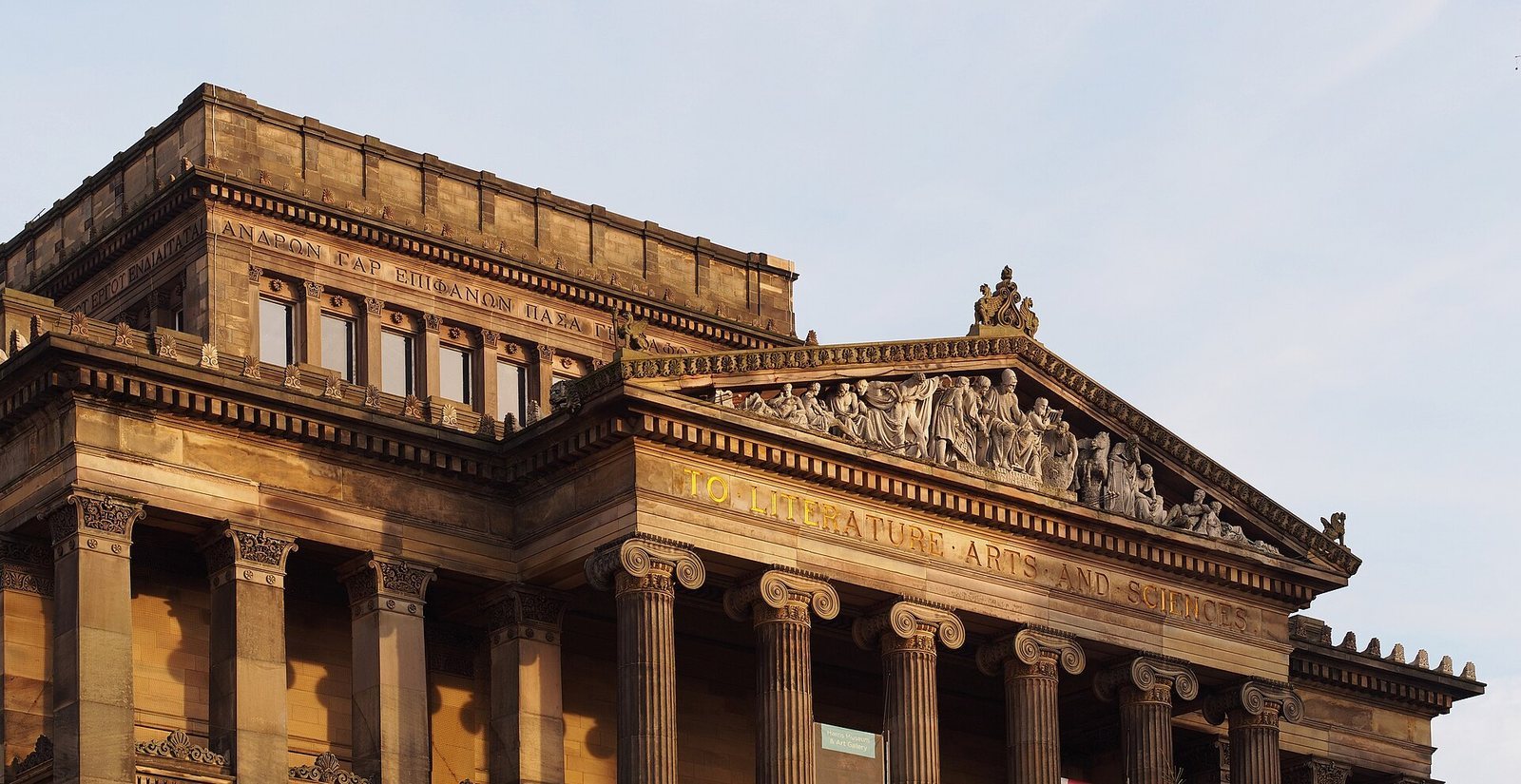
The building covers about 60,000 square feet, or 5,600 square metres, and contains 23 public spaces. Its Neo-Classical architecture draws on Greek and Roman forms, with a restrained, symmetrical exterior and refined detailing. Entrances are at ground level on each side. Facing the Flag Market, the principal facade has a raised columned entrance, or portico, beneath a triangular pediment, the upper section of the facade. Six fluted Ionic columns, with the order’s characteristic scroll-shaped capitals, support the pediment.
London sculptor Edwin Roscoe Mullins created the pediment sculpture, inspired by Raphael’s Renaissance painting The School of Athens. Pericles, a leading Athenian statesman and general, stands at the centre, with twelve men arranged symmetrically around him. Beneath the pediment, an inscription reads, “To Literature, Arts and Science.” Another inscription on the building states, “On Earth there is nothing great but man: in man there is nothing great but mind.” The lantern tower carries a quotation in Ancient Greek from Pericles’ Funeral Oration, a speech commemorating Athenians killed in war.
Central hall and interior sculpture
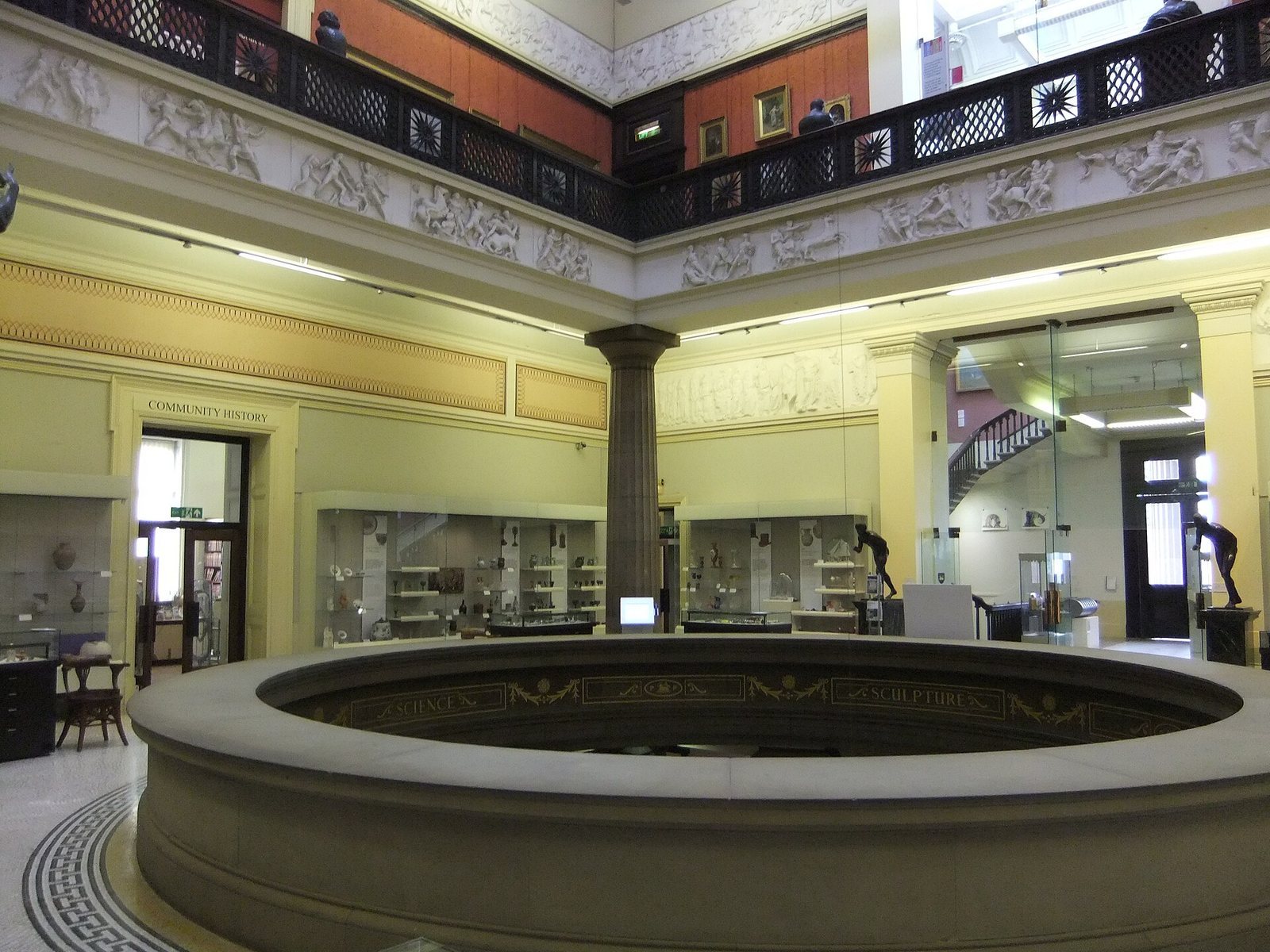
The central hall rises more than 120 feet from the ground floor to the ceiling of the lantern tower. Balconies on three upper floors overlook the hall, which connects with collection halls and exhibition spaces on each level. Interior decoration draws on Greek, Assyrian and Egyptian art, including columns and mosaic floors.
The surviving sculpture includes Greek and Assyrian carved bands on the upper floors and plaster copies of ancient sculpted friezes in the central hall. These reproduce reliefs from the palace of the Assyrian king Assurnasirpal at Nimrud, the Parthenon in Athens and the Temple of Apollo at Bassae. On the ground floor is a copy of Lorenzo Ghiberti’s Gates of Paradise, the Renaissance sculptor’s doors for the Florence Baptistery.
A Foucault pendulum hangs through the floors of the hall, suspended 35 metres above a butterfly-shaped plate marked with the hours. Its swing demonstrates the Earth’s rotation, while the marked plate allows it to serve as a reasonably accurate clock.
Collections and display spaces
The museum’s holdings range across fine and decorative art, archaeology, local and social history, photography, glass, ceramics, costume, textiles and ethnographic objects. They include British, regional and international material. The permanent local-history gallery, Discover Preston, includes a Discovery Room for broader collections, while the Ceramics and Glass Gallery displays decorative arts.
Fine art
The fine-art collection includes more than 800 oil paintings and over 6,000 watercolours, drawings and prints. Its works span the twelfth century to the present, alongside sculpture and books on art. Notable concentrations include eighteenth-century portraits and landscapes and British art of the Victorian and twentieth-century periods. Artists represented include Richard Ansdell, George Frederick Watts, Lawrence Alma-Tadema, Stanley Spencer, Lucian Freud, Ivon Hitchens, Graham Sutherland, Anthony Devis and Reginald Aspinwall. Herbert James Gunn’s 1944 portrait of his wife, Pauline in the Yellow Dress, is among the collection’s best-known paintings.
Archaeology and local history
The Discovery Room displays the complete skeleton of the Poulton Elk, around 13,500 years old and found in 1970 at Carleton near Poulton-le-Fylde. Two human-made barbed points remain embedded in its bones, and bone weapons were found with the skeleton. The museum presents the find as the earliest evidence of human occupation in Lancashire. Other archaeological holdings include Bronze Age finds from Bleasdale, Roman objects from Ribchester, medieval material, Viking coins and parts of the Cuerdale Hoard.
Social and ethnographic history
Objects from Africa, North America, Oceania and Australasia form part of the ethnographic collections, which use material objects to represent cultures and societies. A smaller Egyptian collection came to Preston with support from the Egyptian Research Account. Social-history holdings cover everyday and working life in Preston and Britain, including the local cotton industry and firms such as Horrockses, Crewdson & Company, Stephen Simpson Gold Thread Works and Courtaulds Red Scar Works. Other subjects include Preston Guild, Preston Dock, trade, crafts and urban life; objects range from toys and dolls to cards, stamps and sheet music.
Photography
The photographic holdings include prints, glass and film negatives, slides and albums by amateur and professional photographers. Charles Wilson’s photographs from 1850 to 1853 are among the earliest photographs of a British city; they show Preston’s historic marketplace, railway bridges and housing. Robert Pateson’s albumen prints, made with a process using egg white, record Preston and its surroundings in the 1860s. The collection also includes industrial photographs commissioned by local firms, a daguerreotype, an early photograph made on a treated metal plate, from 1846, and Crimean War photographs by Roger Fenton.
Glass and ceramics
The glass collection contains about 750 objects and consists almost entirely of British glass. The Dr Taylor Collection includes eighteenth-century drinking glasses, among them engraved examples with varied decorated stems. The mainly Victorian Mrs Seddon Collection of English Coloured Glass includes bowls, jugs and drinking glasses. Glassworkers’ novelty objects made from leftover glass, known as “friggers” or “end-of-days,” include boats, shoes and hats. Contemporary artists represented include Kalim Afzal, Angela Jarman and Ana Rosa Hopkins. One of Hopkins’s works incorporates broken glass she collected after the 2011 Manchester riots.
Fashion and textiles
The fashion collection contains more than 6,000 garments, with a strong group of women’s clothing and accessories from the nineteenth and early twentieth centuries. Highlights include a Spitalfields silk dress from the 1740s and Horrockses Fashions dresses from the 1940s to the 1970s, alongside material from the company’s design archive. Other holdings include men’s clothing, workwear, farmers’ clothing, servants’ uniforms, Quaker dress, wartime CC41 utility clothing and designer fashion from the 1960s onward, including work by Vivienne Westwood and David Fielden. Many items were made in Preston or worn by local residents.
Textile holdings include embroidery, lace, quilts and printed cottons. They range from a Coptic textile fragment, from Egypt’s late antique or early medieval period, to modern textile art. Artists and designers represented include William Gear, Shirley Craven, Althea McNish, Ann Sutton, Juniichi Arai and Liz Nilsson. Eighteen volumes of Textile Manufactures of India, assembled in 1866 and edited by John Forbes Watson, contain about 800 historical South Asian textile samples. The collection also includes more than 2,000 hand-coloured fashion illustrations from eighteenth- and nineteenth-century women’s magazines.
Library
The public library holds local-studies material, nineteenth-century journals, rare books and books on art. Its other collections include illustrated children’s books and chapbooks from the Spencer Collection.