Catacomb of Priscilla: An Early Christian Burial Ground in Rome
Site at a Glance
- Popularity
- Very High
- Country
- Italy
- Primary era
- Classical
- Eras represented
- Classical
- Civilizations
- Roman
- Site type
- Burial
- Remains
- Catacomb
On this page25 sections
History
The Catacomb of Priscilla is an Early Christian burial ground on the Via Salaria in Rome, Italy, developed by the Christian community in a former Roman quarry in the late second century. Thousands of Christians were buried there through the fourth century, after which the cemetery was abandoned.
Origins and the Acilii Glabriones
The origin of the name Priscilla is uncertain. One explanation identifies her as a member of the Acilii Glabriones, a Roman senatorial family, who gave the land for burials. An inscription naming Priscilla with an honorific indicating senatorial rank, together with inscriptions connected to the Acilii, supports an association between the cemetery and the family. The name also appears in early Christian records commemorating bishops and martyrs.
Inscriptions suggest that Acilii buried in the catacomb descended from Manius Acilius Glabrio, a consul and senator. After he converted to Christianity, Emperor Domitian, who ruled from AD 81 to 96, exiled him from Rome and later condemned him to death. The cemetery may have followed other uses of the site, and some people buried there may have been transferred from elsewhere, but this interpretation remains highly controversial.
Burial traditions and relics
Tradition associates the cemetery with seven popes, the bishops of Rome: Marcellinus, whose martyrdom is uncertain; Marcellus I; Sylvester I; Liberius; Siricius; Celestine I; and Vigilius. It also connects the catacomb with more than 300 martyrs, including a group numbered at 365 and figures named Felix, Philip, Crescens, Priscilla, Fimita, Pudentiana, Praxedes, Philomena, Paul, Maurus, and Symetrius. The number of martyrs gave the cemetery the old epithet “Queen of the Catacombs.”
Catholic tradition holds that remains attributed to Saint Philomena were found in the catacomb on May 24–25, 1802, and later transferred to Mugnano del Cardinale. In the ninth century, Pope Paschal I moved the bones of Praxedes and Pudentiana to the rebuilt church of Santa Prassede. Relics said to belong to Popes Sylvester I, Stephen I, and Dionysius were also taken from the cemetery and placed beneath the high altar of San Martino ai Monti.
Sylvester I’s original burial place is uncertain. An unidentified papal sarcophagus discovered during the demolition of Old Saint Peter’s Basilica was attributed to him and taken to Nonantola Abbey. Another tradition associates relics of Sylvester I and Vigilius with an altar in Saint Peter’s.
Archaeological investigation
Investigation of the catacomb’s remains began in the nineteenth century, including work by Giovanni Battista de Rossi, an archaeologist of early Christian remains in Rome, and his protégé Joseph Wilpert. They excavated the Greek Chapel. In 1894, Wilpert uncovered its Fractio panis painting, which had been concealed beneath a thick coating of lime.
Remains
The catacomb extends for more than seven miles beneath the Via Salaria and is among Rome’s most extensive underground burial complexes. Its galleries were cut into porous volcanic rock called tufa in a former quarry. The remains include a broad covered gallery, burial chambers, a mausoleum, and painted spaces, among them the Greek Chapel and the burial chamber of the Acilii.
Covered gallery and mausoleum
The covered gallery
The cryptoporticus, a covered passage or gallery, is a broad rectangular structure built of brick and stone. Intersecting barrel vaults form its cross-vaulted ceiling, and the space includes doors, arches, and two chapels. Its original purpose is uncertain. Decorated walls and smaller burial and painted spaces are part of this area, while traces of painting survive in its arched tomb recesses.
Mausoleum and adjoining galleries
A large mausoleum has curved apses, or semicircular recesses, and a vaulted roof; marble once covered the lower walls. A table tomb stands beside one apse. Wall niches and sarcophagi are also present in the complex. Galleries beyond the mausoleum include an arched tomb recess painted with garlands and peacocks, as well as scenes of Adam and Eve, Jonah, and the healing of a man born blind.
Greek Chapel
Chamber and inscriptions
The Greek Chapel is a square burial chamber divided into three spaces, each with an arch and an apse. The arrangement was intended to hold sarcophagi. Greek inscriptions commemorate Palladius, a cousin and fellow student of Óbrimo, and Nestoriana, Palladius’s wife. The chapel’s painted and stucco decoration dates broadly from the late second to the later third century. Differences in subject and color have led to the suggestion that more than one artist or workshop contributed.
Painted biblical scenes
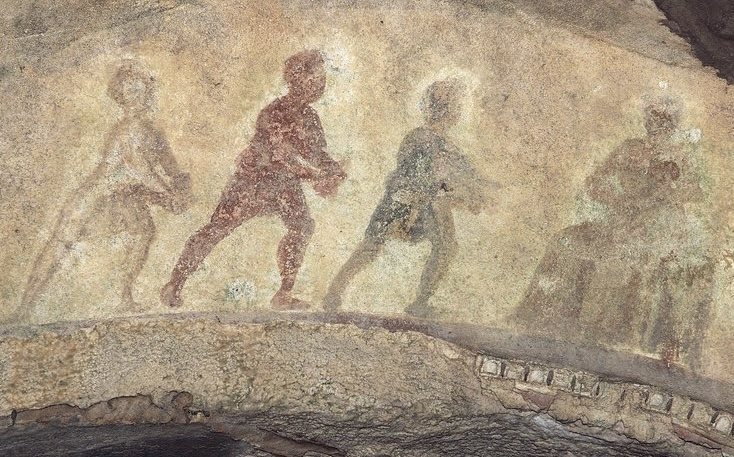
Paintings on the ceiling include Daniel in the lions’ den and episodes from Jonah’s life. On a side wall, the healing of a paralytic appears beside a bust representing Summer, with a phoenix amid flames below it. The phoenix is regarded as the earliest depiction of that bird in a Christian setting and came to represent resurrection. On the entrance wall, as seen from inside, Moses brings water from a rock, while three young men in Eastern-style clothing stand in a furnace. Scenes associated with Susanna cover the side walls. They may show the biblical story of Susanna, although another interpretation connects them with events in the life of a distinguished Christian woman.
Scenes around the arches
Above the arch between the first and second spaces, Mary sits with the child and offers him to the three Magi. Other paintings show Abraham raising a knife in the sacrifice of Isaac, Daniel between two lions with Babylon behind him, and the raising of Lazarus. Lazarus’s tomb is shaped like a temple; Jesus raises his hands toward him, while one of Lazarus’s sisters stands behind. Noah in the ark appears beside the entrance arch.
The Breaking of Bread fresco
A stylized vine decorates the ceiling of the second space. A fragment of a central scene includes the feet of goats. Above the apse arch, the Fractio panis, meaning “Breaking of Bread,” shows a bearded central figure with arms extended after breaking bread. A veiled woman and other figures sit at the table, which holds a two-handled cup, plates with two loaves and five fish, and seven baskets of bread, three on one side and four on the other. The number and identities of the people depicted have been interpreted in different ways.
Acilii burial chamber
The underground chamber
The hypogeum, or underground burial chamber, of the Acilii is a small room situated on the former ground floor of a villa. It may have served as a cistern before becoming a burial place. Inscriptions identify a family mausoleum there and helped connect the Acilii with the catacomb.
Nearby painted recess
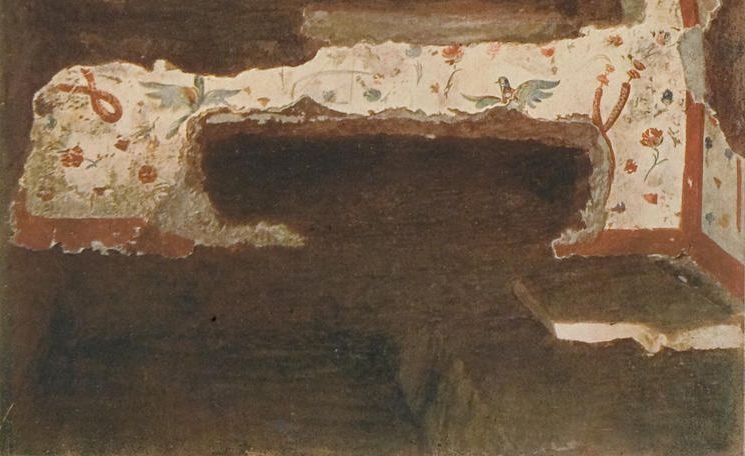
A nearby gallery contains an arched tomb recess with peacock paintings and a Greek inscription asking God to receive Irene, Zoe, and Marcelo. An anchor is painted beside the inscription.
Quarry galleries
Shepherd and animal paintings
Long galleries with broad vaults and walls lined with burial niches form part of the former quarry. Some contain smaller burial chambers. Beside one decorated niche, a ceiling painting shows the Good Shepherd carrying a goat on his shoulder, with two other goats, trees, and birds inside a red or orange circle. Another image of the shepherd, modelled in stucco, has similar details and is badly deteriorated but still visible.
Mary and other gallery paintings
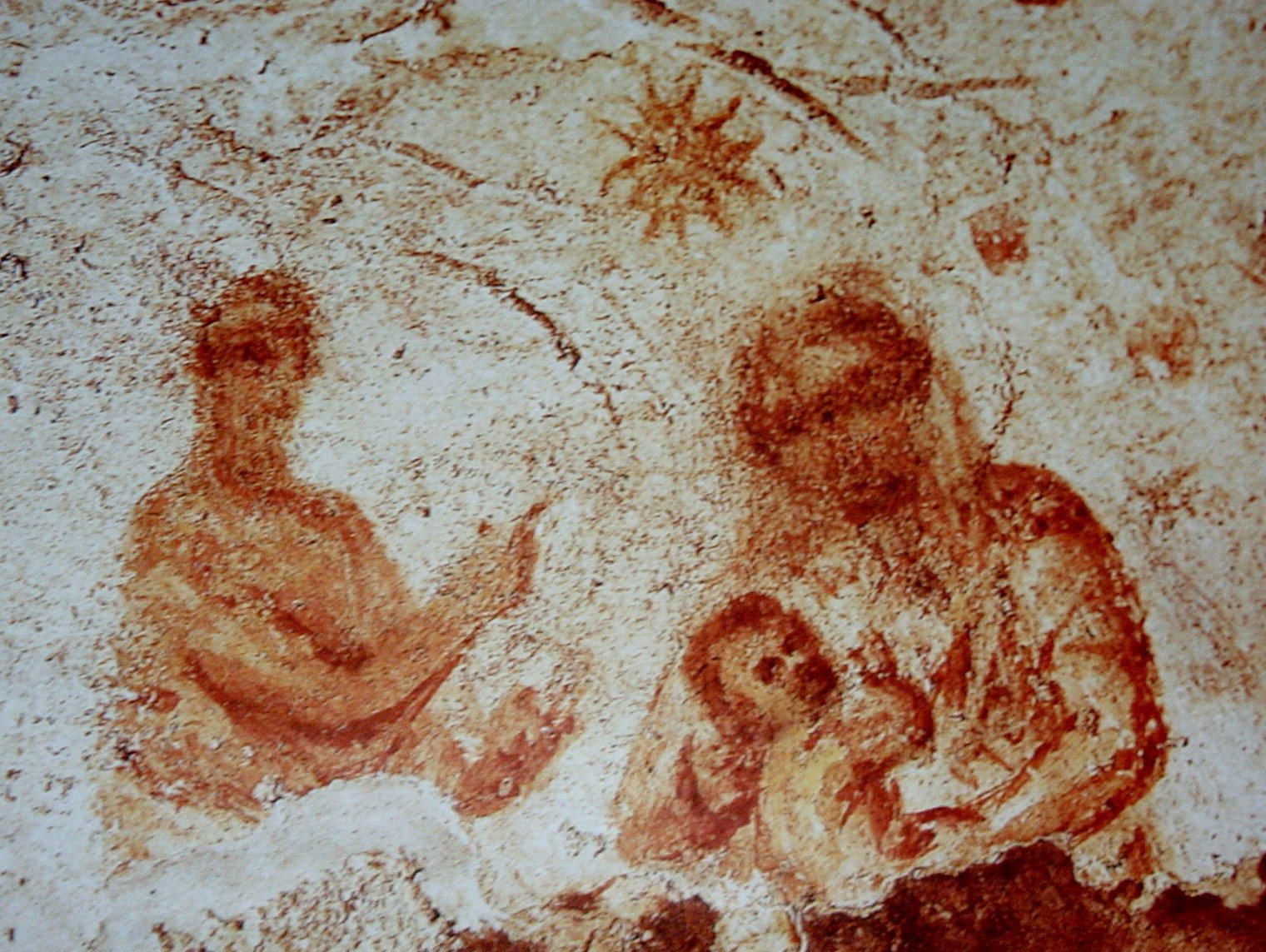
A painting shows Mary nursing the infant Jesus, while a figure points toward a star between them. The figure is most often identified as the prophet Balaam, though Isaiah has also been proposed. Dated to approximately the mid-second century, the image is regarded as one of the oldest surviving depictions of Mary. An Annunciation may also appear in the catacomb, but that identification is disputed. Other gallery paintings include animals, plants, further Good Shepherd scenes, and episodes from Jonah’s life. The oldest part of the galleries contains children’s graves with inscriptions.
Cubiculum of the Velata
The lunette and its interpretations
The Cubiculum of the Velata, a small burial chamber, takes its name from a well-preserved fresco in a lunette, the semicircular panel above an opening. The entrance arch shows Jonah being cast ashore by a whale, surrounded by birds, animals, and flowers. The lunette contains three scenes: an older seated man, a young woman holding a scroll, and another man behind her; a veiled woman in a purple tunic praying; and the same woman unveiled, dressed in white, and holding a child.
One interpretation reads the scenes as episodes in the life of a woman buried there: marriage, prayer, and motherhood. In this reading, the veil and scroll refer to marriage obligations, while the final scene may suggest that she died in childbirth; the praying figure may represent her in heaven. Another interpretation sees a child’s life followed by consecration as a virgin and later motherhood. The final image has also been identified as Mary with Jesus. The frescoes date to the second half of the third century.
Other chamber paintings
A charcoal inscription beneath the central scene reads BOSIVS and is associated with Antonio Bosio, who explored several Roman cemeteries in the seventeenth century. A painting on the right wall shows the three young men praying in the furnace, with a dove carrying an olive branch above them. A damaged scene on the left wall shows Abraham and Isaac at the sacrifice. On the ceiling, the Good Shepherd carries a goat and gestures toward other goats among large shrubs and birds.
Inscriptions and burial objects
Church widows
Inscriptions commemorate numerous widows associated with the church. One names a widow called Mother Regina and connects her with a position of authority in her congregation.
Decorative objects
Objects made of chalcedony, rock crystal, and glass have been found in the catacomb, including a chalcedony phalera, an ornamental disk of a kind used on military equipment or horse harnesses. These objects are thought to have arrived through trade with the Kushan Empire, a power in Central and South Asia during the first centuries AD linked to long-distance trade. They may have served as amulets.