Santa Restituta: Naples’s Fourth-Century Basilica and Former Cathedral
Site at a Glance
- Popularity
- High
- Country
- Italy
- Primary era
- Classical
- Eras represented
- Classical, Medieval, Early Modern, Modern
- Civilizations
- Ancient Greek, Italian, Kingdom of Naples, Kingdom of Sicily, Roman, Spanish
- Site type
- Religious
- Remains
- Basilica
On this page15 sections
History
Foundation and early history
Santa Restituta is a fourth-century Christian basilica in Naples, Italy, and the oldest basilica in the city. It served as Naples’s first cathedral and principal Christian church, initially dedicated to the Savior, a title for Jesus. The Liber Pontificalis, a collection of papal biographies, attributes its foundation to Emperor Constantine in the life of Pope Sylvester I.
The basilica probably occupies the site of an ancient temple dedicated to Apollo, a deity worshipped in Greek and Roman religion. Its name also changed over time. From the ninth century it was known as the Stefanìa, a name associated with Stefano I, a sixth-century bishop of Naples. Santa Restituta probably became its name after the saint’s relics were brought there in the eighth century. Restituta is venerated as an early Christian martyr of North African origin.
Incorporation into the cathedral
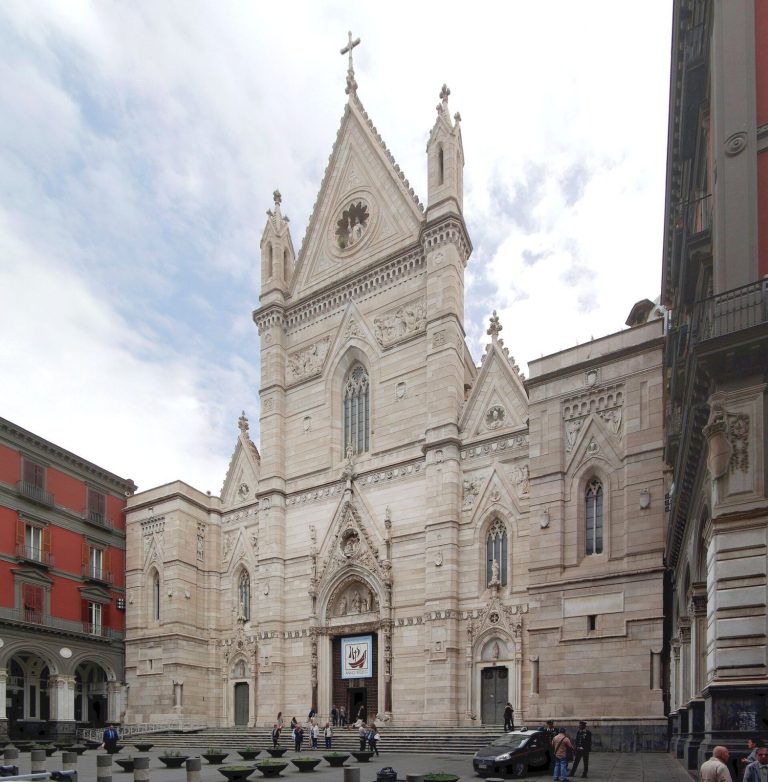
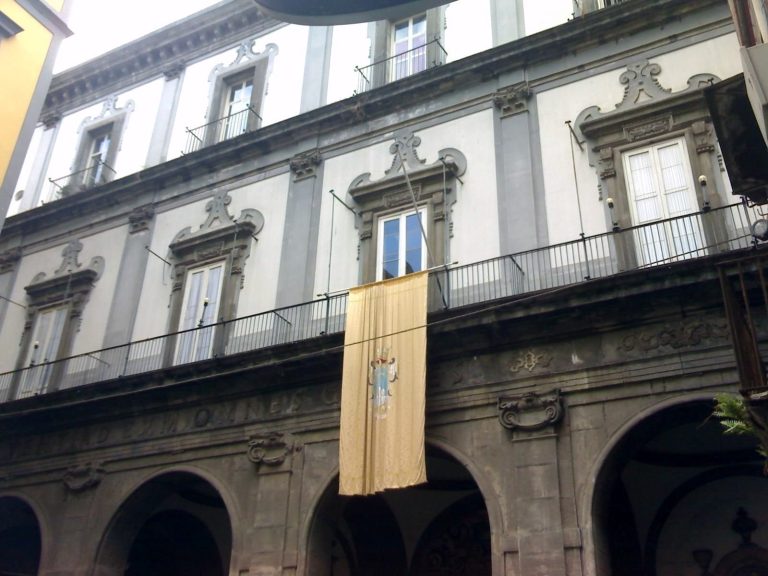
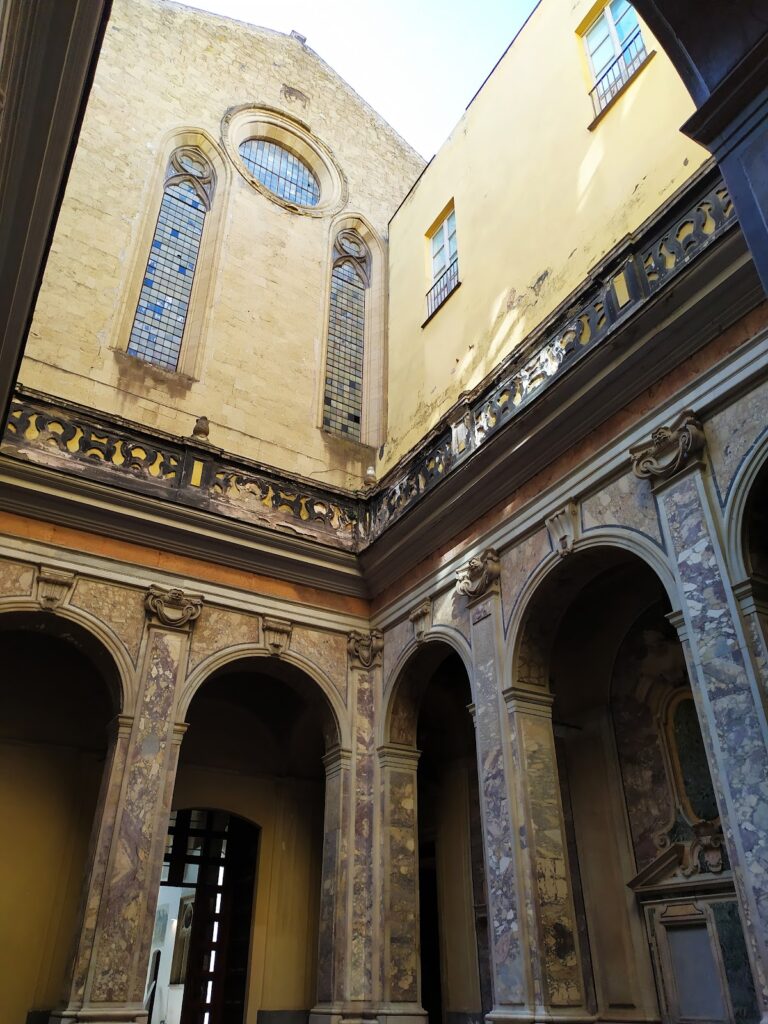
In the thirteenth century, the Angevins, a dynasty originating in Anjou, built a new Gothic cathedral dedicated to the Assumption, the Christian belief that Mary was taken into heaven. Santa Restituta was reduced in size and incorporated into the new complex, where it continued as a chapel.
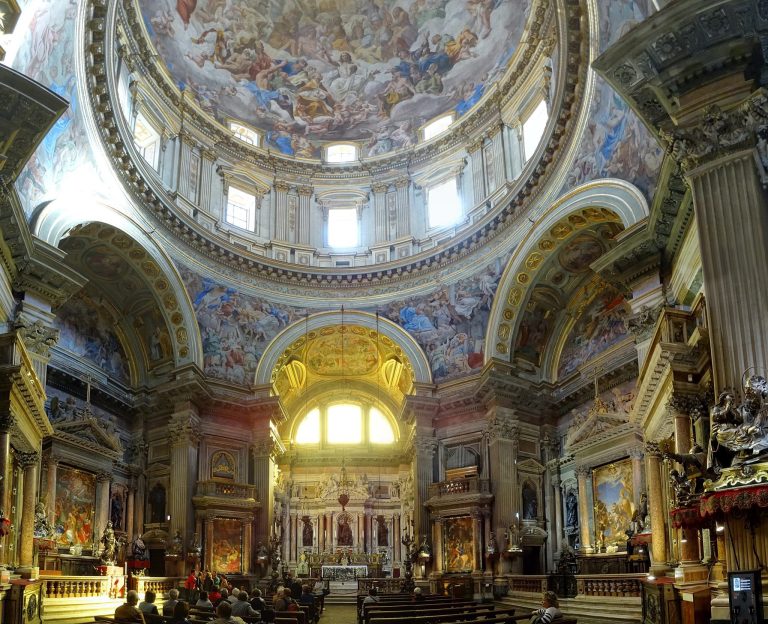
The earthquake of 1456 led to further changes. The outer aisles became side chapels, and two entrances were blocked to strengthen the building. Late in the seventeenth century, restoration directed by Arcangelo Guglielmelli, especially in the apse, gave the basilica its Baroque appearance. After the earthquake of 1688, Guglielmelli raised the floor. In 1742, Cardinal Archbishop Giuseppe Spinelli directed additional consolidation work, during which two more side entrances were closed. Santa Restituta forms part of the UNESCO World Heritage property Historic Centre of Naples, designated in 1997.
Remains
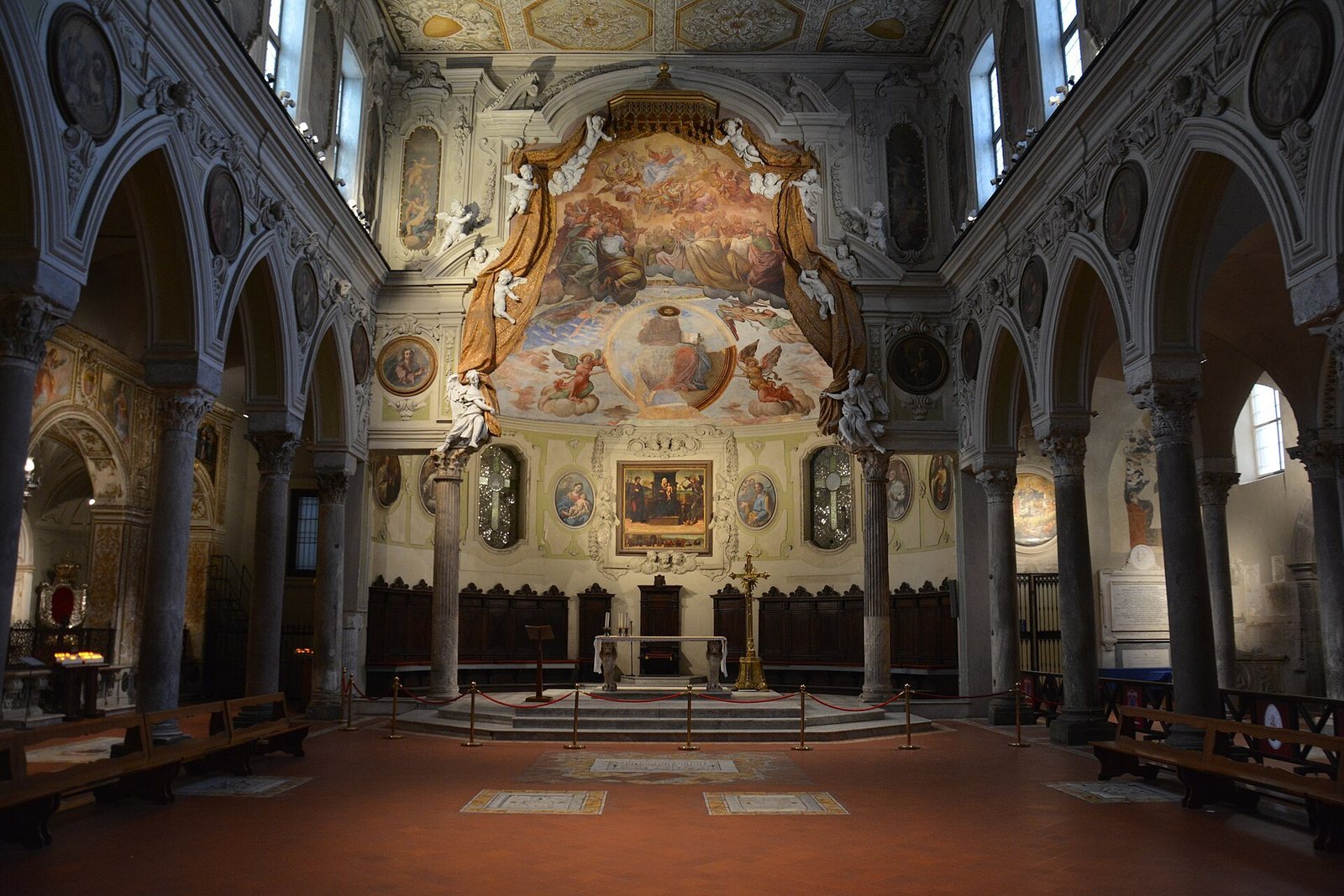
Santa Restituta is incorporated into Naples Cathedral and now has three naves, or long interior divisions. Its original plan had five naves, an additional bay, a separate front, and an entrance for each nave. The present interior is divided by seven pointed arches on either side, supported by 27 ancient columns with Corinthian capitals. Fourteen chapels occupy the entrance end and the sides of the basilica.
Nave and central decoration
Nave and entrance wall
The basilica lies at the third chapel of the cathedral’s left nave. Its entrance portal is in the cathedral’s fourth bay, opposite the entrance to the Chapel of the Treasury of San Gennaro, and sits to the right of Santa Restituta’s high altar. The lateral naves retain their Gothic ribbed ceilings, while the central nave has a Baroque ceiling and rectangular windows associated with Guglielmelli’s late-seventeenth-century work. Tomb slabs in the raised floor commemorate cathedral canons and date from the last quarter of the fifteenth century.
A pipe organ built by Tomaso de Martino in 1750 stands in the choir loft on the entrance wall. An illusionistic architectural scene covers that wall. Beside the entrance niche, a funerary monument to Alessio Simmaco Mazzocchi was made by Giuseppe Sanmartino. Other fifteenth- and sixteenth-century memorials to Neapolitan clergy stand on a nearby pier and within an arch that once belonged to a nave.
Ceiling, altar, and apse
Giuseppe Simonelli’s central ceiling painting shows the arrival of Saint Restituta’s body on Ischia; Luca Giordano later restored it. Sixteen paintings of prophets by Santolo Cirillo alternate with the windows. Eighteen roundels between the nave arches, by Francesco De Mura, depict Christ, the Virgin, and the Apostles. At the rear of the central nave, a large stucco drapery by Guglielmelli, made with Bartolomeo Ghetti and Lorenzo Vaccaro, frames Nicola Vaccaro’s Glory of the Savior.
The apse, the rounded end of the church, is lower than the central nave. Its conch preserves fragments of an eleventh- or twelfth-century fresco of the Deesis, an image of Christ accompanied by figures who intercede. The work is attributed to an artist or workshop following a refined Byzantine painting tradition. Its unusual technique combines painted wall surfaces with panels set into the wall for the heads. Surviving elements include an angel at upper left, Christ enthroned within an almond-shaped frame called a mandorla, and symbols of the Evangelists above. The head of Christ was painted on a panel, and the figure is heavily worn. Angels in Glory around the scene were added in the sixteenth century and may reflect the original composition. The frescoes also connect Neapolitan and Sicilian artistic styles.
A wooden choir stands behind the altar. Above it is a sixteenth-century altarpiece attributed to Andrea da Salerno, showing the Madonna enthroned between Saints Michael and Restituta.
Chapels and memorials
Chapels at the entrance end
The two chapels at the entrance end have different altars and paintings. On the left is a Baroque altar by Domenico Antonio Vaccaro, formerly in the Chapel of the Succorpo and moved here in 1887. The chapel on the right contains an anonymous painting of the Martyrdom of Saint John the Baptist.
Chapels along the left side
The De Gennaro family chapel is dedicated to Saint Nicholas. It contains busts of Bishop Matteo De Gennaro and Marc’Antonio De Gennaro, as well as a marble altar. The Polverino chapel is dedicated to Saint Helena and has seventeenth-century paintings of Saint Francis of Paola and the Betrayal of Judas by unknown artists. The De Rossi chapel contains family burials and a seventeenth-century altarpiece of the Assumption of the Virgin.
In the chapel dedicated to Saint Aspreno are memorials to Carlo Maiello and Giuseppe Maria Pulci. Its altar painting by Santolo Cirillo depicts Saint Peter preaching in Naples, and a painting of Saint Nicholas hangs to the right. Other chapels contain funerary monuments to Neapolitan ecclesiastical figures from the Middle Ages to the twentieth century, including Gennaro Aspreno Galante.
Madonna del Principio and Basile space
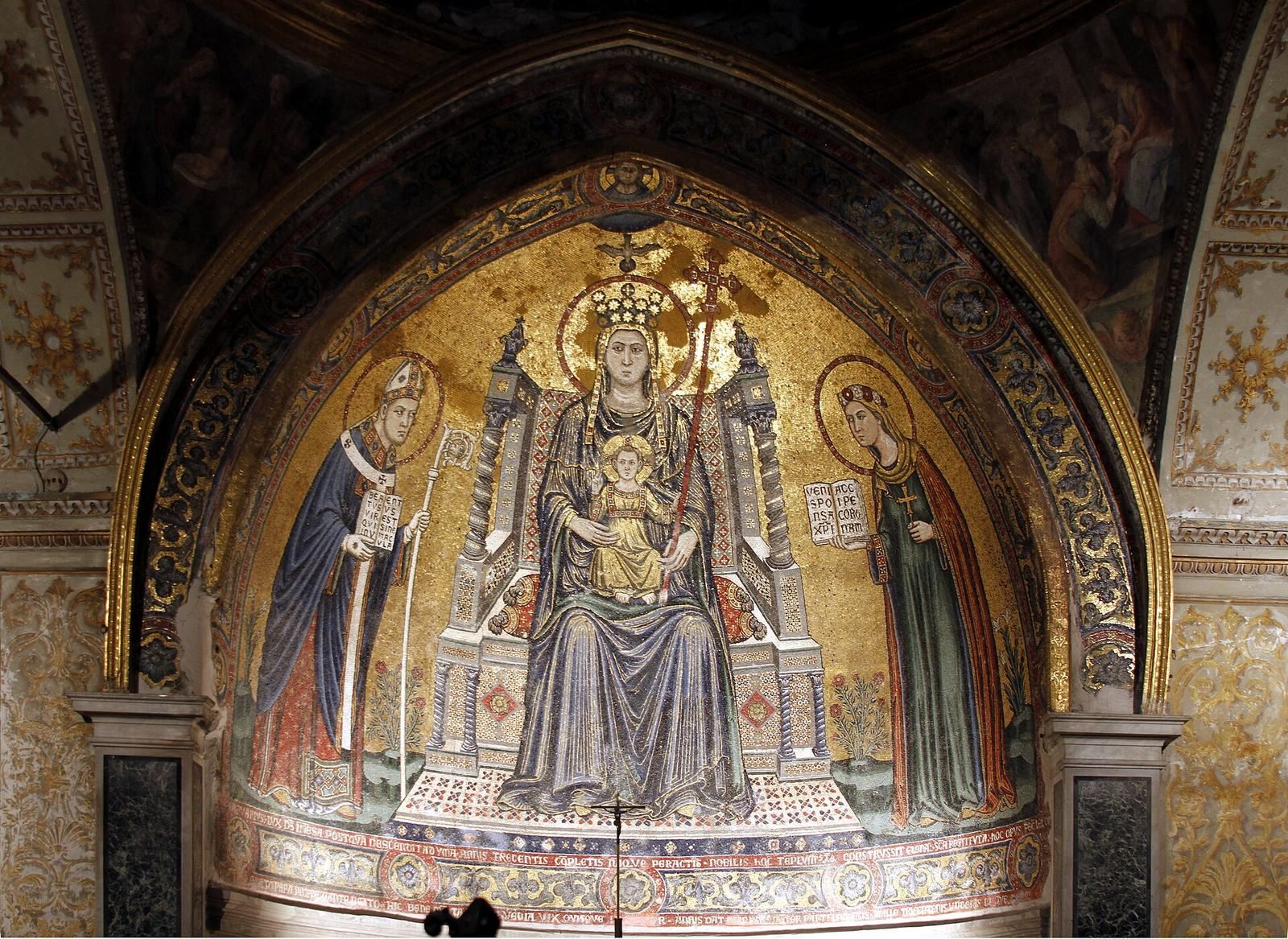
The fifth and sixth chapels on the left, identified as the Madonna del Principio and Basile chapels, form one space with the adjoining presbytery, the area around the altar. The apse contains a 1322 mosaic by Lello da Orvieto. It shows the Virgin enthroned with the Child between Saints Gennaro and Restituta. The Virgin wears a crown and holds a processional cross; Gennaro, patron saint of Naples, wears a bishop’s robes and holds a staff and open book. Restituta wears monastic clothing and a flower crown and carries a small cross and an open book. Gold mosaic pieces form the background, while plant designs and circles containing six-petalled flowers decorate the outer arch. A long inscription on a red ground runs below the image. Its text has been reconstructed using sixteenth- and seventeenth-century transcriptions, and its titles name Gennaro and Restituta and attribute the work to Lello da Orvieto.
A Baroque altar in this space holds relics of Saint Restituta and Saint John Scriba. Thirty low-relief panels, made by an unknown Neapolitan sculptor in the early thirteenth century, line the side walls and depict stories of Joseph, Samson, and Saint Gennaro. Tomb slabs and funerary monuments to Neapolitan canons are also found here.
Chapels along the right side
The twelfth-century Chapel of the Crucifix contains cabinets for relics and has a floor bearing a family coat of arms dated 1603. In the Piscicelli chapel, three painted panels came from the Galeota chapel in the cathedral transept. The central image of the Savior dates to 1484 and is flanked by Saint Gennaro and Saint Athanasius of Alexandria.
The Caracciolo Guidazzi chapel contains a painting of Saint Anne with the Virgin and Child on its front wall, another of the Madonna between Saint John the Baptist and Saint Gennaro on its left wall, and a floor slab commemorating Giannone Caracciolo. Commemorative plaques and inscriptions in the Forma chapel name Giovanni and Marino Forma and record changes in the room’s ownership. In the Chapel of Saint Joseph, Hendrick van Somer’s Pietà hangs above the altar. Giovanni Balducci’s paintings on either side show Saint Gennaro protecting Naples from Vesuvius and Saint Agnello driving away the Saracens.
At the end of the right nave, the presbytery contains Roman sarcophagi adapted as funerary monuments in the fourteenth century. A niche in its front wall holds a sixteenth-century tabernacle with a canopy-like structure, made by the school of Tommaso Malvito.
Baptistery and remains beneath the basilica
Baptistery of San Giovanni in Fonte
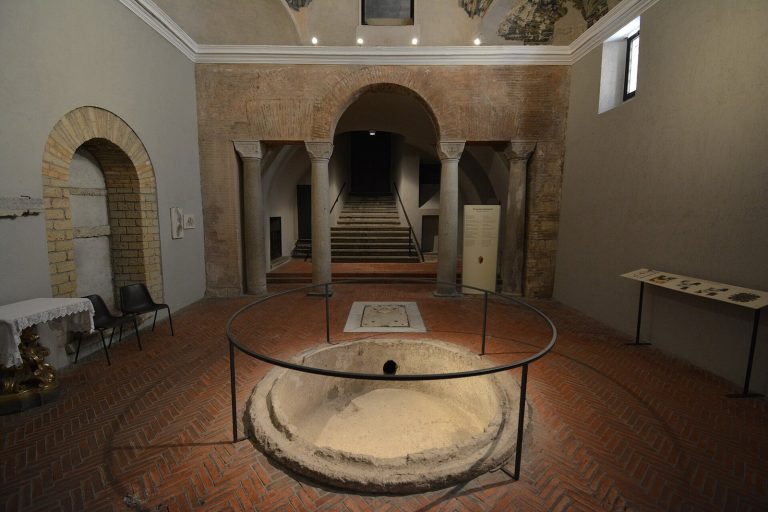
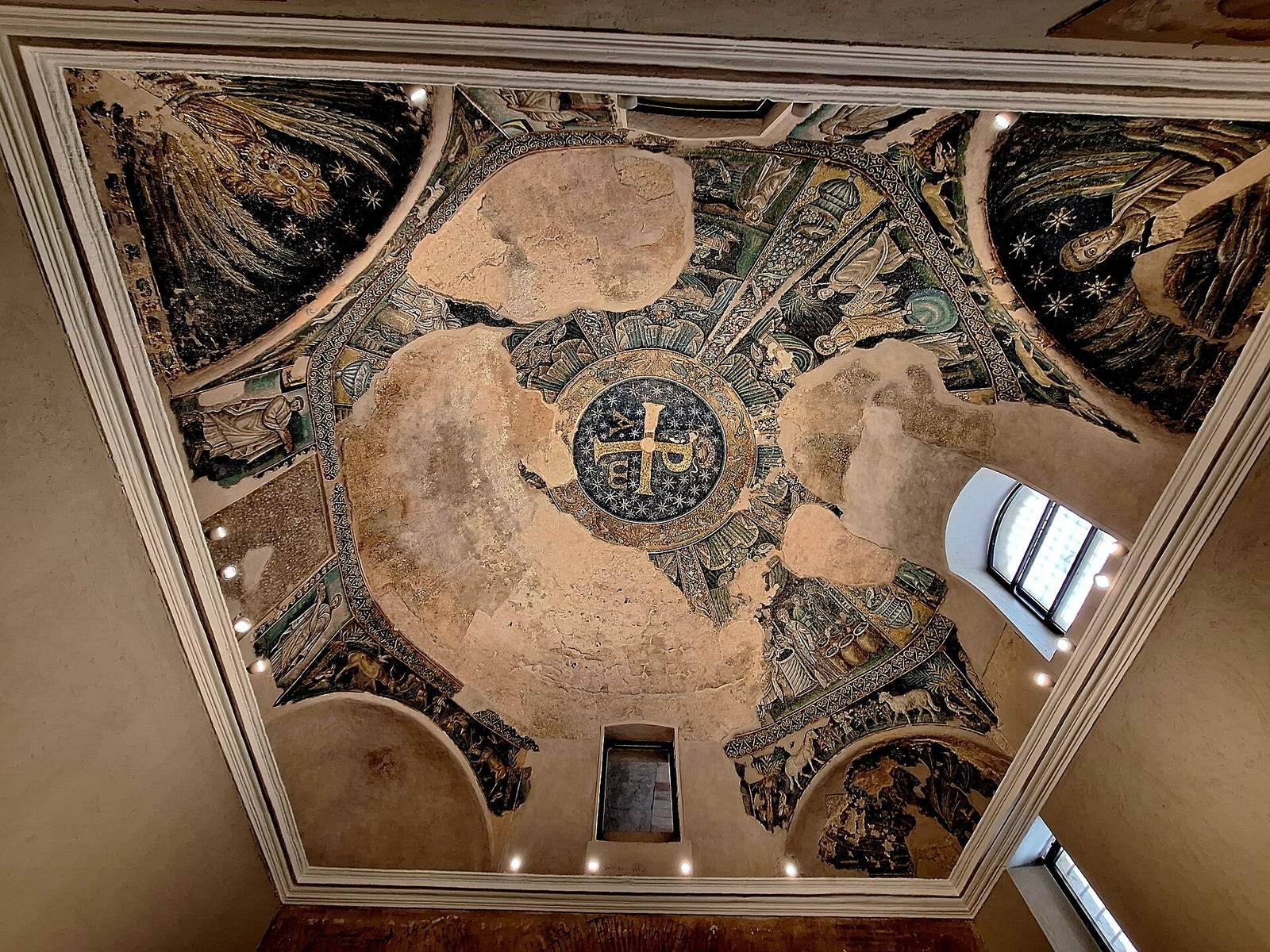
The fourth-century baptistery of San Giovanni in Fonte, a building used for Christian baptism, extends to the right of the apse and is reached from the presbytery wall. It is attributed to Saint Severus, a late-antique bishop of Naples, during the final years of his episcopate, dated to about 362–408. Its upper structure is decorated with mosaics. It is regarded as the oldest baptistery in the West.
Archaeological remains
Below the basilica are remains from Greek and Roman Naples. A Greek wall associated with the temple of Apollo uses net-pattern masonry, formed from small stones set diagonally. Beneath the apse is the colonnaded courtyard of a late-imperial Roman house. Other remains include part of a Roman aqueduct dating from after the city’s foundation and a sloping section of Greek road. Part of the cathedral’s archaeological excavations lies directly beneath Santa Restituta.