Da Ponte Fountain: A Baroque Public Fountain in Koper
Site at a Glance
- Popularity
- Low
- Country
- Slovenia
- Primary era
- Early Modern
- Eras represented
- Early Modern
- Civilizations
- Venetian
- Site type
- Civic
- Remains
- Fountain
On this page10 sections
History
Koper’s water supply and the earlier fountain
The Da Ponte Fountain is a seventeenth-century Baroque public fountain on Prešeren Square in Koper, Slovenia. Completed in 1666, it formed the endpoint of a water system that brought spring water from the mainland into the island city.
Koper’s island setting, separated from the mainland by shallow water, meant residents initially depended on rainwater stored in cisterns. As the population grew to about 10,000 by the sixteenth century, those supplies became inadequate. An aqueduct connected the mainland to the island by the end of the fourteenth century, carrying water from springs in the hills east of the city. In a seventeenth-century account, historian Niccolò Manzuoli described a spring about two miles away. He traced the water through an underground stone channel to Colonna, then in wooden pipes beneath the sea to parts of Koper. Excavations have also uncovered wooden pipes that crossed marshy ground and the shallow water between mainland and island.
A public fountain at this site is recorded from 1423. It provided drinking water beyond the private and monastic cisterns, but its equipment wore out, supplies were disrupted, and water could become contaminated. The earlier structure therefore required repeated repairs.
The fountain completed in 1666
In 1665–1666, Koper’s podestà, a chief civic magistrate, and captain Lorenzo Da Ponte set out to renew the city’s water system and replace the old fountain. The new structure was completed in 1666. Local patrician families, members of the urban elite, contributed to its construction, and their coats of arms were placed on stone posts around the basin.
Changing use and conservation
The fountain supplied drinking water until 1898, when a modern water system took over. It then remained a historic feature of Prešeren Square and one of its principal landmarks. Conservation took place during the square’s repaving in 1990. The fountain is part of Koper’s protected historic urban ensemble and was declared a local monument of cultural significance on 3 February 1993.
Remains
Fountain composition
Form and setting
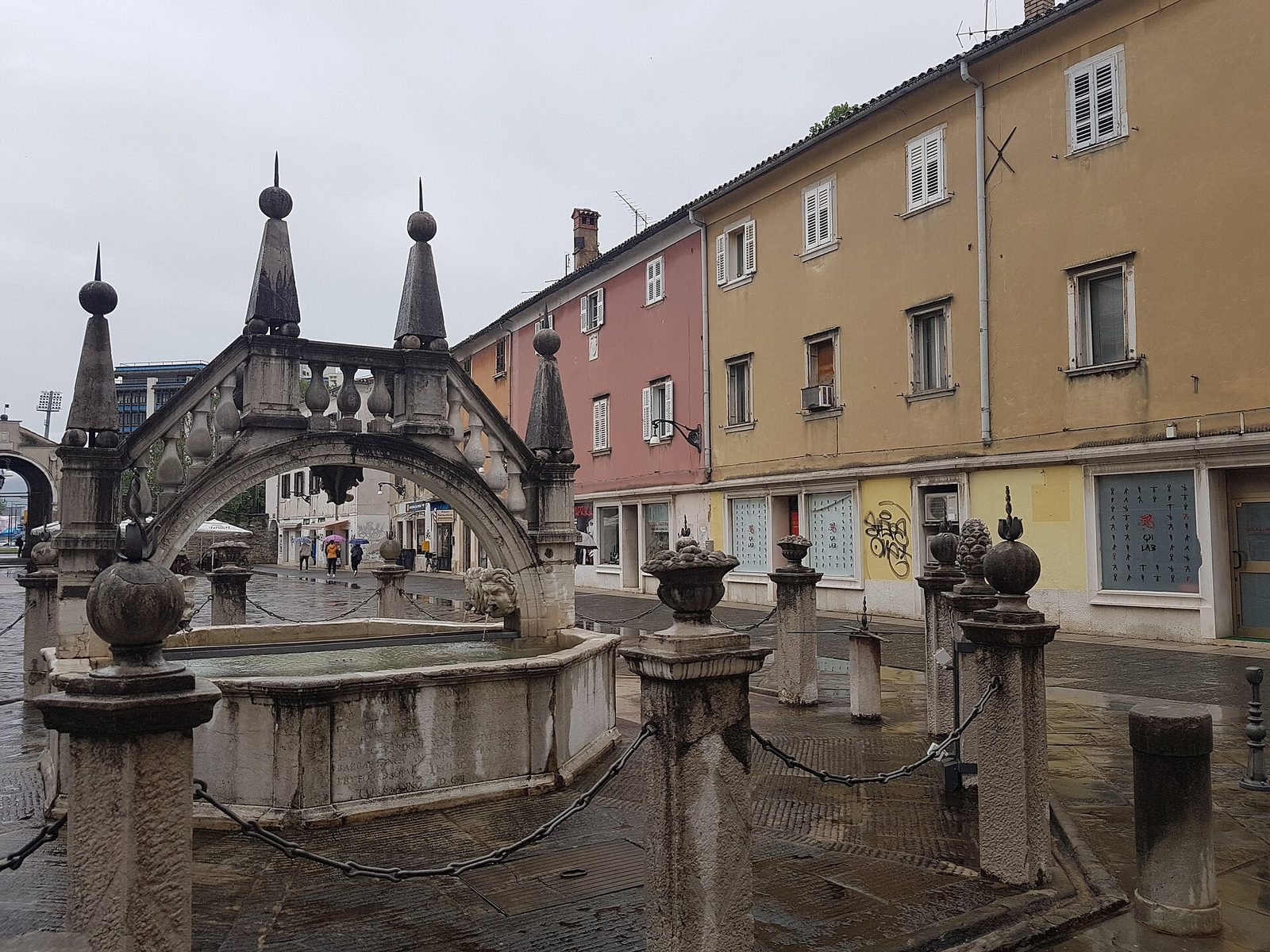
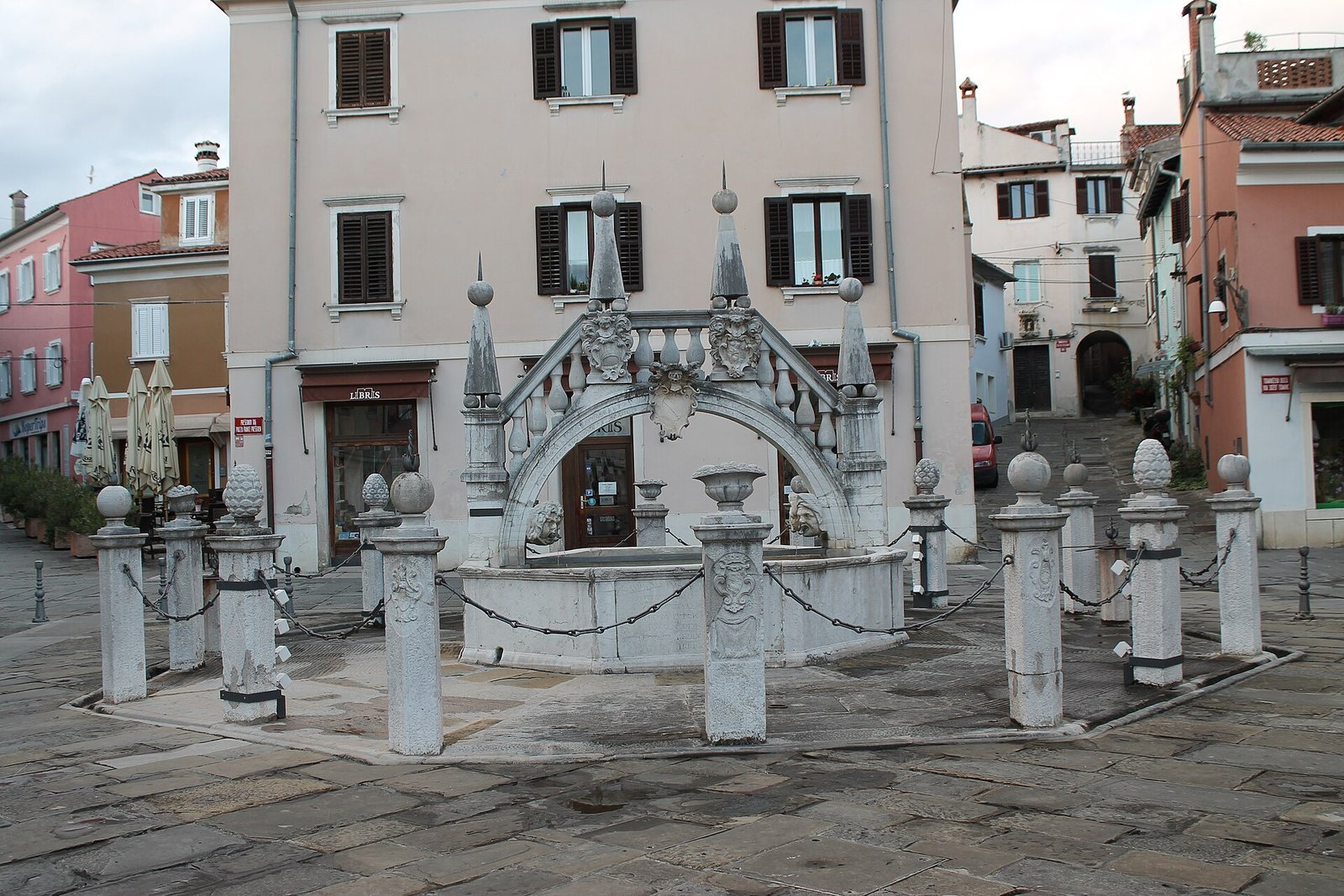
The stone fountain stands in Koper’s historic center on Prešeren Square, formerly known as Muda Square, beside the former Muda Gate, once the principal landward entrance to the walled town. Its main elements are an octagonal basin and a tall arch shaped like a bridge. The composition reflects Baroque architecture of the Venetian region, an early modern style known for elaborate, expressive forms.
Basin and water outlets
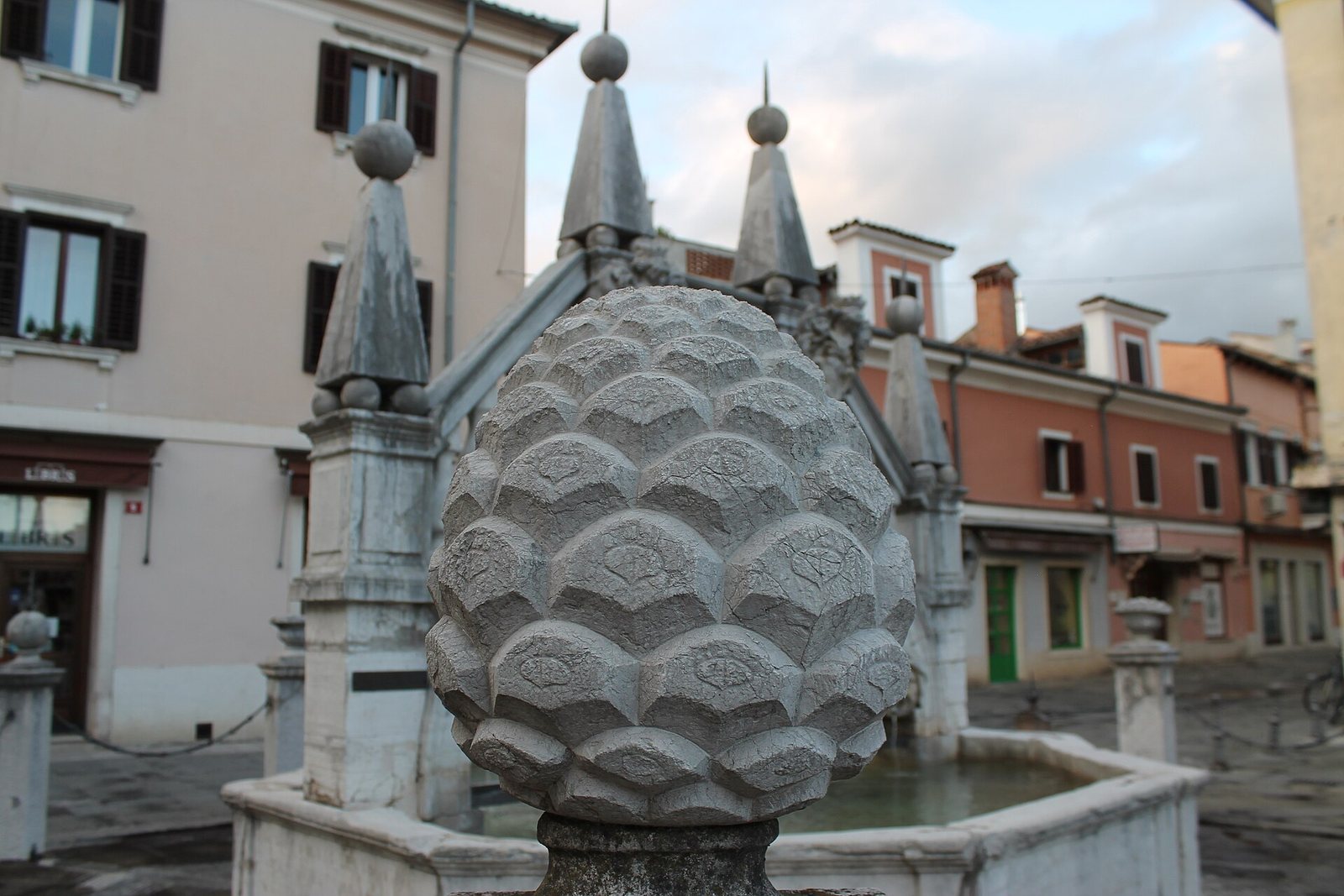
Fifteen stone posts encircle the basin and are linked by metal chains. The posts bear the coats of arms of the Koper patrician families that helped pay for the fountain. At the base of the arch, four carved faces, called mascarons, have open mouths that served as outlets for water into the basin.
Arch and ornament
A stone balustrade tops the arch, with decorative pyramid- or obelisk-like forms at its sides, along with stone spheres and heraldic details. The bridge shape also plays on Da Ponte’s surname, since ponte means “bridge” in Italian. It has been interpreted as recalling Koper’s historic connection to the mainland and its political ties with the Republic of Venice, a maritime state governed from Venice with influence and territories around the Adriatic. Although the arch has been compared with Venice’s Ponte delle Guglie because of their similar balustrade ornaments, it is not considered a direct copy; the Venetian bridge acquired its present form through later rebuilding, and the two are understood as sharing a broader Baroque vocabulary.
Conservation
The 1990 conservation renewed stone elements, the basin, sculptural decoration, and the immediate surroundings while retaining the fountain’s seventeenth-century Baroque composition.