Ciavieja: Archaeological Site of the Ancient City of Murgi
Site at a Glance
- Popularity
- Medium
- Country
- Spain
- Primary era
- Classical
- Eras represented
- Bronze Age, Classical
- Civilizations
- Roman
- Site type
- City
On this page10 sections
History
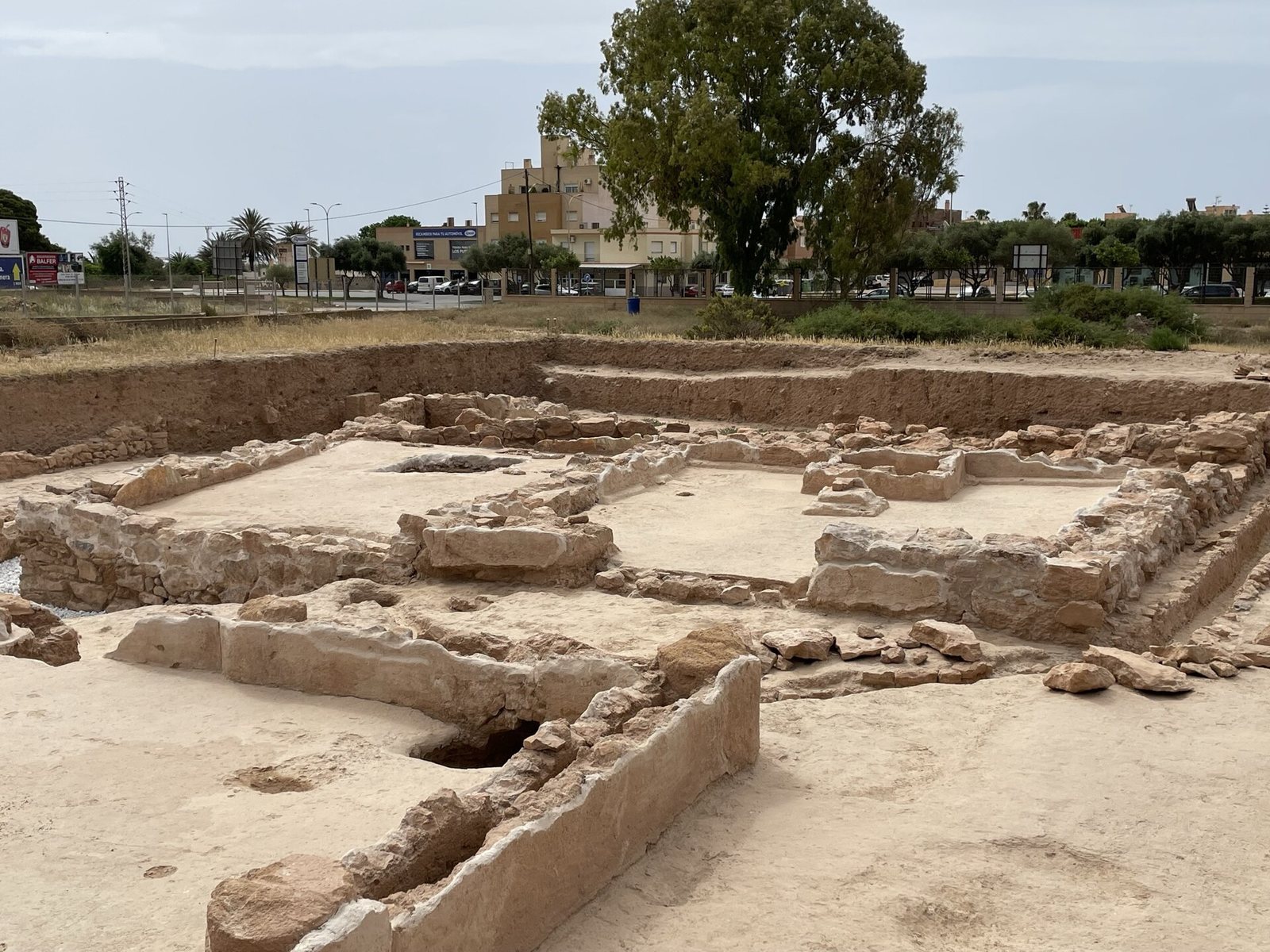
Ciavieja is an archaeological site associated with the ancient city of Murgi in El Ejido, Spain. Its history reaches from prehistoric settlement through the Roman period, when Murgi served as a regional political and administrative center.
Prehistoric and early settlement
Finds connect the area with Neolithic and Copper Age activity and with the Argaric culture, a Bronze Age society of southeastern Iberia. After a period without settlement, occupation began again in the fifth century BCE, initially under Tartessian influence and later under Carthaginian influence. The name Ciavieja has more than one proposed origin. One explanation derives it from the Latin civitas vetula, or ‘old city’, perhaps referring to Murgi. Another traces it to an earlier form, Cidavieja, with the intervocalic d lost in the Mozarabic speech of Almería before Castilian and Aragonese arrivals following the conquest of Granada.
Roman Murgi
After Rome drove the Carthaginians from southern Iberia in the late third century BCE, Murgi became a community required to pay tribute. It later gained the status of a municipium, a town with recognized civic standing, possibly following an edict by the emperor Vespasian. Three inscriptions referring to the res publica, the local civic community, support this status. A fragment naming the Quirina, one of Rome’s citizen tribes, has been taken to suggest an association between the city and that group.
Murgi first belonged to Hispania Ulterior, an early Roman province, and lay near the boundary between the provinces of Roman Hispania. After Augustus reorganized provincial government, the city became part of Baetica and the judicial district of Gades, the Roman name for Cádiz. Pliny the Elder placed Murgi at the boundary between Baetica and Tarraconensis, while the geographer Ptolemy located it between the Turduli settlements of Detunda and Salduba. The Turduli were an ancient people of Iberia.
As the center of the territorium Murgitanum, the land administered by Murgi, the city’s reach extended to the Sierra de Gádor and the Mediterranean coast to the south, with Urci to the east and Abdera to the west. Murgi also marked Baetica’s southeastern limit and was known for making garum, a fermented fish sauce prized by Romans. One proposed interpretation connects the name Murgi to Iberian place-names for fortified settlements on high ground, whose inhabitants later moved to lower locations. This has been suggested as a possible parallel for the site of present-day El Ejido.
Abandonment and archaeological investigation
Murgi was finally abandoned in the late Roman period. In 1983, engineer and amateur metal detectorist Andrés Ramírez Franco found part of a mosaic on a hill near the former route of National Road 340. Councillor Juan Llerena ordered its immediate protection, after which the Andalusian cultural authority recovered and safeguarded it. Excavations in 1985 explored the remains of a building thought to have included an elite Roman residence.
Ciavieja was added to the Andalusian General Catalogue of Historical Heritage as an archaeological zone in April 2017. University of Almería excavations between 2020 and 2022 covered more than 600 square metres. Work resumed in 2026 under archaeologist Carmen Ana Pardo, extending south to expose the outer face of the pre-Roman wall and addressing the baths, the wall, and the restoration of wall paintings.
Remains
The site contains remains from prehistoric, pre-Roman, and Roman occupation. These include burial and pottery evidence, a pre-Roman wall, a Roman building interpreted as baths, and remains associated with a Roman residence.
Pre-Roman evidence
Tombs and ceramics are associated with the Argaric culture. Finds from the Punic period include Greek pottery, particularly Athenian black-glazed and red-figure vessels that may have reached the site from nearby Abdera. Iberian bowls, plates, and other vessels, along with amphorae of Punic type, also belong to this period.
Roman buildings and civic features
Civic center and possible arena
Two pedestals dedicated to the emperors Hadrian and Caracalla point to a forum, the city’s public civic center, apparently with statues of the emperors. Nine Latin inscriptions date from the first through third centuries CE. They include a monumental inscription, a dedication, texts praising individuals, inscriptions commemorating the dead, and two whose type is uncertain. A second-century funerary inscription has been studied in its archaeological context, and painted texts appear on several amphorae. Ground-penetrating radar detected a circular wall that may be part of an amphitheatre, an arena for public spectacles. A second-century inscription honoring Porcia Maura mentions circus games and also supports the possibility of such a venue.
Pre-Roman wall and Roman baths
Excavations have identified a wall dating to the pre-Roman period and a Roman building interpreted as baths. The 2026 work extended south to reveal the wall’s exterior face.
Residence and mosaic
The mosaic found in 1983 belonged to a room in a Roman residence thought to have been an elite domus, or urban house. Part of the room’s wall survives above floor level, retaining traces of painted stucco. The step at the entrance still has sockets for the door hinges, and a passage runs beside the doorway. The incomplete mosaic dates to the third century CE and measures about 4.45 by 4.60 metres, covering roughly 20 square metres. Irregular blue, black, red, and white pieces form a design with branching acanthus foliage, fan-shaped palmettes, pointed leaves, flower cups, and small flowers. Maenads, female followers of Bacchus, represent the seasons. At the center, a seated panther is framed by repeated wave-like ornaments. The mosaic is now held in the Archaeological Collection of El Ejido.