Early Christian Necropolis of Santo Lio: A Rock-Cut Settlement in Sicily
Site at a Glance
- Popularity
- Medium
- Country
- Italy
- Primary era
- Medieval
- Eras represented
- Bronze Age, Classical, Medieval
- Civilizations
- Byzantine, Roman
- Site type
- City
On this page14 sections
History
The Early Christian Necropolis of Santo Lio is an archaeological area in Contrada Santo Lio, near Palazzolo Acreide in Sicily, Italy. Its earliest tombs date to about 2300–1600 BCE and belong to the Castelluccio culture, a prehistoric culture of Sicily. Later, a substantial rock-cut settlement developed during Late Antiquity, the transition from the ancient to the medieval world, and the Byzantine period, associated with the Eastern Roman Empire and its successors.
Late Roman and Byzantine settlement
Fertile land and access to water supported farming and the growth of a largely self-sufficient village. Its facilities included systems for collecting water, internal routes, cemeteries, places of worship, and oil mills. The settlement lay near the church of Bibbinello and beside an important road, probably the Via Selinuntina, thought to have linked Santo Lio with Akrai, an ancient Greek city in southeastern Sicily.
Some scholars have proposed that the Regia trazzera Fondi, a local road crossing part of the area, followed a route laid out by the Syracusans when they founded Akrai. Rock-cut monuments were reused by different communities over time, and the settlement’s history extended across Greek, Roman, and Byzantine cultural horizons.
Archaeological investigations
Investigations began around 1895, when Italian archaeologist Paolo Orsi and German archaeologist Joseph Führer examined the area around Canicattini Bagni, including Santo Lio. Führer surveyed and photographed several local cemeteries. He died in 1903 before completing his work; in 1907, his wife and Victor Schultze of the University of Greifswald reorganized his notes for publication in Berlin.
Later research was encouraged by Giuseppe Agnello, a scholar of Christian archaeology, the study of material evidence for Christian communities and practice. He held a chair in the subject from 1948 to 1963 and set students research on early Christian cemeteries in eastern Sicily. Studies of Santo Lio included Giuseppina Grasso’s thesis of 1952–53 and Salvatore Carpinteri’s work of 1955–56. The rock-cut monuments received occasional attention between 1957 and 1970; later studies by Santino Alessandro Cugno and Laura Carracchia included a thesis on the settlement in Contrada Santolio.
Remains
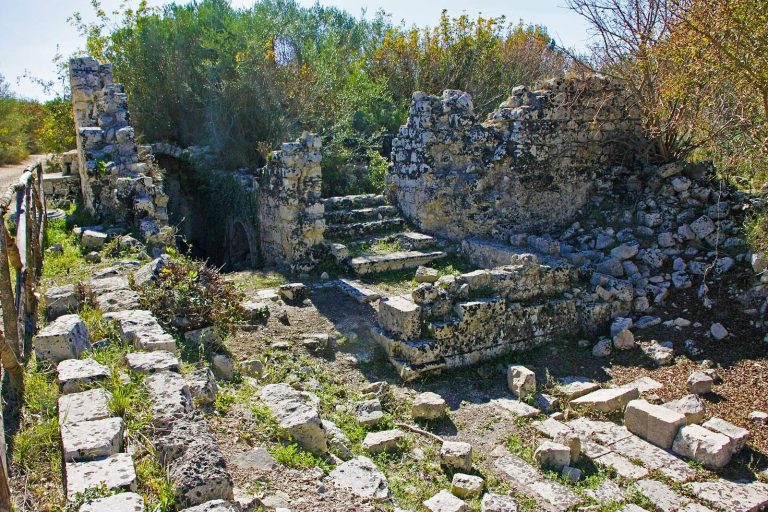
The extensive area contains rock-cut tombs, habitation features, and deep grooves in the stone. The settlement structures survive largely as surface traces, and their broad distribution has prompted the suggestion that more than one community lived here.
Water channels and routes
Some grooves are irregular and end in square basins; they appear to have collected rainwater. Other cuts are straighter and often parallel, and may have formed routes within the settlement.
Burial structures
Open-air tombs
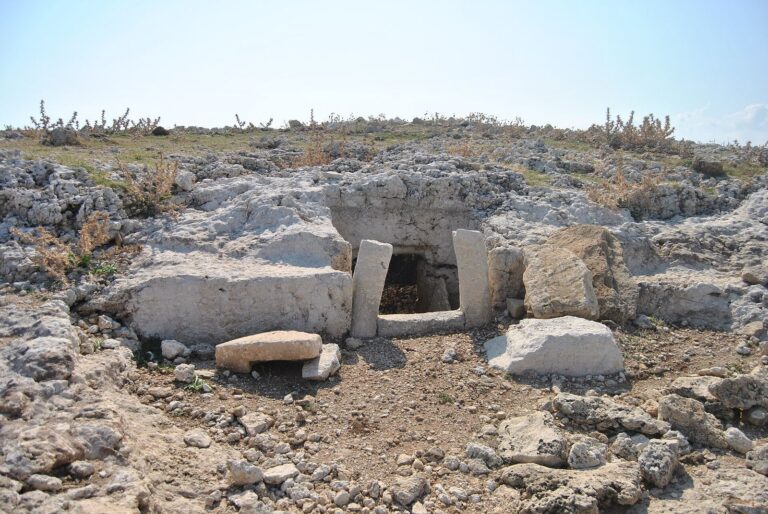
Some graves lie beneath arcosolia, arched recesses associated with burials, cut into the open rock above one or more rock-cut graves.
Underground chambers
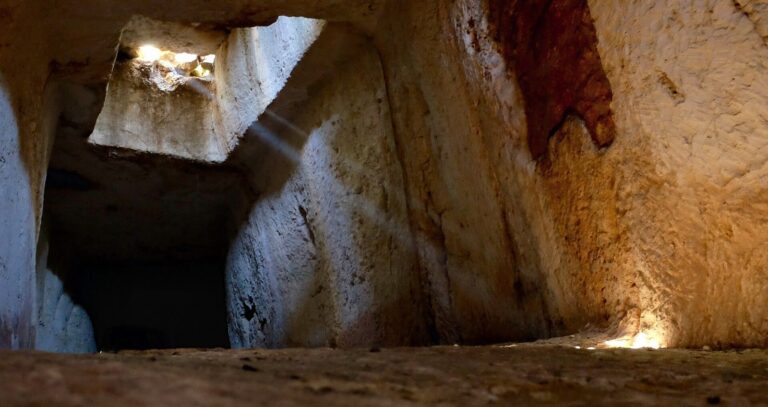
The small hypogea (underground burial chambers) have irregular plans, though their rooms are often roughly square. Some include one or more canopies, tomb recesses facing the entrance, or side passages. Burials were often closed with stones. In one chamber with two entrances divided by a pillar, the arrangement suggests that a partition once separated two rooms before its removal created a larger space.
Wall-cut tomb recesses
Other arcosolia were cut directly into walls, forming another recurring type of tomb in the cemetery.
Rock-cut dwellings and Christian features
The habitation caves have more regular plans than the tomb chambers. Their rooms vary in size and are usually square or rectangular; some have several spaces divided by pillars left in the rock. Entrances could be closed with wooden boards fixed to the lintels, the horizontal supports above doorways, or with dry-stone walls. Inside, niches and cavities at different heights occur alongside compartments, small benches, and sleeping platforms carved from the rock. Crosses cut into the stone and some chambers with cruciform plans have been taken to indicate a Christian settlement. Reuse in antiquity, environmental changes, and more recent excavation may all have altered parts of the rock-cut remains.
Finds
Pottery
Pottery is abundant across the area. The recognizable forms include plates, small jugs, and cooking vessels, among them large pots.
Bronze ornaments and buckles
A bronze earring from Contrada Santo Lio consists of a main ring with four smaller rings attached. Although this type circulated widely from the fourth to the eighth century CE, features of this example place it in the sixth or seventh century. Orsi also recorded numerous bronze belt buckles, some decorated with animal forms and others with plant designs, often rendered in a stylized manner. The buckles are broadly dated to the sixth or seventh century.
Incense burner
Orsi recorded a bronze-sheet incense burner dated to the sixth through eighth centuries. Its hemispherical bowl has a toothed pattern at the base and a curving cluster motif, while three holes at the top held chains that met at a small star-shaped fitting. A Greek inscription runs around the rim. Orsi considered household or church use possible, but favored a funerary purpose, noting that this type was found in Sicilian cemeteries; he suggested it may have hung above tombs. The formulaic votive phrases on such burners were almost certainly connected with prayers for the dead.