Pirene: The Ancient Fountain of Corinth
Site at a Glance
- Popularity
- High
- Country
- Greece
- Primary era
- Classical
- Eras represented
- Iron Age, Classical, Medieval
- Civilizations
- Ancient Greek, Byzantine, Roman
- Site type
- Civic
- Remains
- Fountain
On this page10 sections
History
Pirene is the lower fountain of ancient Corinth in Greece. Its earliest installations date to the Archaic period, the early phase of Greek history before the Classical period. Those installations have been dated to the eighth or seventh century BCE, while the earliest masonry is assigned to the seventh century or, more probably, the sixth. The fountain was among Corinth’s earliest constructions, alongside the temple of Aphrodite on Acrocorinth and the city’s northern walls.
Early history and traditions
Ancient writers used the name Pirene for a Corinthian fountain from the late Archaic period, but they did not agree about its location. Roman-era writers Strabo and Pliny connected the name with a spring on Acrocorinth, the mountain above the city. Pausanias, a Greek travel writer of the second century CE, said he had heard that this mountain spring was the true Pirene. The two springs became known as Upper and Lower Pirene, and tradition held that water from the upper spring fed the lower one.
Myths offered different explanations for the springs. In one, Pirene wept until she became a spring after Artemis, a goddess associated with hunting, accidentally killed her son Cenchrias. Pirene was variously described as the daughter of Asopus, a river god, or of the legendary King Oebalus, and as a beloved of Poseidon. Her sons Leches and Cenchrias gave their names to Corinth’s ports of Lechaeum and Cenchreae. A separate story explained Upper Pirene: Zeus, the chief god, abducted Aegina, a nymph or female nature spirit, and Sisyphus, Corinth’s legendary first king, told her father Asopus who had taken her. In return, Asopus made a spring flow continuously on the mountain.
Pirene was also associated with the Muses, goddesses of the arts and learning, and with Pegasus, the winged horse. Poets were said to drink there in search of inspiration. Pindar, a Greek lyric poet, made the earliest known literary reference to the fountain in Olympian 13, linking it with the hero Bellerophon’s capture of Pegasus. Another tradition said Pegasus created a spring by striking the ground with his hoof, although Pausanias’s account of the spring’s origin was more widely followed. The association between Pegasus and Upper Pirene probably developed in the Roman period. In another tale, Athena gave Bellerophon a golden bridle to tame Pegasus, allowing him to undertake the quest against the monster Chimera.
Roman and Byzantine transformations
Corinth was destroyed in 146 BCE, but Pirene appears to have escaped major damage. After the city’s refoundation in 44 BCE, the fountain’s façade was substantially changed within a generation. The complex underwent at least nine transformations. Archaeologist Bert Hodge Hill’s architectural sequence distinguishes twelve periods, seven of them Roman. During the Roman imperial period, the Greek public benefactor and public speaker Herodes Atticus restored the fountain, shaping its general form today.
In late antiquity, the open-air fountain was replaced by a circular basin. During the Byzantine period, the later eastern Roman era, five columns taken from different ruined buildings were set in front of the façade, no later than the fifth century. After part of the Byzantine façade was destroyed, a chapel was built in the courtyard’s southwest corner.
Disappearance and rediscovery
The fountain had disappeared by the Middle Ages, perhaps by the fourteenth century. Early modern travelers mistakenly identified other fountains as ancient Pirene. Excavations in 1898 rediscovered the actual site.
Remains
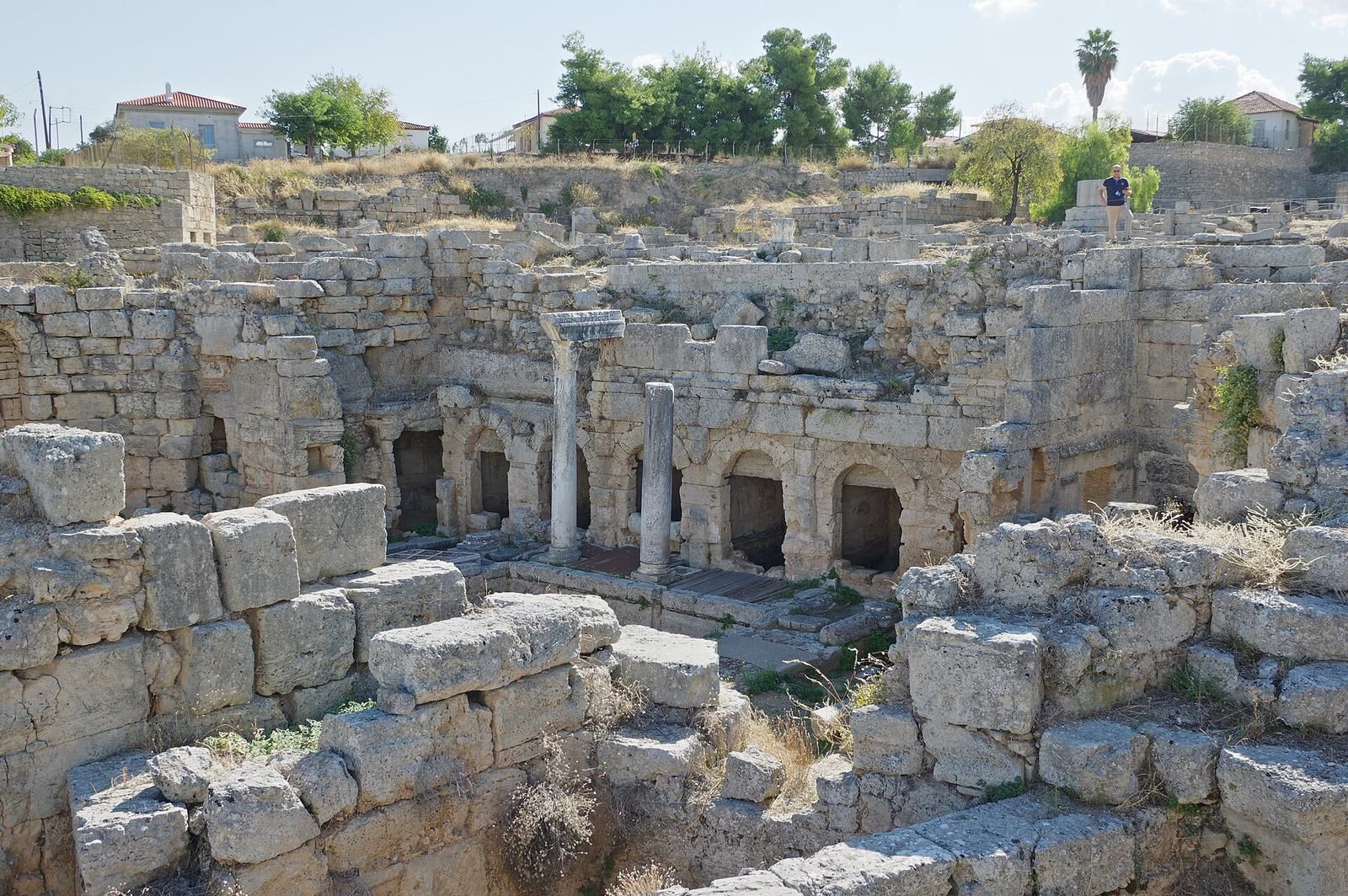
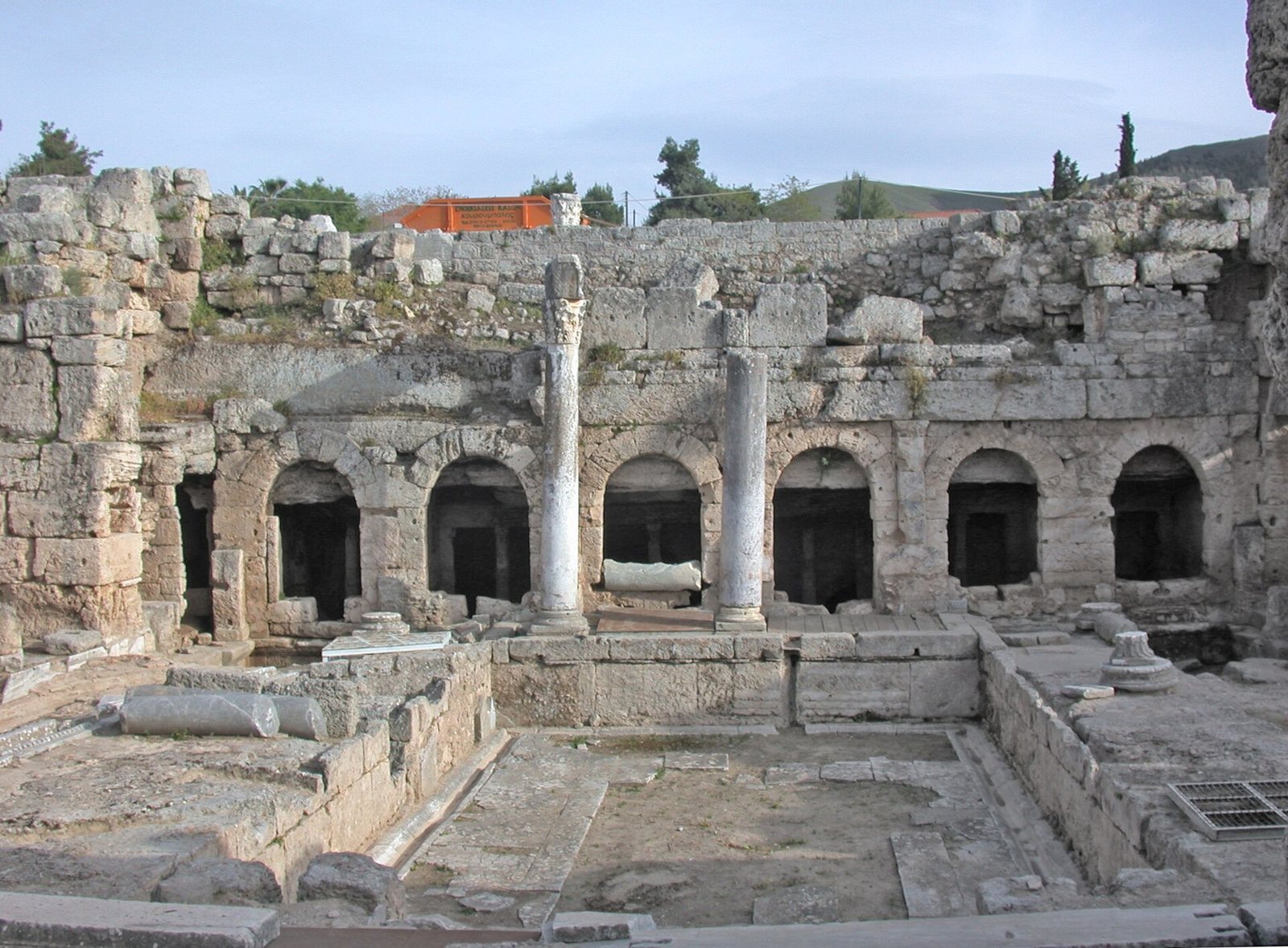
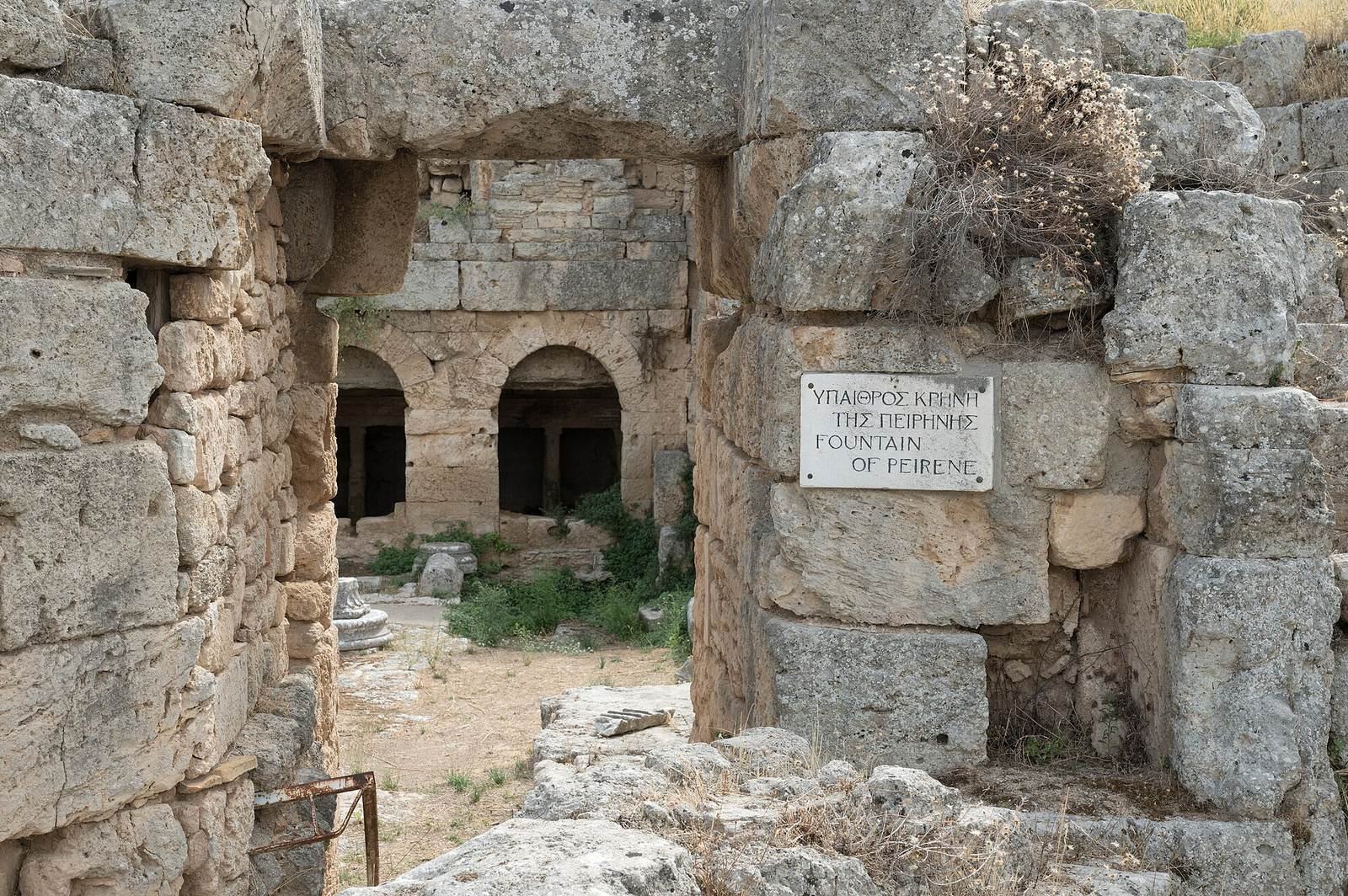
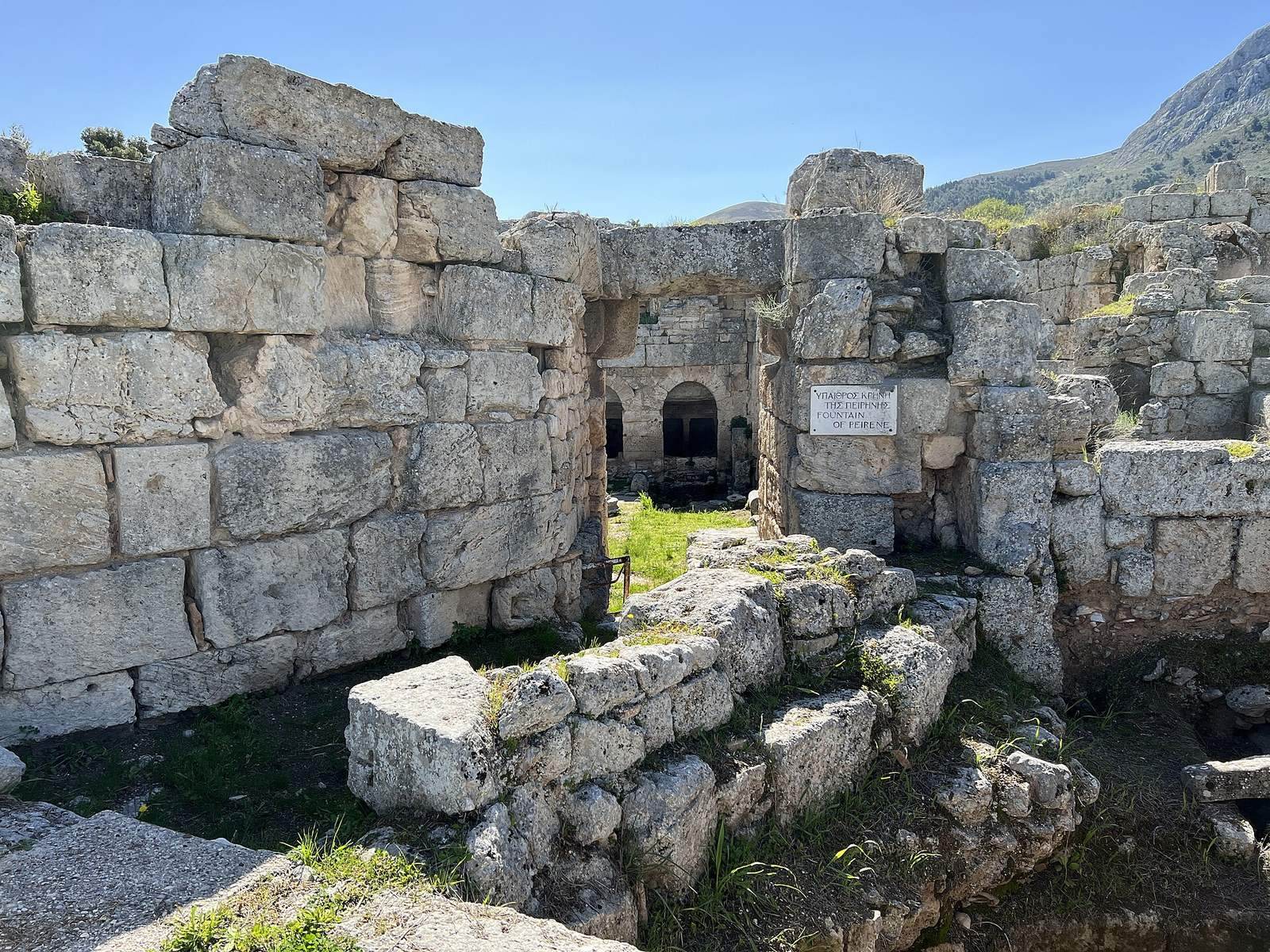
The fountain’s layout centers on a repeatedly altered monumental façade and a rectangular space flanked by three recessed or open-sided architectural areas. Six cisterns with arched ceilings formed part of the water system. Underground conduits extended nearly a kilometre, and all but three branches have been traced to their ends.
Greek and Roman installations
Greek water chambers
In the Greek-period arrangement, six entrance chambers stood behind an openwork screen, a patterned wall that allowed air and light through, decorated with Ionic-style half-columns. The chambers opened onto three basins for drawing water. Six reservoirs cut into marl, a soft sedimentary rock, supplied them.
Roman façade and courtyard
Following Corinth’s Roman refoundation, a wall with six arches was built in front of the Greek façade. A new low wall converted the entrance chambers into additional basins. By the fourth Roman architectural phase, a fountain in the open courtyard distributed water through at least fifteen outlets along the sides of a rectangular area cut into the ground.
Later basin and Byzantine additions
The circular basin that replaced the open-air fountain in late antiquity was destroyed during the 1898 excavations. Five columns from different ruined buildings had been erected before the façade during the Byzantine period. A chapel was subsequently built in the southwest corner of the courtyard after damage to part of the façade.
Pausanias’s description
Pausanias described a second-century fountain decorated with white marble, with cave-like chambers that discharged water into an open-air well. He praised the water’s taste and recorded a claim that it gave heated bronze a “Corinthian” color when the metal was plunged into it, since the Corinthians had no copper of their own. He placed the spring beyond a gateway on the road from the marketplace toward Lechaeum. Two gilded chariots stood on the gateway, one carrying Phaethon, son of Helius, the sun god, and the other Helius himself. Just inside, a bronze statue of Heracles stood to the right, beyond which lay the spring entrance. Pausanias also described an image of Apollo and a sacred enclosure near the spring, with a painting of Odysseus fighting the suitors inside.