Goat’s Bridge: An Ottoman-Period Crossing on the Constantinople Road
Site at a Glance
- Popularity
- Medium
- Country
- Bosnia and Herzegovina
- Primary era
- Early Modern
- Eras represented
- Early Modern, Modern
- Civilizations
- Austria-Hungary, Habsburg, Ottoman
- Site type
- Infrastructure
- Remains
- Bridge
On this page10 sections
History
Goat’s Bridge carries the Constantinople Road across the Miljacka in a rocky gorge about three kilometres east of Sarajevo’s old centre, in Bosnia and Herzegovina. It was probably built in the second half of the sixteenth century, during the Ottoman period. Its position on a major imperial route gave it importance beyond its local role as a river crossing.
Construction and the imperial road
The Constantinople Road ran east from Sarajevo through the Miljacka valley toward Prača and the Drina. Via Prača and Goražde, it connected Bosnia with the Sandžak, a historical region in the western Balkans, as well as Serbia, Macedonia, Constantinople (modern Istanbul), and other eastern regions. The route served as a principal transport artery from the fifteenth through the nineteenth century. Its crossing of the Miljacka at Goat’s Bridge formed part of this wider network.
The bridge’s precise founder and builder are unknown. A suggestion that it dates to Roman times has no supporting evidence. A traveller in 1550 described crossing bridges on the Miljacka while heading east from Sarajevo, but did not identify Goat’s Bridge; those crossings may have been earlier wooden structures. One leading theory places the bridge within road-building activity associated with Mehmed Pasha Sokolović, an Ottoman grand vizier from 1565 to 1579. It proposes that a craftsperson trained by the builder of Višegrad Bridge may have constructed it. This remains a circumstantial attribution, as does a proposed connection between the bridge’s design and position and the imperial engineering school in Constantinople.
An inscription associated with a kiosk beside the bridge records the kiosk’s installation in 1577-1578. The kiosk was probably built around the time the bridge was completed, but the inscription does not identify the bridge’s builder or commissioner.
Stories about the bridge’s name link it to goats and buried treasure. In one version, a poor shepherd noticed goats lingering beside a bush, found treasure there, and used his new wealth to study in Constantinople. He later entered imperial service and built the bridge in memory of the goats and his discovery. Another version tells of two brothers who found treasure in a cave while herding goats near Jarčedol. One supposedly built the bridge, while the other built a mosque in Bistrik. The mosque’s date and the identity behind its name have been debated, and the legend may have joined its history to that of the bridge. A separate, conjectural explanation connects the name with a livestock market near the road, where goats from Jarčedol may have been sold.
During Ottoman rule, the bridge also served as a gathering place for the arrival of newly appointed viziers, senior officials who governed the region. Notable Sarajevans and other residents came to welcome them. Some young men reportedly jumped from the bridge into the shallow river and received money from the visiting official.
Repairs during Ottoman rule
The earliest known written reference connected with the bridge appears in a 1771 entry by Sarajevo chronicler Mula Mustafa Bašeskija. It describes a stone wall built from Goat’s Bridge toward Alifakovac using funds from Haji Osman Hadžibektašević’s endowment. The entry concerns the road leading to the bridge, rather than the bridge itself.
An Ottoman tax assessment from the tenure of Bosnian vizier Husamudin Pasha lists substantial spending on bridge repairs. It itemizes payments for dressed stone, masons, laborers, timber and iron, transport, and supervision. The work may have followed Sarajevo’s major flood of 1768. Bašeskija described extensive damage to bridges in the city and surrounding area, but did not name Goat’s Bridge. The recorded timber and iron costs suggest that scaffolding was needed and that the arch may have been badly damaged, although the cause and extent of the damage remain uncertain.
Four years after the repair account, a temporary wooden bridge was built nearby so that traffic could continue while work proceeded on the damaged stone crossing. The materials included flooring boards, wooden supports, and oak timbers. In 1799, the rebuilt stone arch collapsed as its scaffolding was removed. Five or six craftsmen were beneath it; one died and the others were injured. A later legend tells of a builder standing under the arch at the moment the supports came down.
A record from 1838 concerns repairs to the road leading to the bridge and to a damaged cemetery wall at Alifakovac. The work was paid for from one-third of Haji Mustafa-aga Begić’s estate, which he had set aside for that purpose in his will. The last repair recorded during Ottoman rule took place in 1866, after part of the bridge had deteriorated.
Changing routes and conservation
Under Austro-Hungarian rule, which lasted in Bosnia and Herzegovina from 1878 to 1918, roadworks toward Pale led to alterations at the bridge between 1880 and 1888. Once a newer route made the old road redundant, the bridge lost most through traffic and was used mainly by pedestrians and local carts. Its reduced use was accompanied by inadequate maintenance.
Repairs and conservation took place in 1956-1957. In 2004, the Commission for the Preservation of National Monuments, Bosnia and Herzegovina’s body for protecting nationally recognized monuments, designated Goat’s Bridge a National Monument of Bosnia and Herzegovina.
Remains
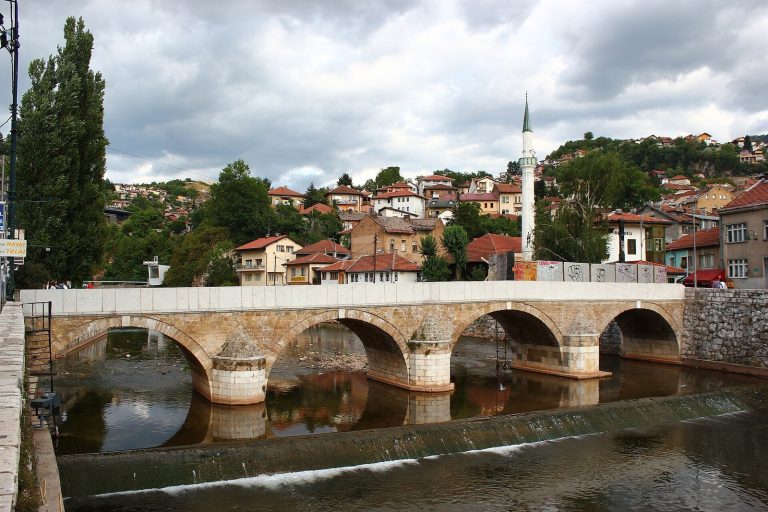
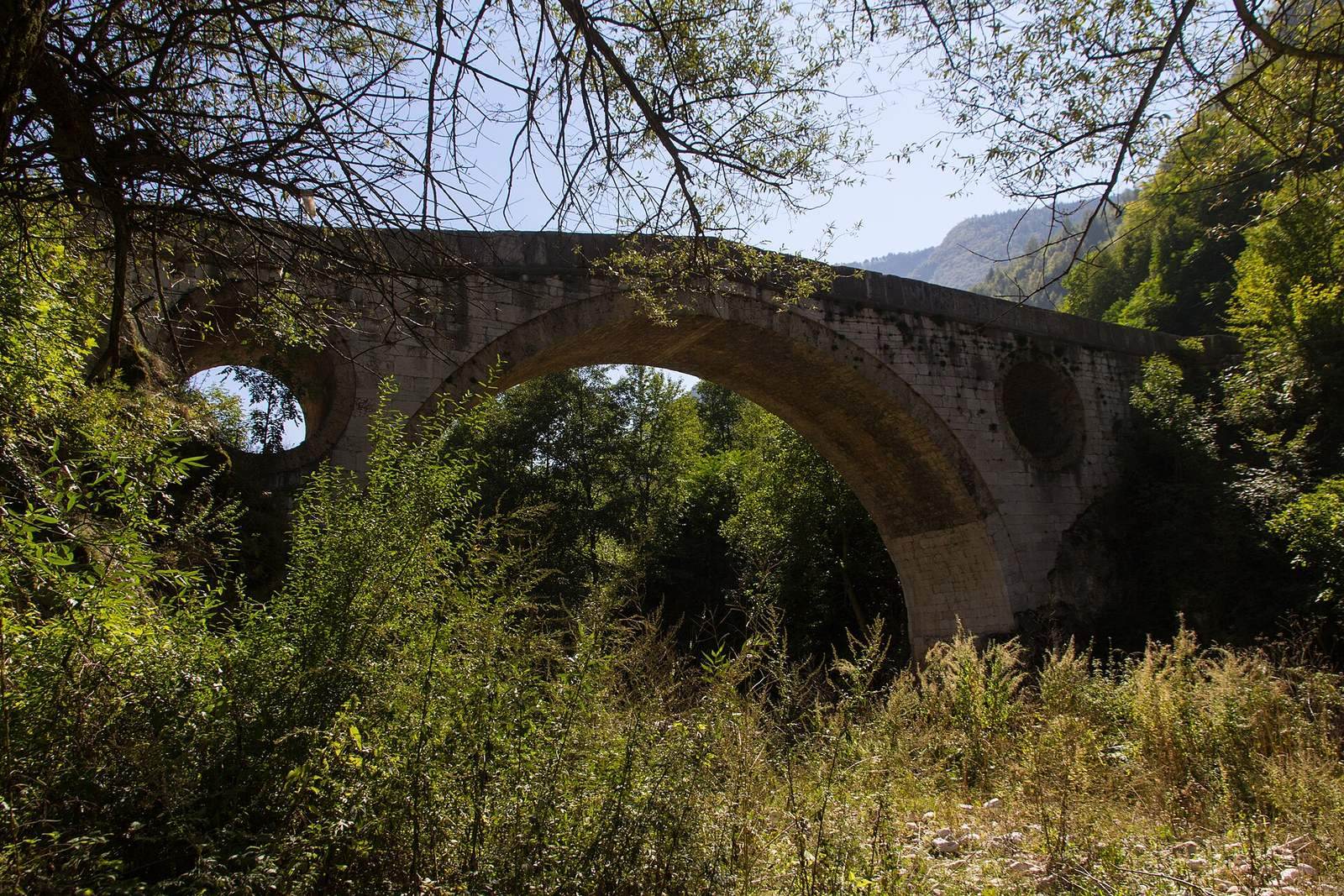
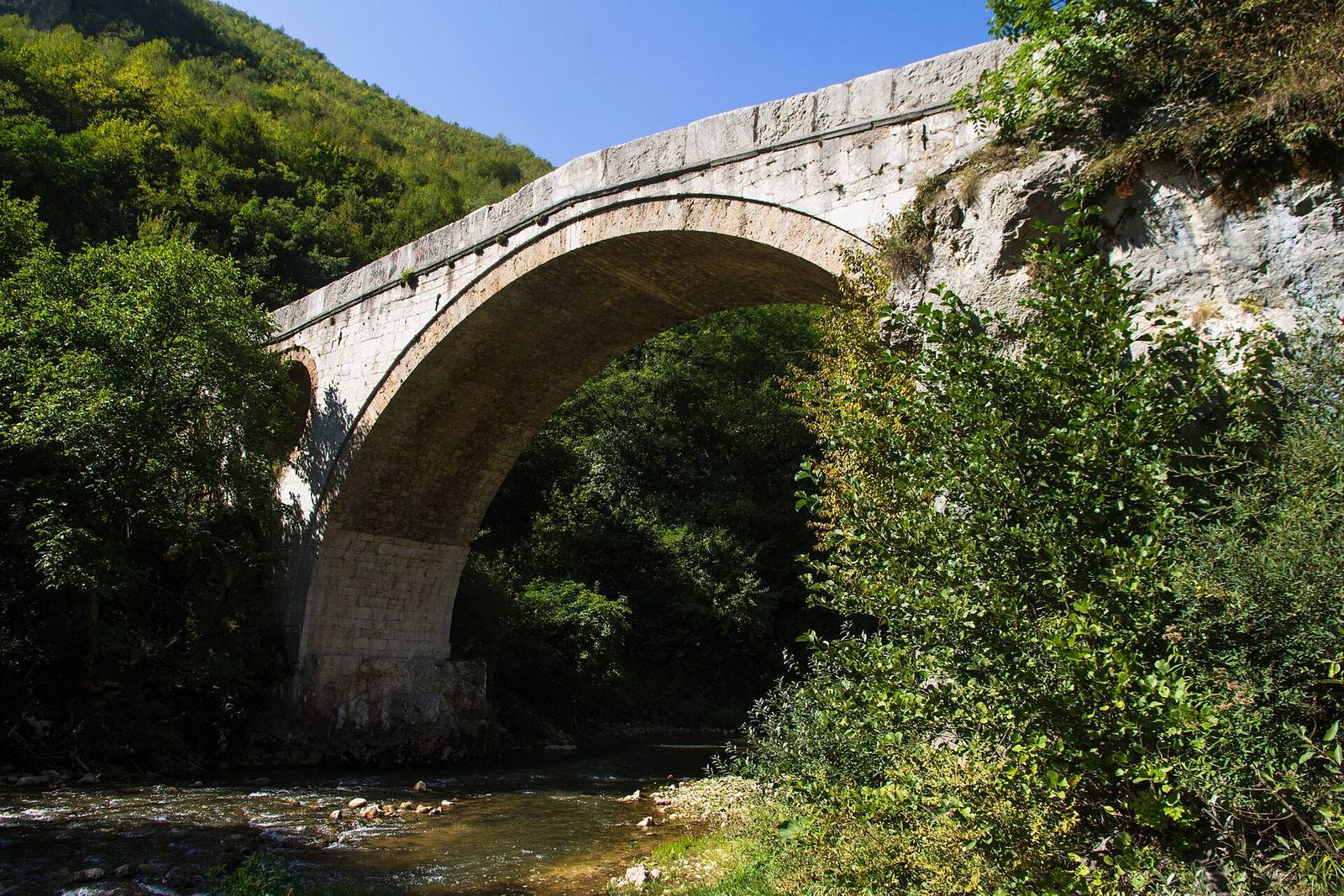
The bridge crosses a narrow, rocky gorge where the Miljacka runs between steep banks. Two rocky masses of roughly equal height constrict the crossing to about 17.5 metres. The bridge combines one main arch with smaller openings in its front walls, and its stonework and roadway preserve evidence of later alterations.
Bridge structure and associated feature
Main arch and openings
The bridge has a single, slightly flattened arch that is approximately semicircular and spans about 17.6 metres. Its curve begins roughly two metres above the river’s normal level, leaving about ten metres between the water and the arch’s underside. Two semicircular openings in the front walls, called relieving openings because they reduce the structure’s weight, measure about 3.01 and 3.15 metres across. They sit asymmetrically in relation to the main arch and the projecting band above them. The stones forming the arch curve are set back from the front walls, while the tufa frames around the smaller openings are recessed by about three to four centimetres.
Stonework and foundations
Limestone and tufa, a porous limestone formed by mineral-rich water, make up the bridge. Limestone forms the lower arch, tufa its upper section, and regularly cut Sarajevo limestone the front walls. The pale limestone contrasts with the ochre-coloured tufa. The bridge’s end supports rest on bedrock: rock is visible beneath the left-bank support and lies underwater beneath the one on the right. Several courses of vertically laid stone form the supports.
Roadway and approaches
The bridge measures about 42 metres in a straight line and 49 metres along its full length. Its average width is approximately 4.75 metres, with noticeable variation, particularly near the left bank. A white limestone projecting band and a low protective wall, or parapet, mark the roadway’s profile. Both survive on Goat’s Bridge, though they had disappeared from other old bridges in Sarajevo. The walkway is paved with cobbles, renewed during later bridge works.
Road changes under Austro-Hungarian rule raised the approach levels. On the right bank, stonework was added above the front walls to bring the approaches into line with the newly cut road. During conservation in 1956, workers removed a raised section of the left-bank path and returned the projecting band and parapet to their earlier positions.
Kiosk inscription
A kiosk stood beside the bridge as a separate structure. The text of its inscription survives and records the kiosk’s installation date.
Goat’s Bridge is the only fully preserved old Ottoman-period bridge still spanning the Miljacka, and one of four old bridges preserved in Sarajevo.