Kekeki Sinan Bakarević Mosque: An Ottoman Neighborhood Mosque in Sarajevo


Site at a Glance
- Rating
- 5
- Popularity
- Very Low
- Country
- Bosnia and Herzegovina
- Primary era
- Early Modern
- Eras represented
- Early Modern
- Civilizations
- Ottoman
- Site type
- Religious
- Remains
- Mosque
On this page7 sections
History
Kekeki Sinan Bakarević Mosque, also known as Bakareva Mosque, is an Ottoman-style neighborhood mosque in Sarajevo, Bosnia and Herzegovina. Its origins lie in a small Muslim prayer place built before 1515, when the city’s Ottoman urban quarters were developing along the Miljacka River. The mosque served the local community of Bistrik and remains administered by the Islamic Community in Bosnia and Herzegovina.
Early Ottoman origins
By 1515, seven neighborhoods had formed on the left bank of the Miljacka River. One of these was associated with the mosque’s predecessor, the Kečedži-Jusuf mescid. A mescid was a small Muslim prayer place, generally distinct from a mosque used for congregational Friday prayer. The neighborhood contained 61 houses, and cadastral registers of the Bosnian Sanjak identify the founder’s surname as Kekeki rather than Kečedži. They also indicate that Kekeki built the mescid before 1515.
The founder’s activities extended beyond the prayer place. He built a stone fountain within the enclosure wall and a stone turbe, a mausoleum or tomb structure associated with a Muslim burial, beside the mosque. The fountain later became locally known as Švrakina Fountain after a Sarajevo mufti repaired it.
Destruction and restoration
The mosque was destroyed during the great fire of 1697. It was restored in 1763–1764, and a Turkish inscription above the entrance records that rebuilding. The restoration became a lasting part of the building’s historical identity and explains the date preserved on the entrance plaque.
War damage and protection
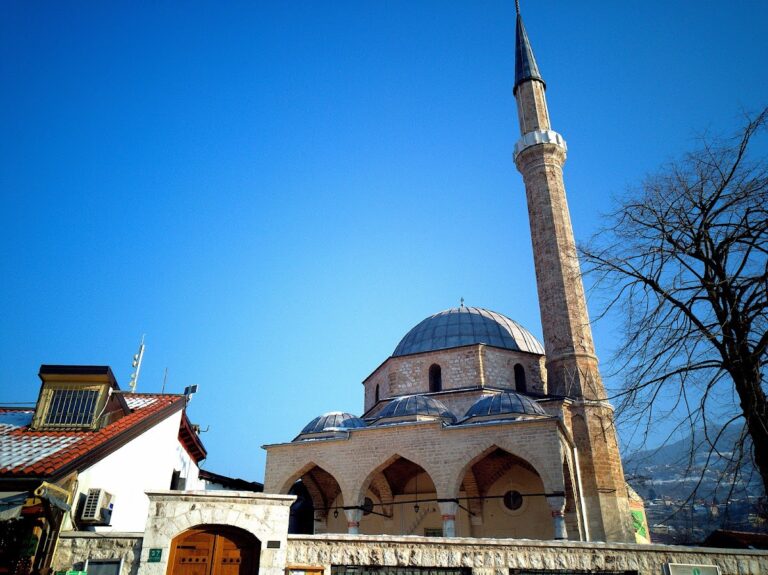
During the 1992–1995 war in Bosnia and Herzegovina, shelling destroyed part of the minaret above its projecting balcony, known as a šerefe, from which the call to prayer is traditionally proclaimed. The attack also severely damaged the roof, walls, doors, and windows. Reconstruction and restoration followed from 1997 to 2000 under the supervision of the Cantonal Institute for the Protection of Cultural-Historical and Natural Heritage.
The mosque was designated a National Monument of Bosnia and Herzegovina by the Commission for the Preservation of National Monuments on 7 December 2017. The protected monument includes the mosque, its courtyard and cemetery enclosure, and its fountain. The building remains in use and is maintained in good structural condition.
Remains
Prayer hall and minaret
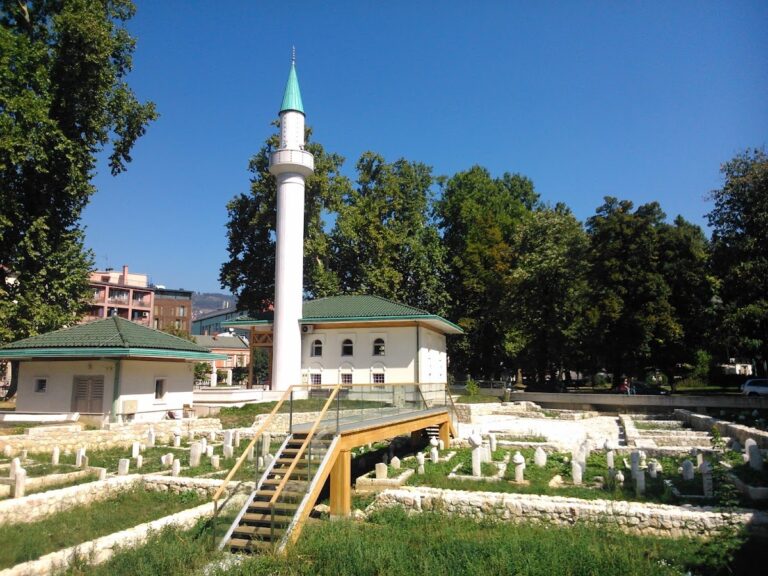
The mosque is a single-space building with a hipped roof and a stone minaret. Its adobe walls are plastered and approximately 70 centimetres thick. Together with the wooden entrance porch, the building measures about 10.61 by 15.30 metres externally. The prayer space and porch share one hipped roof, preserving the compact form typical of a neighborhood mosque.
The rectangular entrance portal measures 2.78 by 5.20 metres and projects 25 centimetres from the wall. A tall arch above it is finished in stepped stages. Set above the entrance, a stone plaque measuring 60 by 40 centimetres carries the Turkish inscription commemorating the 1763–1764 restoration.
The stone minaret rises 28.85 metres. Its square-based stone pedestal is approximately 5.30 metres high, while part of the tower projects into the mosque’s interior and passes through the sloping roof. An ablution room made of reinforced concrete was added beneath the porch.
Courtyard, cemetery, and fountain
The harem, meaning the mosque courtyard or enclosure in the architectural terminology used for Balkan mosques, lies beside the building and includes a cemetery. Approximately 150 gravestones of different sizes and forms date from 1795 to 1881. The oldest recorded stone dates to 1795–1796. Burials include members of the Bakarević, Sokolović, and Turhanija families, linking the enclosure to several established Sarajevo families.
Švrakina Fountain is set into the stone retaining wall of the courtyard enclosure. It measures 130 by 70 by 35 centimetres and has a depth of 20 centimetres. Built from stone blocks, it has a basin carved from a single block, a pointed-arch profile, and a roof made of dressed stone. Together with the cemetery enclosure and the mosque, it forms part of the surviving architectural complex.