Teos: An Ancient Ionian City in Turkey
Site at a Glance
- Popularity
- High
- Country
- Turkey
- Primary era
- Classical
- Eras represented
- Iron Age, Classical, Medieval
- Civilizations
- Ancient Greek, Byzantine, Roman
- Site type
- City
On this page23 sections
History
Teos was an ancient Greek Ionian city on the western coast of Asia Minor, in present-day Turkey. People lived there by about 1000 BCE, although the date of the city’s formal foundation is uncertain. Traditions describe several settlement groups, beginning with Minyans from Orchomenus led by Athamas, followed by Ionians under Apoecus and then Athenians and Boeotians under leaders including the sons of the legendary Athenian king Codrus.
Ionian city and Persian rule
Teos belonged to the Ionian League, a confederation of Greek cities along the coast of Asia Minor, and was part of the league’s Lydian dialect group. Around 600 BCE, Thales of Miletus proposed that its central position made it a suitable meeting place for the Ionian cities, but they did not adopt the plan. Colonists from Teos and Erythrae helped establish Phocaea, and Teos also joined other Greek cities in founding a settlement at Naucratis in Egypt. During the reign of Pharaoh Amasis II, Teos and eight other cities contributed to the Hellenion, a Greek sanctuary at Naucratis.
Maritime trade helped Teos prosper, particularly in the sixth century BCE. Its wine was well known, while other sources of income included animal husbandry, textile and pottery production, and the export of timber and limestone. From the late fourth century BCE, the city also produced fine clothing from Milesian wool. In the fourth century, an estimated 2,000 to 3,000 people lived there, including about 400 members of the wealthy class.
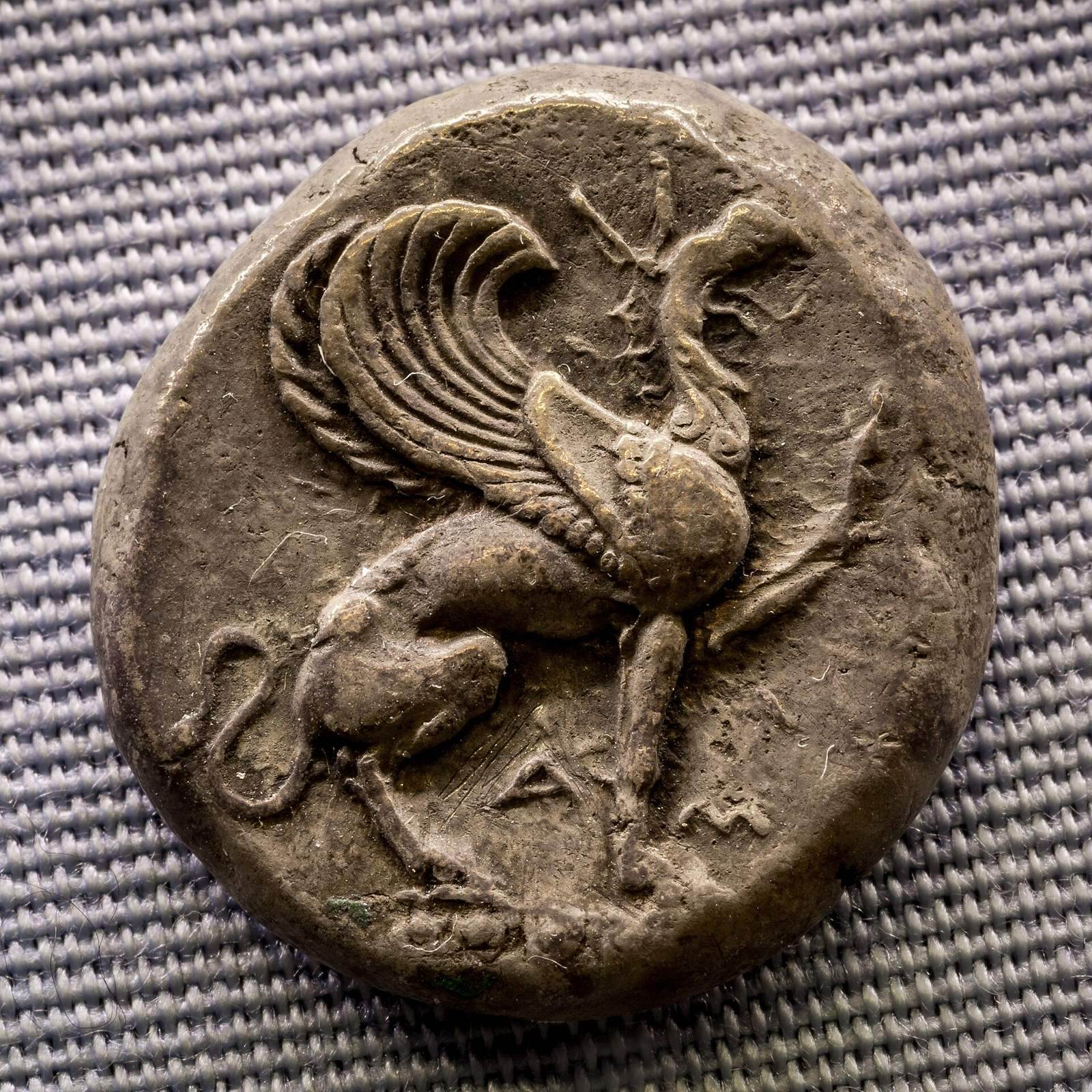
Teos issued coins from the late sixth century BCE. Its silver staters, an ancient coin denomination, and those of Abdera bore a griffin from about 520 to 515 BCE. Electrum, a natural alloy of gold and silver, was also used for Teian coins. The griffin was associated with Dionysus, the Greek god of wine, performance, and festivity. Abdera may have helped channel Thracian silver to Teos, supporting the city’s financial independence during Persian rule.
Before the Persian conquest, Teos was subject to Croesus, king of Lydia. After Cyrus II conquered Lydia, his commander Harpagus brought the coastal Greek cities under Persian control in 546 BCE. Many Teians left around 545 to 540 BCE. They founded or helped establish Abdera in Thrace and Phanagoria on the Asian shore of the Cimmerian Bosporus, the strait between the Black Sea and the Sea of Azov. The lyric poet Anacreon was among those who went to Abdera. Some Teians stayed or later returned, and the two cities retained close political, commercial, and religious connections into the second century BCE. They shared festivals, and Abdera adopted Teian laws.
Teos joined the Ionian Revolt, a Greek uprising against Persian rule, and sent 17 ships to the Battle of Lade in 494 BCE. Persian control ended after the Greek victory at Mycale in 479 BCE. Teos then belonged to the Athenian-led Delian League until 412 BCE, when it came under Spartan control. Spartans took the city in 407 or 406 BCE, under either Lysander or Callicratidas. The Athenian general Conon recovered it in 394 BCE. The Peace of Antalcidas, a treaty that assigned Greek cities in Asia Minor to Persia, returned Teos to Persian rule in 386 BCE.
Hellenistic kingdoms
Alexander the Great’s victory at the Granicus in 334 BCE ended Persian control of Teos. The city established a sanctuary to Alexander and held the Alexandrian Games there. After Alexander’s death in 323 BCE, Teos became part of the contests among the Hellenistic kingdoms, whose ruling dynasties competed for territory. Antigonus I captured the city in 319 BCE and later tried to unite it with nearby Lebedos, between 306 and 302 BCE, but the plan failed. In 302 BCE, Lysimachus’s commander Prepelaus took Teos. Lysimachus subsequently moved many residents of Teos and Lebedos to Arsinoe, the new name for Ephesus.
After Lysimachus died in 281 BCE, Teos passed to the Seleucids. Seleucid and Attalid rulers, the latter based at Pergamum, disputed control during the third century BCE. Teos was under Achaean control from 222 to 218 BCE and had come under Attalus I by 205/204 BCE, before returning to the Seleucids that year. The city supported Antiochus III in the war between Rome and the Seleucid kingdom. After Roman and Rhodian forces defeated Antiochus’s fleet at Myonnesus in 190 BCE, Teos appealed to the Roman Senate to prevent the city from being plundered. The Peace of Apamea, which ended the conflict, transferred Teos to Pergamum in 188 BCE. Inscriptions from the middle of the second century BCE attest to worship of Pergamum’s ruler Eumenes II in the city.
Dionysus was Teos’s principal deity, and the city also particularly honored Poseidon, the god associated with the sea. Its annual religious calendar included the Anthesteria and Dionysia for Dionysus, as well as festivals for Heracles and Zeus. Teos and Abdera shared major celebrations, including festivals for Heracles and Zeus. In the fourth century BCE, Teos was a center for the Dionysian Artists, an association of actors, singers, musicians, and poets whose touring groups performed across western Asia Minor. Relations between the association and the city later deteriorated, and the artists moved to Ephesus around the middle of the second century BCE.
Government and Roman rule
A civic inscription from the 470s BCE indicates that Teos had a democratic system. The assembly and council were its principal governing bodies. From the fourth to the first century BCE, a prytanis, a senior civic magistrate, held the chief magistracy, while the timouchoi served as an executive body. The city had four Ionian-Attic tribes, of which the Geleontes are the only known by name. The Apatouria, a festival associated with civic and kinship groups, and divisions based on both territory and family ties are also attested. Under Roman rule, a strategos, a military commander who could also exercise civic authority, governed the city, and citizens performed public services at their own expense.
Inscriptions preserve agreements between Teos and Rome, the Aetolians, Crete, and other states. Some protected the inviolability of Teian territory, affirmed the precedence of Dionysus, or recognized the right of asylum. In 133 BCE, Attalus III bequeathed Pergamum to Rome. Rome established its province of Asia, an administrative territory in western Asia Minor, in 129 BCE. Teos declined under Roman rule and was struck by an earthquake in 47 or 46 BCE. Augustus contributed to its rebuilding. The city remained known in the Roman period for its wine, theatre, and sanctuary of Dionysus.
Christian and Ottoman periods
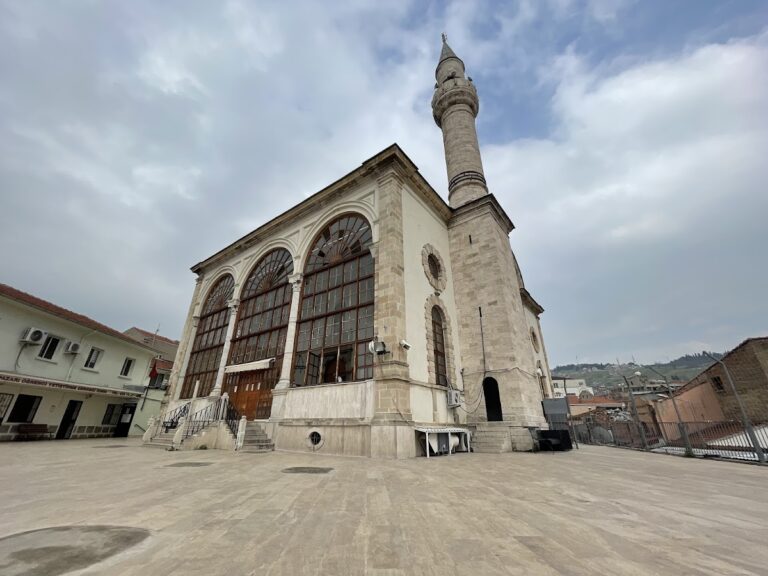
Teos later had a Christian bishopric subordinate to Ephesus. Bishop Maximus attended the Council of Nicaea in 325 CE, a gathering of Christian bishops, and Gennadius attended the Council of Chalcedon in 451. Teos subsequently became a former Catholic diocese subordinate to Ephesus. In the sixteenth century, the Ottoman Empire built a fortress in the area; stone from the ancient theatre was reused in its construction.
Archaeological investigation
Investigation of the Temple of Dionysus began in 1862, when architect and archaeologist Richard P. Pullan prepared detailed plans. French archaeologists continued work in 1924. Ankara University resumed investigations in the 1960s, and Y. Boysal and B. Öğün excavated the temple and carried out its first restorations between 1962 and 1967. N. M. Uz studied the building from 1980 to 1991. Intensive cultivation across the ancient urban area complicates excavation, while surveys have collected pottery brought to the surface by ploughing.
Remains
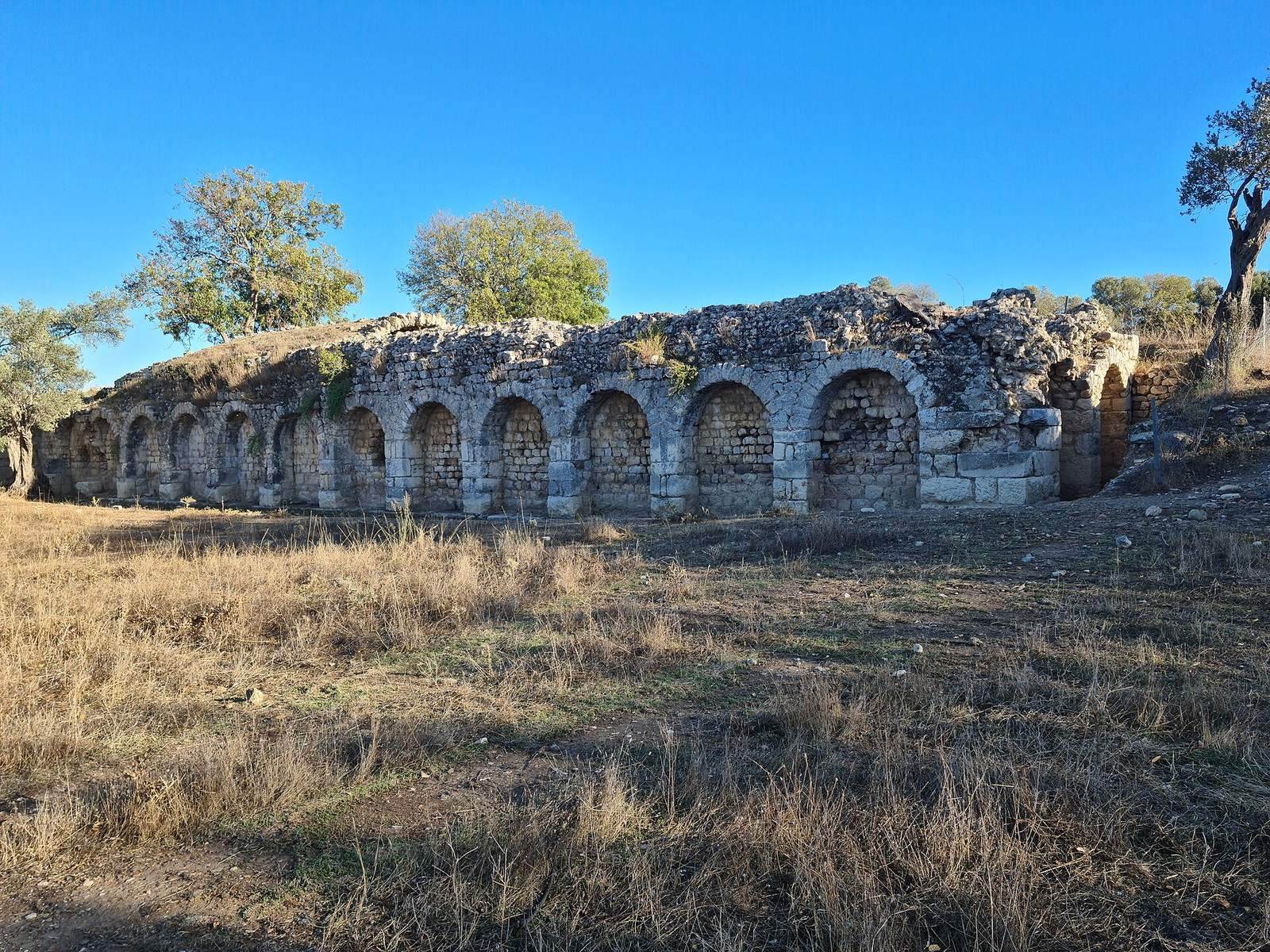
Teos occupied a peninsula between Chytrium and Myonnesus, with two harbors on its northern and southern sides. Its acropolis stood on a north-south ridge, now called Kocakirtepe, about 35 metres high; most of the lower city lay between this high ground and the southern harbor. The estimated territory of the city covered about 100 to 200 square kilometres. Limestone was used in the city walls and in the masonry of houses, while streets, public buildings, harbors, and sanctuaries occupied distinct parts of the urban area.
Defenses and harbors
City walls and gates
The Hellenistic circuit extended about 3.7 kilometres and enclosed roughly 0.5 square kilometres of the lower city. Built of limestone and about four metres thick, it ran from the acropolis toward the southern harbor. Its course can still be traced around the city, with the strongest remains on the west and south and surviving sections on the east and north. Construction is generally dated between the late fourth and early second centuries BCE. A separate stretch of Archaic wall survives in the western acropolis area, where fortifications date to the sixth century BCE. Three gates are identified: the Herodotus Gate southeast of the acropolis, the Dionysus Gate west of the Temple of Dionysus, and the South Necropolis Gate, set between two towers on the way to the southern harbor. The necropolis lay beyond the walls.
Harbors
The northern and southern harbors were about 30 stadia apart, using an ancient Greek measure of distance. Strabo called the northern harbor Gerreídas; it is associated with the present harbor at Sığacık. Underwater remains of breakwaters survive at both sites. Silting made the southern harbor unusable, but its east-west breakwater remains for about 200 metres. The southern harbor is among the best-preserved ancient harbors in western Anatolia.
Acropolis and sanctuaries
Acropolis buildings
The acropolis contains the remains of a rectangular temple from the late Archaic period, measuring about 37.4 by 7.3 metres, and a second building, about 9.6 by 18.2 metres. The latter has been interpreted either as an altar or as a structure from the Roman period. Finds dated to 630 to 590 BCE from the space between the two buildings indicate religious use of this area.
Temple of Dionysus
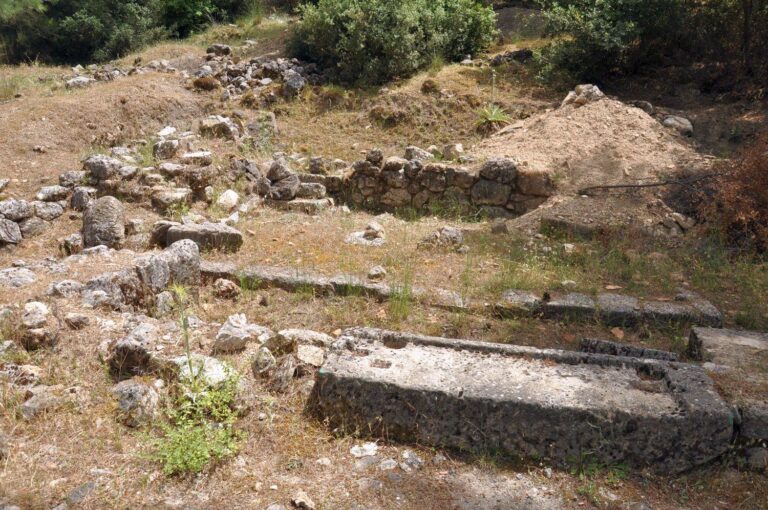
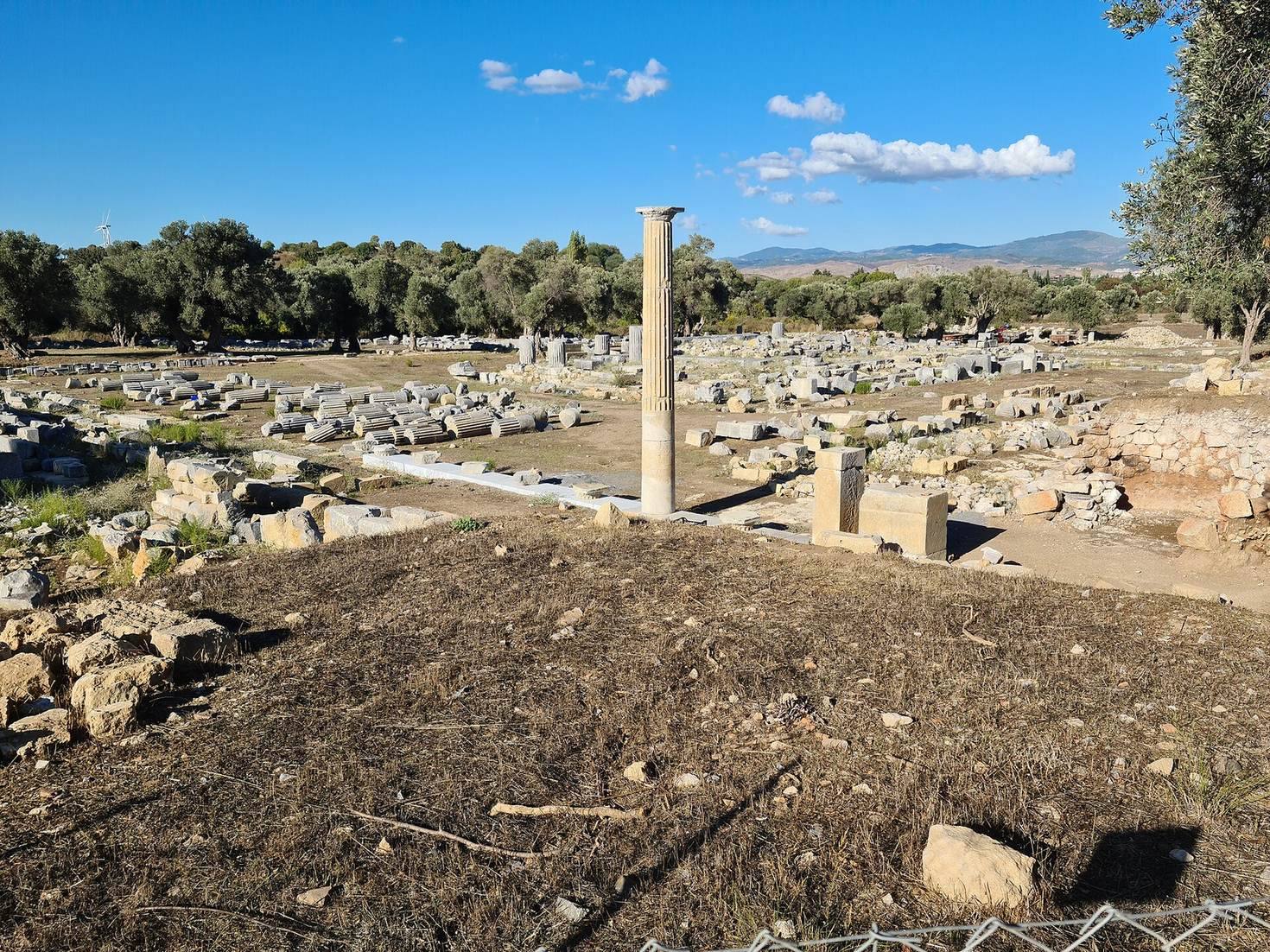
The Temple of Dionysus stood within the western city wall, inside a sacred precinct. Its construction has been dated either to the last quarter of the third century BCE or to the second quarter of the second century BCE; an earlier temple also occupied the site, but its date is uncertain. Designed by Hermogenes of Priene, the building had an Ionic design, a Greek architectural style recognized by its scroll-shaped column capitals, and a single colonnade around the exterior. Six columns stood along each short side and eleven along each long side. The supporting platform measured about 35 by 18.5 metres. Its entrance porch had two rows of columns, leading to a main chamber and a rear chamber.
Four colonnaded walkways surrounded the temple, with Doric ones to the north and south and Ionic ones to the east and west. An altar was customarily placed on the eastern side. Some columns have been restored, while the roof ornaments and sections of the carved relief frieze are held at the archaeological museum in Izmir. The temple was the largest temple dedicated to Dionysus in the ancient world. Its architectural details resemble those of the Temple of Athena at Priene and the Temple of Artemis at Magnesia on the Maeander.
Public and performance buildings
Theatre
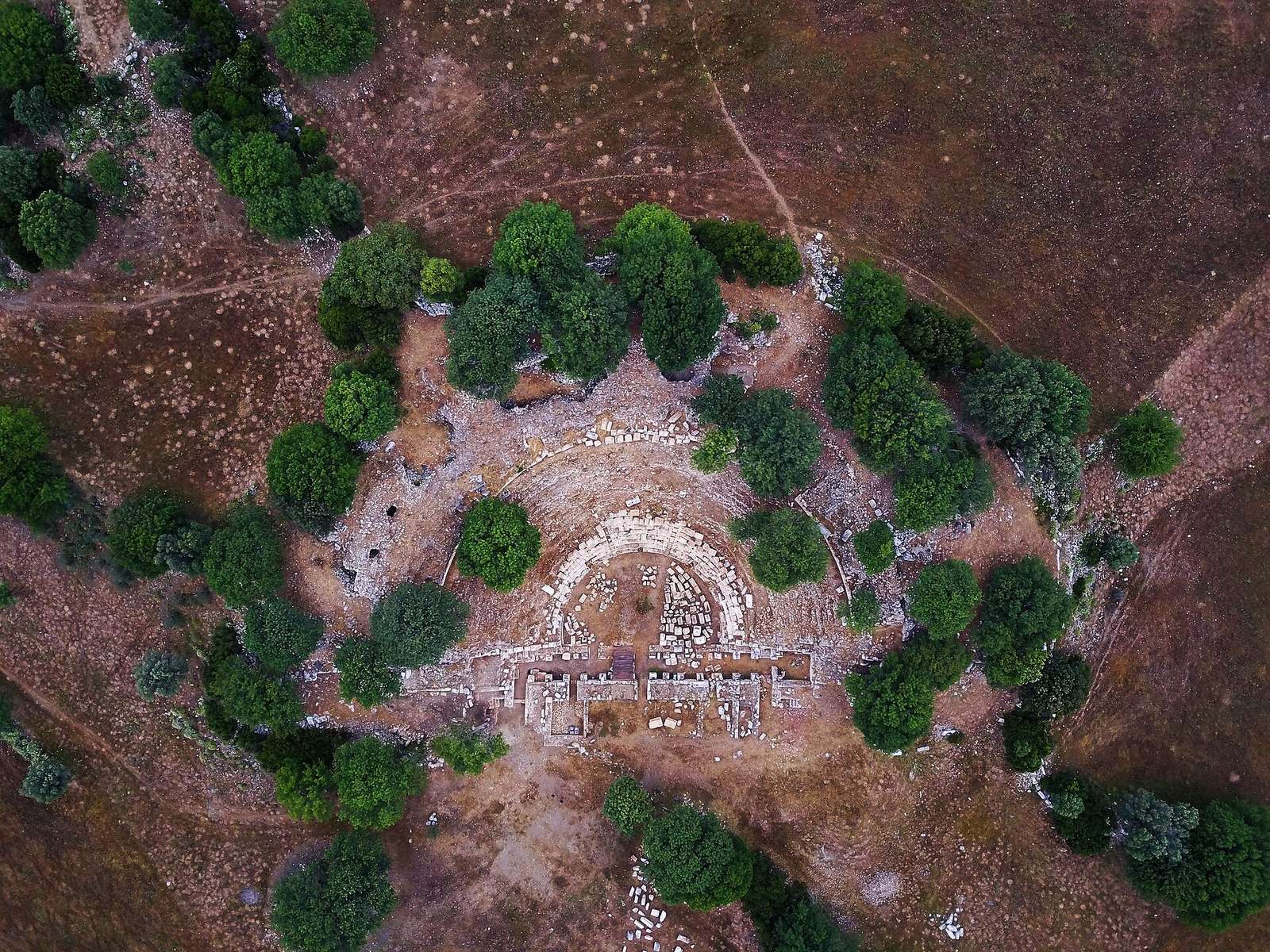
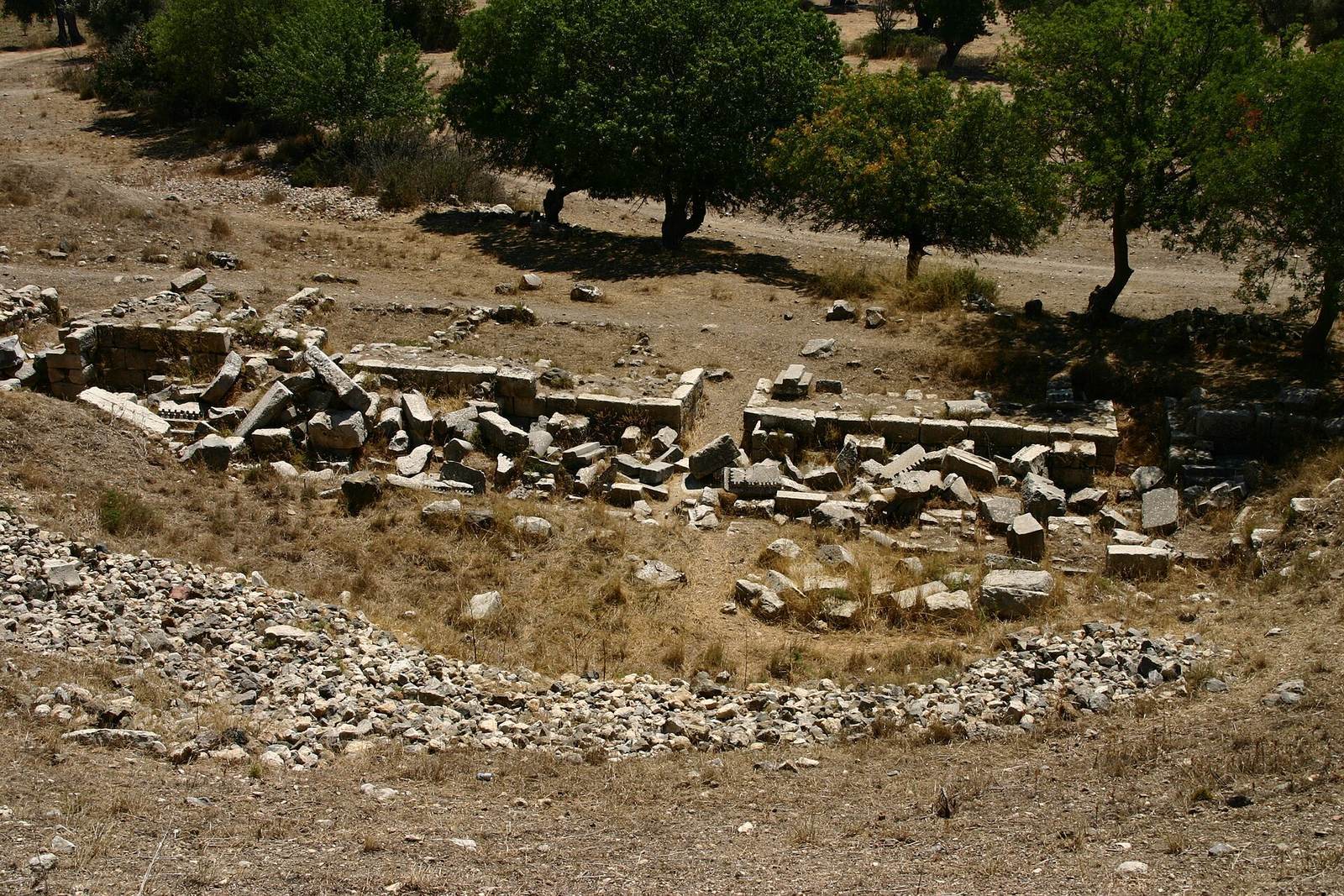
The theatre was built in the second century BCE on the southeastern slope of the acropolis, about 350 metres northwest of the Temple of Dionysus. It was later altered into a Roman-style theatre under Hadrian. Most of its seating area has been lost, although lower rows remain. The stage, rebuilt in the Roman period, survives substantially.
Odeon
Southeast of the theatre is a well-preserved Roman-period odeon, a roofed building for performances or gatherings. It retains eleven rows of seats. Ruins of private houses and sections of an ancient road lie to its west.
Agora and council house
Near the harbor, the agora, the city’s central public and commercial space, included a small Hellenistic temple. Remains of the bouleuterion, or council house, lie at the agora’s northern corner. Built around 200 BCE, it has a rectangular foundation and seating arranged in sixteen tiers, divided into four sections. It is among the best-preserved buildings in the ancient city.
Gymnasium
A large building northeast of the acropolis has been identified as a gymnasium, a center for athletic training and education.
Lower city and archaeological finds
Street and houses
A paved street with water channels has been found in the lower city. Classical and early Hellenistic houses and surviving walls were built with local limestone masonry.
Church at the southern harbor
A small church found in 2011 at the eastern edge of the southern harbor has a rectangular plan and measures 11.4 by 5.2 metres. Its construction date is unknown, but finds indicate that it was in use around the tenth to twelfth centuries CE.
Inscribed rental agreement
A stone stele, an upright slab used for inscriptions, discovered in 2016 stands 1.5 metres high and carries 58 densely carved lines. The text sets out the leasing of an area containing buildings, enslaved people, and a sacred altar, along with conditions governing its use.
Shipwreck near Tektaş
A shipwreck near Tektaş, a small rocky outcrop by the harbor, dates broadly to the sixth through fourth centuries BCE. It provides evidence of maritime connections between Teos and the eastern Aegean islands.