Vatican Necropolis: Roman Cemetery Beneath St Peter’s Basilica
Site at a Glance
- Popularity
- Very High
- Country
- Vatican City
- Primary era
- Classical
- Eras represented
- Classical
- Civilizations
- Roman
- Site type
- Burial
- Remains
- Necropolis
On this page17 sections
History
The Vatican Necropolis is an ancient Roman cemetery beneath St Peter’s Basilica in Vatican City. Its open-air burial ground was used from the late first century BC to the fourth century AD, and its principal funerary buildings date mainly to the second century AD. It lay on the southern slope of Vatican Hill, beside the racecourse built by Caligula and beyond Rome’s city walls. Roman law prohibited burials within the walls, so cemeteries developed along roads outside the city, including the Via Cornelia and Via Triumphalis. The Vatican cemetery held both pagan and Christian burials and was not originally an underground catacomb.
Peter and the early cemetery
Christian tradition holds that the Apostle Peter, a leading figure in early Christianity, was martyred under the Roman emperor Nero in AD 64 or 67 and buried near the racecourse. The grave beneath St Peter’s Basilica is traditionally identified as his burial place. Tradition also places a shrine above the grave about a century after Peter’s death.
The shrine is associated with Gaius of Rome, an early Christian priest who referred to apostolic trophies at the Vatican and on the road to Ostia. A trophy could be a victory monument; about a century later, the Christian historian Eusebius of Caesarea understood Gaius’s reference as meaning honored graves. Archaeologist Harald Mielsch argued that the archaeological case for veneration begins instead with a memoria, a commemorative structure linked to a revered person or burial place, built around AD 160–180.
Constantine’s basilica
In the early fourth century, the Roman emperor Constantine I began building the first St Peter’s Basilica above the place identified as Peter’s grave. Burials continued in the cemetery during the building work: an urn contained a coin dated AD 318. Although the burial ground had legal protection, parts of its buildings and Vatican Hill were dismantled to level the site. Material removed from the hill was used to fill the cemetery, apart from the area of Peter’s grave.
Peter’s skull relic may have been removed from the grave during construction of the basilica. At an unknown date it was placed in the Chapel of St Lawrence at the Lateran. In 1367, Pope Urban V transferred it to the Lateran Basilica.
Discoveries before the modern excavations
The necropolis came to notice during construction of a Vatican fortification bastion in 1543. In 1574, work near the main altar of Old St Peter’s broke through a crypt wall into what became known as Mausoleum M. Workers examined and described the chamber briefly before sealing the opening. Mausoleum O was opened during construction of the foundation for a statue of Pope Pius VI. Mausoleums R and S came to light during work on the southern part of the foundation for Gian Lorenzo Bernini’s canopy.
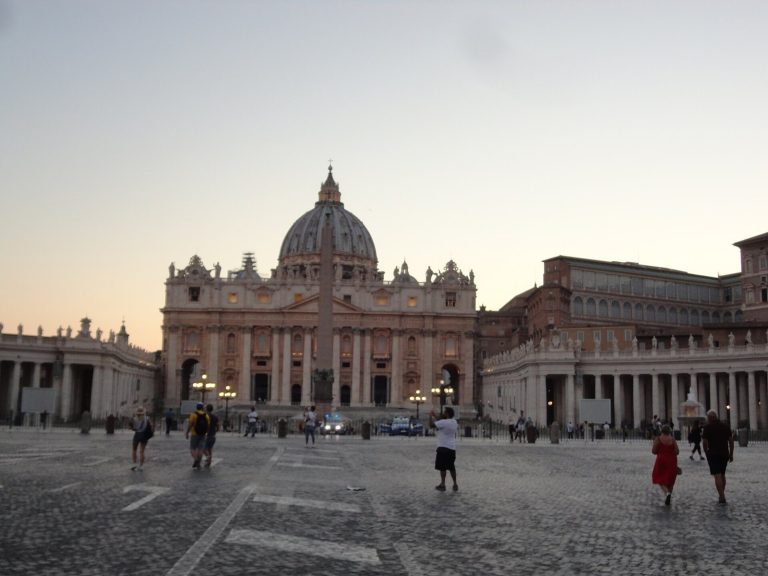
In 1586, Pope Sixtus V ordered the Egyptian obelisk from the central divider of Caligula’s racecourse moved to St Peter’s Square. The architect and engineer Domenico Fontana carried out the move.
Excavations beneath the basilica
Modern investigations began after Pope Pius XI expressed in his will a wish to be buried in the Vatican Grottoes as close as possible to the shrine associated with Peter. The burial space proved too small, so Eugenio Pacelli, then a camerlengo, a senior papal administrator, and later Pope Pius XII, arranged for it to be enlarged. Lowering the grotto floor and probing behind a wall exposed pavement from the old basilica and a chamber filled with rubble. Pius XII then ordered investigations aimed at finding Peter’s grave.
Excavations beneath the basilica continued from 1940 to 1949. Monsignor Kaas directed the work with a team that included scholars Antonio Ferrua, Engelbert Kirschbaum and Enrico Josi. The project was kept secret. Relations between Kaas and the researchers became strained, and the lack of an excavation journal was later considered a serious methodological shortcoming. The excavated tombs were first labeled with Greek letters and later with Latin letters.
On June 26, 1968, Pope Paul VI announced that scientific studies had identified Peter’s relics convincingly, though many researchers remained cautious about the identification. Construction of a car park exposed a further part of the necropolis in 2003.
Remains
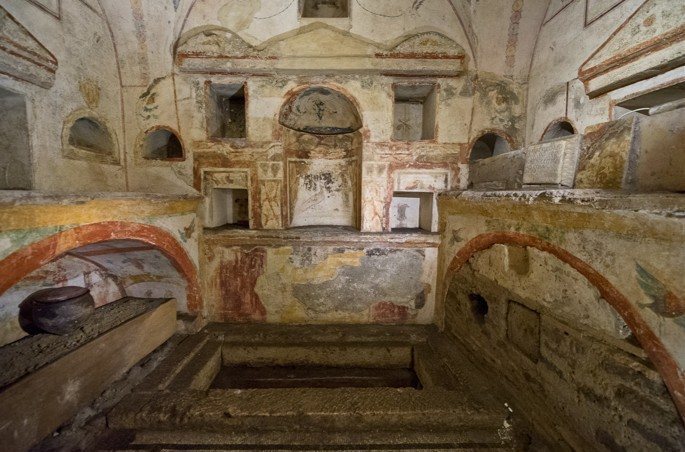
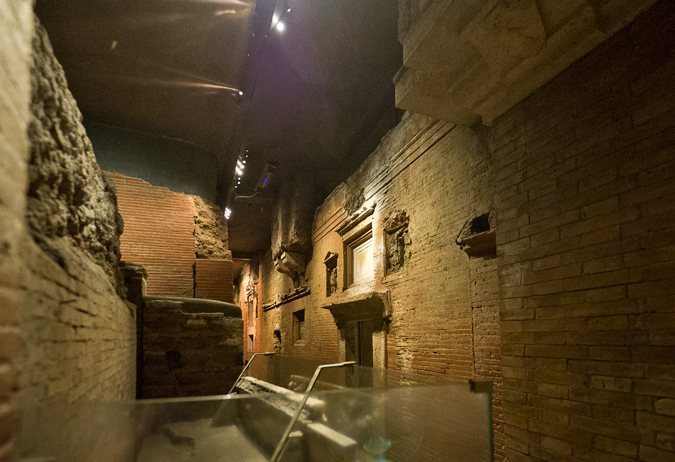
The cemetery lies about 5 to 12 metres below St Peter’s Basilica. It is distinct from the Vatican Grottoes, which occupy the level of the old Constantinian basilica. Excavations revealed two rows of family burial buildings, or mausoleums, arranged side by side along the slope from west to east. They were constructed of brick, with interiors decorated in plaster, paintings and mosaics. The cemetery’s main architectural core dates to the second century, within a longer period of use.
Rows of family mausoleums
The first row
Mausoleum A was built first, followed quickly by B, C, D and E. G probably dates to about the same period as B, while F probably belongs to the reign of the Roman emperor Antoninus Pius, AD 138–161. These seven freestanding buildings stood at different heights along a road about 32 metres long. Mausoleum O was built during the reign of Hadrian, AD 117–138, and later buildings filled spaces between G and O.
Southward extension
Mausoleum H, dating to the second half of the second century, interrupts the straight line of the row because an atrium already occupied the area. By then, the racecourse had gone out of use and graves had spread over it, allowing the cemetery to expand southward. A grave dating to about the time H was built lay near the obelisk’s foundation. After the racecourse was demolished, a second group of mausoleums, Z, Phi, Chi and Psi, was built opposite the earlier row. Buildings from the late second to the mid-third century generally had entrances facing south toward the racecourse and the Via Cornelia, except for Mausoleum R1. A ground plaque in St Peter’s Square marks the obelisk’s former position in front of the Excavation Office of the Fabbrica di San Pietro.
Family burials and inscriptions
Families used the mausoleums across generations. Excavators counted about 120 burials in F and at least 170 in H. Across the 22 excavated mausoleums, the total exceeds 1,000 body and urn burials. Inscriptions above the entrances name former owners of A, C, H, L, N and O. The inscription for N identifies it as the tomb of Marcus Aebutius Charito and says that Lucius Volusius Successus and Volusia Megiste jointly purchased half of it.
Mausoleum M and its mosaics
The burial chamber
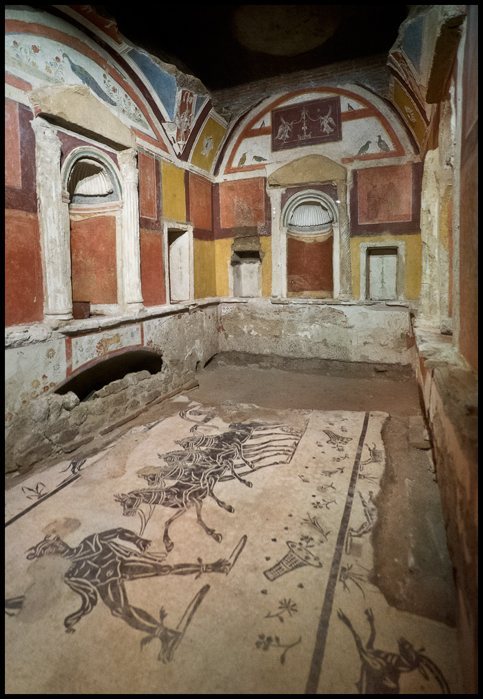
Also called the Tomb of the Julii, Mausoleum M is regarded as the necropolis’s only exclusively Christian burial chamber. Built in the early third century, it measures 1.63 by 1.98 metres. An inscription copied by Giacomo Grimaldi names Iulia Palatina, a freedwoman, and her husband Maximus, an enslaved man, as the builders. They made the tomb for their son Iulius Turpinus, who died at the age of one year, nine months and twenty-seven days.
Mosaic decoration
Mosaics were added in the late third or early fourth century. Fragments on the west wall show the Good Shepherd carrying a lamb; the north wall depicts a fisherman, and the east wall shows Jonah being swallowed by a whale. On the ceiling, Christ rides in a chariot with a halo and attributes of Sol Invictus, the Roman sun god. Vine branches with leaves surround the figures. They may refer to the Gospel of John’s image of the true vine rather than the customary association of vines with Dionysus, a Greek god of wine and fertility.
Peter’s grave area and surrounding walls
Field P and the Red Wall
The small area known as Field P contains the grave traditionally identified as Peter’s, with other tombs immediately beside it. The shrine is next to the Red Wall, which was built to protect a higher terrace from earth washing down the slope. The wall crosses part of the area proposed for Peter’s grave.
The Graffiti Wall
At the shrine’s right side, the Graffiti Wall joins the Red Wall at a right angle. Built in the second half of the third century, it bears numerous Latin inscriptions. Its remains, along with those of the shrine, are concealed behind Baroque cladding at the niche for the pallia, woolen liturgical garments worn by the pope and certain archbishops.
A marble-lined opening in the Graffiti Wall contained bones belonging to a robust man estimated to have been 60–70 years old. Margherita Guarducci interpreted inscriptions behind the pillar monument, including the sequence ‘PETR… EN I’, as referring to Peter’s relics. She proposed that the bones had been moved from the original grave to the wall opening during construction of Constantine’s basilica. Similar graffiti elsewhere in Rome commemorated Peter and Paul as martyrs.
Conservation
A conservation campaign in 1998 sought to protect the walls, decorative plaster and wall paintings. The work examined the interior climate and biological and salt-related deterioration, consolidated paintings with plaster and added pigments to their underlying material. Glass doors were installed at some mausoleums and along the excavation route, while filtered, humidified air and special vents helped maintain environmental conditions. The Valerii Mausoleum also underwent a ten-month restoration.