Divín: A Gothic Castle Ruin in Slovakia


Site at a Glance
- Rating
- 4.7
- Popularity
- Medium
- Country
- Slovakia
- Primary era
- Medieval
- External website
- Open
- Eras represented
- Medieval, Early Modern
- Civilizations
- Habsburg, Hungarian
- Site type
- Military
- Remains
- Castle
On this page5 sections
History
Divín is a Gothic castle ruin in Slovakia, standing above the centre of the municipality of Divín. Built in the late thirteenth or early fourteenth century, probably by a member of the Lošonci noble family from nearby Lučenec, it protected the road leading toward the central Slovak mining region.
Early records and noble ownership
The castle appears in written records in 1329 under the name Dyun. Later forms included castrum Duyen in 1393 and castrum Dywyn in 1467 to 1469. Its earlier standardized name was Divínsky hrad.
In the fifteenth century, Lošonci family members Žigmund and Štefan took part in an unsuccessful conspiracy against the king. In 1469, King Matej Korvín, also known as Matthias Corvinus, who ruled Hungary from 1458 to 1490, granted the castle and the Divín estate to Michal Orság. Divín soon passed to Ján Nádašdy Ongor, and after his death Žigmund Balaša seized it by force.
Ottoman occupation and destruction
Under the Balaša family, the castle was strengthened in 1559 with a new forecourt, an outer fortified area in front of the main castle, containing modern defensive works. Ottoman forces, the armies of the Ottoman Empire, captured Divín after a prolonged siege in 1575 and held it until 1593. A royal army, assisted by Bálint Balaša, then recaptured the castle.
The later history of Divín was associated with the plundering activities of its owner, Imrich Balaša. In 1679, imperial troops serving the ruling Habsburg monarchy captured and destroyed the castle by explosion. Divín subsequently remained a castle ruin in the municipality of Divín, in the Lučenec District of Slovakia’s Banská Bystrica Region.
Remains
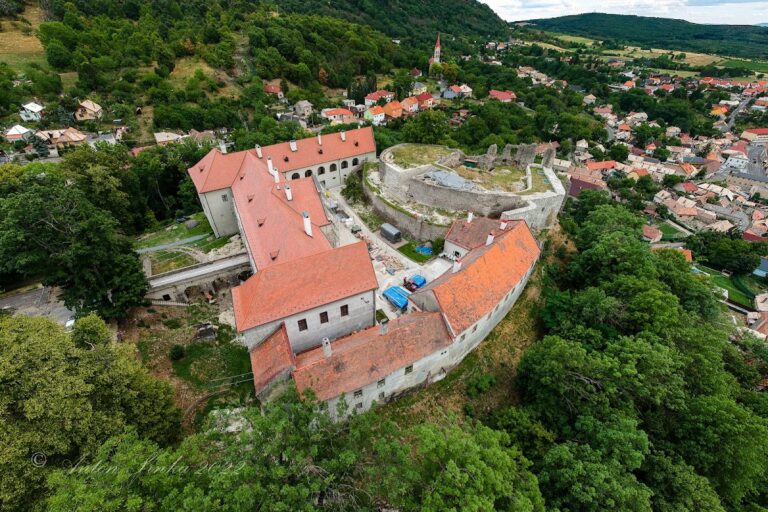
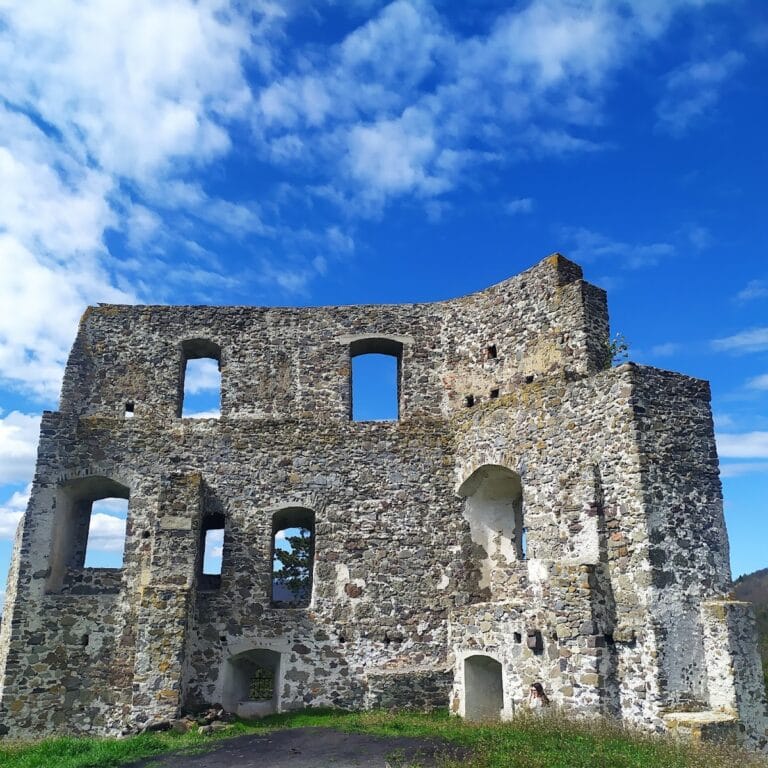
The surviving Gothic ruins occupy a low hill directly above the centre of Divín, at the boundary between the Krupina Plateau and the Lučenec Basin. The site lies at approximately 305 metres above sea level, and the castle survives as a ruin.
Castle and defensive additions
The original castle was built in the Gothic architectural style, a medieval form associated with substantial masonry and pointed arches. Its surviving remains occupy the hilltop, while the later defensive expansion belongs to the Balaša period.
Constructed in 1559, the forecourt formed an outer fortified area before the castle’s main defensive core. Its modern defensive additions included a projecting bastion, a fortification designed to permit defensive fire along the faces of surrounding walls, and two corner towers. These features form part of the surviving ruin and reflect the castle’s adaptation to changing military requirements.