Štamberk: A Medieval Hilltop Watch Castle in Czechia
Site at a Glance
- Rating
- 4.4
- Popularity
- Low
- Country
- Czechia
- Primary era
- Medieval
- External website
- Open
- Eras represented
- Medieval, Modern
- Civilizations
- Holy Roman Empire, Kingdom of Bohemia
- Site type
- Military
- Remains
- Castle
On this page6 sections
History
Foundation and the Telč Estate
Štamberk is a ruined hilltop watch castle in Czechia, erected by the Bohemian nobleman Jaroslav of Sternberg during the late thirteenth century, probably in the 1280s. Originally called Sternberg, it stood on royal land and served as a fortified lookout. Jaroslav was burgrave of Bítov, an official responsible for administering and defending a castle or territorial district, and the highest cupbearer of the Kingdom of Bohemia, a senior court office.
By 1339, Margrave Charles IV had exchanged Štamberk and the Telč estate with Ulrich III of Neuhaus for the remote Bánov estate. Charles IV later became king of Bohemia and Holy Roman Emperor, but at this time he held the title of Margrave of Moravia. The exchange indicates that Štamberk already belonged to the Telč territorial complex. In 1356, Stephen of Březnice sold the castle to Henry II of Neuhaus.
Inheritance and Neuhaus Control
The castle remained involved in the changing ownership of the surrounding estates. In 1385, Henry the Younger and Hermann of Neuhaus settled a dispute over Bělkov and Sternberg. In 1392, Henry III of Neuhaus transferred the Sternberg estate, inherited from his brother Henry the Younger, to Hermann of Neuhaus in exchange for half of Slavonice.
In 1398, Hermann assigned Bělkov, Königseck, Tremles, and Sternberg to his daughter Elisabeth as hereditary marriage property. Elisabeth, who died in 1417, was married to John of Krawarn-Krumlov. The estate included parts of Slavonice, the market towns of Kunžak and Stremilov, numerous villages, and a mill at Krahulčí. The Lords of Krawarn held Sternberg around the turn of the fifteenth century, and around 1410 it belonged to Benedict of Krawarn-Krumlov. In 1414, Ulrich and John the Elder of Neuhaus agreed that Ulrich would receive Bělkov and John the Elder Sternberg after Benedict’s death. The castle and its associated settlements consequently returned to the Neuhaus branch of the Witigonen, a powerful medieval noble family whose estates extended through southern Bohemia and nearby regions, and were incorporated into the Telč estate.
Destruction and Later Conservation
During the Hussite Wars, the religious and political conflicts associated with the reform movement inspired by Jan Hus, Štamberk was destroyed in 1423 by Hussite forces commanded by Jan Hvězda of Vícemilice. The castle was not rebuilt and subsequently became a ruin.
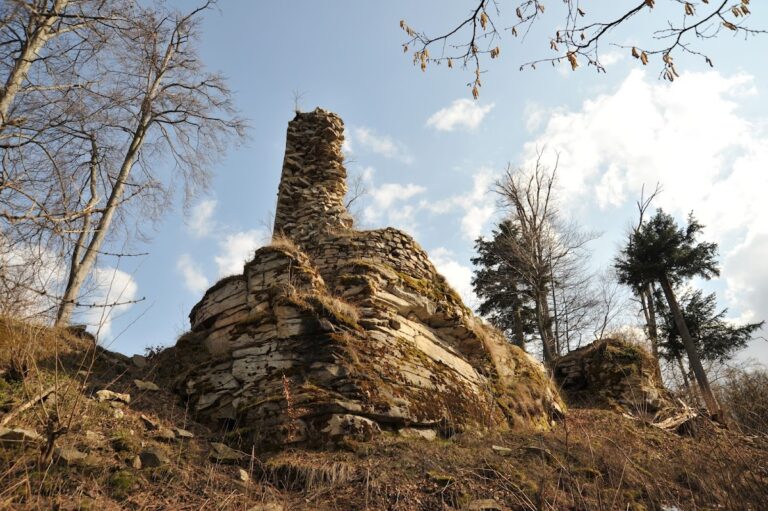
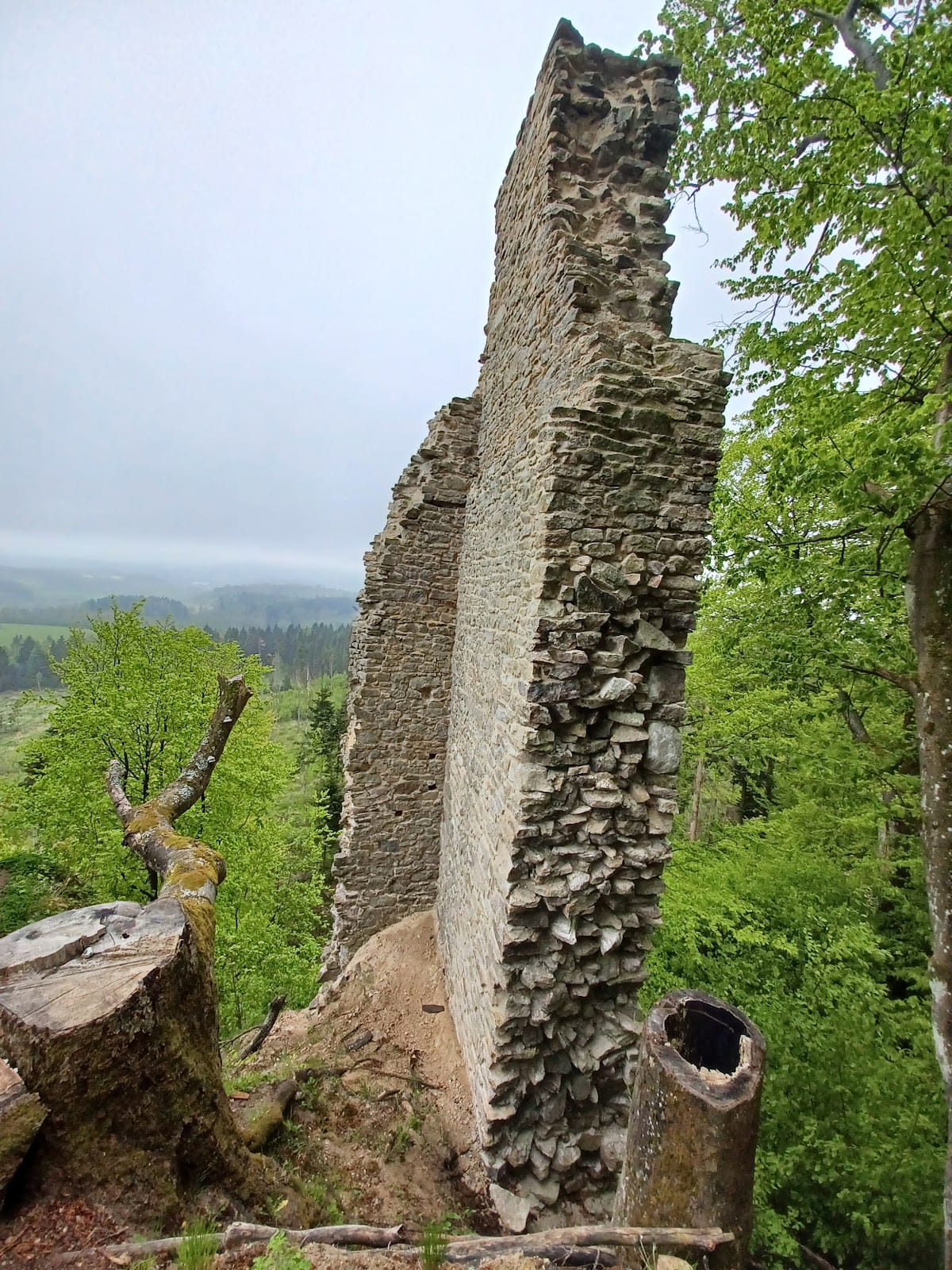
Between 2020 and 2023, conservation work stabilized the surviving fragment of the tower wall through repairs and additional masonry. Archaeological investigation was undertaken, the surrounding area was arranged, and a wooden shelter was erected on part of the former courtyard. Štamberk is protected as a cultural monument of the Czech Republic.
Remains
Hilltop Ruins
Štamberk is a stone hill castle situated at approximately 695 metres above sea level on the southern slope of Vrch, a 726-metre hill above Řásná in the Jihlava District of the Vysočina Region, about seven kilometres north of Telč. Its surviving fabric consists of a fragmentary tower wall and other remnants of the castle walls. The tower-wall fragment was structurally secured during the conservation campaign of 2020 to 2023.
Part of the former courtyard now contains a wooden shelter. The elevated site provides a view southward, and in exceptionally clear conditions the peaks of the Lower Austrian Alps, including Schneeberg and Ötscher, can be seen.