Doria Castle in Dolceacqua: A Historic Fortress in Italy

Site at a Glance
- Rating
- 4.6
- Popularity
- Medium
- Country
- Italy
- Primary era
- Medieval
- External website
- Open
- Eras represented
- Medieval, Early Modern
- Civilizations
- Duchy of Savoy
- Site type
- Military
- Remains
- Castle
On this page12 sections
History
Doria Castle in Dolceacqua is a fortress in Italy whose origins predate 1177, when the castle and the settlement, then known as Dulzana, were recorded as possessions of the Counts of Ventimiglia. Its position above the Nervia Valley gave it a strategic role in controlling the surrounding territory.
Ventimiglia and Doria Rule
In 1270, Oberto Doria, identified as the founder of the Doria dynasty, acquired the castle, its feudal territory, and nearby lands. The Doria were a prominent Genoese family whose influence extended across Liguria and the Nervia Valley. Under Oberto, their authority expanded to Apricale, Perinaldo, and Isolabona.
Guelf and Ghibelline Wars
The castle became involved in the fourteenth-century conflicts between the Guelfs and Ghibellines, rival political factions in medieval Italy broadly associated with papal and imperial interests. The Ghibelline Doria family endured sieges in 1319 and 1329 ordered by Robert of Anjou, Count of Provence and a leader of the Guelf faction.
Robert conquered the castle and forced the Doria lords to become his vassals. The family later entered a vassal relationship with the Republic of Genoa, continuing the fortress’s connection with the competing political powers of the region.
Savoyard Control and Later Conflicts
In 1526, Bartolomeo Doria transferred the family’s feudal rights over Dolceacqua to the Duke of Savoy and became a vassal of the Duchy of Savoy. The House of Savoy was a ruling dynasty whose territories and influence included the Duchy of Savoy. The relationship was reinforced by agreements involving Stefano Doria and Emmanuel Philibert I of Savoy.
Relations between the Doria family and Savoy worsened in the early seventeenth century, especially after the Doria supported the Republic of Genoa in its war against the Duchy of Savoy in 1625. The fortress again became a military objective during the War of the Austrian Succession, an eighteenth-century European conflict over the succession to the Habsburg monarchy. Its position could obstruct allied French and Spanish forces, which captured the castle in July 1745.
End of Military Use
The castle’s strategic military function ended during the eighteenth century. In 1937, it was designated Italian national heritage. The Municipality of Dolceacqua acquired the property in 1942, and the castle is identified as a historical museum.
Remains
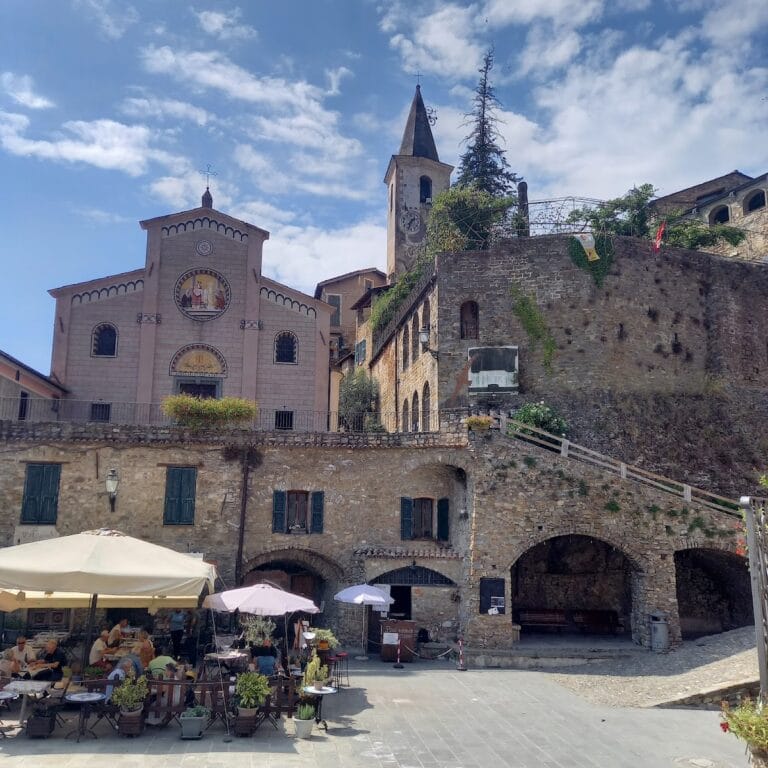
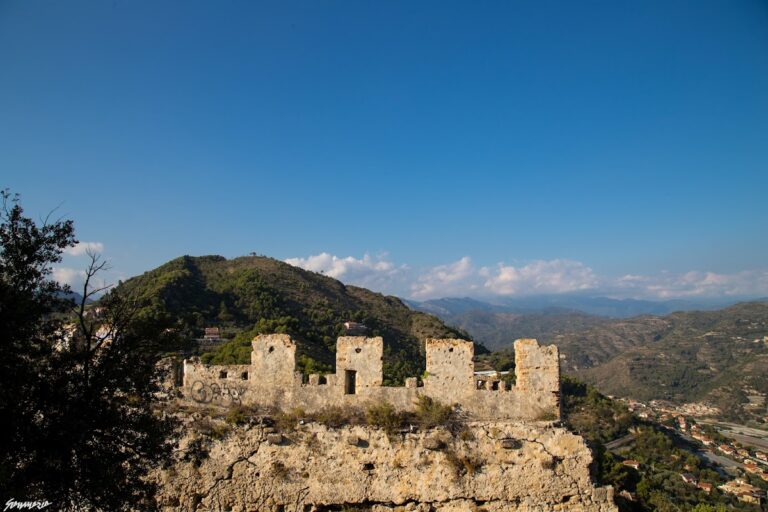
The ruined fortress is incorporated into the historic village of Dolceacqua, above the settlement on the left bank of the Nervia stream in the area known as Terra. Its surviving form combines a twelfth-century core with major sixteenth-century additions, and the complex occupies a commanding position on an exposed rock face.
Twelfth-Century Core
The original complex included a central circular tower and a smaller building used for the guard post or guard office. The circular tower has partly collapsed, while a section of its structure survives as part of the ruined fortress.
Sixteenth-Century Expansion
Stefano Doria enlarged the earlier fortress in the sixteenth century. The work added a projecting bastion on the eastern side and two matching square towers. These additions established the castle’s present general form.
Principal Castle Blocks
Front Block
The front block contained the spaces used to control and secure the village. It also included service rooms, prisons, and warehouses, giving this part of the fortress both defensive and practical functions.
Rear Block
A large courtyard connected the front block with the rear block. The rear section held reception and representative rooms, together with the residences of the local lords.
Geological Setting
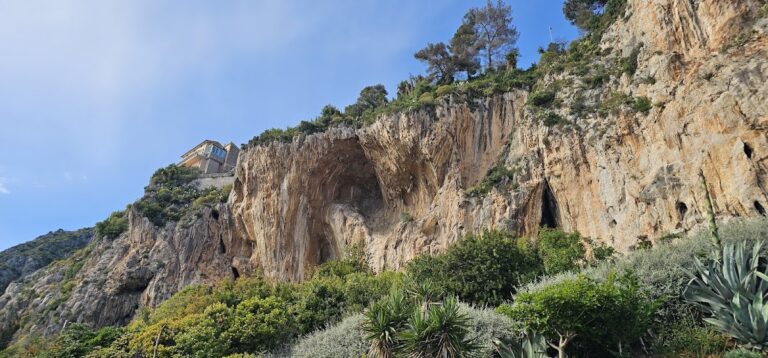
The castle stands on Ventimiglia flysch, a geological formation made of repeated sedimentary rock layers. The exposed rock shows thick sandstone strata interlayered with turbidites, which are deposits formed by underwater sediment flows. The vertical layering includes clearly visible divisions of the Bouma sequence, a characteristic arrangement of beds produced by such flows, particularly the Ta-d and Ta-c divisions.