Erdut Castle: Medieval Fortress Above the Danube in Croatia


Site at a Glance
- Rating
- 4.6
- Popularity
- Low
- Country
- Croatia
- Primary era
- Medieval
- Eras represented
- Medieval
- Civilizations
- Hungarian
- Site type
- Military
- Remains
- Castle
On this page10 sections
History
Erdut Castle is a medieval fortified site in Erdut, Croatia, built during the fourteenth or fifteenth century, although its exact construction date remains uncertain. Its architectural similarities to Italian fortifications suggest that Italian military engineers probably built it, likely after the fall of Constantinople in 1453. Set above the Danube, the castle became a fortified residence and a place of repeated military conflict during the Ottoman and Habsburg periods.
Medieval origins and noble ownership
The settlement of Erdut appears in a record of 1335 under the name “Ardud.” The castle was recorded in 1472 as belonging to the provostry of Titel, an ecclesiastical and administrative estate. In 1499 it came into the possession of the noble Bánffy family, linking the fortress with one of the region’s important landholding families.
Ottoman conquest and sixteenth-century fighting
In 1526, after the Hungarian defeat at Mohács, the Ottoman Empire captured Erdut Castle. Mehmed Pasha Yahyaoglu, the sanjak-bey, or governor and military commander of an Ottoman territorial district, attacked the fortress. The castellan, the officer responsible for commanding and administering a castle, surrendered the keys without a fight because the garrison was unwilling or unable to resist.
Erdut became a battlefield again in 1536. Johann von Katzianer, a commander serving King Ferdinand, had launched an unsuccessful attack on Osijek. His army was left without supplies, and he ordered Boldizsár Bánffy, lord of Kórógy, to seize Erdut Castle because he believed the Ottomans had stored large quantities of food there. Bánffy took the castle with light cavalry, but found little food. Katzianer then retreated, and his army suffered a severe defeat at Gara.
Decline under Ottoman rule
During the Ottoman period, the castle gradually deteriorated. In 1608 Adam Herberstein, an imperial envoy travelling to Constantinople, prepared an illustrated account of fortifications along the Danube. His description stated that the castle’s roof had gone and its interior had been destroyed, while the high outer walls remained in relatively good condition.
The Ottoman garrison lived in the cellars and dungeons beneath the ruined structure. Its last commander was Hasan Bey. In 1687, an imperial army led by General Francis d’Aspremont overcame the determined resistance of the small Ottoman and Vlach garrison. The term Vlachs was used in the region for various Romance-speaking or pastoral Balkan communities, with its meaning changing according to period and context.
Habsburg administration and later owners
After the Ottoman withdrawal, Erdut Castle passed to the Court Chamber, the Habsburg central authority for crown revenues and estates. Imperial troops commanded by German officers occupied it for a long period. One part reportedly collapsed and fell down the slope toward the Danube, after which demolition probably followed for safety reasons.
In 1730 the castle became the pledged estate of Baron Ivan Zuan. János Pálffy of Erdut bought it in 1746, and in 1785 it passed to the Adamovich family of Čepin. Through marriage, ownership later came to Ervin Cseh of Szentkatolna, governor of Srem County. He lived in a village manor rather than in the castle and remained associated with the estate until his death in 1918.
Twentieth-century damage and protection
Artillery launched by the Yugoslav People’s Army damaged the castle in July 1991 during the Croatian War of Independence. Croatian authorities subsequently placed it on a list of cultural monuments marked with the protective sign of the Hague Convention for the Protection of Cultural Property in the Event of Armed Conflict. This international framework is intended to protect monuments, archaeological sites, and other cultural property during war. Erdut Castle is protected as tangible cultural heritage in Croatia under register number Z-1643.
Remains
Bluff setting and fortified enclosure
Erdut Castle occupies the northeastern edge of Erdut on a steep bluff above the right bank of the Danube, near the beginning of a major river bend. The bluff rises about 70 metres above the river and reaches approximately 141 metres above sea level. The surrounding flat terrain provides views toward the opposite bank, the Bačka Plain and its vineyards, and the Slavonian and Syrmian regions.
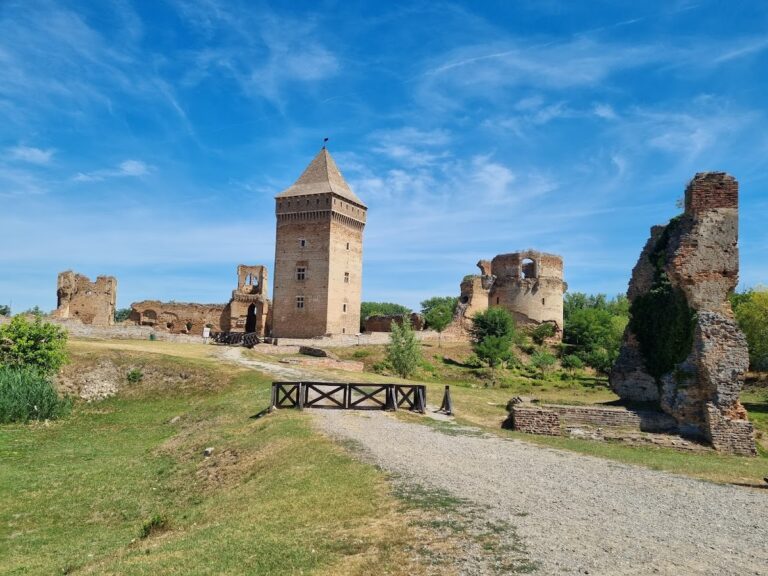
The fortress is a lowland castle built from stone and brick. Its walls measure only about 0.83 to 1.13 metres thick, unusually thin for the Danube region. Numerous large gun openings and loopholes compensated for this relative weakness. The enclosure is comparatively small, with the central residential tower forming its dominant element. The outer castle also retains the exterior wall of a northwestern palace wing, although ground movement has displaced it and left it noticeably leaning.
Residential tower and palace features
The central tower served as the castle’s principal residential element. Ceiling beams once divided its interior into several levels, but repeated renovations have made the original arrangement impossible to determine. The castle also functioned as a palace, and surviving features of that use include broad stone staircases, fireplaces, remnants of frescoes, and a chapel on the tower’s second floor.
Corner towers and surviving fabric
A northwestern corner tower survives in very good condition and displays the influence of the Italian Renaissance. Another tower ruin lies about 40 metres below the castle. Its architectural solutions match those of the palace and the round corner tower, but its original position remains disputed. It may have formed the northern corner of the outer castle before being displaced by a landslide in 1860, or it may still stand in its original location as part of an earlier external defensive system. A substantial archaeological excavation would be needed to resolve the question.
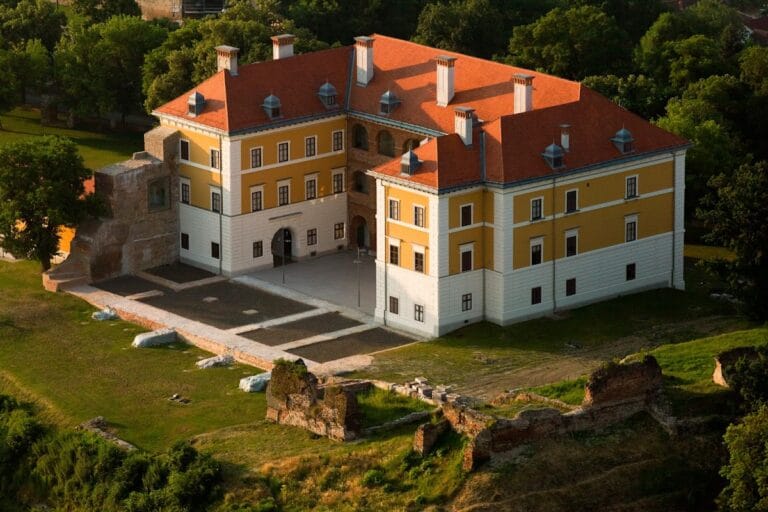
Today Erdut Castle is a large, neglected ruin. Much of the interior has disappeared, while substantial portions of the exterior fabric remain, including the bluff-side walls, the leaning palace-wing wall, the northwestern corner tower, and the surviving remains of the residential complex.