Grotte de Cussac: A Decorated Paleolithic Cave in France
Site at a Glance
- Popularity
- Medium
- Country
- France
- Primary era
- Stone Age
- Eras represented
- Stone Age
- Civilizations
- Unclassified
- Site type
- Civic
- Remains
- Rock Art
On this page14 sections
History
Grotte de Cussac is a decorated Paleolithic cave at Le Buisson-de-Cadouin, France, with engravings generally assigned to the Gravettian, an Upper Paleolithic culture, and estimated to be about 25,000 years old. The cave is one of a small number of European Paleolithic sites where human burials occur in association with wall art.
Exploration and discovery
Denis Peyrony explored the entrance area in 1950, and his son Élie returned some years later. Their work extended about ten metres but did not reach the decorated cave. Other cavers also tried to proceed, then stopped when a scree blockage and the lack of airflow prevented further exploration.
Marc Delluc and Fabrice Massoulier began cave exploration on 16 September 2000. After clearing the entrance passage, Delluc returned on 23 and 30 September. On 7 October, he, Massoulier and Hervé Durif forced their way through a difficult section where limestone flakes threatened to fall. They explored another 600 metres and encountered human traces, but halted to protect the fragile clay walls. Prehistorian Norbert Aujoulat and regional cultural-affairs official Christian Archambeau inspected the cave the next day. The French Ministry of Culture announced the discovery on 8 December 2000.
Paleolithic art and funerary practice
The engravings are usually attributed to the Gravettian. An earlier Aurignacian attribution, which would place the art in an older Upper Paleolithic culture, is considered less likely. The imagery and style have been compared with Gravettian cave art in the Quercy region, especially at Pech Merle.
At least five people, four adults and an adolescent, were placed in natural cavities in the cave. The arrangement has been interpreted as a planned funerary rite carried out in two stages. The burials probably belong to the same period as the art, and the entrance may have become blocked soon after the artists were active. The Grotte du Visage in Charente is another site described as Gravettian with a comparable association between burial and cave art.
Aujoulat used the press description Lascaux of engraving, while prehistorian and archaeologist Jacques Jaubert offered the counter-description anti-Lascaux, pointing to Cussac’s distinct discovery and preservation history and its burials alongside the art.
Research and protection
Multidisciplinary study began in 2009. Formal protection had started earlier, with a classification proceeding on 23 November 2000, registration in the supplementary inventory of historic monuments on 23 December 2001, and final classification as a French historic monument on 3 July 2002. This status is a legal protection for heritage property.
State agencies pursued the acquisition of 14 parcels and introduced layered closures, archaeological zoning and safeguards for the surrounding massif. Plans for a protected perimeter drew on climate assessment and mapping of the perched underground aquifer, while the entrance passage was stabilized. The cave remains under scientific protection. Intermittent carbon dioxide makes access and work underground difficult.
Remains
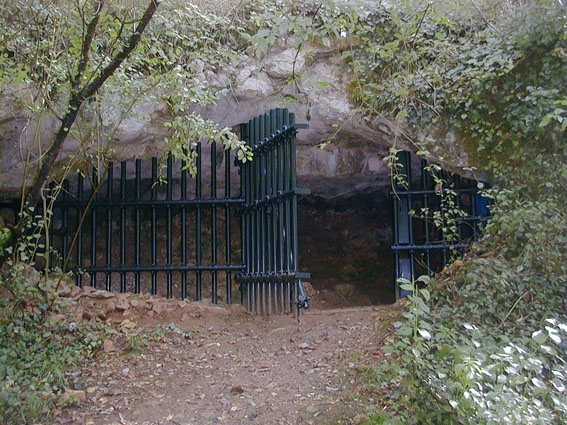
The cave extends for about 1.6 kilometres through fissures in the Cussac massif, in limestone of the Campanian stage, part of the Late Cretaceous. The surrounding karst is terrain shaped as water dissolves limestone. On the right bank of the Bélingou, a southern tributary of the Dordogne, the entrance sits on a travertine terrace, a calcium-carbonate deposit formed by mineral-rich water, above rocky ground and rapids. It marks a resurgence, where underground water reappears at the surface, of an active river system. The decorated gallery follows an inactive passage of that system.
Gallery layout and entrance
The cave’s main passage is broadly linear, with a central entrance separating a downstream branch about 600 metres long from an upstream branch of roughly one kilometre. The downstream branch, formerly called the Chestnut Gallery, contains most of the decorated panels and all three areas with human remains. The upstream branch, once known as the Truffle Gallery, contains other engraved panels and finds.
Entrance passage
The entrance area extends about 12 metres inward and averages three metres in width. An eight-metre corridor reaches the foot of a scree mound; beyond it, the passage opens into a gallery 10 to 15 metres wide and about 12 metres high, with stalagmites. Organic material was repeatedly taken from the entrance area for use as fertilizer in nearby fields. The inner chamber is thought to have remained unentered and undisturbed for centuries before the cave was discovered.
Engravings
Animal figures
More than 150 engravings are attributed to the cave. A 2005 inventory counted 135 graphic elements, including 91 animal images. Bison form the largest group, at 31 percent of the inventory, followed by mammoths at 15 percent and horses at 12 percent. Aurochs, geese, ibex and rhinoceroses are also represented, as are individual bears and felines. Other images include deer, hippopotamuses, unusual long-beaked birds, composite creatures and uncertain or monstrous forms.
Human figures and signs
The inventory also includes about a dozen human-like figures, roughly nine percent of its elements. Four are female silhouettes shown in profile, with small heads. The imagery includes vulvas and pubic-triangle forms associated with mammoths, as well as interlaced and serpentine designs, incomplete figures, net-like and almond-shaped signs, small dark dots, finger tracings and markings on the clay floor. Indeterminate forms account for about 15 percent of the inventory, and signs for about nine percent.
Engraving techniques and scale
Artists cut the limestone walls with stone, bone or hard-wood tools. Pale lines lie beneath an ochre-coloured calcite coating. Engravings make up 93.4 percent of the counted elements when finger tracings and scraped marks are excluded. The Grand Panel, about 310 metres from the current entrance, contains roughly 130 graphic elements; its largest specified image is a bison four metres long. A few red dots provide evidence of pigment use, while charcoal traces have been interpreted as marks from resin-coated torches. Scratches made by cave bears predate the human art.
Upstream gallery
The upstream branch contains panels depicting a rhinoceros and a goose, along with signs on the floor. A deer-antler point and lamps are among the finds from this part of the cave.
Human remains
Human bones occur in three areas of the left gallery, within natural hollows and bear wallows. In the first, disarticulated bones lay in a rounded depression made by a bear, with ochre staining in sediment beneath some of them. A bone from this area produced a radiocarbon date of 25,120 ± 120 years before present; its calibrated range is 29,500–28,835 years before present. Radiocarbon dating estimates the age of once-living material from its radioactive carbon. In the second area, at the base of the east wall, a nearly complete adult skeleton lay in a depression, probably face down. Preserved connections between bones indicate that this deposit remained undisturbed. The third area held scattered bones from at least three adults on raised ground. The first and third areas had been disturbed.
Reconstructions
Two reconstructions made by the Périgord Facsimile Workshop reproduce the decorated Discovery Panel and the bear wallow where a skeleton was found. They are displayed in Le Buisson-de-Cadouin.