Cairns de Larcuste: A Neolithic Burial Complex in France
Site at a Glance
- Popularity
- Low
- Country
- France
- Primary era
- Stone Age
- Eras represented
- Stone Age
- Civilizations
- Unclassified
- Site type
- Burial
- Remains
- Necropolis
On this page18 sections
History
Cairns de Larcuste is a prehistoric burial complex in Larcuste, near Colpo, France, in the Lanvaux moorlands, an area rich in megalithic monuments. Its principal remains are assigned broadly to the Early and Middle Neolithic and associated with the Chasséen, a Neolithic culture identified in France. The site is also classed as protohistoric, a term for a period known through records from literate societies despite scarce local writing. Architectural comparisons place Cairn I in the fourth millennium BC.
Neolithic use and dating
The excavators assigned the complex broadly to about 3600–3200 BC. Pottery from Cairn I, apart from its distinctive Colpo-style cup, points to a relative date of about 3400–3100 BC. The six-chambered monument may have been built around 3540 BC and abandoned around the middle of the third millennium BC. Its chamber deposits are sparse and consistent, suggesting that it was used for a relatively short time.
Five radiocarbon tests were made on charcoal from the area in front of a cairn’s eastern face, its chambers, and its entrance passage. The results were 3980 ± 110 BP (GIF 2435), 4610 ± 110 BP (GIF 2454), 5490 ± 120 BP (GIF 2826), 4060 ± 120 BP (GIF 2827), and 2230 ± 100 BP (GIF 2828). BP means “Before Present,” with 1950 as the reference year; the last result is considered contaminated.
Nineteenth-century investigations
The monuments appeared in inventories in 1825, 1839, and 1869. The first archaeological excavations in the area took place in 1855, when Henri de Cussé and Léon Lallement, members of the Société polymathique du Morbihan, a learned society concerned with the region’s history and antiquities, investigated local monuments. Cussé excavated a monument that has since been lost. Lallement investigated the Bronze Age Motten Larcuste tumulus and the Min Goh Ru dolmen. He also described a nearby megalithic group that corresponds to Cairns I and II, though he did not excavate those cairns.
Damage, excavation, and restoration
Land consolidation destroyed the Min Goh Ru dolmen in 1967. Work threatened a nearby megalithic complex as well, but Joël Lecornec intervened to protect it. Lecornec and Jean L’Helgouach excavated the complex from 1968 to 1972, and its burial mounds were restored in 1972.
Remains
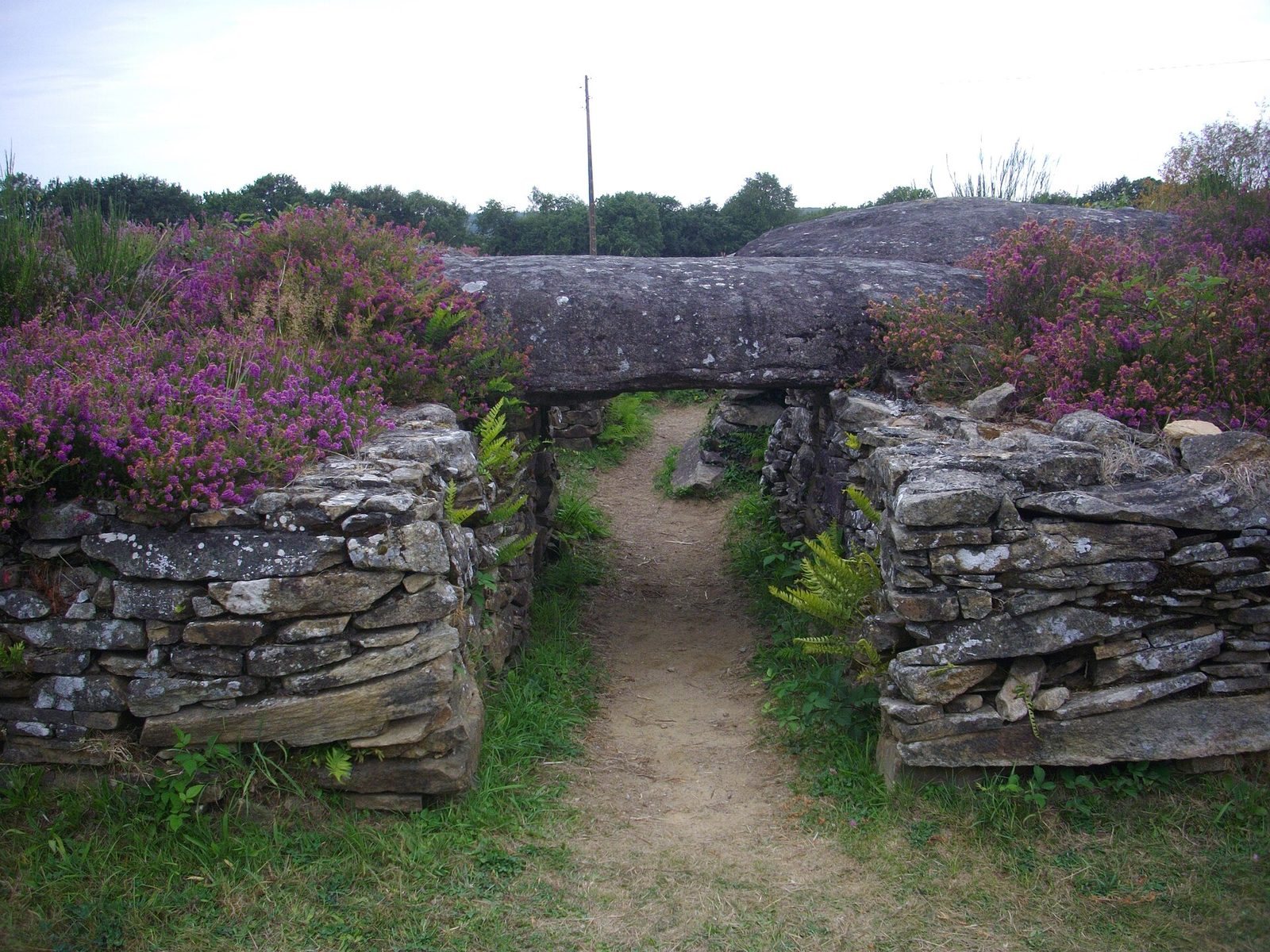
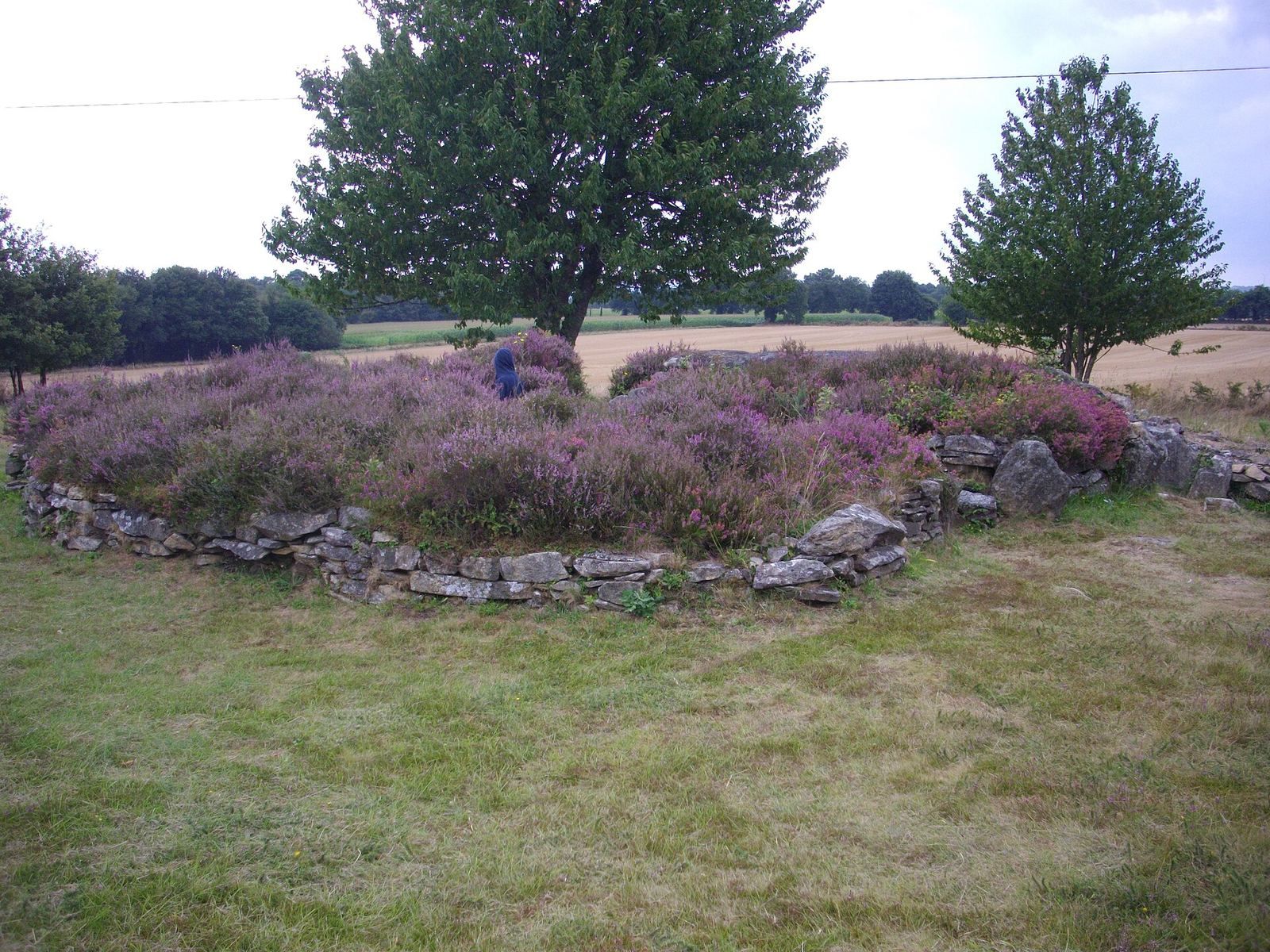
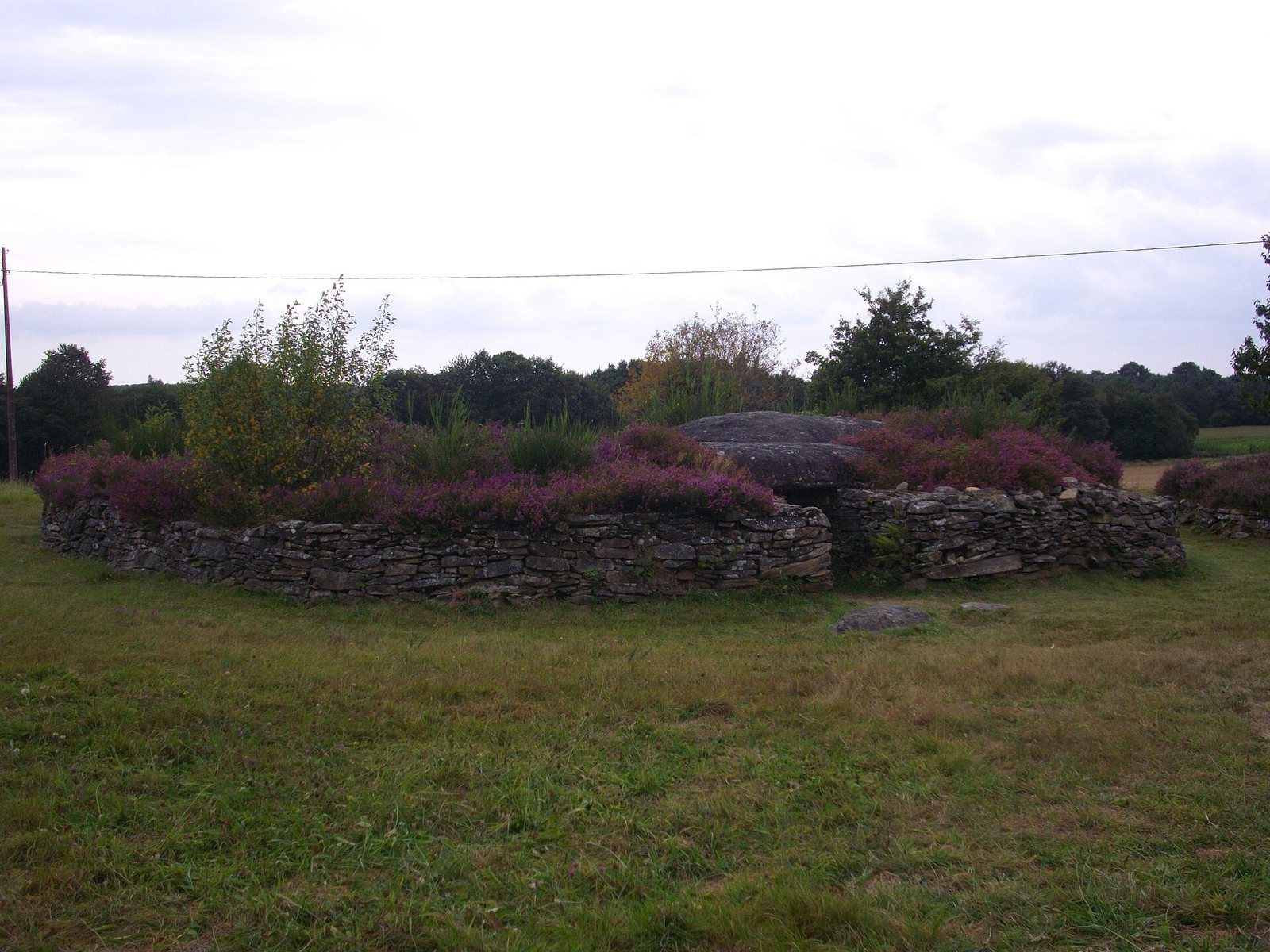
Two cairns, stone-built burial mounds, stand about 2 m apart. Cairn I is rectangular and contains two passage tombs, while the other cairn is larger, irregular in outline, and organized around a long passage and six burial chambers. The monuments combine large upright stones with masonry laid without mortar.
Cairn I
Mound and paved entrance area
Cairn I measures 13 m by 8.5 m and runs southwest to northeast. Two retaining walls, 0.8–1 m apart, enclose the mound. Its passage tombs, dolmens made up of stone burial chambers reached by passages, are called IA and IB. Both entrances face southeast onto a regularly paved area.
Dolmen IA
In the northern part of the cairn, dolmen IA has a passage 2.8 m long, 1.1 m wide, and 0.8 m high. Four upright stone slabs and short walls made of stones laid without mortar define its paved floor. The passage sits slightly off the centre of an oblong chamber measuring 3.3 by 3.1 m. Slabs form the chamber, with short sections of small-stone wall between them, and a single capstone of about 10 m² covers it. An upright slab at the back bears a U-shaped engraving. Finds include a coarse bowl with a dark, uneven surface, a fragment of a second, smooth grey vessel, and numerous flints, among them a small triangular arrowhead.
Dolmen IB
Dolmen IB has a 3.1 m passage bounded by granite upright slabs. On its right side, small flat stones set vertically narrow the passage from 1 m to 0.65 m. Its irregular chamber, about 3.2 by 2.9 m, is offset from the passage and formed by adjoining upright slabs and stone walls. Two slabs carry engravings, one U-shaped and the other a wavy line. The tomb probably had a corbelled roof, made by laying stones in successive courses that project inward; the roof collapsed. Finds include eight flint flakes, a round-bottomed urn 280 mm high and 230 mm across with a very narrow opening, and fragments of a coarser bowl.
Colpo-style cup
Pottery fragments found 0.3 m from the base of Cairn I’s retaining wall made it possible to reconstruct almost all of a decorated cup with a hollow foot, 152 mm high. The excavators thought it had originally stood on the wall between dolmens IA and IB. Its beige-orange surface is carefully smoothed, and two opposing knobs and triangular punch marks in slanting rows decorate its body. Similar vessels from Barnenez, Île Guénioc, Sainte-Marine, Carnac, and Dissignac contributed to the later definition of a distinct Colpo pottery style. The cup is held at the Musée de Bretagne.
Six-chambered cairn
Passage and chambers
The second cairn measures 30 m east to west and 27 m north to south. Its irregular, oblong outline has no corners or facing walls. A single dolmen opens southeast through a straight passage about 10.2 m long and 1.1 m wide. Stone walls define the first 4 m; six small chambers occupy the remaining length, arranged on both sides of an east-west axis.
The chambers range from roughly circular to rectangular. Five have threshold slabs, and their original height probably did not exceed 1.1 m. The structure is built of stones laid without mortar, apart from the large capstones, with one capstone over each chamber. After use, each chamber was blocked by an upright stone backed by a stone wall, concealed within the passage wall. Illicit digging heavily damaged the chambers.
Finds
Finds from the entrance and the first part of the passage include retouched flint flakes and varied pottery. The pieces comprise part of a shouldered bowl with a finely rolled rim, a bowl with a truncated-cone shape, a small beaker, a dish with paired cone-shaped perforations, a shouldered vessel, a small vessel, and fragments of a small container with fine incised mouldings. Numerous Neolithic pottery fragments and about half a dozen flints were also found outside the entrance. The pottery resembles Chasséen material. Excavators interpreted the concentration of pottery in front of the entrance as possible evidence that the chambers had been swept clear.
Other monuments around Larcuste
Recorded megalithic group
Lallement described a local megalithic group that included a second dolmen, seven menhirs, or standing stones, arranged in a circle, and a cairn. His description corresponds to Cairns I and II, which he did not excavate.
Min Goh Ru dolmen
The position of the Min Goh Ru dolmen, about 20 m east of Cairns I and II, remains visible. Lallement described a circular chamber 2.4 m across, covered by a single capstone 2.2 m long and 1.4 m wide. The chamber ran east to west and rested on stone walls and slabs about 0.5 m high; its floor was paved. Finds from Lallement’s excavation, a scraper and the upper part of a well-made globular vessel, are held in the collections of the Société polymathique du Morbihan.
Motten Larcuste tumulus
The Bronze Age Motten Larcuste tumulus remains visible. It measures 50 m east to west and 40 m north to south, and rises no more than 1.5 m. Lallement uncovered a cist, a small stone-built burial chamber, within it. The chamber measured 2.65 by 1.2 m and was 0.7 m deep; a single slab, 2 by 1.3 m, covered it. A small vessel with four handles was found inside.
Separate Motten Larcuste dolmen
A separate dolmen stood about 300 m east of the village. Cussé described it as a cairn containing a passage tomb, with a chamber 0.8 m high and a total length of 3.2 m. Its capstone measured about 2.2 by 2 m, and Cussé considered the tomb undisturbed when he excavated it. Finds included three flint knives, one 15 cm long and made from Grand-Pressigny flint, associated with the Grand-Pressigny area of France, as well as a small blade, a scraper, a talc pendant, a yellow-quartz pendant, and pottery fragments. Later finds from nearby comprise two flint flakes, a large grey flint bladelet, a quartz hammerstone, and two pottery fragments; these are in a private collection.