Resurrection Church of Uspensky Vrazhek: A Russian Orthodox Parish in Moscow
Site at a Glance
- Popularity
- Very High
- Country
- Russia
- Primary era
- Early Modern
- Eras represented
- Early Modern, Modern
- Civilizations
- Russian
- Site type
- Religious
- Remains
- Church
On this page14 sections
History
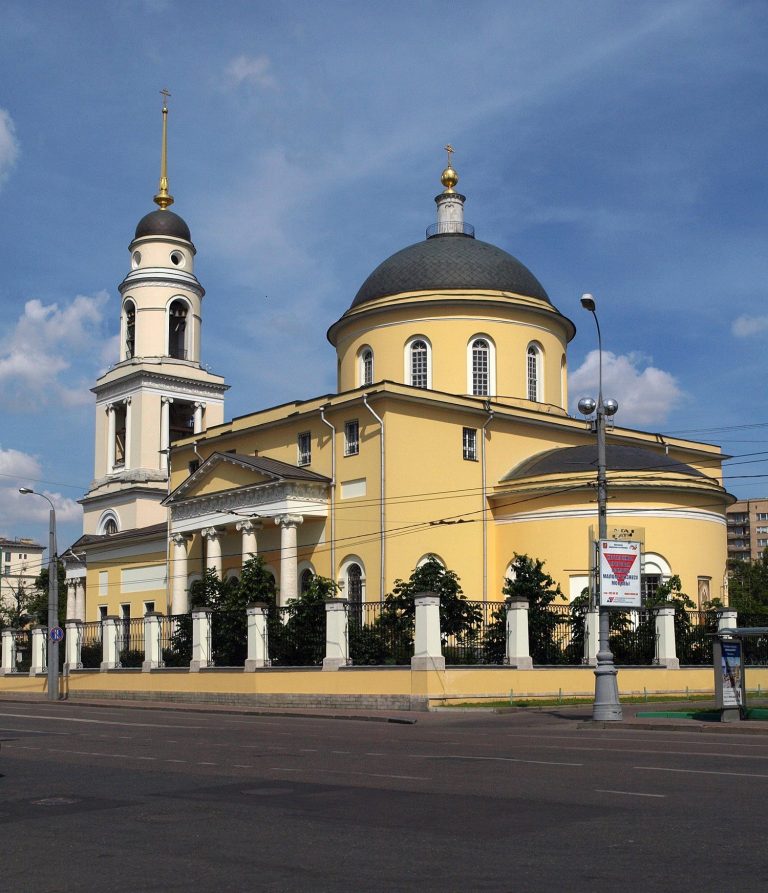
The Resurrection Church of Uspensky Vrazhek is a Russian Orthodox parish church in the historic center of Moscow, Russia. Its stone building, an example of seventeenth-century Russian uzorochye, or decorative architecture, was probably begun in 1629 and was complete by 1634.
Early church and stone rebuilding
The name Uspensky Vrazhek comes from a deep ravine that crossed the area of present-day Bryusov Lane between Nikitskaya and Tverskaya streets. A nearby wooden church dedicated to the Dormition of the Virgin gave the ravine its name. The neighborhood lay within Moscow’s historic White City, a district enclosed by a defensive wall. The Resurrection Church was first mentioned in 1548, and its wooden predecessor appears on a plan of Moscow drawn in 1596–1598.
A major fire in 1629 destroyed the church and the surrounding settlement. A stone church was likely begun soon afterward, possibly that summer, and had been completed by 1634. An archival entry from that year records the priest Matthew asking Patriarch Ioasaph I for permission to consecrate two altars. A 1638 census notes a cell where poor elderly women lived. This helps explain a reference to the church as being “at a monastery,” but does not establish that it was a formal monastery.
Parish chapels and fires
A separate wooden church dedicated to the Prophet Elisha stood about 150 metres west of the Resurrection Church from 1620. It commemorated the meeting of Tsar Michael I, the first Romanov tsar, with his father, Patriarch Filaret, when Filaret returned from Polish captivity. A stone replacement was built in 1636. In 1810, the church was attached to the Resurrection parish because its congregation was small. After the 1812 Moscow fire damaged it, the building was dismantled in 1813. Its altar was transferred to the Resurrection Church, and the south chapel, consecrated in 1705 to the Protection, was rededicated to Elisha. An altar dedicated to Justin the Philosopher was also transferred, but had fallen out of use by the 1870s.
The stone church was damaged by fires in 1717, 1737, 1773, and 1812; French troops looted it during the last of these. The original refectory, an attached hall, and tent-roofed bell tower were dismantled after the 1812 fire. New structures were built in 1818–1820. By the mid-eighteenth century, the north side altar dedicated to St Nicholas the Wonderworker had been consecrated. The church’s three altars were dedicated to the Resurrection, the Prophet Elisha, and St Nicholas. Its feast commemorates the dedication of the Church of the Resurrection in Jerusalem and is observed on September 13/26. It is distinct from Easter, the feast of Christ’s Resurrection.
Changes in the nineteenth and twentieth centuries
The bell tower’s upper tier was redesigned in 1898. After 1917, furnishings from Orthodox churches that had closed or been demolished were brought to the church. These included icons of St Nikita, Saints Cosmas and Damian, St George, and St Sava of Storozhev, as well as copies of the Konevskaya and Passion icons of the Mother of God. In 1922, valuable liturgical vessels and ornaments were confiscated.
The icon of the Mother of God called Seeking of the Lost was transferred here no earlier than 1937 from the Nativity Church in Palashi, demolished in 1936. A family had used it for private devotion. According to tradition, a widower gave it to the church after his prayers for his daughters’ welfare were answered. At the icon’s former home, Patriarch Tikhon repeatedly celebrated services before it. Its feast is observed on February 18.
The church remained open during the Soviet anti-religious campaign, although its bells were removed in the 1930s. Appeals from prominent local artists helped prevent its closure. It was among the most centrally located churches still operating in Soviet Moscow.
Restoration and present status
Restoration work took place in 1963–1964, 1979, and 1982–1986. In 1981, a candle left near the Seeking of the Lost icon caused a fire that damaged its case; the icon and case were later restored. A comprehensive project in 2018–2022 repaired the façades and bell tower, recovered early church paintings from beneath later layers, and restored nineteenth-century monumental painting.
The Resurrection Church remains an active parish of the Russian Orthodox Church. It belongs to the Moscow Diocese, a bishop’s territorial jurisdiction, and the Central Deanery, a grouping of parishes within that diocese. The church is a federally significant cultural heritage site.
Remains
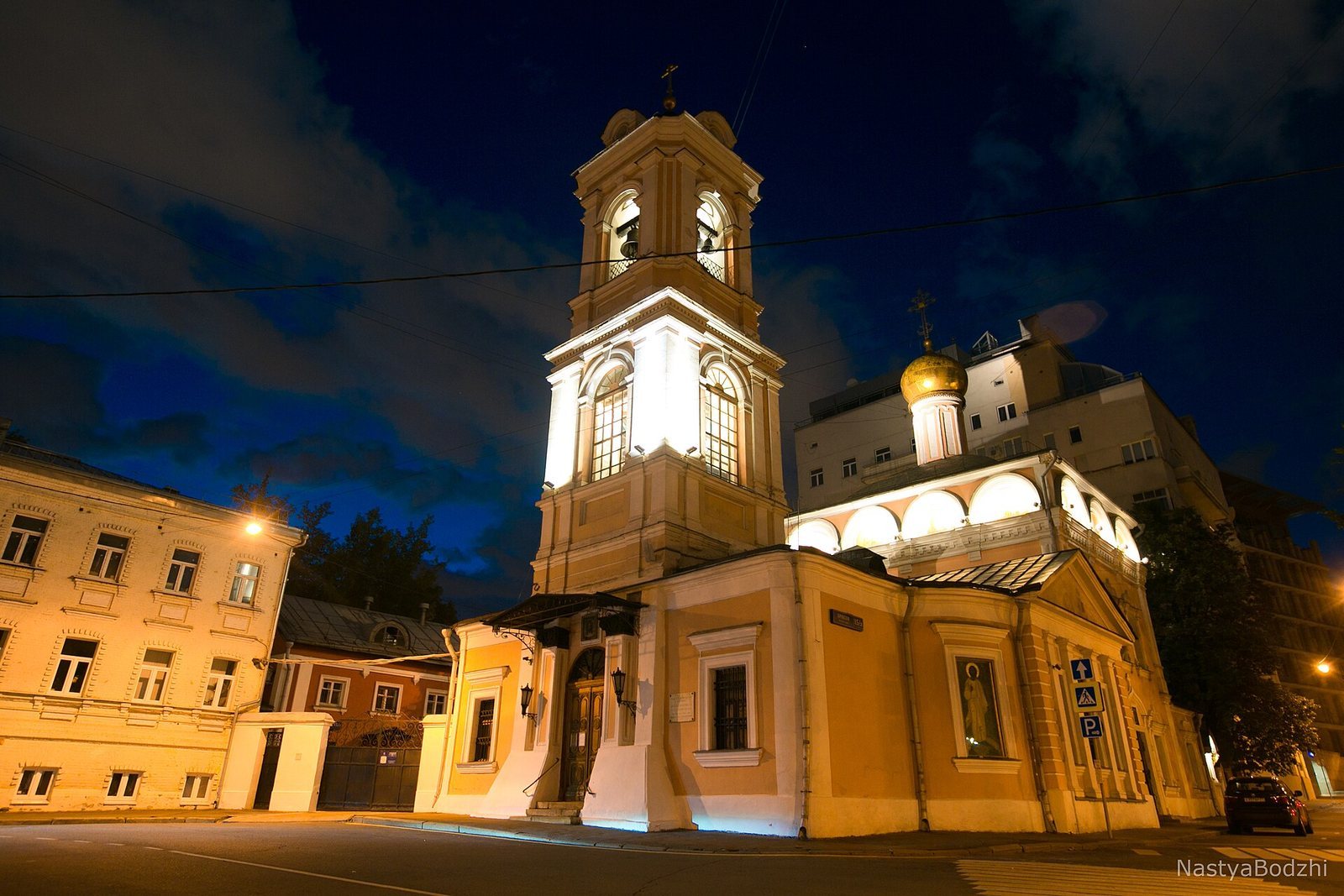
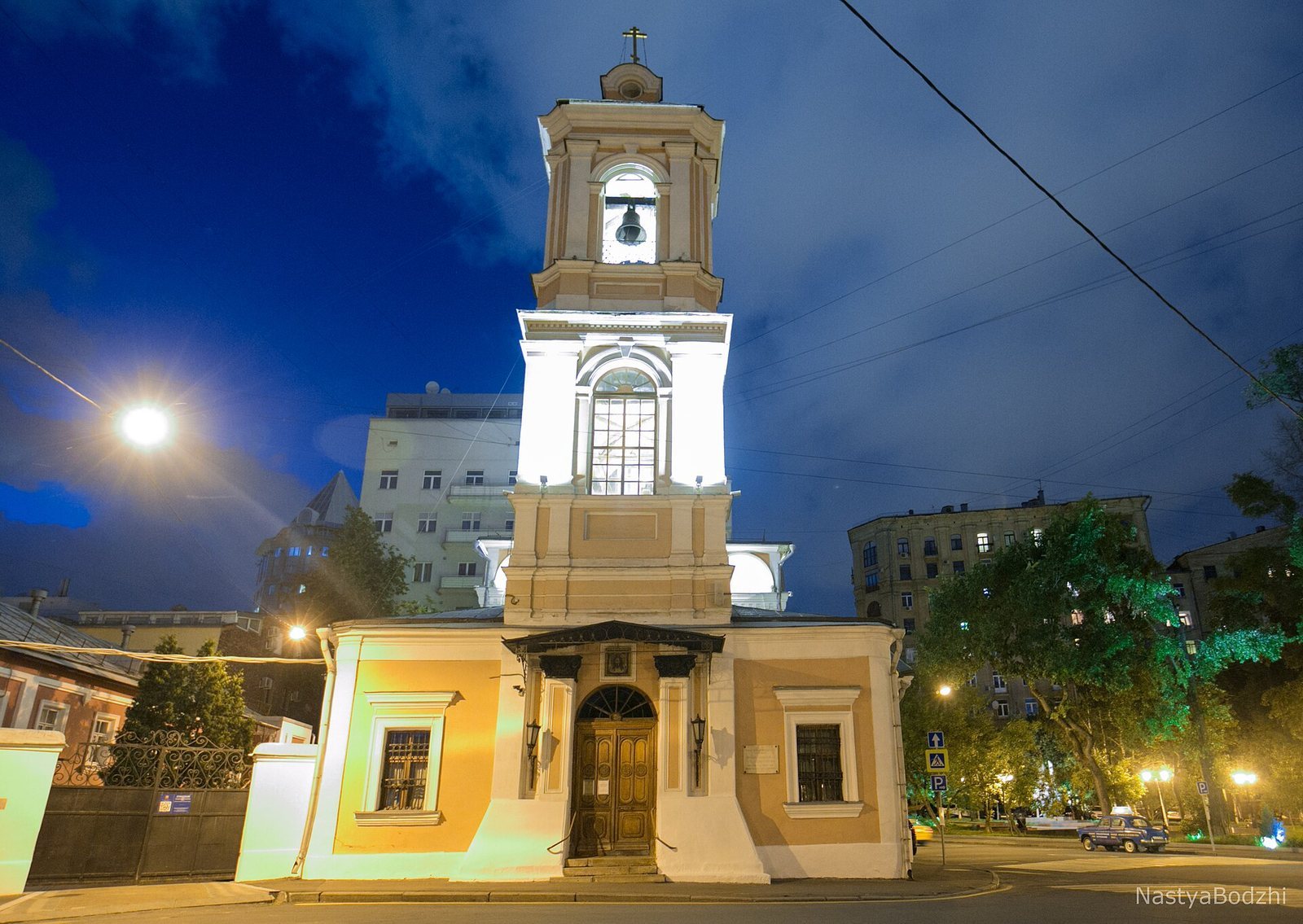
The church is a single-domed building with a four-sided main block, no internal supporting columns, and a three-part sanctuary end. Its original composition survives chiefly in the compact, two-storey main church and sanctuary end. The broader refectory and bell tower extend to the west.
Exterior and layout
Main church
The main church is an example of uzorochye, a decorative Russian architectural style of the seventeenth century. Its exterior has semicircular ornamental gables with small niches, restrained window surrounds, and corner details combining flat wall strips with half-columns. A molded band runs along the walls, while large decorative gable-like forms encircle the upper part of the building. The cylindrical structure supporting the dome is ringed by a row of small columns. A white-stone tomb slab dated 1715 is set into the south wall.
Refectory and bell tower
The refectory has a classical appearance and contains two side chapels with oval plans. Its side façades feature projecting blocks with rough-textured surfaces at the corners, shallow fronts framed by flat columns, and triangular gables. The bell tower’s rectangular upper tier combines Baroque elements with the Moscow Empire style, a local form of Empire-style architecture.
Entrance enclosure
An ornamental entrance gate and enclosure were added to the church grounds in the late nineteenth century.
Interior and furnishings
Main church and icon screen
The main church rises about 15 metres from the floor to the top of its vaulted ceiling and receives light through two tiers of windows. Plasterwork and painted ornament in the style of the 1870s–1880s decorate the ceiling. Paintings dating from 1820–1854 survive in the sanctuary and main church. The main iconostasis, the screen of icons separating the sanctuary from the congregation, was made in 1816–1817 by Semyon Nikitin to a design by Stepan Melnikov. It replaced a screen damaged in the 1812 fire. That earlier iconostasis had been installed in 1750 by painter Alexander Durakov and sexton Nikolai Gavrilov. The main screen was restored in 2022.
Icons in the main church
The 1802 icon called Seeking of the Lost depicts the Mother of God, an Orthodox title for Mary, with her head uncovered. Its borders show saints associated with the image’s former owners. It now stands at the left choir stand. To the right of the pulpit in the main chapel is an icon of St Spyridon of Trimythous, regarded as wonder-working and containing a fragment of his relics as well as small portions of relics of other saints. Beside it is an image of Christ called Not Made by Hands, representing Christ’s face and traditionally understood as not made by human hands.
Side chapels
The carved icon screens in the side chapels are white with gilding and date stylistically to the late nineteenth century. The south chapel contains seventeenth- and eighteenth-century icons of the biblical prophets Elisha and Elijah, including scenes from their lives. The north chapel, dedicated to St Nicholas, holds the church’s oldest icon, a late-sixteenth-century image of Nicholas of Mozhaisk. It stands in a case to the left of the pulpit and contains a small portion of relics of St Nicholas the Wonderworker. The north chapel’s iconostasis also includes a seventeenth-century icon of the martyr Justin the Philosopher, renewed in the nineteenth century.