Saint John the Baptist Church in Megève: A Catholic Church in France
Site at a Glance
- Popularity
- Medium
- Country
- France
- Primary era
- Early Modern
- Eras represented
- Medieval, Early Modern, Modern
- Civilizations
- Duchy of Savoy, French, Holy Roman Empire, Kingdom of Sardinia
- Site type
- Religious
- Remains
- Church
On this page14 sections
History
Foundation and medieval development
Saint John the Baptist Church in Megève, France, is a Catholic church whose foundation is dated to 1202. Benedictine monks from the Abbey of Saint-Michel-de-la-Cluse in Piedmont, northern Italy, established a priory, or religious house led by a prior, dedicated to John the Baptist. The monks followed a Christian monastic tradition organized around the Rule of Saint Benedict, but the date of their arrival in the area is uncertain. The church belongs to the Diocese of Annecy and the Sainte-Anne-d’Arly-Montjoie parish.
The church was enlarged in the 14th century. Its nave appears to have been rebuilt between 1687 and 1692.
Fires and religious processions
A fire may have destroyed the church in 1728. On 9 November 1754, a fire certainly destroyed it, including its bell tower. In the 18th century, the church was also part of a Rogations tradition. Rogations are Christian days of prayer commonly marked by processions. On the second day, Megève’s procession met the one from Combloux and continued with it to Saint-Nicolas Church there. The following day, the two processions set out for Saint John the Baptist Church in Megève.
Nineteenth-century reconstruction
After the 1754 fire, Megève resident Muffat de Saint-Amour restored the bell tower, which was rebuilt in 1809. Later fires struck the village without damaging the church.
Twentieth-century restoration and protection
Artist Georges Gimel created an enamelled Stations of the Cross for the church in 1956. A complete restoration followed in 1957, directed by an architect in collaboration with a Savoyard architect. France listed the church as a historic monument in 1988. Its 19th-century bell tower is protected, and its 18th-century holy-water font was classified as a historic monument in 1984.
Remains
A few traces of the 1202 building survive. The church’s recorded features include its entrance and façade, nave, choir, bell tower, and interior furnishings, which reflect alterations made across several centuries.
Exterior and bell tower
Entrance and façade
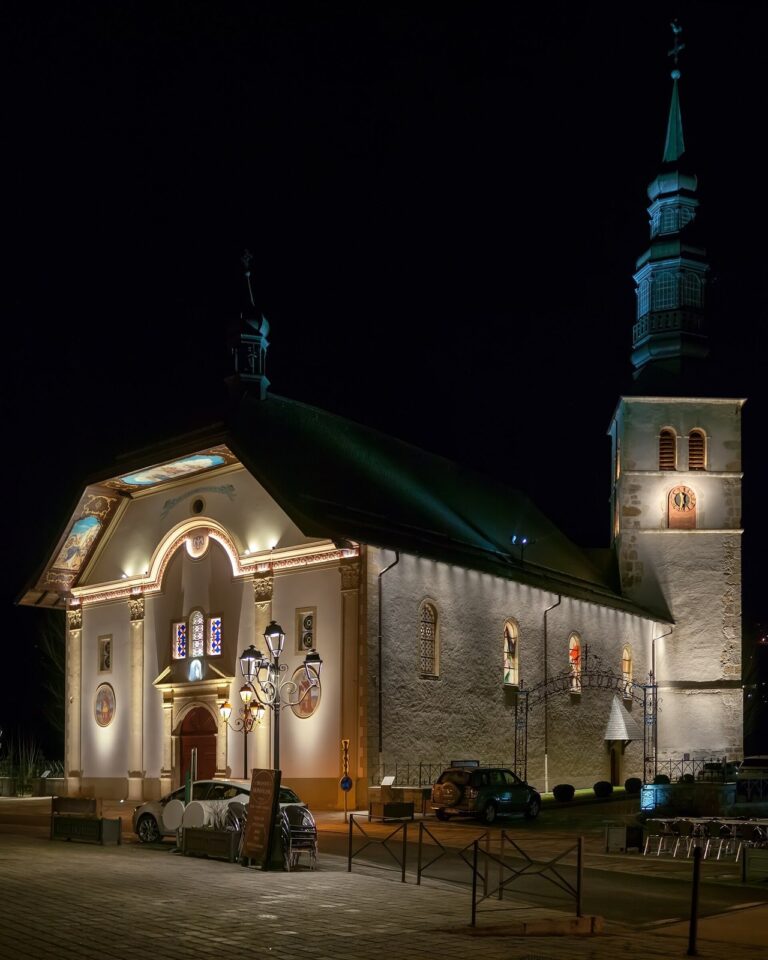
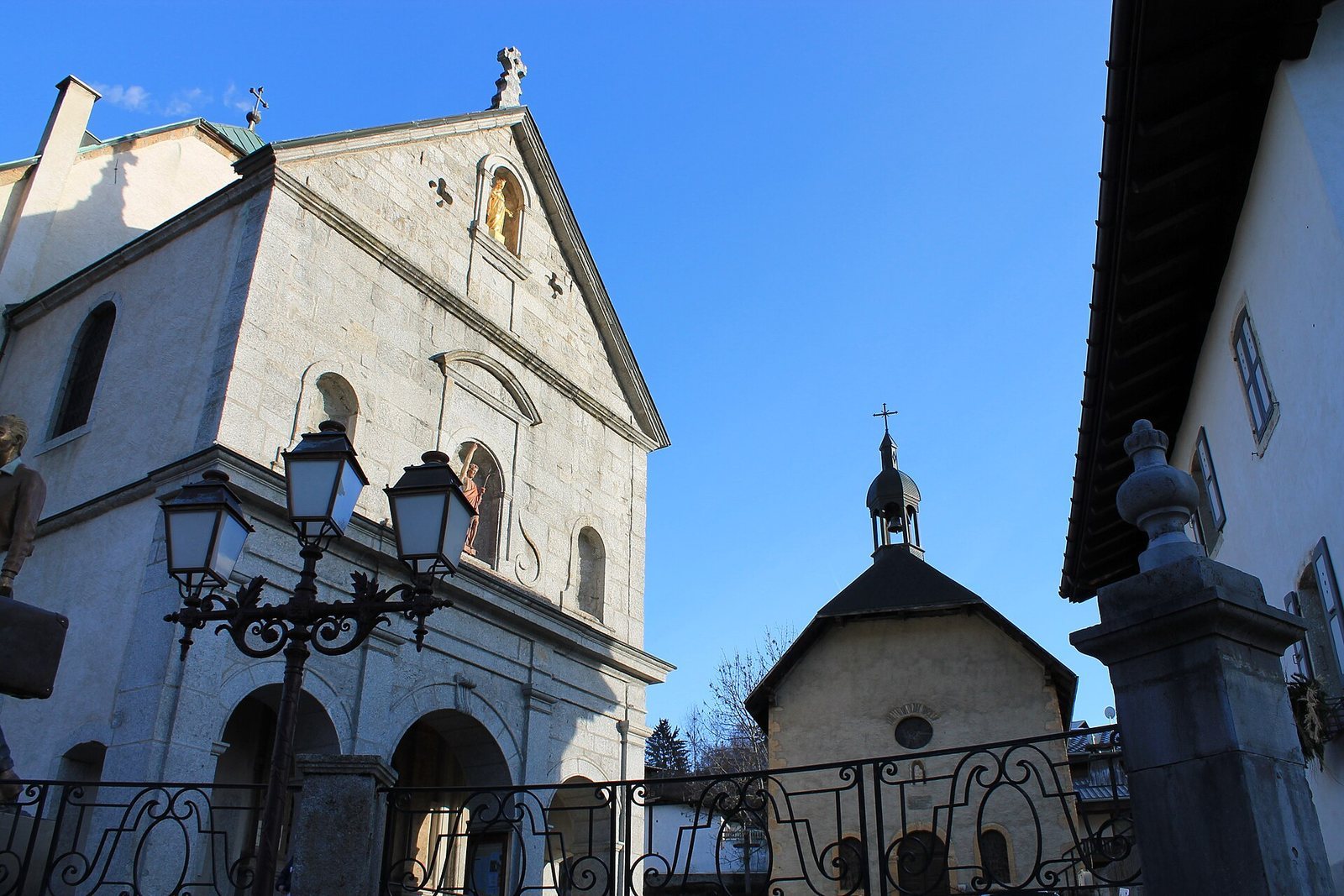
The entrance vestibule dates to 1872, and the façade was rebuilt in 1879. The church door bears the date 1622. Above the façade’s statue of John the Baptist is a statue of the Immaculate Conception, the Catholic doctrine that Mary was conceived without original sin.
Bell tower and bells
The bell tower contains a carillon, a set of tuned bells arranged to sound musical sequences. It has 11 bells, five of which are swung. The largest is a low-pitched bell weighing about 3,000 kilograms, cast in 1886 by Georges and Francisque Paccard. It sounds B-flat 2 and is among the largest bells in the department.
The second bell weighs 2,000 kilograms and the third 1,200 kilograms. Both were cast in 1825 by Louis Frèrejean and Claude Paccard, sounding C 3 and E-flat 3 respectively. The fourth, made that year by the same founders, weighs 950 kilograms and sounds F 3. The fifth swung bell, cast in 1783 by the Lièvremont brothers of Pontarlier in the Doubs, weighs 650 kilograms and sounds G 3.
The sixth bell is fixed rather than swung. Alfred Paccard cast it in 1924; it weighs 400 kilograms and sounds A 3. The seventh weighs 300 kilograms, sounds B-flat 3, and bears the name Paccard with the year 1886. Paccard cast the eighth, ninth, and tenth bells in 1896. Each weighs about 300 kilograms, and they sound C 4, D 4, and E-flat 4. An eleventh bell, mounted on the tower’s small turret, sounds an out-of-tune E-flat 4.
Interior and furnishings
Choir and high altar
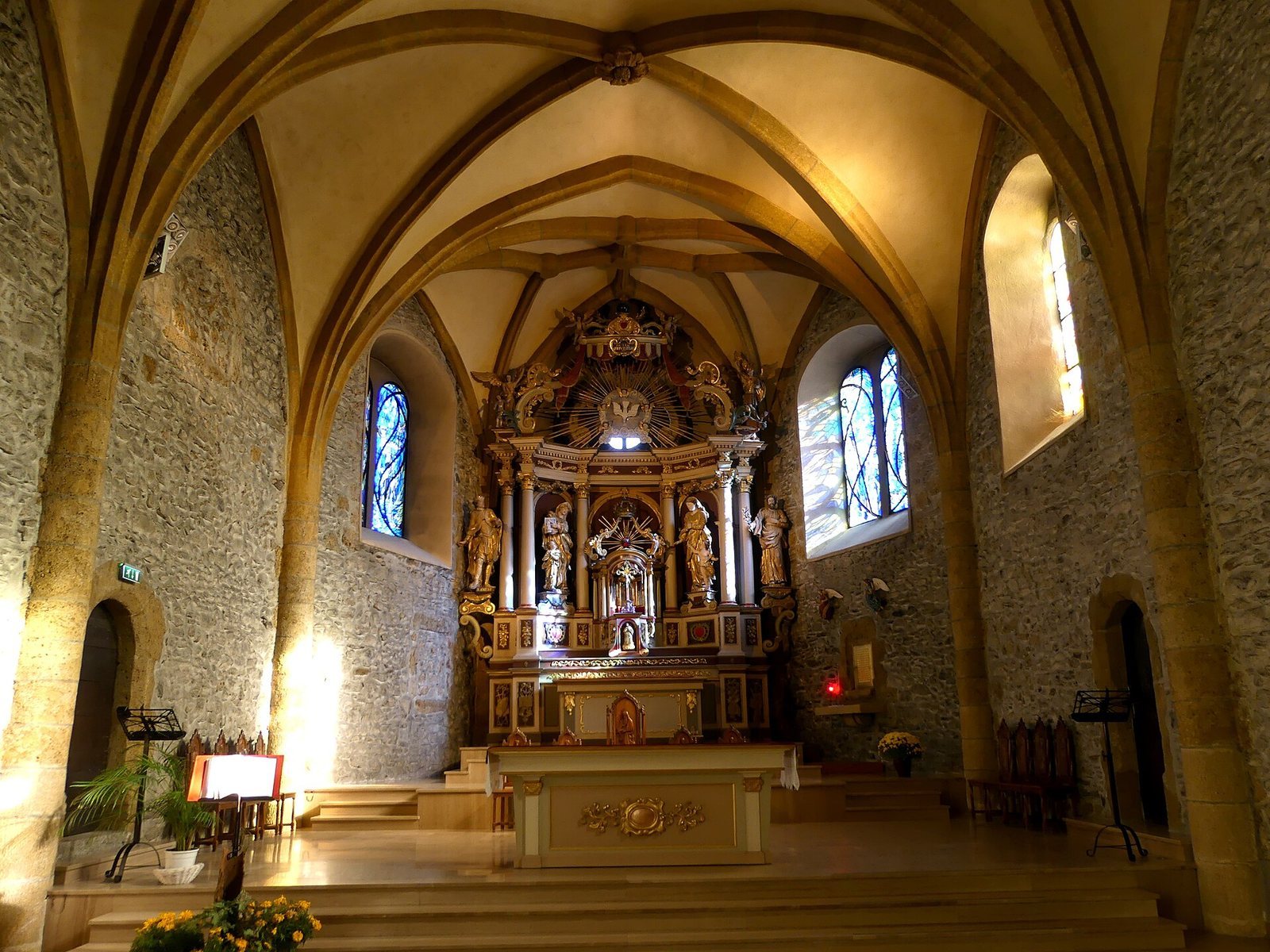
The choir is in the Flamboyant Gothic style, a late Gothic form characterized by elaborate, flame-like tracery. Its high-altar altarpiece dates to 1731. It was partly destroyed during the Revolution and later rebuilt during the Sardinian Restoration, when Sardinian rule returned after the revolutionary and Napoleonic period.
Interior decoration
The Italian painter Mucengo decorated the church after 1827. Humidity damaged the work, and painter Ferraris restored it in 1859.
Stations of the Cross
The enamelled Stations of the Cross use precious-metal oxides. This devotional sequence represents episodes from the final hours of Jesus’s life.
Holy-water font
The church contains an 18th-century holy-water font.