Dolmen de Cubillejo de Lara: A Prehistoric Collective Tomb in Burgos
Site at a Glance
- Popularity
- Medium
- Country
- Spain
- Primary era
- Bronze Age
- Eras represented
- Bronze Age
- Civilizations
- Unclassified
- Site type
- Burial
- Remains
- Tomb
On this page10 sections
History
The Dolmen de Cubillejo de Lara is a prehistoric collective tomb in Burgos, Spain, built about 5,000 years ago as a passage grave, a burial chamber reached through an entrance passage. Its construction used large stones, the defining feature of megalithic monuments.
Prehistoric burial and regional connections
Similarities between this tomb and megalithic burial monuments in Beira, Portugal, and in Extremadura and Salamanca have informed arguments about connections between western Iberia and the eastern Meseta, the central plateau’s eastern region. Study of this eastern Meseta example has also contributed to the view that the dolmens of Burgos had western origins.
Excavation and heritage
Local residents knew the stones before their archaeological importance was recognized. After the Burgos Speleological Services reported the site and it was surveyed, excavation began in 1970. The work was carried out by Osaba, Abásolo, Uribarri, and Liz, researchers associated with the University of Valladolid and the Burgos Museum, and published in 1971. A large quantity of stones had to be cleared from the burial chamber. Disturbance over time was considered one reason for the limited number of recovered objects.
The monument is also known as the Dolmen de Mazariegos and the Dolmen de Mecerreyes. Its municipal location is disputed between Mambrillas de Lara and Mecerreyes. Although cadastral records place the parcel in Mecerreyes, the boundary has not been established with sufficient certainty. In 2014, the High Court of Justice of Castile and León rejected a private request to change the recorded location and name, finding the cadastral evidence insufficient to show that the record was wrong. The regional government recommended retaining the established name, Dolmen de Cubillejo, regardless of the eventual boundary decision.
On 25 June 1985, the dolmen received Spain’s Bien de Interés Cultural designation, a formal cultural-heritage protection status. It is also included in the heritage catalogue of Castile and León.
Remains
Physical layout and features
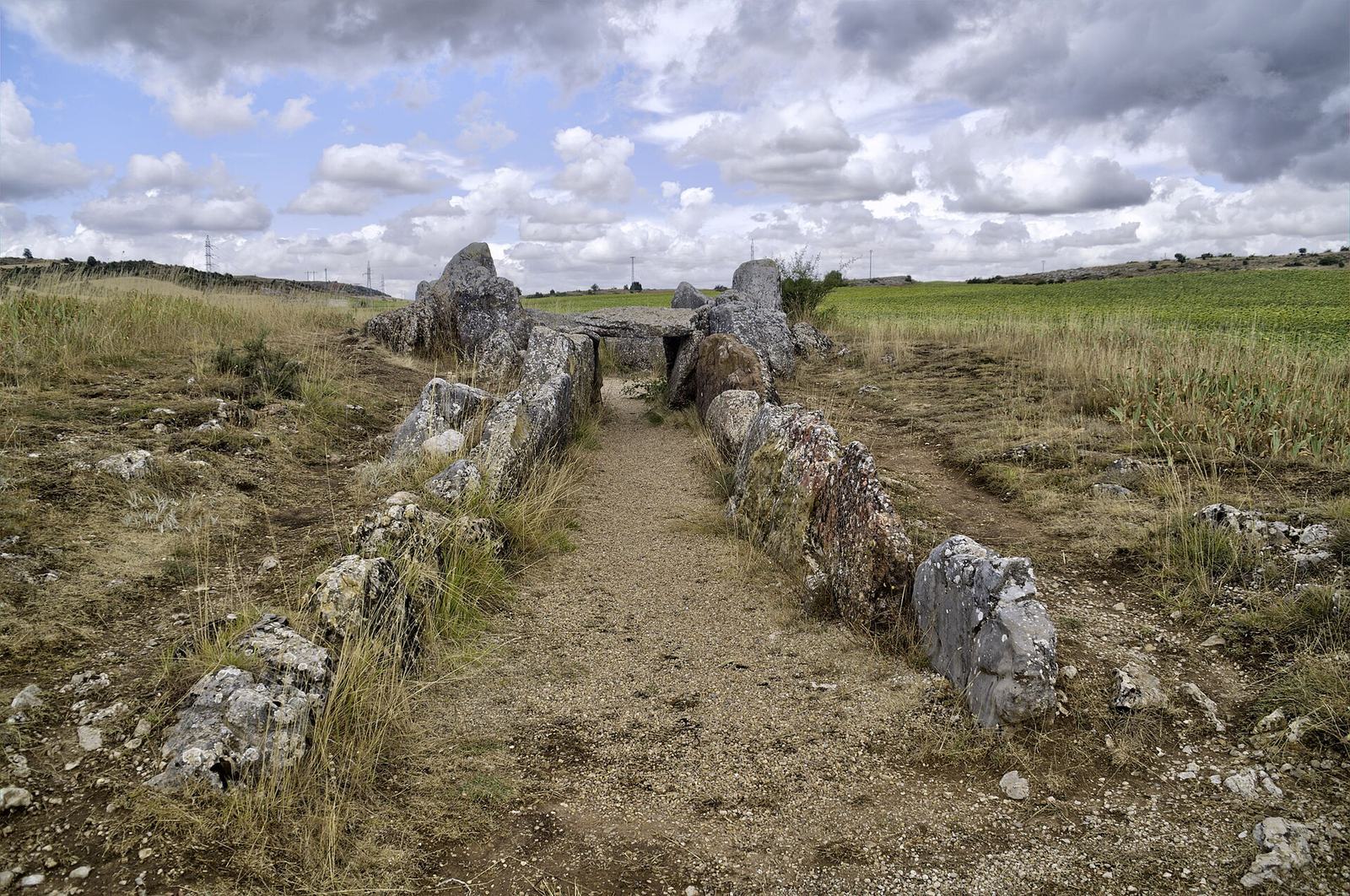
The tomb stands on a small spur where two streams meet, in a valley between Peñalara to the north and the Sierra de las Mamblas to the south. Its setting marks a transition between the Tertiary Basin of the Northern Submeseta and the western side of the Iberian Range at the Sierra de la Demanda. Limestone, conglomerate, clay, and alluvial deposits occur in the surrounding geology. The monument’s position beside a path and the Cañada Real de las Merinas, a traditional livestock route for seasonal transhumance, made it a local landmark.
Mound and outer ring
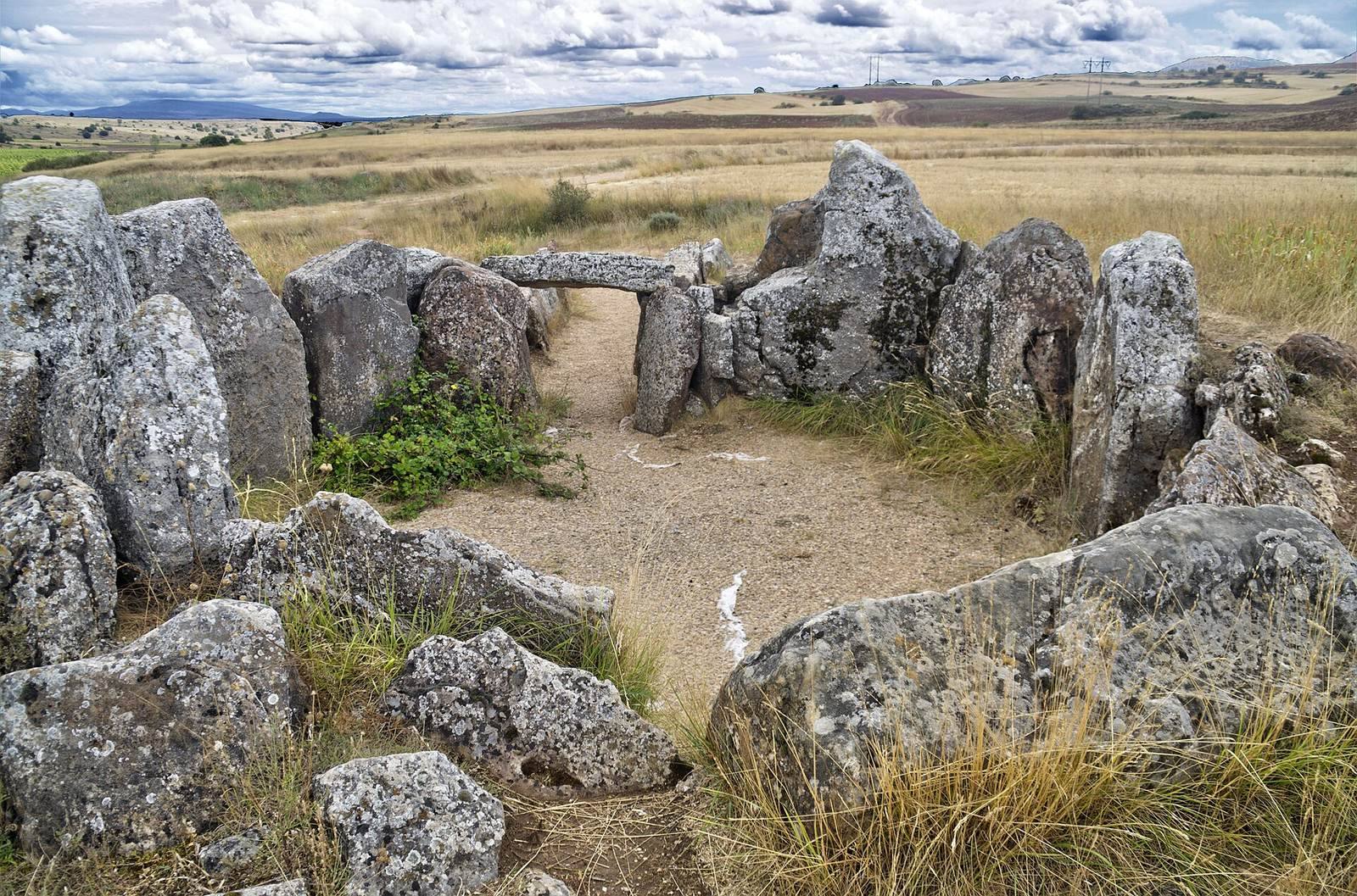
A low, poorly preserved mound once covered the chamber and passage. Its inferred plan is oval, with the longer axis following the passage. Stream erosion and the trenches and debris left by investigation have altered its form. Lines on some stones indicate how far the structure was once buried. Fourteen large stones make an outer ring around the chamber, with smaller stones packed between the ring and the chamber.
Burial chamber
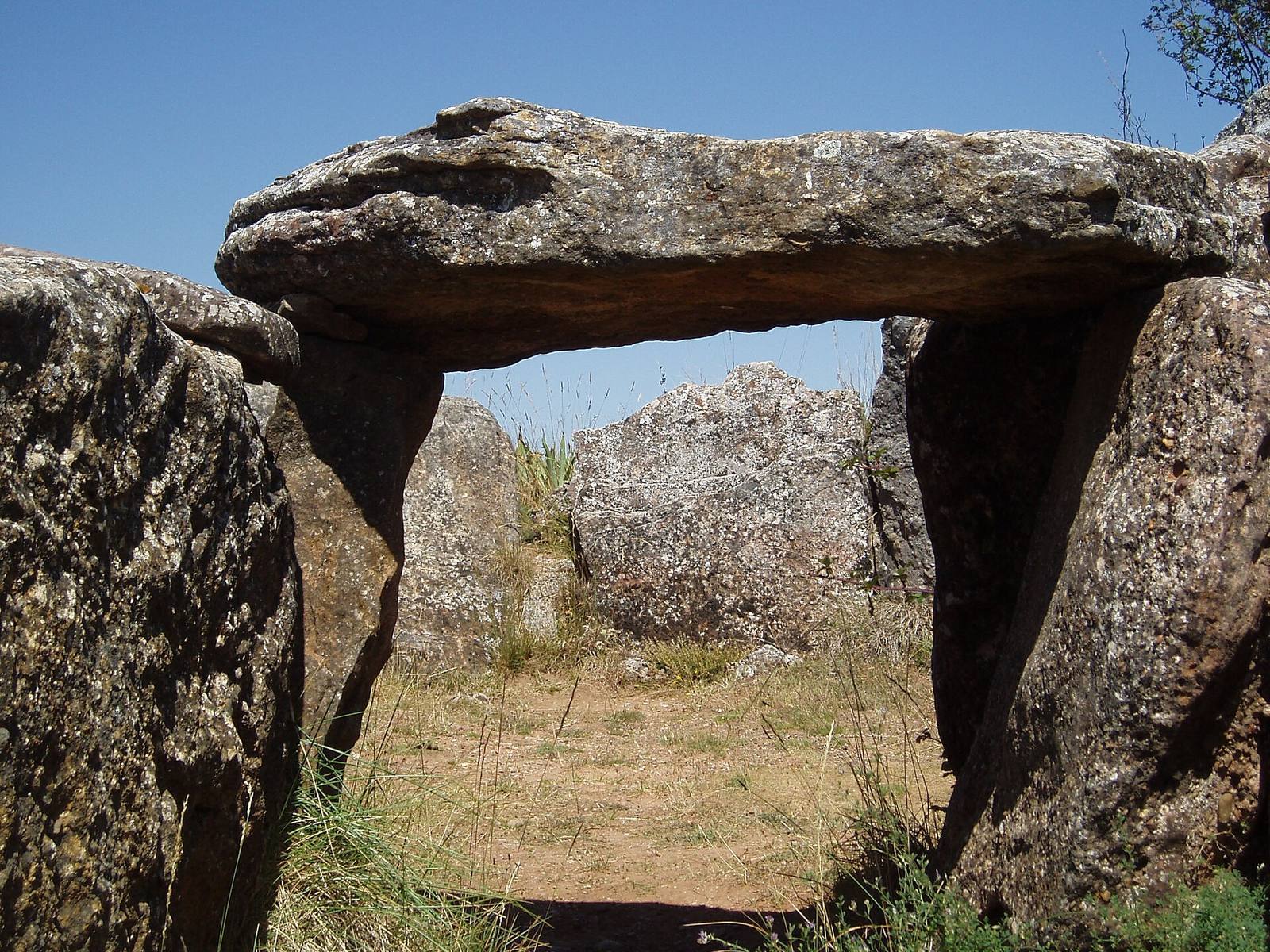
The circular chamber measures about 4.5 to 6 metres across. It was formed from eleven upright limestone and conglomerate blocks, ten of which survive. Most are naturally shaped, unworked stones attributed to a nearby small quarry. They lean inward and differ in height; the largest is 2.25 metres high and 0.40 metres thick. Rectangular and semicircular recesses on some lower stones may have helped support the roof.
Passage and roof
The passage faces southeast and extends 10.5 metres from the chamber. Its two parallel walls each consist of six horizontally laid slabs, with some supports on the outside. The passage is 1.5 metres wide, and its height decreases from 1.5 metres at the chamber entrance to 0.75 metres at the far end. The floors are compacted clay. The roof is poorly understood, and its covering stones are no longer in place. A hollow in the chamber floor may have held a central support post, while two more circular hollows occur in the passage. The passage may have had lintels like the one at the chamber entrance, which had fallen inside before excavation began in 1970.
Engraved panel
An upright slab in the passage’s right-hand wall, close to the chamber entrance, bears a heavily weathered engraved panel. Its images include two schematic four-legged animals and a design shaped like a double branch or comb. The carvings’ date in relation to the tomb’s construction is uncertain, and they may be later. If they were made at the same time as the tomb, they could be compared with prehistoric rock art in eastern Iberia. Excavation exposed the panel to rain, wind, frost, and the risk of human damage.
Excavated objects
Finds include human remains from four individuals, four flint blades, a flint nodule, and a smoothing stone. A white bracelet made from Glycymeris shell has been interpreted as evidence of exchange between the eastern Meseta and the eastern Iberian coast in the second half of the fourth millennium BC. The shell’s Mediterranean origin suggests that coastal goods may have reached the interior by way of the Ebro. Two greenish beads were made from callaïs, a green ornamental stone. Two small decorated pottery fragments are attributed to the Bell Beaker horizon, a prehistoric tradition associated with distinctive pottery. Their incised designs include a band of parallel vertical lines and a zigzag pattern forming a lattice. The finds and a model of the dolmen can be viewed at the Burgos Museum.