Santa Cruz Roman Villa: A Late Roman Rural Estate in Spain
Site at a Glance
- Popularity
- Medium
- Country
- Spain
- Primary era
- Classical
- Eras represented
- Classical
- Civilizations
- Roman
- Site type
- Domestic
- Remains
- Villa
On this page11 sections
History
The Santa Cruz Roman villa was a rural estate near Baños de Valdearados in Burgos, Spain. Its principal phase dates to the fourth and fifth centuries, although an earlier building stood on the site in the first or second century. The estate lay within the territory of Clunia Sulpicia, a Roman city a few kilometres away and the capital of a judicial and administrative district in the province of Hispania Citerior, in the Iberian Peninsula.
Early building and Roman estate
Parts of the earlier building were incorporated into the villa during the late fourth century. Its rooms and mosaics have been interpreted as reflecting the taste and wealth of its cultivated owners in the late fourth and early fifth centuries.
Discovery and protection
The site came to light by chance when land was being levelled in the Santa Cruz area and an excavator exposed mosaic and pottery fragments. Archaeologist José Luis Argente led excavation campaigns in 1973, 1974 and 1978. On 11 March 1994, the villa was declared a Spanish Asset of Cultural Interest in the Archaeological Zone category.
Remains
Excavated plan and setting
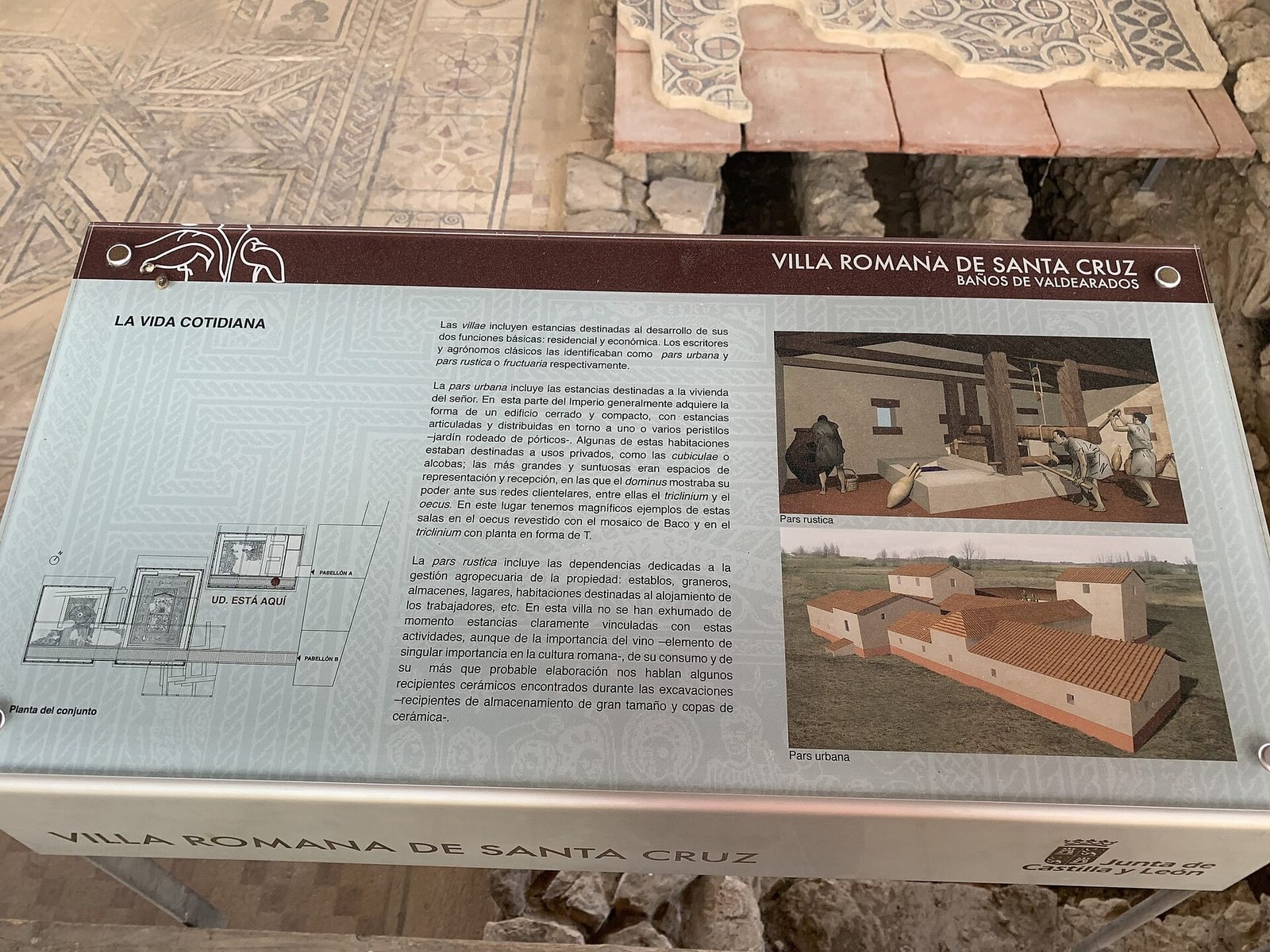
The excavated area covers just over 1,000 square metres and represents only part of the villa. Its known plan contains ten rooms and four corridors. The remains lie about 300 metres south of Baños de Valdearados, near the Bañuelos River and close to a Roman road linking Caesaraugusta, modern Zaragoza, with Asturica Augusta, now Astorga, and Bracara Augusta, now Braga. Finds from the initial discovery included pottery, curved roof tiles, column shafts and decorative stucco.
Water and heating
A water system gathered, stored and drained water through galleries radiating from a well. The well remained in use until the fifth century. Some rooms had hypocaust heating, a system that circulated hot air through channels.
Mosaic floors
Oecus
The principal reception room, or oecus, had a 66-square-metre mosaic that is exceptionally well preserved. Its central design consists of two panels showing the triumphal return of Dionysus, also called Bacchus, the Greek and Roman god associated with wine and ecstatic celebration. In the upper panel, an intoxicated Dionysus appears with Ariadne and Ampelos, figures from myths associated with the god, and seven other figures. Below, Dionysus and Ariadne accompany Pan, a pastoral god, in a chariot drawn by panthers.
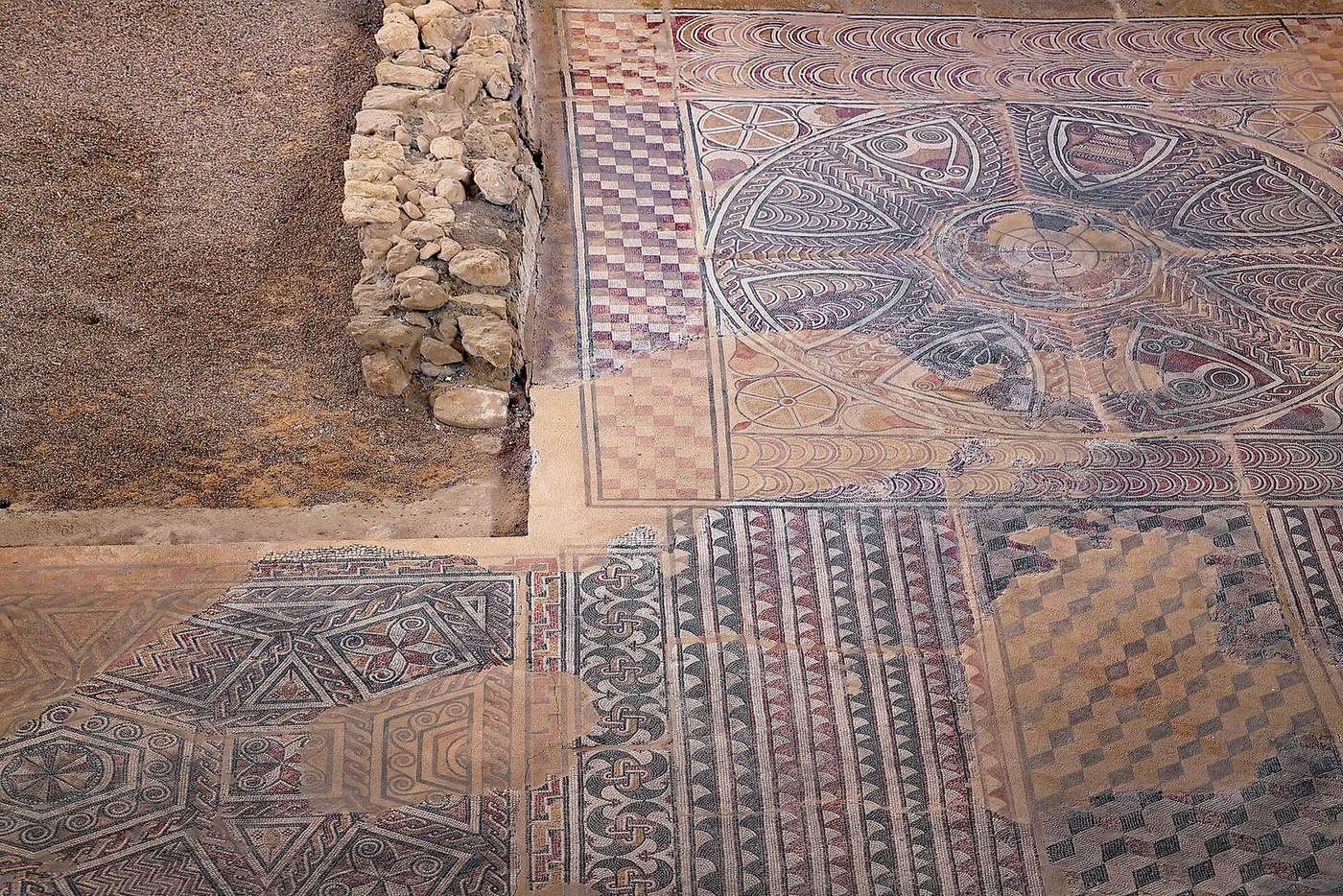
A border of interlocking bands and swastika-shaped motifs surrounds the central scenes. Six rectangular panels with animals interrupt the border; four carry Latin inscriptions naming wind deities. Square panels at the four corners contain male busts. The mosaic has been described as unique in its subject and quality, and as among the best-preserved on the Iberian Peninsula. On the night of 27–28 December 2011, three sections were stolen using rudimentary methods. The central section, probably already broken, measured about 2.30 by 2.50 metres. It showed Dionysus in a panther-drawn chariot with Pan and Ariadne, holding a thyrsus, a staff associated with Dionysus, in his left hand and a krater, a vessel for mixing wine and water, in his right. The two end sections each measured about 1.30 by 0.70 metres. One depicted Eurus, a personification of a wind, with a dog chasing a hare; the other showed Zephyrus, another wind personification, with a dog pursuing a gazelle.
Triclinium
The dining room, or triclinium, had a T-shaped mosaic in poor condition. Its designs included a krater set within a shield-shaped motif, swastikas combined with Solomon’s knots, an interlaced decorative pattern, checkerboards, diamonds and a rosette.
Eight-pointed star mosaic
A further room had a figured floor arranged around an eight-pointed star. Its imagery included Ceres, the Roman goddess of agriculture, and Fortuna, goddess of fortune, along with four animal scenes and female busts in the corners.
Medieval cemetery
Several tombs at the site belong to a cemetery dated from the ninth to the eleventh centuries.