Saint Anne Rotunda in Horiany: A Medieval Church in Ukraine
Site at a Glance
- Popularity
- Medium
- Country
- Ukraine
- Primary era
- Medieval
- Eras represented
- Medieval
- Civilizations
- Hungarian
- Site type
- Religious
- Remains
- Church
On this page10 sections
History
Saint Anne Rotunda is a centrally planned medieval church in Horiany, now a neighborhood of Uzhhorod, Ukraine. A rotunda is usually circular, but the term also applies to polygonal centrally planned churches. The building’s construction date is unsettled: it is commonly assigned to the tenth or eleventh century and often regarded as the oldest building in Zakarpattia, though proposed dates range from the ninth to the fourteenth century.
Dating and historical interpretations
Research into the church began in the early twentieth century, when the region was part of the Austro-Hungarian Empire. Restoration work in 1911 exposed its wall material for closer study. Hungarian researchers compared it with material in castle walls and argued for a tenth- or eleventh-century date. Interest in the question increased after the region became part of the Czechoslovak Republic.
Several interpretations placed the building in earlier periods. I. Kral associated it with ninth-century churches of the Great Moravian state, an early medieval Slavic polity in Central Europe. Volodymyr Sichynskyi proposed a tenth-century church built by Slavic builders influenced by Byzantine architecture, the tradition of the Eastern Roman Empire. In 1921, M. Novakivsky also argued that its style reflected Byzantine influence.
Other proposals put the church later. Florian Zapletal suggested a fourteenth-century date and raised the possibility that Fedir Koriatovych, a prince of Podillia, had built it. V. Pachovsky compared it with churches in Galicia, where foundations of similar centrally planned churches had been found. V. Zalozetsky drew parallels with Balkan rotundas dated to the eleventh and twelfth centuries.
During the Soviet period, Hryhoriy Lohvyn proposed a thirteenth-century date and suggested that builders from Galicia may have taken part. Historian P. Sova instead favored the twelfth century and proposed that monks of the Order of St Paul, a Catholic monastic order, built the church. In the late 1960s, Vera Gervers-Molnár compared it with churches in Kiszombor and Korcso in Hungary. Their shared geometry and building materials led her to place the group in the eleventh century.
Ownership and religious use
The church belonged to the Drugeth dynasty, a noble family prominent in the medieval Kingdom of Hungary. After the medieval period, it was part of the Catholic Church. Its original dedication was to Saint Anne, traditionally regarded in Christianity as Mary’s mother. It is now dedicated to the Intercession of the Theotokos. Theotokos means God-bearer and is a title for Mary; the associated Eastern Christian feast honors her protection and intercession.
Soviet authorities transferred the church to the Orthodox Church in 1949 and barred its use as a church in 1962. It was restored again during the 1980s. Since 1990, it has served as a Greek Catholic church in the Mukachevo Greek Catholic Eparchy, an Eastern Christian church district comparable to a diocese. The site is designated an Immovable Monument of National Significance of Ukraine.
Remains
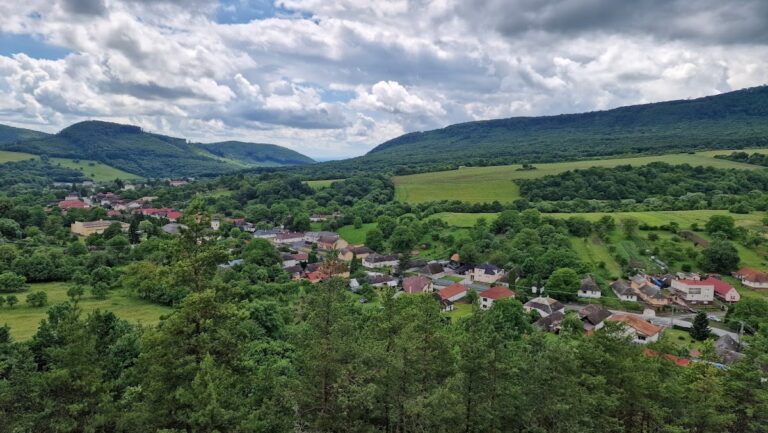
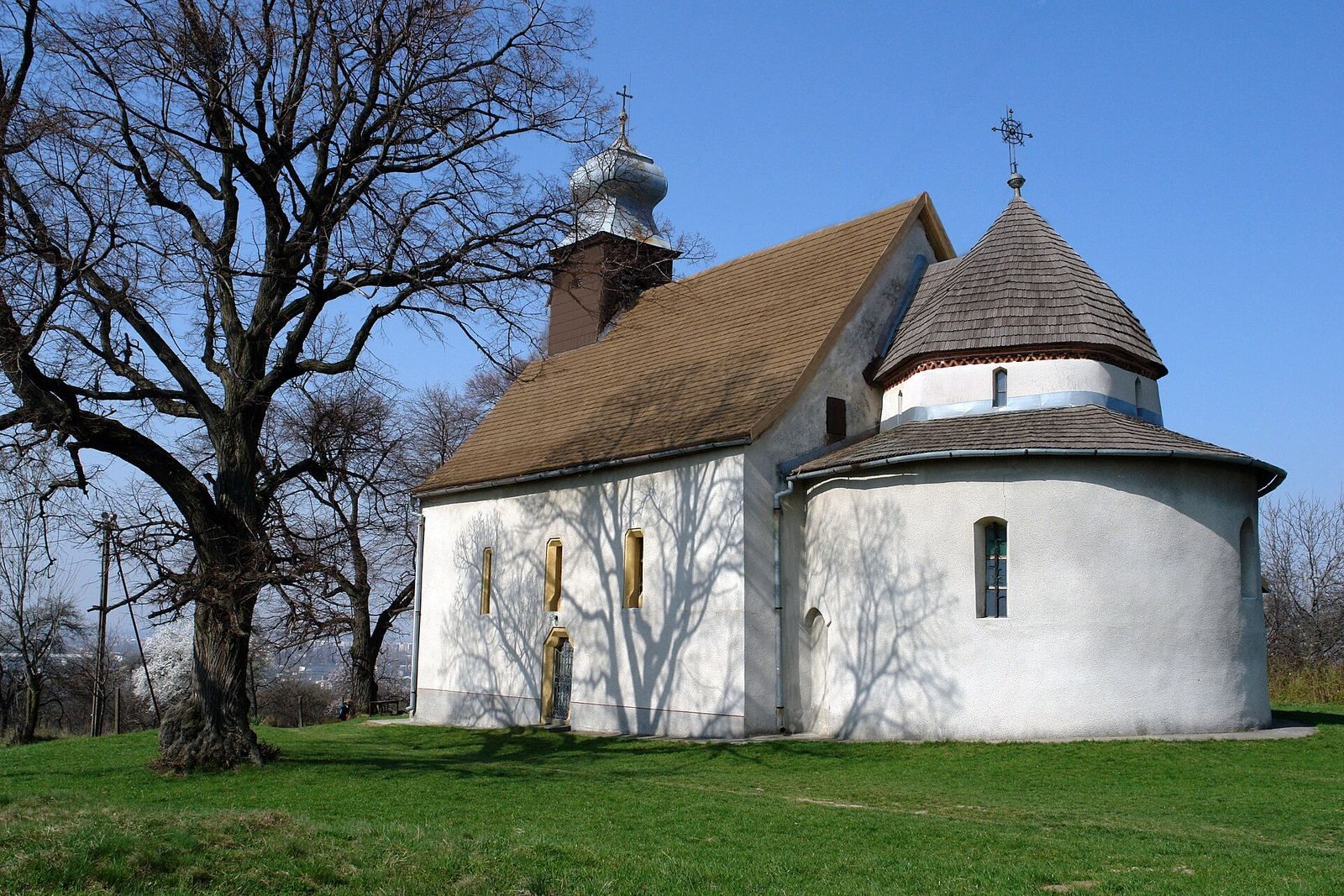
The church stands on a hill in Horiany, described as the last hill of the Carpathians on the outskirts of Uzhhorod. Its layout combines a hexagonal medieval rotunda with a single nave and a projecting bell tower. The Gothic nave is a later enlargement of the original building.
Rotunda and church plan
Hexagonal core
The rotunda has a six-sided plan. Six semicircular niches and three windows are set into its thick walls. Above them rises a lighter upper section with six windows.
Gothic nave and bell tower
A Gothic nave was added to the rotunda in the fourteenth century, forming the church’s single-nave layout. The bell tower projects from the nave.
Painted and commemorative features
Frescoes
Frescoes dated to the fourteenth century cover the rotunda’s interior walls. Their style is associated with the Italian Proto-Renaissance, an artistic period preceding the Renaissance, and with the painter Giotto.
Memorial sculpture
A bronze sculpture near the rotunda was unveiled on 26 September 2021 to commemorate the church as the oldest functioning church in Zakarpattia. It depicts the oldest part of the rotunda resting on an open book, alongside Saint Anne and the letters Alpha and Omega. The sculpture stands on a pedestal of local andesite. Priest Bohdan Savula initiated the project; Vasyl Homonai was its patron, Roman Murnyk its sculptor, and Stepan Rusnak its blacksmith.