Valley of the Muses: A Sanctuary to the Greek Muses in Boeotia
Site at a Glance
- Popularity
- Medium
- Country
- Greece
- Primary era
- Classical
- Eras represented
- Classical
- Civilizations
- Ancient Greek, Roman
- Site type
- Religious
- Remains
- Sanctuary
On this page17 sections
History
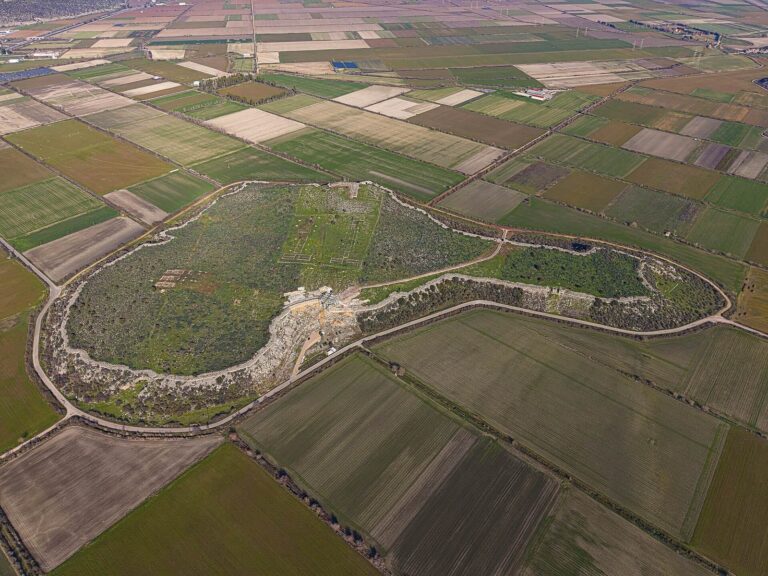
The Valley of the Muses was a sanctuary to the Muses, Greek goddesses associated with poetry, music, and the arts, in the territory of Thespiai in Boeotia, Greece, east of Mount Helicon. The oldest finds belong to the Geometric period, an early phase of Greek history and art. The sanctuary was established by the sixth century BCE, and the valley was associated with the Muses by about 500 BCE at the latest.
Origins and local traditions
Greek tradition attributed the sanctuary’s foundation to the twin giants Otus and Ephialtes, known as the Aloadae. They were said to have worshipped three Muses named Melete, Mneme, and Aoide. A later story credited Pierus of Macedonia with bringing the worship of nine Muses from Thrace. He named his daughters after them, and their children were consequently described as the Muses’ grandchildren.
The poet Hesiod came from Askra, a village in the valley. In his poetry he describes the local Muses and tells of meeting them while he was tending sheep. A tripod he won in a singing contest at Chalkis, on the Euripus Strait, was later dedicated at the sanctuary.
Festivals and the Hellenistic period
The people of Thespiai organized the Mouseia, festivals and contests in honor of the Muses. The festivals’ original schedule is uncertain. They were reorganized late in the third century BCE and thereafter took place every five years. Competitions included epic and lyric poetry, recitation of epic verse, performances on the stringed kithara and reed aulos, and plays including tragedy, comedy, and satyr drama.
The sanctuary and its contests thrived especially during the Hellenistic period, the era after Alexander the Great’s death in 323 BCE through the Roman conquest of the Hellenistic kingdoms. The second century BCE was a particular high point. Shortly before the Battle of Leuctra in 371 BCE, the Thespians probably built a square tower on Pyrgaki hill, apparently to monitor Theban movements.
Roman influence and abandonment
From the second or first century BCE, contests in honor of Roman emperors entered the festival program or took precedence over earlier events. The celebrations became known as the Great Kaisareia, and Roman emperors sponsored them. The games remained prominent into the first century BCE. Lucius Cornelius Sulla Felix, a Roman general and dictator, dedicated a statue of Dionysus by Myron of Orchomenus to the Muses. The sanctuary flourished again in the second century CE, but its program was curtailed in the third century.
The sanctuary also drew the attention of ancient writers. Athenaeus, a Greek author whose work preserves antiquarian material, says that Amphion of Thespiai wrote at least two books about it. Philostratus, a Greek biographical writer, recounts a visit by Apollonius of Tyana, a philosopher and religious teacher. As monotheism spread, the festivals and the valley were abandoned. In 330 CE, Emperor Constantine the Great moved statues of the Muses to his new capital, Constantinople. Their later whereabouts are unknown.
Excavation began with test trenches dug by Panagiotis Stamatakis in 1882. The French School at Athens carried out systematic work from 1888 to 1890 under Paul Jamot, exposing the altar, colonnaded halls, and theatre. The church standing over ancient foundations was demolished during the excavations.
Remains
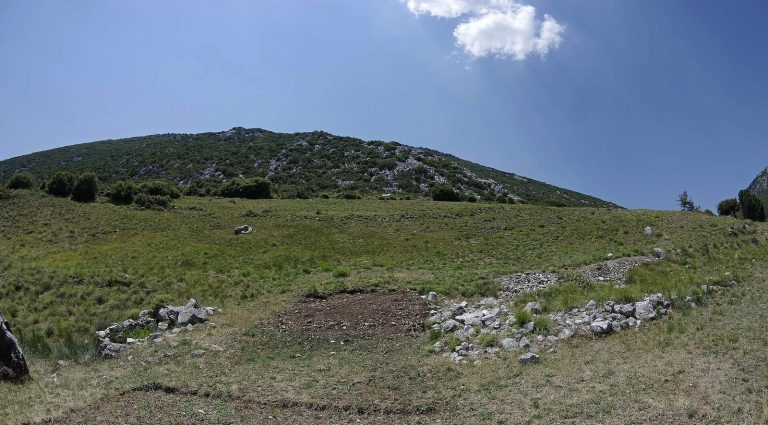
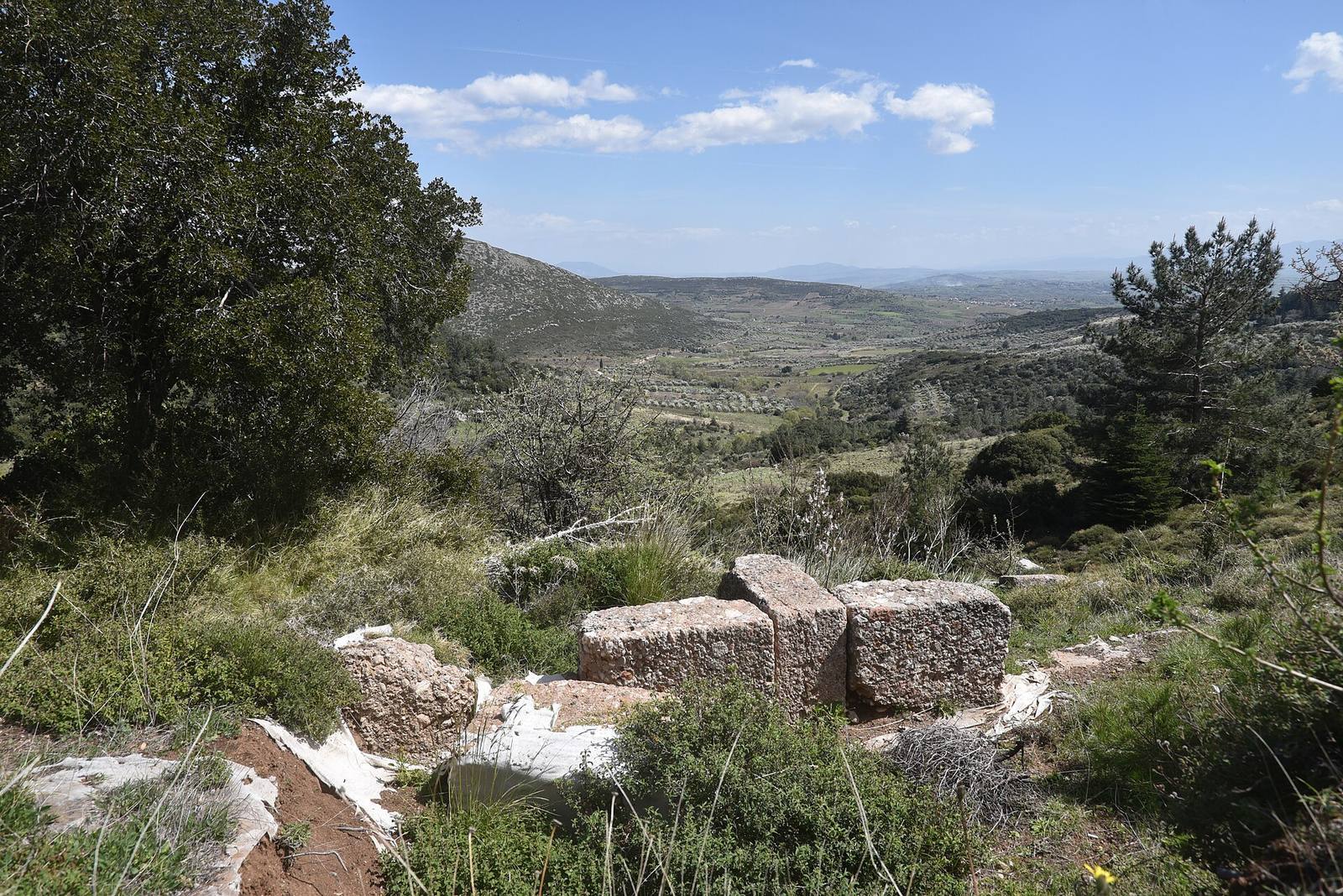
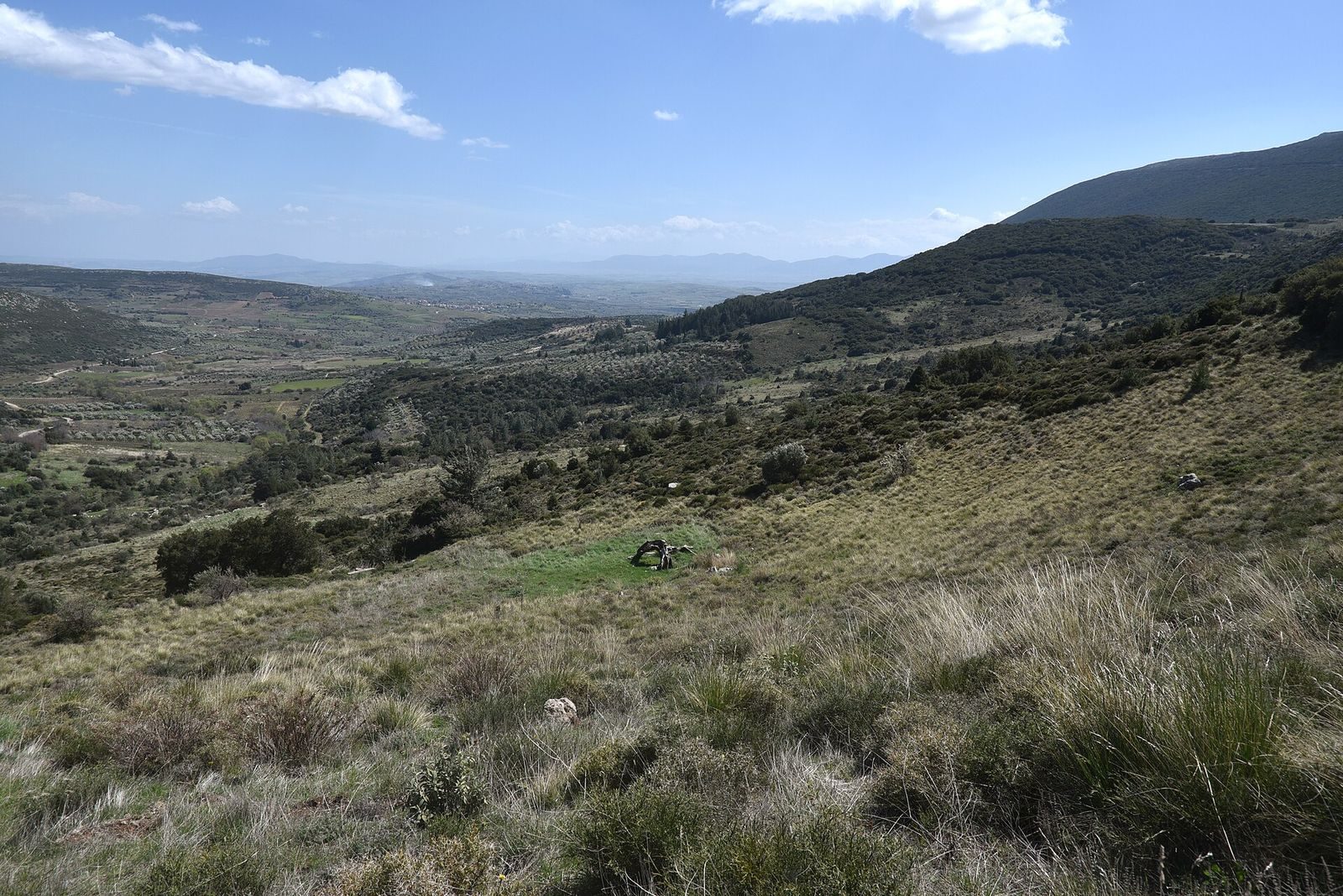
The sanctuary occupied the eastern part of the Valley of the Muses, about 4.5 km west of present-day Askri. Its sacred grove extended along both banks of the Permessos. The Lamos, Permessos, and Olmeios rivers flowed through the valley, which lay east of Mount Helicon; the nearby Leibethrion range is identified with present-day Koufospithári. Aganippe and Hippocrene were springs on Mount Helicon, with Hippocrene about 2 km west of the sanctuary. Pausanias, a second-century CE travel writer, described Aganippe as a daughter of Termessos, another name for the Permessos, and understood the spring to flow into the river. In antiquity, the valley also contained Askra, Keressos, Donakon, and Leontarne. Askra lay farther west than the present village of Askri.
Altars and colonnaded buildings
Altar
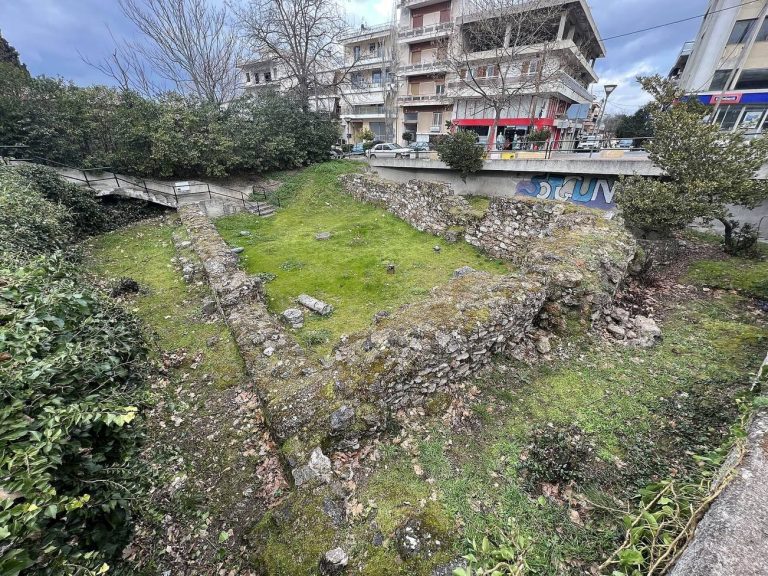
On the right bank of the Permessos, the foundations of a large altar run north to south and measure 9.80 by 5.80 m. Its materials include poros, a soft porous building stone, as well as conglomerate and limestone. These materials place the structure in the third century BCE. Foundations at the site later occupied by a church dedicated to the Holy Trinity were first identified as a temple and are now interpreted as an altar.
Temple
A small temple dedicated to the Muses was built in the second century BCE. Rectangular in plan, it measured about 12.5 m long by 6.5 m wide and followed the Ionic order, an ancient column style. It had four columns at each end. The inner sanctuary chamber opened to the west, and the building apparently had neither a front nor a rear porch. A Roman-period enlargement widened the structure to 12.5 m.
Colonnaded halls
An Ionic colonnaded hall, or stoa, stood about 40 m west of the temple or altar. It measured 96.7 m long and 13 m deep, with its long axis running north to south. The building originally had an inner wall and numerous rooms; Corinthian columns, another ancient column style, were installed inside later. The hall housed offerings to the Muses, especially gifts dedicated by victors in the Mouseia. Foundations north of the hall, across the Permessos, probably belonged to a second stoa.
Performance and defence
Theatre
The theatre stood about 300 m southwest of the colonnaded hall, on the slope of Mount Helicon at the western end of the valley. It dates to the late third or early second century BCE. Its semicircular seating fitted a natural hollow in the slope and faced across the valley. The front row was marble; the other surviving seating is not described here. At the center was a circular performance area.
The stage building measured about 18.1 m long, while the stage was about 22.2 m wide and 10.5 m deep. A structure in front of the stage had 14 Doric half-columns, using a third ancient column style. Parts of the theatre’s stage structures survive.
Tower
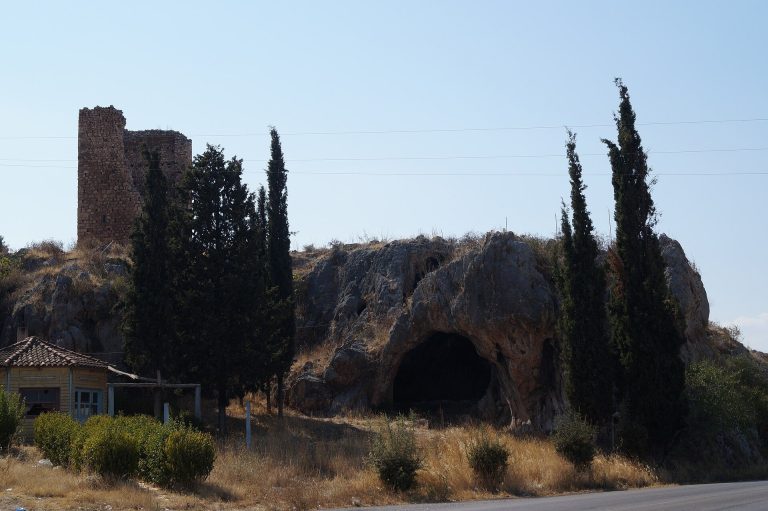
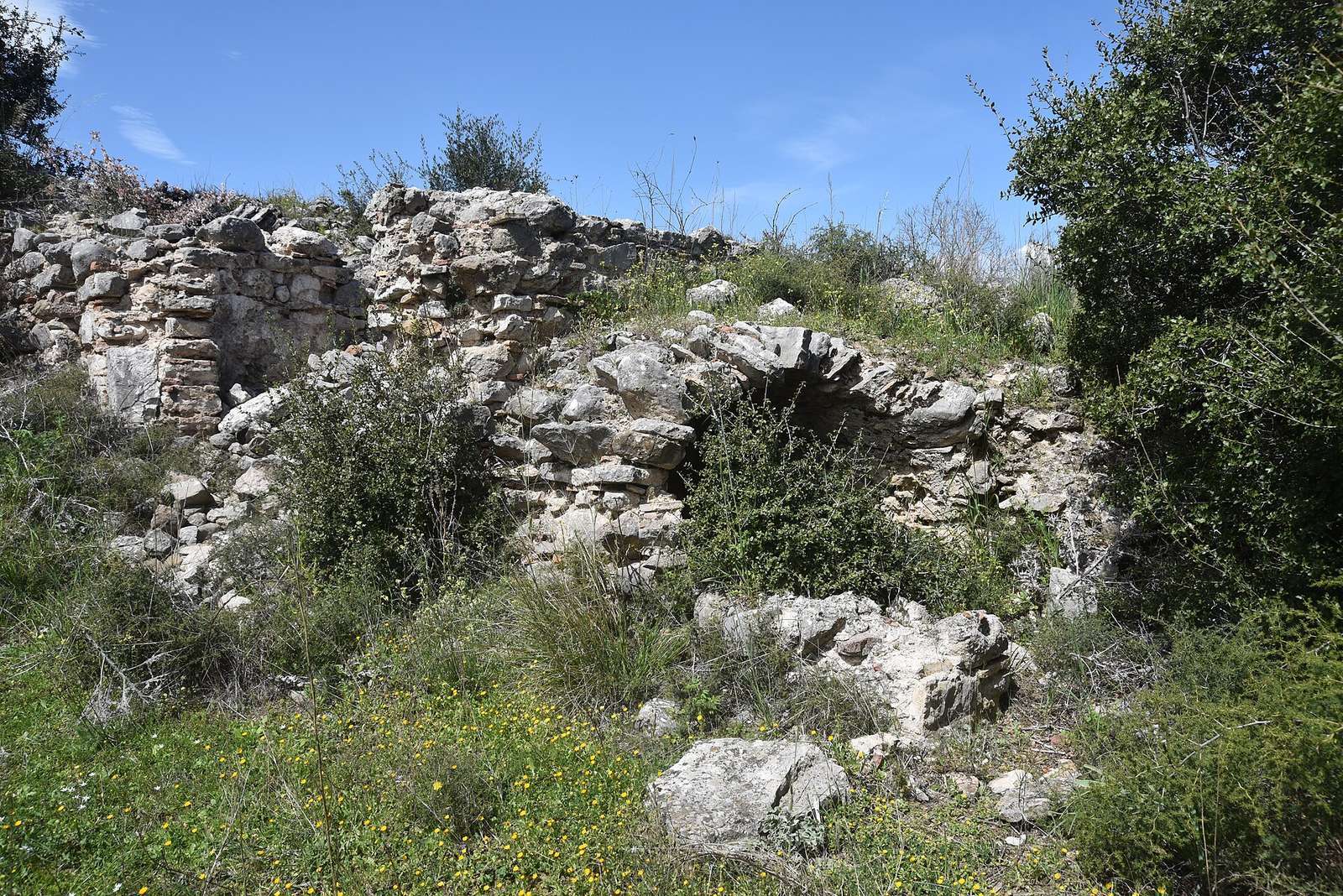
The square tower stood on Pyrgaki hill at the northern edge of the valley, overlooking it. Its ground floor contained three storerooms. The tower was enclosed by an earlier circuit wall, which now lies in ruins.
Sculpture and cult images
The Muses
The Thespians dedicated statues of all nine Muses at the sanctuary. A group attributed to Onestos, a poet and sculptor, stood on a semicircular base found at the site. Five of the best-preserved bases bear the names of Muses and short verse inscriptions. Other sculptural groups showed all nine Muses or sets of three. One group was by Kephisodotos the Elder, while others were attributed to Strongylion and Olympiosthenes.
Poets, musicians, and mythic figures
Other statues portrayed Thamyris, a legendary singer shown blind with a broken kithara, and Arion, a Greek lyric poet riding a dolphin. The sanctuary’s images also included Sakadas, an ancient player of the aulos; Hesiod; and Orpheus, the mythic poet and musician shown singing to animals. Arsinoë II, a Ptolemaic queen of Egypt, rode an ostrich in one representation. Another showed the mythic hero Telephus, a son of Heracles, being nursed by a hind. Priapus, a Greek fertility god, was also represented.
Gods and historical figures
A bronze group showed Apollo, a god associated with music, and Hermes, associated with travel and communication, struggling over a lyre. The sanctuary also had a statue of Dionysus, the god of wine and theatre, by Lysippos, as well as a second Dionysus by Myron of Orchomenus. Statues of Sulla and the Roman general and statesman Agrippa stood at the site.
Images along the approach
On the route from Thespiai, worshippers passed an image of Eupheme, the mythological nurse of the Muses, and a rock-carved image of Linos, a legendary musician. They sacrificed to Linos before making their offerings to the Muses.