Roman Dam of Belas: A Third-Century Water Supply for Lisbon
Site at a Glance
- Popularity
- Low
- Country
- Portugal
- Primary era
- Classical
- Eras represented
- Classical, Early Modern
- Civilizations
- Portuguese, Roman
- Site type
- Infrastructure
- Remains
- Dam
On this page8 sections
History
Roman water supply
The Roman Dam of Belas is a third-century Roman dam in Portugal, built to supply Olisipo, the Roman-era name for Lisbon. It fed the Roman Aqueduct of Amadora, a constructed system for conveying water, which carried water toward the city and entered it near Santo André in the Graça district. The date when the dam stopped serving the water supply is uncertain.
Plans to restore the supply
In 1571, Portuguese painter and humanist Francisco de Holanda identified the dam and Lisbon’s fountains as possible sources for renewing the city’s water supply. His interest in reviving classical works was influenced by his time in Rome and by King John III’s cultural-education policies. In a royal letter of 1573, King Sebastian called for action to bring water to Lisbon, but little followed.
In 1619, Philip III of Spain, who also ruled Portugal as Philip II, visited the dam intending to promote its reconstruction under engineer Leonardo Turriano. A report that year considered four proposals for Lisbon’s water supply and judged the Roman aqueduct the best option. Taxes were assigned to the public works, but in 1623 they were redirected to support Portugal’s overseas territories in India.
Damage and preservation
Construction of a new aqueduct began in 1728. As water was considered readily available from other sources in the basin, the Roman dam was deemed unnecessary, and part of it was damaged during the work. Later construction of the Caneças–Lisbon road destroyed and buried another section of the wall. In 1974, the ruins were classified as a property of public interest in Portugal.
Remains
Dam wall and reservoir
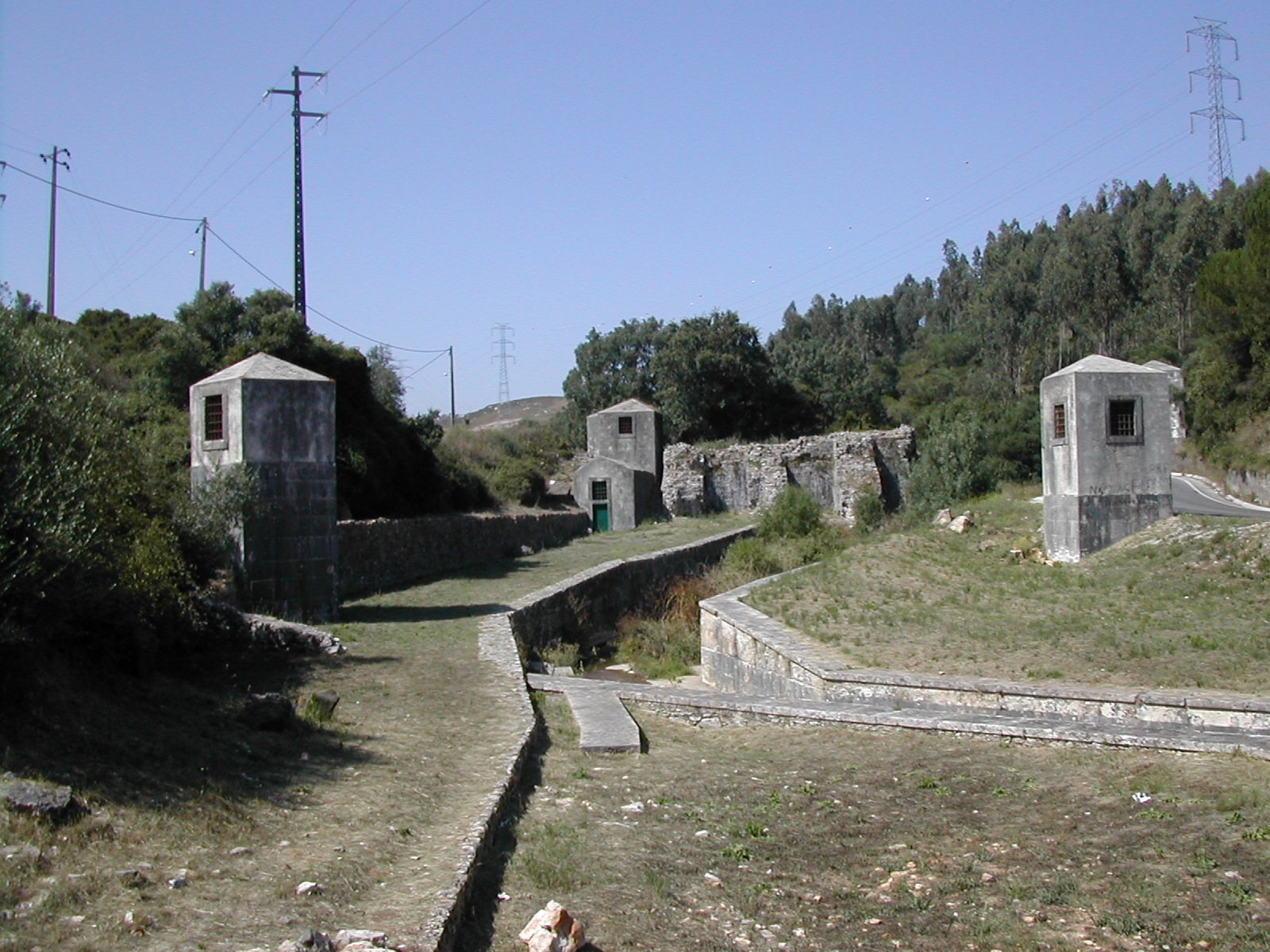
The remains stand on the right bank of the Carenque Stream, in a rural area about 10 km from Lisbon between the present municipalities of Amadora and Sintra. The dam wall was built with opus incertum, a Roman technique using irregular stones set in concrete or mortar, and reinforced by three buttresses on its downstream side. The wall was about 50 m long and 7 m wide, reaching more than 8 m in height. Its surviving central section measures approximately 15.5 m long, 8 m high and 7 m wide. The reservoir held about 125,000 cubic metres of water, and the dam crest was at an elevation of roughly 188 m.
Channels and associated structures
A channel extending about 1,300 m from the dam crossed the later Águas Livres Aqueduct. A branch of that aqueduct also crosses the dam remains. Smaller ventilation structures are associated with the complex and have been maintained by Companhia das Águas de Lisboa.
Setting and surviving fabric
The remains lie alongside and below a road, with parts covered by woodland and other vegetation. The wall extends toward the side of the valley, where a large portion has been destroyed.