Mediolanum: A Late Iron Age and Gallo-Roman City in France
Site at a Glance
- Popularity
- Low
- Country
- France
- Primary era
- Classical
- Eras represented
- Iron Age, Classical
- Civilizations
- Celtic, Roman
- Site type
- City
On this page11 sections
History
Late Iron Age settlement
Mediolanum was a late Iron Age settlement at La Boussière in Mâlain, France, with its foundation placed around 100–70 BCE and also dated specifically to 70 BCE. It was a protohistoric oppidum, meaning a major settlement that was often fortified. In the final phase of the La Tène period, an Iron Age archaeological culture of much of Celtic Europe, Mediolanum stood near the meeting point of territories belonging to the Sequani, Aedui and Lingones, three Gallic peoples. It was attached to the Lingones’ civitas, a territorial community and administrative district in Roman Gaul, whose chief town was Andemantunnum, now Langres.
The name Mediolanum is traditionally interpreted as ‘middle plain’ or ‘plain in the middle.’ French philologist Georges Dottin proposed another explanation, connecting the name’s ending with the Breton word lan, meaning church, sanctuary or consecrated land. Interpretations at Mâlain also relate the name to local geology, soil and water conditions. A religious reading suggests that the ending may refer to a clearing or sacred enclosure, perhaps connected with a cult complex that preceded the city.
Roman urban development
Under Roman rule, Mediolanum belonged to the province of Gallia Lugdunensis in the early Empire and Lugdunensis Prima in the late Empire. Its monumental development began in the early first century CE, after the Gallic Wars. The settlement was occupied on a substantial scale from the beginning of the Gallo-Roman period, with further urban development from the second century CE.
During the first and second centuries CE, the city extended over more than 200 hectares and enjoyed prosperous commercial exchange. Objects recovered through field research support its importance as a trading center.
Later history and archaeological research
The site’s broader historical sequence includes the Merovingian period, an early medieval era associated with the Frankish ruling dynasty of that name.
Systematic archaeological survey began in 1967. Later preventive investigations, including test excavations and aerial surveys, identified additional public buildings. Field research led by the Mesmontois Archaeological Group recovered objects that help establish the city’s commercial importance. The Gallo-Roman site was added to France’s register of historic monuments on 16 October 1992.
Remains
Setting and settlement
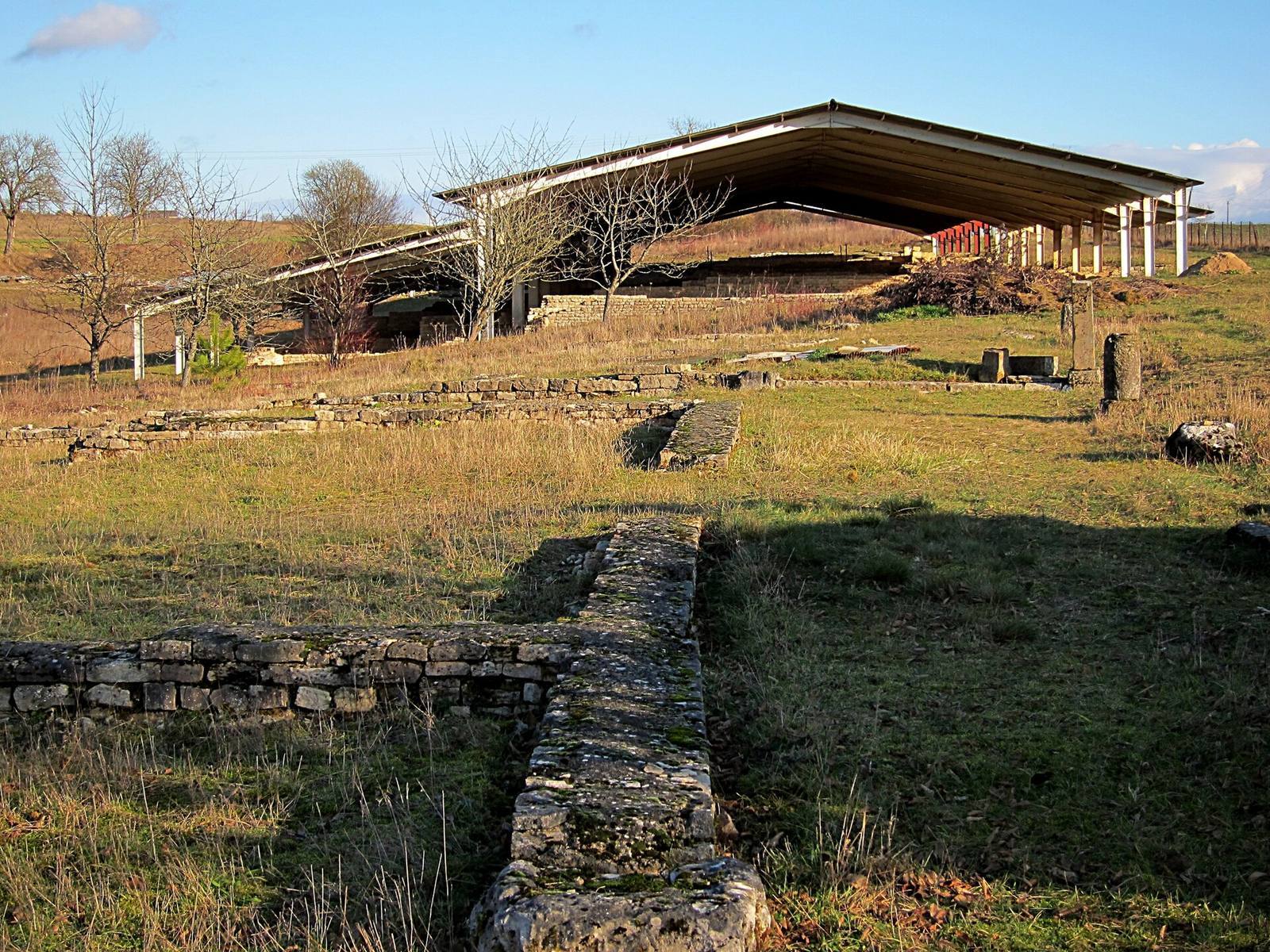
The archaeological site covers 70 hectares and includes residential, sacred and public features. It lies between the Langres plateau and the Auxois region, whose soils are rich in minerals and clay, at elevations ranging from 280 to 535 metres. The site is near the Ouche, a tributary of the Saône, and at the watershed divide between the Seine and Saône basins. It is also at approximately the same latitude as Dijon. Domestic remains include houses and villas. The principal route ran alongside an early church.
Sanctuaries and public buildings
Principal sanctuary
A sanctuary brought together a protohistoric sacred enclosure and a fanum, a form of Gallo-Roman temple dedicated to Mars Cicolluis, a Gallo-Roman deity associated with Roman Mars, and Litavis, a Gaulish goddess. The temple had a quadrangular plan and a large hall containing an exedra, a recessed or projecting space within a larger room. Basins, columns, cornices, altars and inscriptions were associated with the sanctuary.
Second temple and theatre
Investigations identified a second fanum and a theatre. The theatre stands on the right bank of the Douix and was discovered in 1976.
Aqueduct and bathing buildings
An aqueduct and buildings thought to have served as baths lie 750 metres west of the theatre.
Recovered objects
Finds from Mediolanum include amphorae, Gallic coins and objects of Etruscan workmanship. These objects, alongside the architectural pieces and inscriptions associated with the sanctuary, provide material evidence for the range of activity at the site.