Belas Knap: A Neolithic Chambered Long Barrow in Gloucestershire
Site at a Glance
- Popularity
- High
- Country
- United Kingdom
- Primary era
- Stone Age
- Eras represented
- Stone Age
- Civilizations
- Unclassified
- Site type
- Burial
- Remains
- Burial Mound
On this page15 sections
History
Belas Knap is a Neolithic chambered long barrow near Winchcombe in Gloucestershire, England, United Kingdom. Built around 3000 BCE, it belongs to the Cotswold-Severn group, a tradition of chambered tombs found on both sides of the River Severn and in Wales, with its greatest concentration in Gloucestershire. Belas Knap is recognized as an outstanding representative of this group.
Construction and burial
The Neolithic was the later part of the Stone Age, before metal tools came into widespread use. Radiocarbon dates for human remains from Belas Knap fall between 4000 and 3700 BCE, earlier than the estimated date of the mound. Burials accumulated over an extended period, and it is possible that none of the dated remains belongs to the time when the mound was built. After successive burials, the chambers were deliberately blocked.
The chambers may initially have stood apart, each beneath its own mound, before being incorporated into the main cairn, a mound made chiefly of stone. This proposed sequence could help explain the tomb’s unusual north-facing arrangement if chambers C and D, and perhaps B, were already in place. The angled northern end may also reflect the addition of chamber E.
Excavation and archaeological study
Excavations took place from 1863 to 1865, from 1928 to 1931, and again in 1963. The first campaign rebuilt the lintels and much of the dry-stone walling along their original lines. Sir James Berry led the 1929 excavation. After the later campaign, workers secured the walls, covered three chambers and restored the mound’s outline.
In the nineteenth century, physician and antiquarian John Thurnam examined 17 skulls from Belas Knap, then the largest number studied from a long barrow. One adult male skull near the false entrance was relatively broad and short. It challenged Thurnam’s proposed link between long burial mounds and long skulls, and round mounds and round skulls. Radiocarbon dating placed the skull with long-headed remains, while making it more than a thousand years younger than the round skulls associated with the Bell Beaker culture, a prehistoric European culture known for its bell-shaped pottery. A review in 1990 confirmed Thurnam’s claim.
Thurnam introduced a classification of Cotswold-Severn tombs in 1869. Osbert Guy Stanhope Crawford revised it in 1922, followed by Glyn Daniel in 1950. The system distinguishes tombs with chambers at an end from those with chambers along the sides, then groups them by chamber shape. Belas Knap became a scheduled monument in 1922 in recognition of its place within the group. The name’s origin remains uncertain: “Belas” may come from a Latin word meaning beautiful, while “Knap” is a Scots word for a rounded hill.
Remains
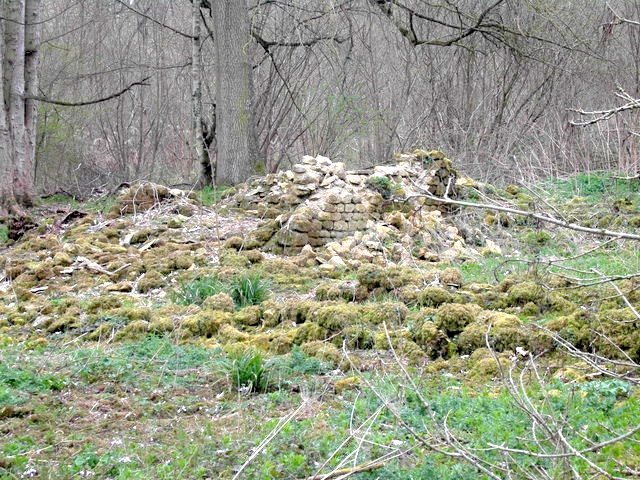
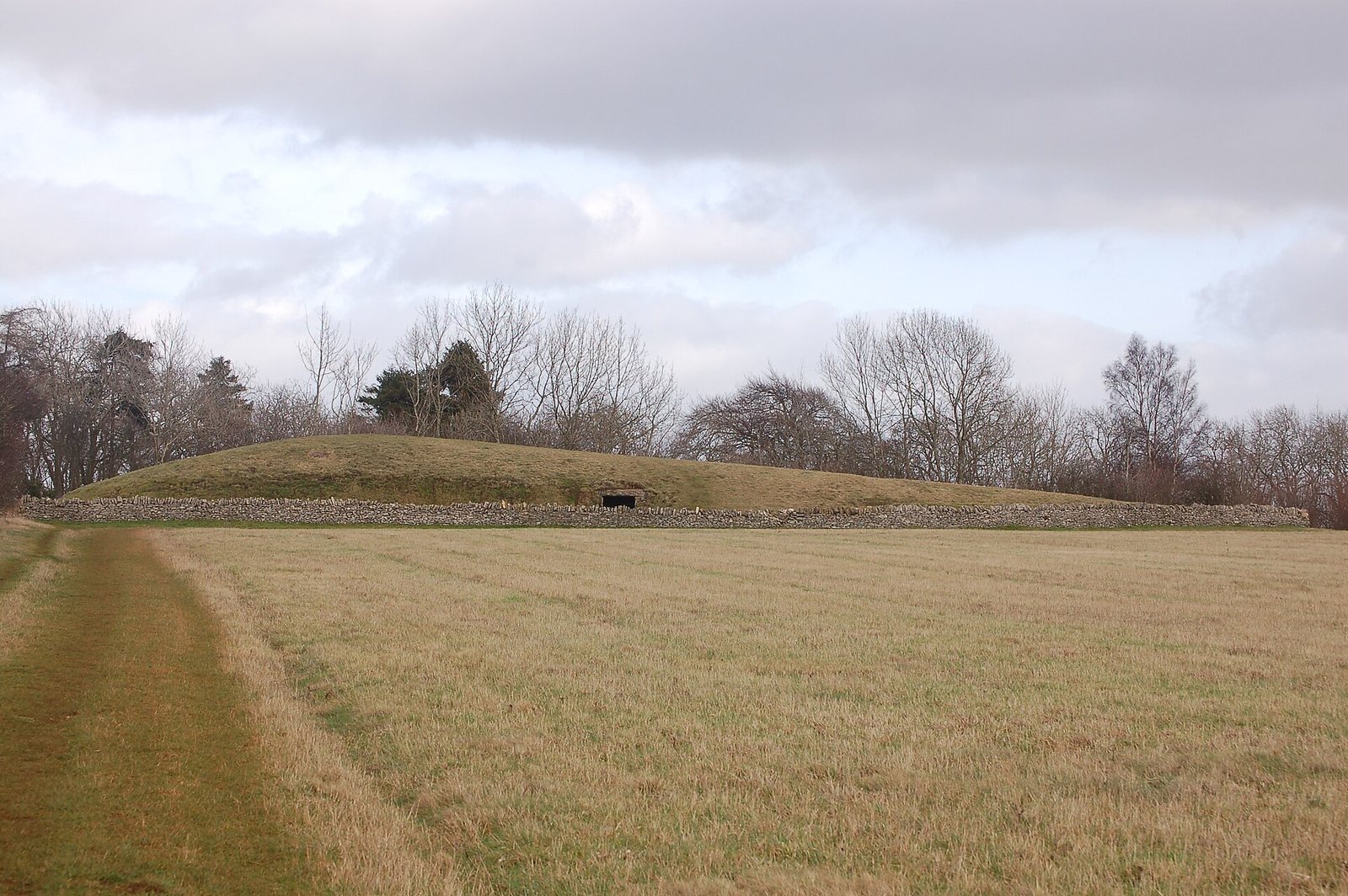
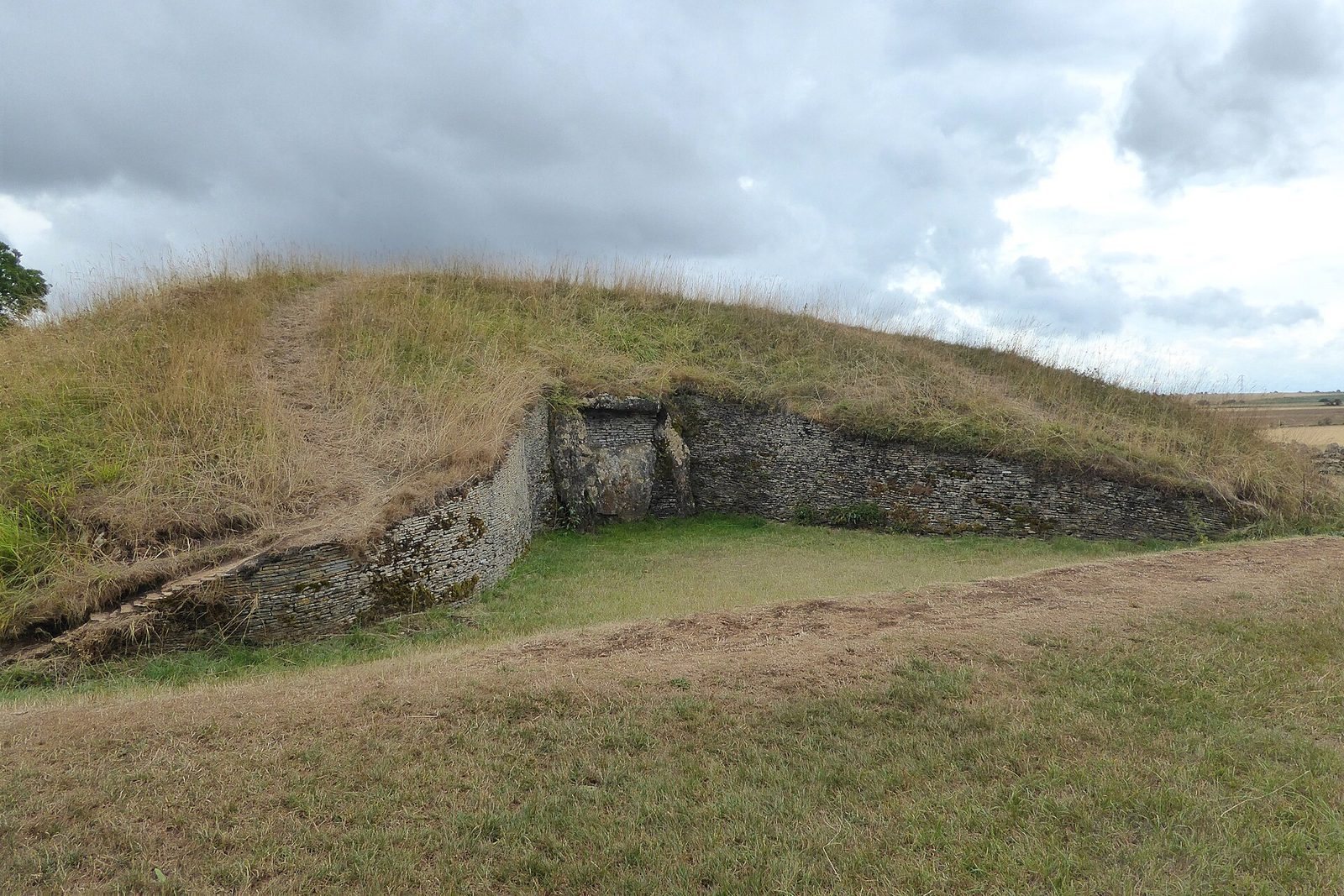
Belas Knap stands just below the summit of Cleeve Hill, about three kilometres south of Winchcombe. Its reconstructed mound is trapezoidal and faced with carefully laid dry-stone masonry, stonework set without mortar. It measures about 54 to 55 metres long and 18 to 18.5 metres wide, reaching roughly 4 to 4.3 metres high at the northern end. Excavation indicated that the original mound exceeded 60 metres in length and 25 metres in width.
Mound and entrance
Mound and forecourt
A funnel-shaped forecourt leads toward the mound’s high-walled façade, while lower facing walls continue along its sides. Ditches beside the tomb provided stone for construction, a feature also found at other Cotswold-Severn monuments. The northern end lies about 10 degrees off the mound’s main axis. The cairn may once have been covered with flat stones, a treatment also seen at Windmill Tump.
False entrance
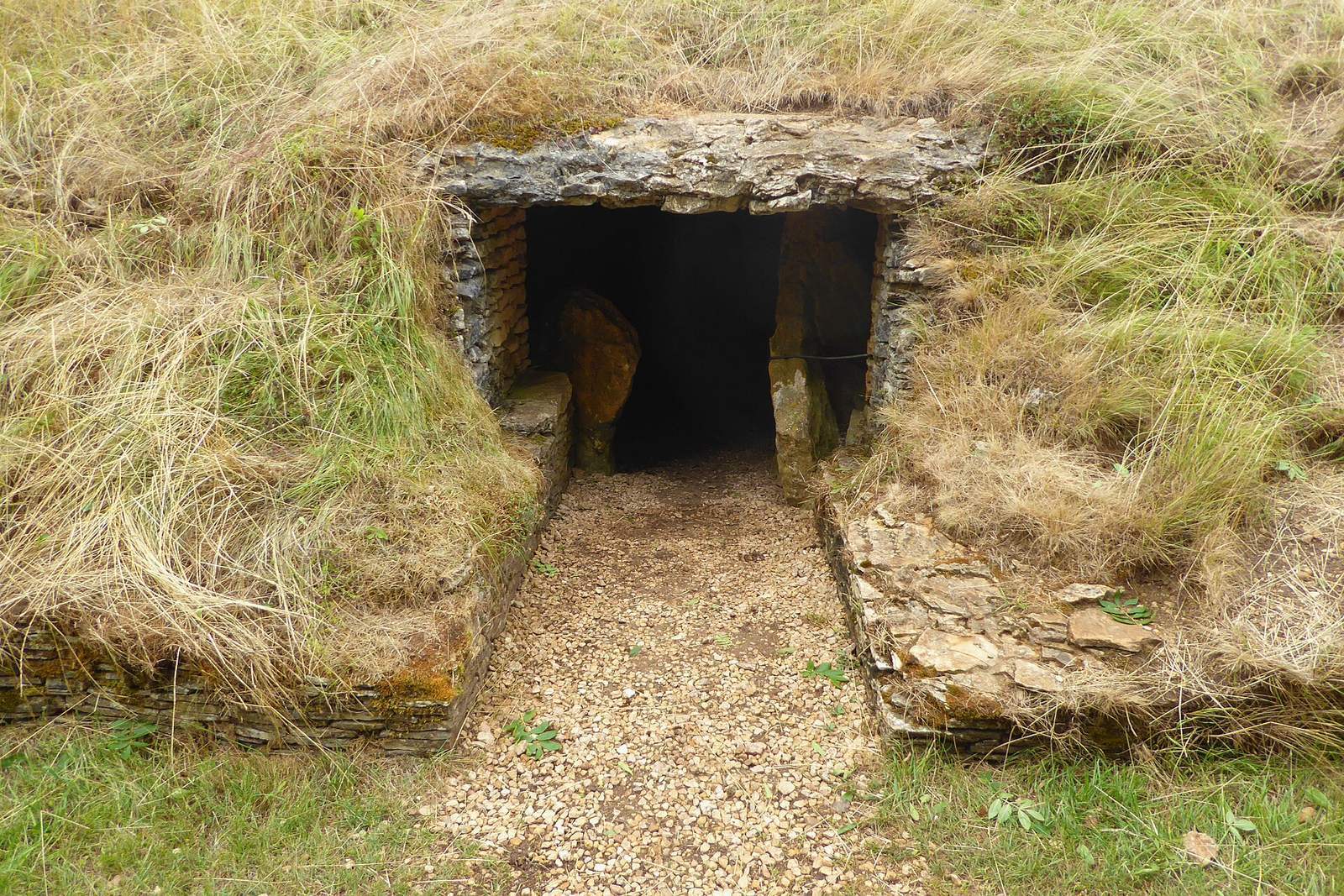
At the centre of the façade, a false entrance takes the form of a trilithon, with two upright supports holding a horizontal stone. A large door slab stands between limestone jambs. The lower dry-stone work and lower part of the doorway are original, while the lintel is a modern replacement. False entrances of this kind also occur at other Cotswold-Severn tombs with side chambers.
Burial chambers
Four chambers, identified by letters B to E or numbers 1 to 4, open from the long sides and southern end of the mound. Three lie along its sides and one extends from the southern end. Chambers C and D face one another near the middle, B is at the southeast corner, and E lies at the southern end.
Chamber B
Chamber B, also called chamber 2, is a long rectangle about one metre wide. Dry-stone masonry rises above low upright slabs, with especially small stones at the rear. A similar arrangement occurs at Kercado in Brittany. The chamber narrows beyond its midpoint, where a crosswise slab marks the division. Its roof was flat apart from a corbelled entrance, made by laying stones so that each course projects inward.
Chambers C and D
The opposing chambers C and D, also numbered 1 and 4, are polygonal and about two metres wide, each with a short, narrow dry-stone passage. Chamber C uses five upright slabs and D uses six, with dry-stone work filling the spaces between them. Their present reconstructions have flat roofs, although corbelled roofs have also been proposed. Hollowed edges on the side stones of C may have formed an entrance known as a soul-hole, an opening traditionally thought to let the dead pass. Comparable openings occur at Windmill Tump, Rodmarton and Giant’s Cave at Luckington.
Chamber E
Earlier excavation disturbed chamber E, also known as chamber 3. Its present reconstruction is a straight dry-stone passage ending in a large stone, but earlier drawings show a polygonal dry-stone chamber instead. The mound’s facing continues across the chamber entrance.
Excavated traces
In the 1860s, excavators dug a trench along the mound from behind the false entrance and cut a cross-trench beside chambers C and D. At the crossing they recorded a stone circle 2.2 metres across, with ash-soaked ground around its stones.
Burials and recovered finds
Human remains
The finds include the remains of 38 people. A large slab at the southeast corner covered four skeletons, including two skulls, probably associated with chamber B. Rubble blocking the false entrance held the remains of five children aged from six months to eight years, animal remains and the skull of a young adult male. Chamber C contained remains of 12 people, including an intact skeleton near the entrance, while the other remains there were mixed together. Chamber D held remains of 14 people.
The arrangement in chamber C has prompted the suggestion that decarnation, the removal or decay of soft tissue before bones are deposited, may have taken place near the entrance. The bones were handled or added to over a prolonged period, but the exact burial practices may remain uncertain.
Other finds
Other recovered material includes horse and pig bones, a bone shovel, pieces of flint including a serrated blade, pottery fragments, Roman pottery and two small Roman bronze coins dating to the late third century CE. Pottery and flint tools found with the human remains have been associated with the end of the Neolithic, around 2000 BCE.