Protestant Town Church Zöblitz: A Baroque Gallery-Hall Church in Germany
Site at a Glance
- Popularity
- Low
- Country
- Germany
- Primary era
- Early Modern
- Eras represented
- Medieval, Early Modern, Modern
- Civilizations
- Electorate of Saxony, German, Holy Roman Empire, Kingdom of Saxony
- Site type
- Religious
- Remains
- Church
On this page10 sections
History
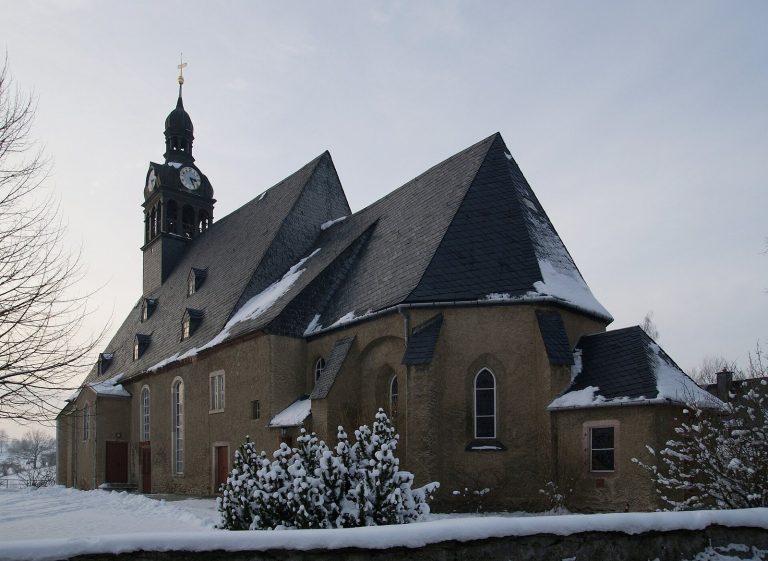
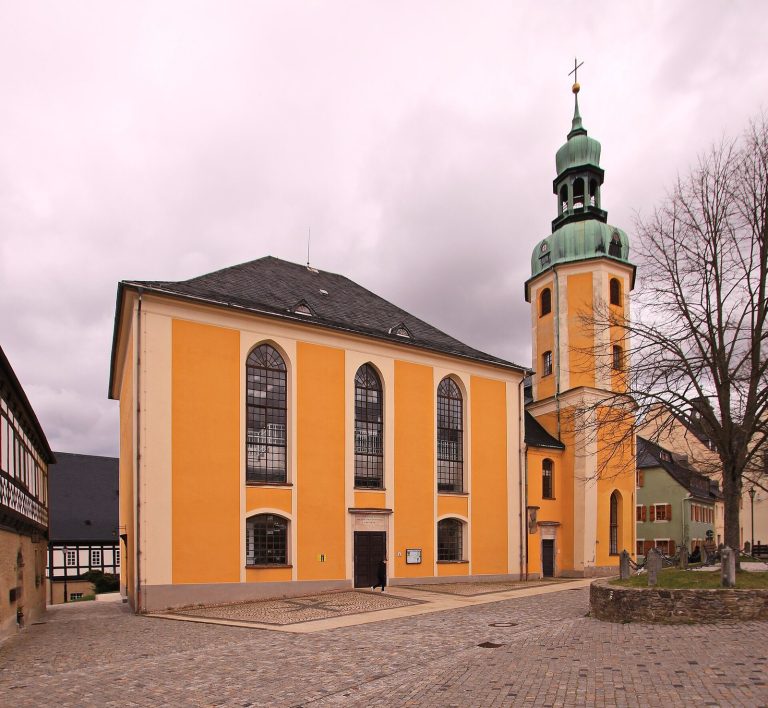
Protestant Town Church Zöblitz, in Germany, took its present form as a Baroque gallery hall in a rebuilding of 1728–1729. Its predecessor was a late Gothic church dating to around 1470. The church is especially known for its well-preserved organ by Gottfried Silbermann, a leading German organ builder of the Baroque era.
Rebuilding and Baroque furnishings
Dresden architect Johann Christian Simon designed the rebuilding as a gallery hall, an interior with raised galleries. The work kept the earlier tower above the chancel, the area around the altar, and reused the predecessor’s chancel arch. Silbermann’s organ was completed in 1742. A carved pulpit-and-altar furnishing followed in 1750. The church belongs to the Zöblitz-Lauterbach Savior’s Church congregation, within the Marienberg church district of the Evangelical Lutheran Church of Saxony.
Alterations and restoration
Organ builder Guido Hermann Schäf modified the instrument in 1894, adding a pedal coupler, exchanging the manual slider coupler for a fork-type coupler, and removing the tremulant, a device that makes the organ’s tone waver. In 1903, the Jehmlich brothers changed the instrument to chamber pitch, a historical tuning standard distinct from choir pitch. They shifted inner pipes, lengthened the front pipes, rebuilt those for C and D, and replaced the Cimbel II, a high-pitched compound stop, with two stops in the upper pipe group. The firm reconstructed the Cimbel in 1952.
An extensive interior remodeling in 1904 introduced Art Nouveau, a decorative style that emerged around the turn of the twentieth century. The chancel arch was walled up, while an upper level of galleries remained until 1956. In 1942, the largest bell was taken for wartime use and marked for melting, but it survived intact and was reconsecrated at Pentecost in 1950. The smallest bell, transferred after the First World War from Reuth to Ruppertsgrün, came to Zöblitz in 1957.
Wieland Rühle restored the organ in 1996–1997. The work removed later additions except for the pedal coupler, reset the inner pipes, returned the instrument to choir pitch, left out the added low C-sharp, and reinstated the tremulant. Günther and Gert Alpha also uncovered, completed, and restored the organ case’s finish.
Remains
Exterior form
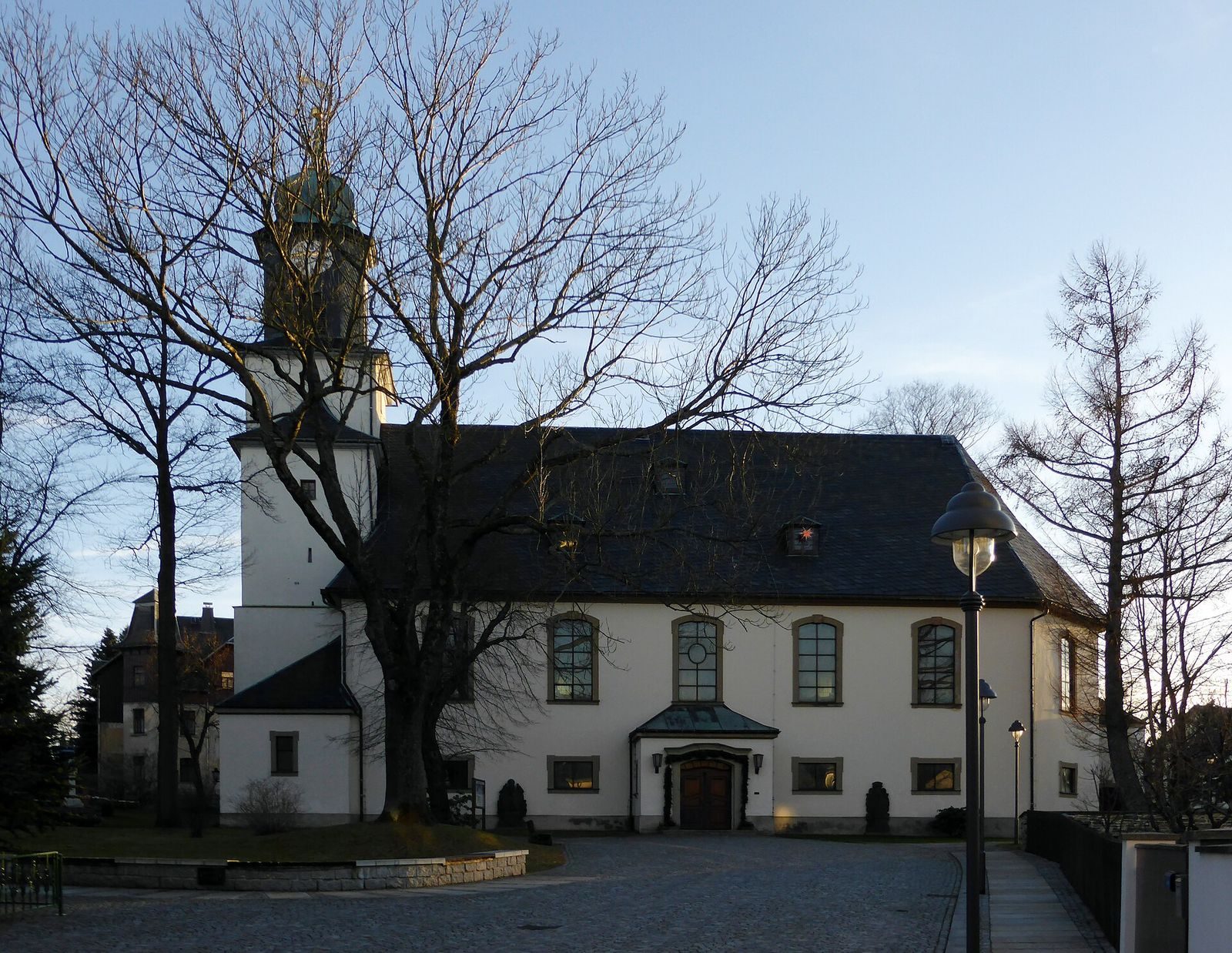
The church is built of rubble stone beneath a hipped roof. Its stepped tower has smaller stair towers at the sides, and the western end finishes in three sides.
Interior plan and supports
The interior has three aisles, with a rectangular end opposite a five-sided polygonal end. The altar stands at the rectangular end, while the organ occupies the polygonal end. Raised galleries run around the interior. Horizontal beams supported by rectangular piers divide the aisles; the piers have plain capitals beneath the galleries and concave supports where they meet the ceiling. A change of level on the upper piers marks the former upper gallery.
Vault and painted decoration
The central nave’s mirror vault, a vaulted ceiling with a flat central section, reaches from one end wall to the other despite the galleries around the interior. Cherubim, angelic beings in biblical tradition, and a dove appear in its painted decoration. Baroque-style acanthus scrolls ornament the vault, window recesses, and side walls. Part of an illusionistic painted drapery is visible behind the organ; it was uncovered in 1994.
Furnishings and windows
The carved pulpit altar combines a pulpit and an altar, and dates to 1750. Its altar rails are made from Zöblitz serpentine, a decorative stone. The baptismal font dates to 1616 and has a pewter basin made in 1614. Cast reliefs on the basin show Christ, the Evangelists, the traditional authors of the four Gospels, and Orpheus, the figure from Greek mythology whose music was said to tame animals. Two confessionals from 1734 also survive.
Stained-glass windows installed in 1904 combine acanthus ornament with scenes of Christ in Gethsemane, Christ as the sower, and Martin Luther. The sacristy contains a depiction of Christ as a wanderer.
Bells
The three bells hang in a steel frame from cranked cast-iron yokes, the offset beams from which bells are suspended. The largest, cast in Dresden in 1710, weighs 975 kilograms and sounds F. The middle bell was cast in 1476, weighs 520 kilograms, and sounds A. The smallest, cast in 1475, weighs 230 kilograms and sounds C.
Silbermann organ
The organ has 20 stops, or sets of pipes, two manuals played by hand, and a pedal played by foot. A slider coupler links manuals II and I, and a mechanical pedal coupler is also fitted. Auxiliary controls include a tremulant and a bell. The instrument’s current pitch is A4 = 465 Hz; it uses well-tempered tuning and wind pressure of about 80 millimetres of water column.