San Carlo al Corso: A Baroque Basilica and Lombard National Church in Rome
Site at a Glance
- Popularity
- High
- Country
- Italy
- Primary era
- Early Modern
- Eras represented
- Early Modern, Modern
- Civilizations
- Italian, Papal States
- Site type
- Religious
- Remains
- Basilica
On this page19 sections
History
San Carlo al Corso is a basilica in Rome, Italy, begun in 1612 in the Baroque style, a European artistic movement prominent in the seventeenth and early eighteenth centuries. Dedicated to Saints Ambrose and Charles Borromeo, it serves as the national church of Lombards, people from northern Italy, living in Rome.
The earlier church and the Lombard confraternity
A church stood on the site by the tenth century and appears in papal records under the name San Nicola de Toffo. On 29 August 1471, Pope Sixtus IV approved a confraternity, a religious association formed around shared devotion or community, for Rome’s numerous Lombards. He assigned the earlier church as its home, recognizing the Lombards’ contribution to the construction of the Sistine Chapel in the Vatican Palace.
The church was rededicated to Saint Ambrose, the fourth-century bishop of Milan. After the canonization of Charles Borromeo, a sixteenth-century archbishop of Milan and Catholic reformer, in 1610, his name was added to the dedication. The confraternity later became the Archconfraternity of Saints Ambrose and Charles of the Lombard Nation.
Construction of the present basilica
The earlier church was demolished when construction of the present building began on its site in 1612, in honor of Borromeo’s canonization. Onorio Longhi designed the initial project, and his son Martino Longhi the Younger continued the work after his father’s death. Limited funds slowed construction. Francesco Borromini took part briefly, while Martino also devised a façade scheme that was never built.
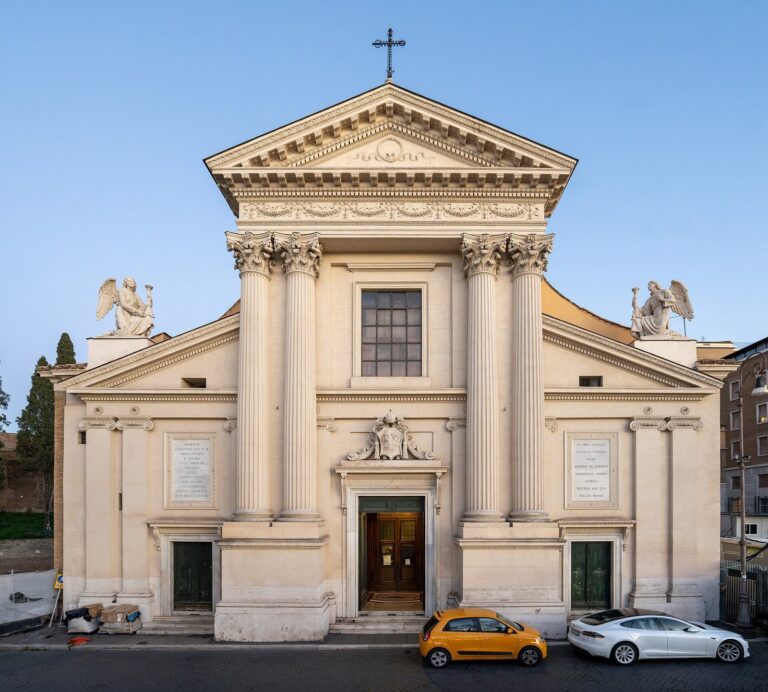
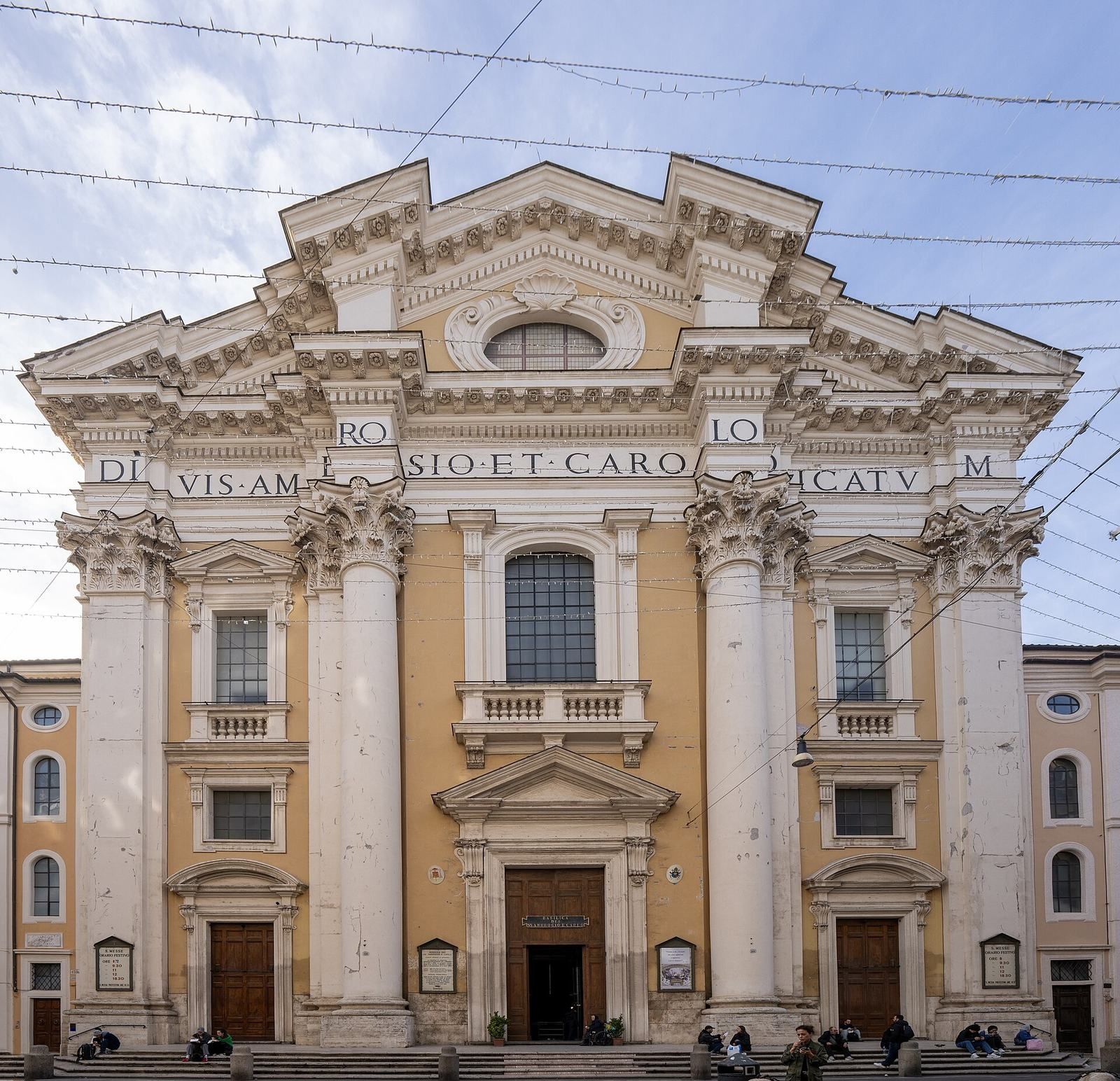
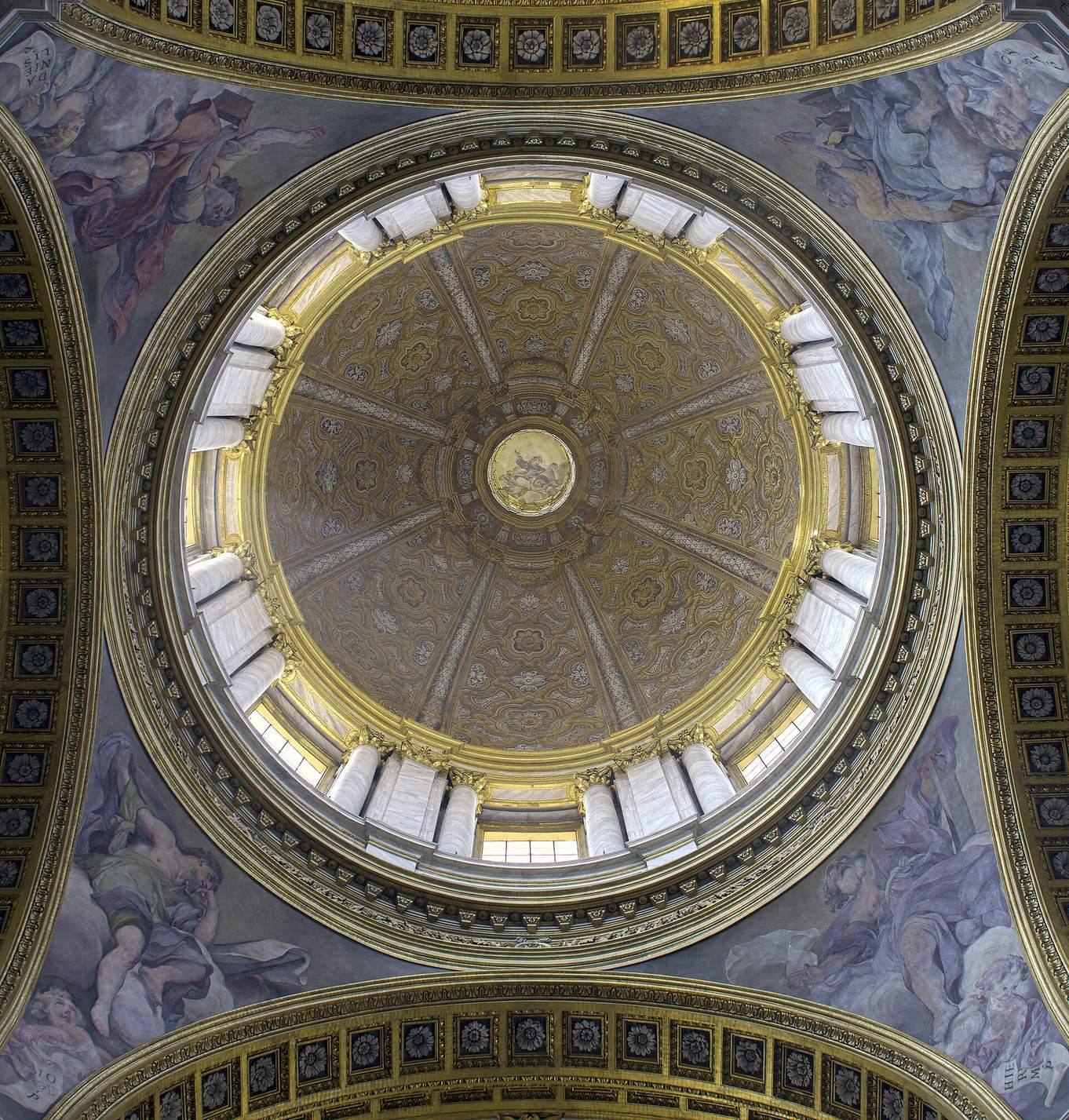
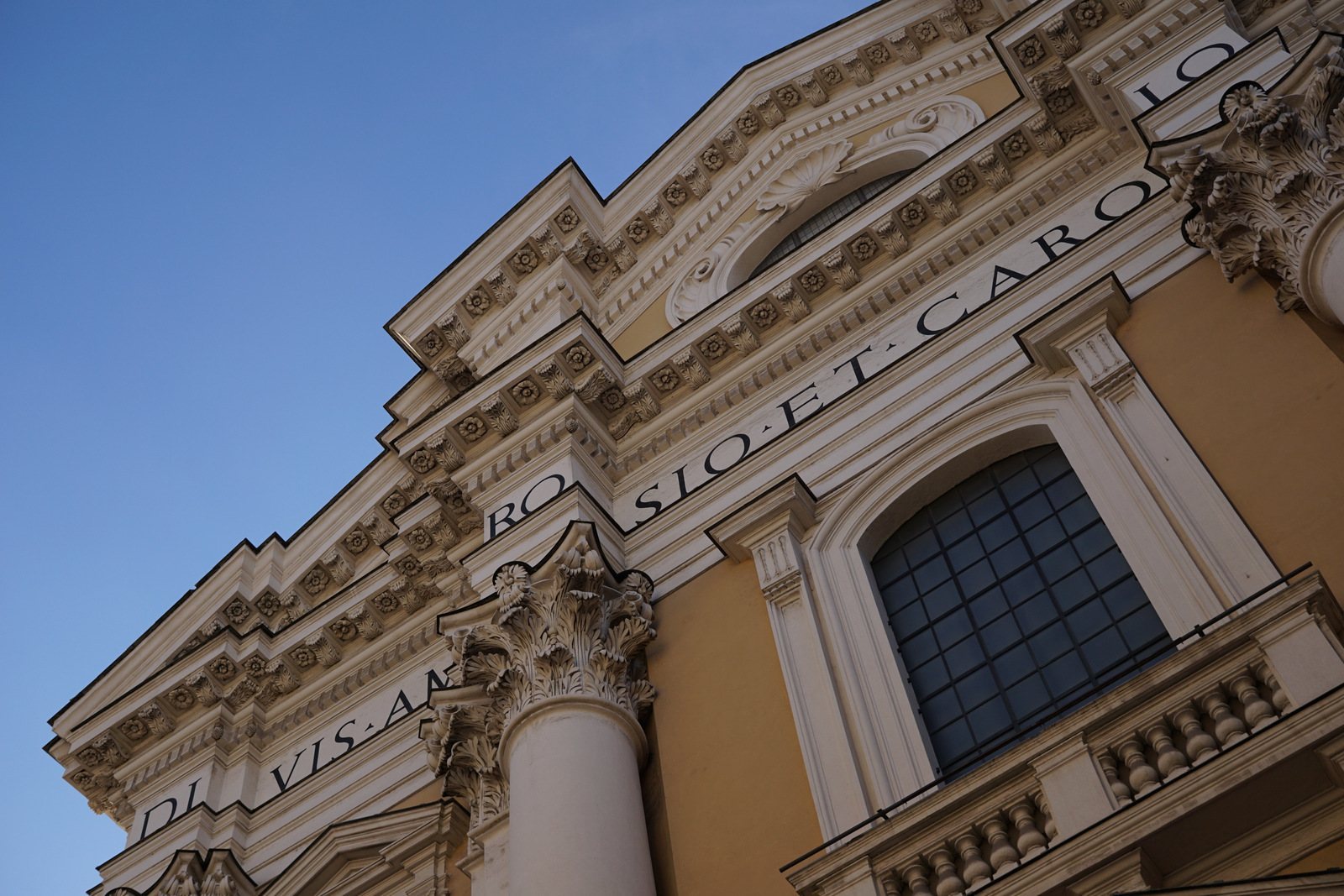
Cardinal Luigi Alessandro Omodei provided the funds to complete the church and declined a design prepared by Carlo Rainaldi. The principal building campaign ended in 1669. Pietro da Cortona designed the dome, finished in 1688, and also worked on the apse, the curved end of the church, and its interior decoration. The façade was completed late in the seventeenth century under Gian Battista Menicucci and the Capuchin friar Mario da Canepina, following a design attributed to Omodei.
Liszt and a planned marriage in 1861
In 1861, the Hungarian composer and pianist Franz Liszt and the Polish-born noblewoman Carolyne zu Sayn-Wittgenstein planned to marry at San Carlo on 22 October, Liszt’s fiftieth birthday. He arrived in Rome on 20 October and filed a declaration of their intention to marry. Bishop von Hohenlohe, Carolyne’s son-in-law’s brother, worked with her relatives to stop the ceremony, partly to keep her assets within the family. The pastor told Carolyne that the request was being reconsidered and postponed the wedding. She then ended her relationship with Liszt.
Carolyne had hosted Liszt at Altenburg in Weimar from 1849. He remained in Rome after the planned marriage fell through, studied theology, and received lower clerical orders from von Hohenlohe. He continued his life in the clergy.
The Norwegian chapel and the basilica’s later role
The Norwegian Chapel of Saint Olaf was inaugurated by Cardinal Lucido Maria Parocchi on 9 April 1893. The date marked the fiftieth anniversary of the first Mass legally celebrated in Norway after the Reformation, a sixteenth-century religious movement that led to the formation of Protestant churches. The chapel’s painting was presented to Pope Leo XIII on 3 March 1893, on the fiftieth anniversary of his episcopal ordination. Bishop Johannes Olav Fallize asked that it be placed in the chapel, and Baron Wilhelm Wedel-Jarlsberg unveiled it.
Since 1906, priests of the Institute of Charity, commonly known as Rosminians, have served the basilica. Angelo Giuseppe Roncalli was ordained bishop there on 19 March 1925. Pope Pius XI granted the church the title of minor basilica, a distinction formally bestowed by a pope, on 21 December 1929. Efrem Forni was ordained bishop there in 1938. The basilica’s cardinal title is traditionally held by the Archbishop of Milan; this is a titular assignment, meaning the cardinal holds the church’s title without necessarily governing it. Clemente Riva, who had been the basilica’s rector in 1966, was ordained bishop there on 22 June 1975.
During the 1960s, the Norwegian chapel was preserved while its conversion to another use was under discussion. Cecilie Riber-Mohn, Olga Térése Mowinckel Ringler, and Andrea Ringler initiated its restoration. Riber-Mohn died in 1978 before the work was finished. John Willem Gran, Bishop of Oslo, reopened the restored chapel in 1980. Norwegian-language Masses are celebrated there at Christmas, on 17 May, Norway’s Constitution Day, and on 16 October, the feast of Saint Olaf’s conversion. Norwegian expatriates, including people who are not Catholic, attend; requiem Masses are also held for Norwegians connected with Rome, and Norwegian pilgrim groups may arrange Mass at the church.
Charles Borromeo’s heart, sent from Milan to Rome in 1613, was donated to the church by his cousin Cardinal Federico Borromeo in 1614. In 2011, during commemorations of the fourth centenary of Charles’s canonization, the relic was sent to Acquarica del Capo and displayed there on 15 May. A commemorative plaque was installed in that town’s church dedicated to the saint.
Remains
The basilica has three naves, with a central nave, the main lengthwise space, flanked by two side naves. A crosswise section called the transept completes its cross-shaped plan. The side aisles continue behind the high altar as an ambulatory, a passage that encircles the presbytery, the area around the main altar. This arrangement, deliberately modeled on Milan Cathedral, was unique in Rome. Inside, stucco, molded plaster ornament, painted imitation-marble finishes, and wall paintings combine in a bright, theatrical Baroque interior.
Exterior and dome
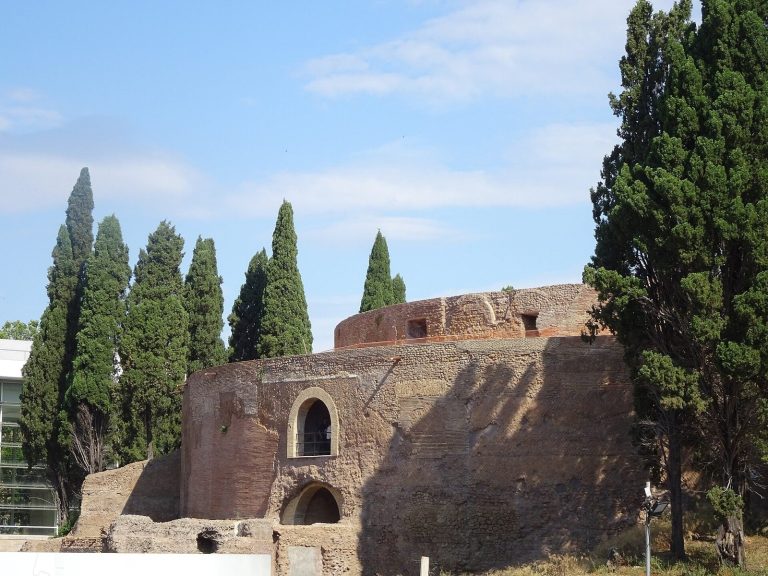
The basilica stands on Via del Corso, with its apse facing across Via di Ripetta toward the Mausoleum of Augustus. Two large statues of Saints Ambrose and Charles stand outside, one on either side of the apse, facing the mausoleum; they are among the largest statues in Rome. The dome rises on a tall drum, its raised supporting structure, pierced by windows that light the interior. It is the fifth-largest dome in Rome. Martino Longhi the Younger’s unused façade proposal had a concave front framed by two cylindrical bell towers and crowded with travertine columns. The built façade followed a design attributed to Omodei.
Nave and side chapels
Central nave and upper decoration
Giacomo and Cosimo Fancelli made the stucco ornament. Giacinto Brandi and Giovanni Battista Beinaschi painted the central nave vault, the curved surface at the end of the apse, and the curved triangular supports beneath the dome, including figures of prophets. Brandi also painted Saints in Glory in the arms of the transept. His central-vault painting, The Fall of the Rebel Angels, dates to the 1670s and depicts Michael leading God’s angels against the rebellious angels led by Lucifer. Paolo Albertoni painted the vault over the first bay of the right nave.
Right aisle and chapels
The right aisle contains Paolo Albertoni’s Moderation, Girolamo Troppa’s Justice, Peace, Law and Truth, and Giovanni Battista Beinaschi’s Religion, Strength, Purity and Chastity. Its first chapel is dedicated to the Crucifixion and includes Albertoni’s wall painting Vigilance. The second chapel, dedicated to Mary Help of Christians, holds an image of the Virgin donated by Saint Vincent Pallotti in the nineteenth century. The third chapel is dedicated to the Holy Family, Jesus, Mary, and Joseph.
Left aisle and chapels
Works in the left aisle include Luigi Garzi’s Faith, Francesco Rosa’s Mercy, and Pio Paolini’s Hope and Truth, as well as a depiction of Jesus Christ with Saints Ambrose and Charles and the funerary monument of Federico Borromeo. The chapel dedicated to Saint Philip Neri contains two paintings by Giacomo Zoboli, Saint Aloysius Gonzaga among the Plague Victims and The Communion of Saint Stanislaus Kostka, both dated 1726. The first chapel on the left has Pier Francesco Mola’s altarpiece The Prophecy of Saint Barnabas. The church also preserves a painting by Pier Francesco Mazzucchelli, known as Morazzone.
Transept and sanctuary
Right arm
The Altar of the Immaculate Conception in the right arm of the transept was erected in 1769, probably by Paolo Posi for Cardinal Erasmo Paravicini. Polychrome marble and gilded bronze decorate the altar, which contains a mosaic copy of Carlo Maratta’s Immaculate Conception, based on his painting in the Cybo Chapel at Santa Maria del Popolo. Marble statues of David by André Jean Lebrun and Judith by Pietro Pacilli flank it.
Left arm
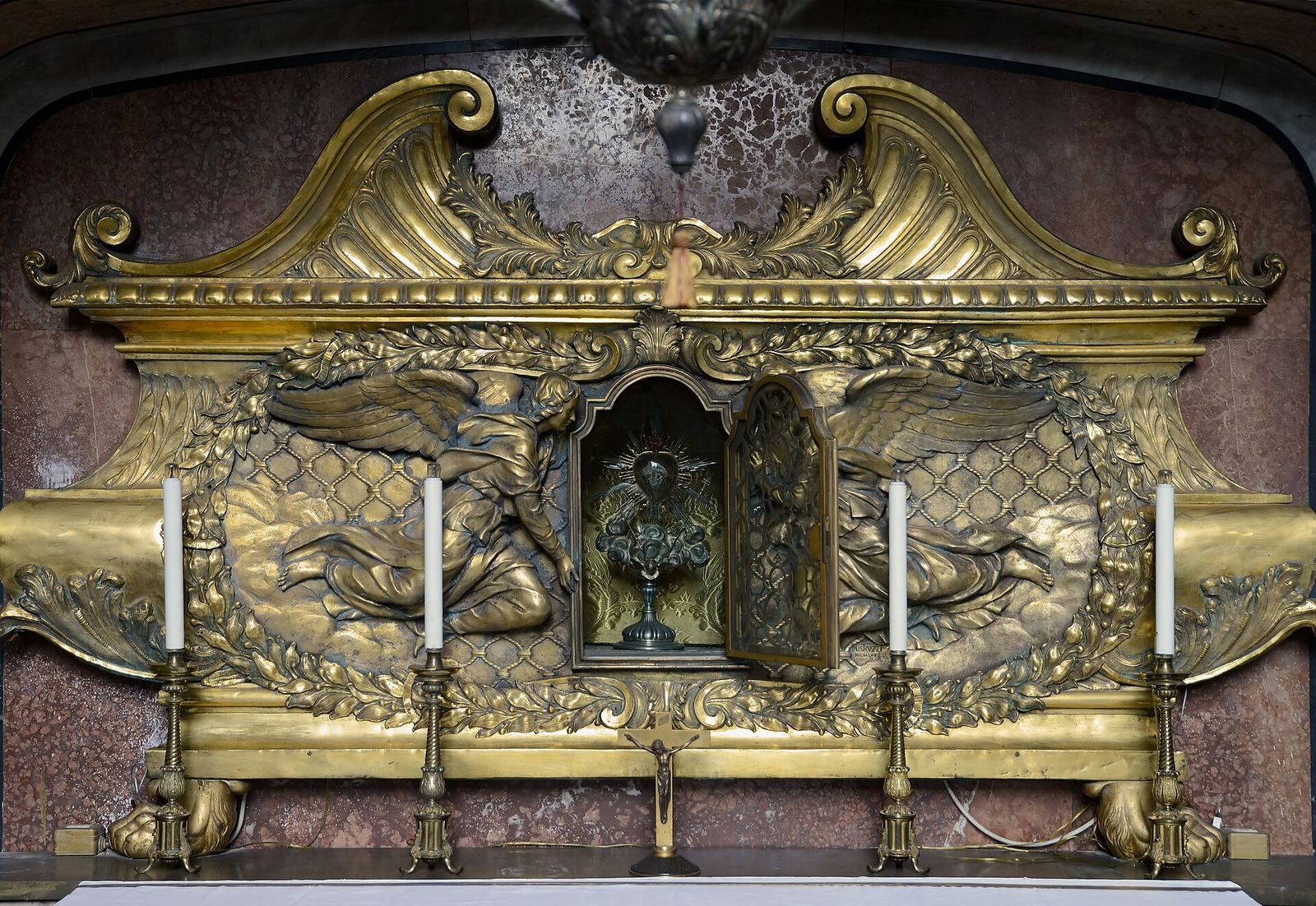
Cesare Bazzani made the Altar of the Blessed Sacrament in the left arm of the transept in 1929 to commemorate Pius XI’s jubilee in office. Tommaso Luini’s The Eternal and the Angels in Prayer, formerly in a side chapel, was moved to this altar. Marble figures representing Religion by Eugenio Maccagnani and Faith by Guido Galli stand beside it. Behind the left arm is a sixteenth-century oratory, a small place of worship, dedicated to Saint Ambrose.
High altar and ambulatory
The high altar’s architectural project, associated with Carlo Maratta and Giacinto Brandi, was completed around 1730. The altar was restored during the pontificate of Pius XI. In a niche behind it, within the ambulatory, a small altar holds the reliquary containing Charles Borromeo’s heart. The relic was displayed in a vessel called a monstrance, supported by an angel figure and a crystal base. Above the niche is a painting of Saint Charles adoring the Virgin and Child, attributed to Brandi’s school. Maratta’s Glory of Saints Ambrose and Charles was placed above the shrine. Garzi’s Glory of the Angels, painted in 1678–1681, is turned 180 degrees in relation to the other ceiling paintings. It was originally intended to be viewed from the high altar, before Maratta’s painting was installed above the shrine.
Norwegian Chapel of Saint Olaf
The chapel is in the left nave. Its painting, by the Polish artist Pius Weloński, depicts the Norwegian king Saint Olaf, or Olaf II, overcoming his pagan past, represented by a dragon. Olaf is venerated as a Christian martyr. A smaller altar image shows Saint Anne with her daughter, the Virgin Mary. Relics of the Roman martyr Saint Saturninus are buried in the altar.
Other artworks and organ
Paintings and sculpture
Other works include Tommaso Luini’s The Trinity and a marble bust of Cardinal Luigi Omodei by Agostino Cornacchini, placed in the main nave. A Descent from the Cross is attributed to J. Cornelisz Cobaert, and statues of saints are by Francesco Cavallini. Fernando Mario Paonessa made a bronze Stations of the Cross comprising 16 panels, each measuring 85 by 15 by 100 cm, positioned to face the central nave. His 250 cm-high bronze It Is Finished depicts Christ on the tree of life. The slender figure appears to free itself from the cross and gesture toward the Resurrection.
Organ
The Tamburini organ, opus 119, was built in 1928 at the request of Pope Pius XI and Cardinal Giovanni Tacci Porcelli. Ulisse Matthey prepared its sound arrangement. The instrument has been restored several times and is divided between two choir lofts beside the presbytery. The left loft contains the first keyboard and part of the foot-operated pedal; the right holds the second keyboard and the expressive division.