San Rocco in Rome: A Baroque Church and Former Hospital Chapel
Site at a Glance
- Popularity
- Medium
- Country
- Italy
- Primary era
- Early Modern
- Eras represented
- Early Modern, Modern
- Civilizations
- Italian, Papal States
- Site type
- Religious
- Remains
- Church
On this page12 sections
History
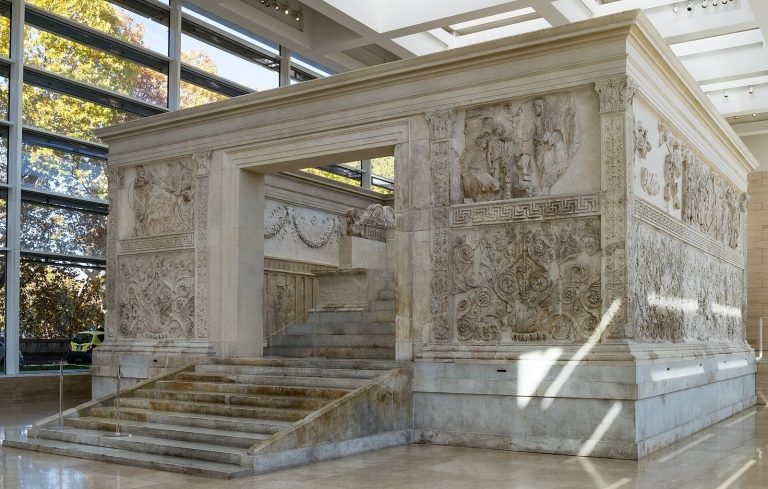
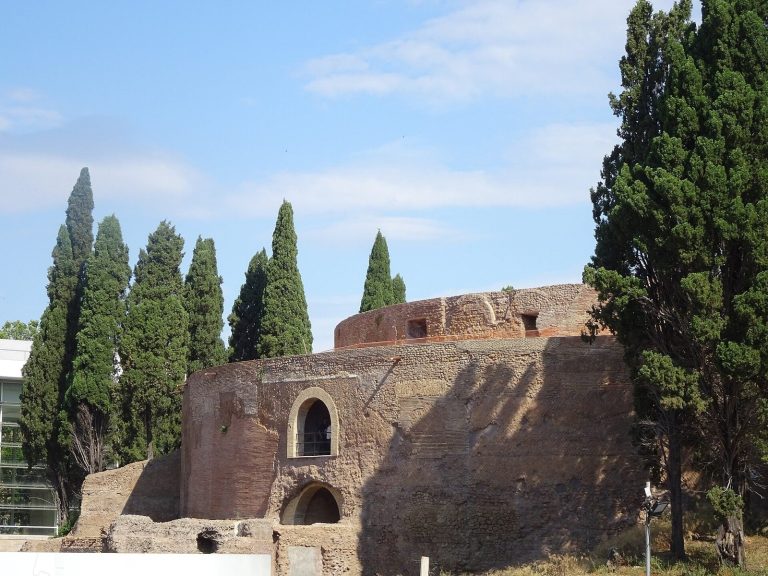
San Rocco is a Roman Catholic church in Rome, Italy, near the Mausoleum of Augustus, the monumental tomb of Rome’s first emperor, and the former Ripetta river port. Established in 1502 for a confraternity of innkeepers and boatmen, it later served an adjoining hospital created to care for people with plague. A Baroque rebuilding, a style associated with dramatic ornament and movement, was completed in 1654.
Origins and hospital
In 1499, Pope Alexander VI granted the confraternity the old church of San Martino and permission to establish a hospital near the Mausoleum of Augustus. The confraternity was a lay religious association linked to the riverside community at Ripetta and founded to assist people suffering from plague. San Martino dated to the eleventh century; it was destroyed in the sixteenth century, and some of its furnishings were transferred to San Rocco.
A church dedicated to Saints Roch and Martin was established in 1502, following the Jubilee of 1500, a Catholic Holy Year of pilgrimage and special religious observance. Saint Roch was traditionally invoked for protection against plague, while Saint Martin was an early Christian bishop associated with Tours. Around 1509, a new church was built to serve as the adjacent hospital’s chapel. The hospital first treated men with plague, then added a maternity ward for women from Tiber barges. It later served mainly unmarried mothers and developed a gynecological department.
Rebuilding and religious devotion
A concealed image of Mary was uncovered in the church in 1645 and regarded as miraculous. Reconstruction began the following year and was completed in 1654, with the patronage of Cardinals Odoardo Vecchiarelli and Francesco Barberini. Giovanni Antonio De Rossi designed the rebuilding.
San Rocco also became a base for the Archconfraternity of the Cord of Saint Joseph. The devotion began after an Augustinian nun in Antwerp recovered from a serious illness in 1657 while wearing a cord in honor of Saint Joseph, the husband of Mary in Christian tradition. It spread through Europe and was revived in Rome during the nineteenth century. Pope Pius IX approved a blessing for the cord in 1859, and in 1862 the confraternity became an archconfraternity, authorized to affiliate other confraternities and extend spiritual privileges to them.
The cord is white, representing Joseph’s purity of heart, and has seven knots for his seven joys and sorrows. Members are encouraged to recite the Glory Be seven times daily. They may wear it around the waist as a sign of purity or over the shoulders as a sign of obedience. A priest’s blessing followed by the wearer’s first use enrolls that person in the archconfraternity.
Hospital, urban change, and the church today
The hospital was rebuilt between 1772 and 1775. In 1811, Giuseppe del Medico, a professor of surgery and lecturer at the Academy of St Luke, Rome’s historic institution for artists, published a book on anatomy for painters and sculptors. He was later buried at San Rocco. The church interior was restored in 1885. The hospital was transferred in 1892, and its building was subsequently used as a concert hall; hospital operations had ended by the early twentieth century.
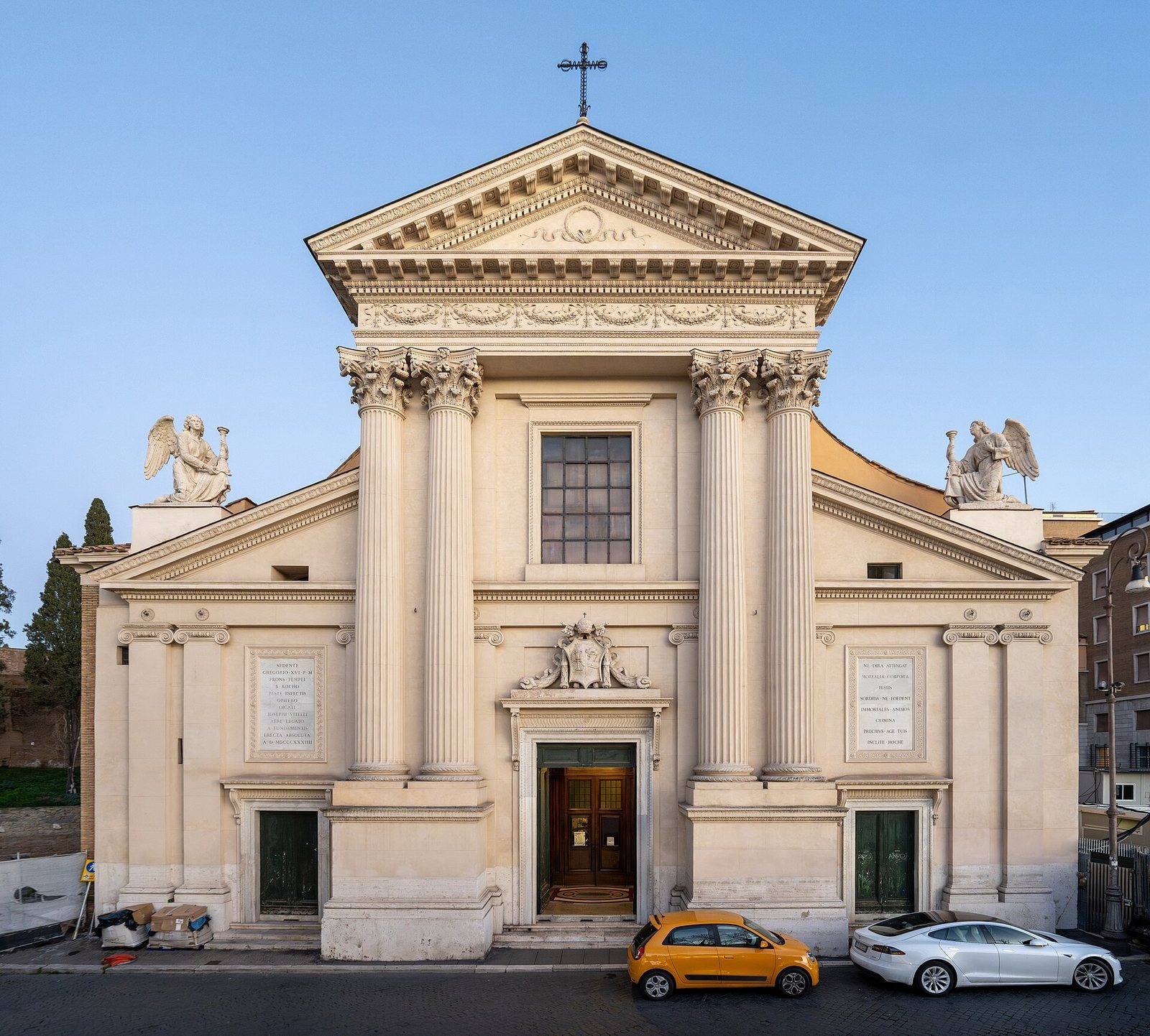
The demolition of Ripetta’s river port in 1890 accompanied the construction of Tiber embankment roads and Cavour Bridge. Later redevelopment around the Ara Pacis and the Mausoleum of Augustus brought clearance of nearby buildings from 1934 to 1938. The hospital and San Rocco’s bell tower were demolished. After adjoining buildings that had supported the church’s side and rear walls were removed, those walls had to be rebuilt. San Rocco survived because of its artistic value and local devotion to the chapel of Our Lady of Graces. Two candle-bearing angels were added to the façade in 1984. The church is a subsidiary church of the parish of San Giacomo in Augusta, and the Confraternity of Saint Roch maintains and administers it.
Remains
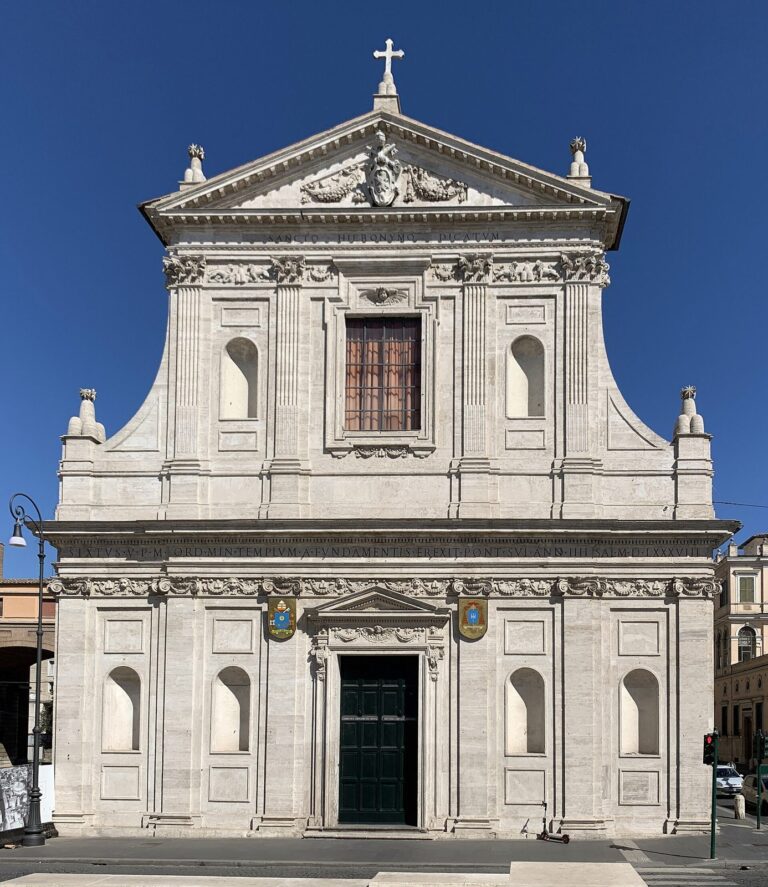
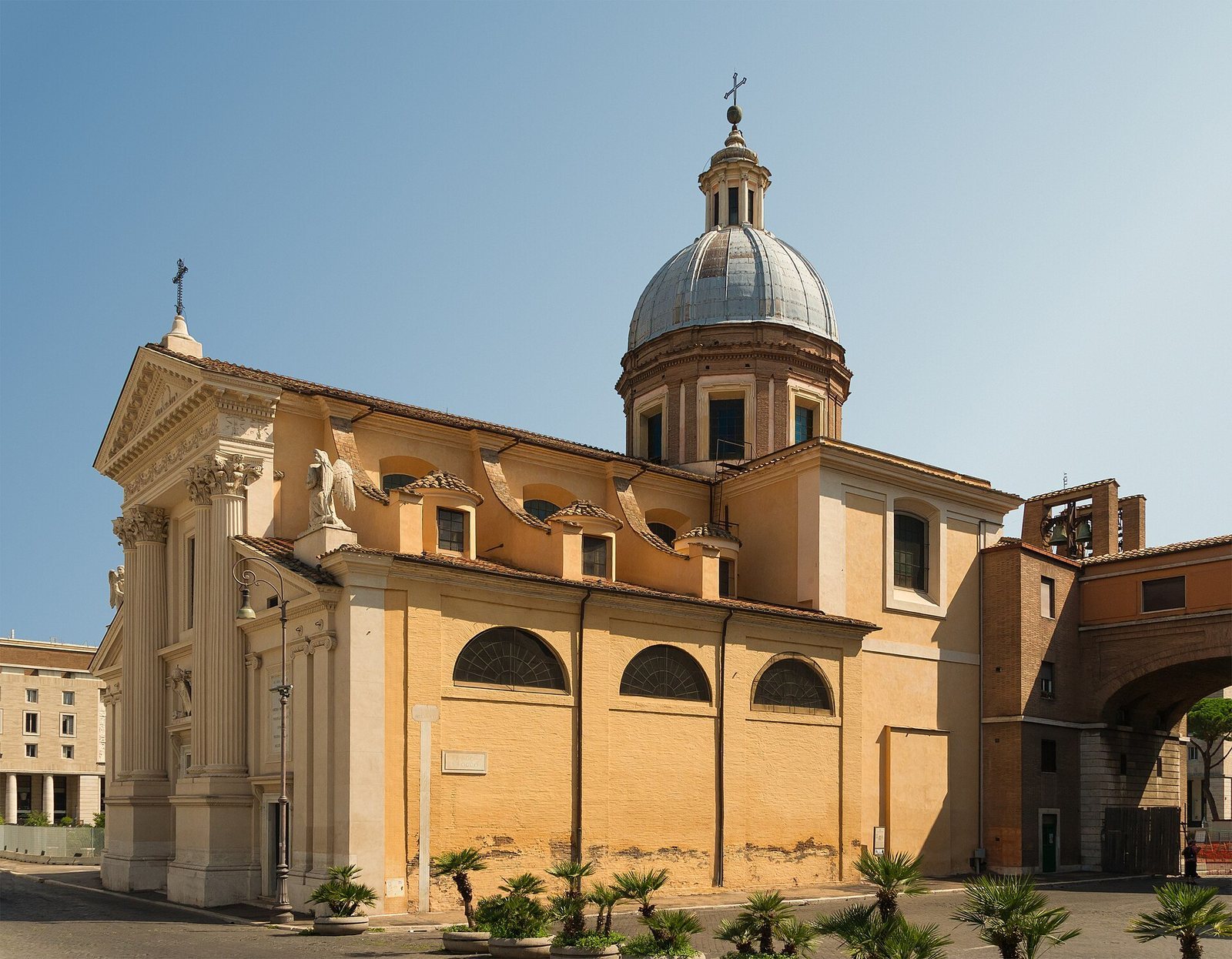
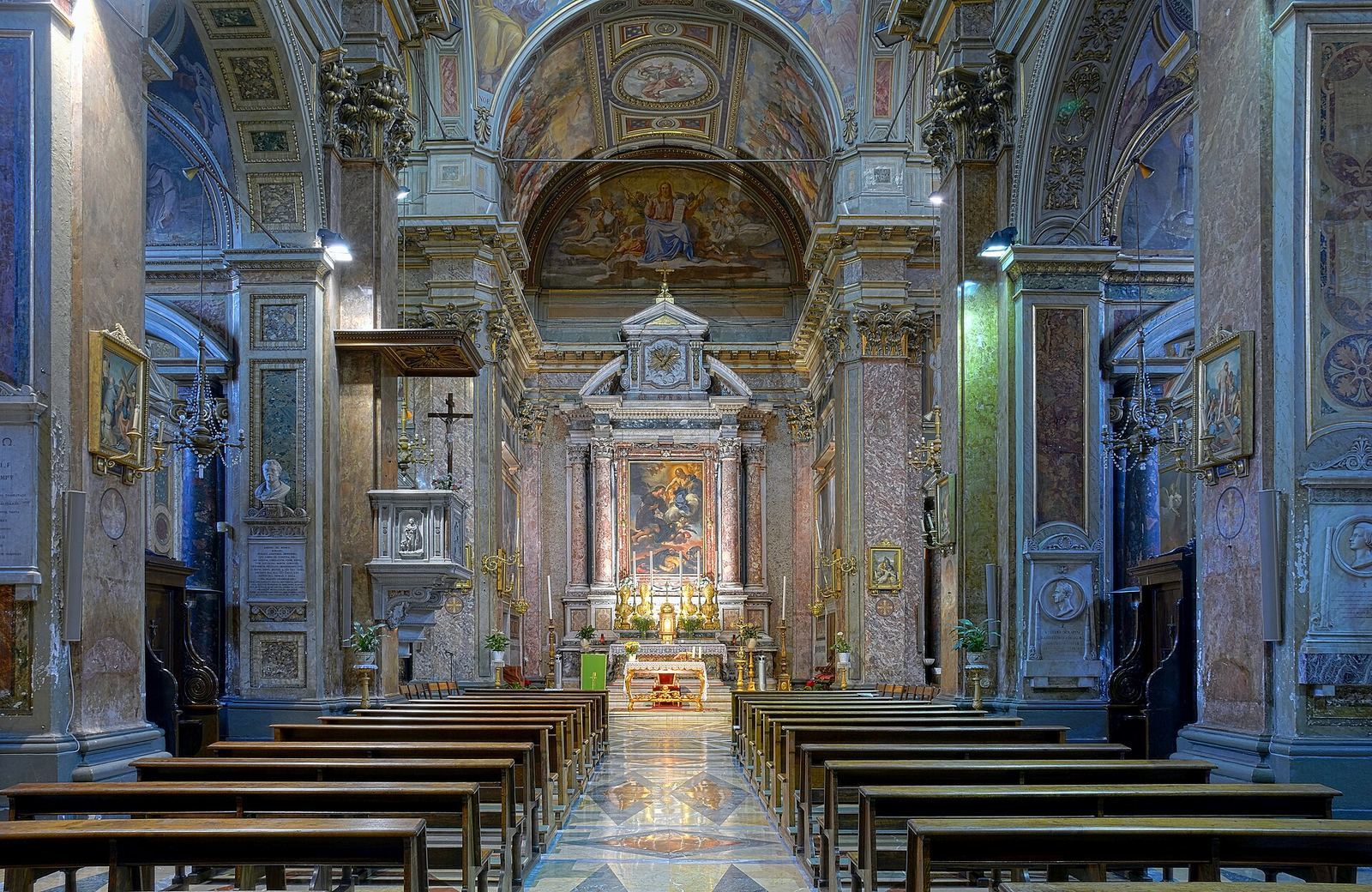
The church is arranged around one long central worship space, with chapels along both sides and a dome and sacristy within the building. Its interior is Baroque in character, while the façade follows Neoclassical design, drawing on ancient Greek and Roman forms.
Church interior
Plan and chapels
Three chapels open on each side of the central space, dedicated to Our Lady of Lourdes, a devotion to Mary; the Nativity, or birth of Jesus; Saint Anthony of Padua; the Immaculate Conception, the Catholic doctrine that Mary was conceived without original sin; Saint Joseph; and Saint Francis of Paola. The chapel of Our Lady of Graces was added during De Rossi’s reconstruction. The chapels received marble decoration in the first half of the eighteenth century.
Paintings
Early interior decoration included work by Baldassarre Peruzzi. His painting of Mary and the Christ Child with Saints Roch and Anthony the Abbot, an early Christian ascetic, was extensively restored by Giovanni Battista Gaulli around 1660 after flood damage; floods destroyed other Peruzzi frescoes, or paintings made on plaster. Giacinto Brandi’s The Glory of Saint Roch (1674) hangs above the main altar, while his Saint Roch Interceding for the Plague-Stricken (1673) is in the sacristy. Other works include Ludovico Stern’s painting of Saints Peter and Paul (1757) and Cesare Mariani’s fresco of Saint Martin sharing his cloak with a beggar (1885).
Furnishings and relics
Above the entrance are a carved organ case and singers’ gallery, both dating to the first half of the eighteenth century. The church holds relics of Saint Roch in a silver reliquary, a container for religious remains. Pope Benedict XV donated the pulpit.
Façade
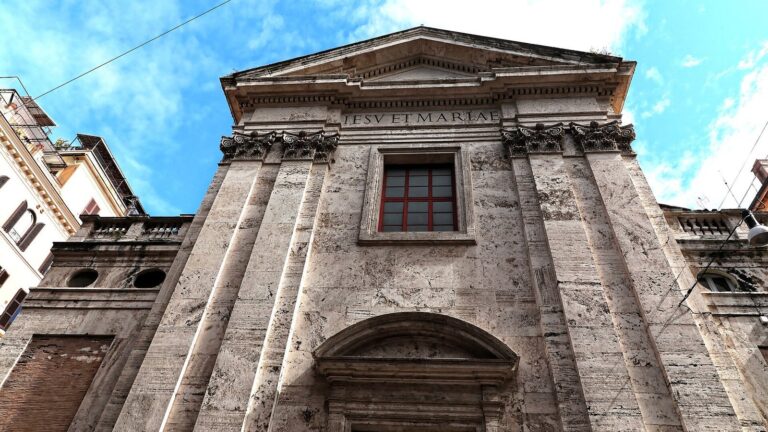
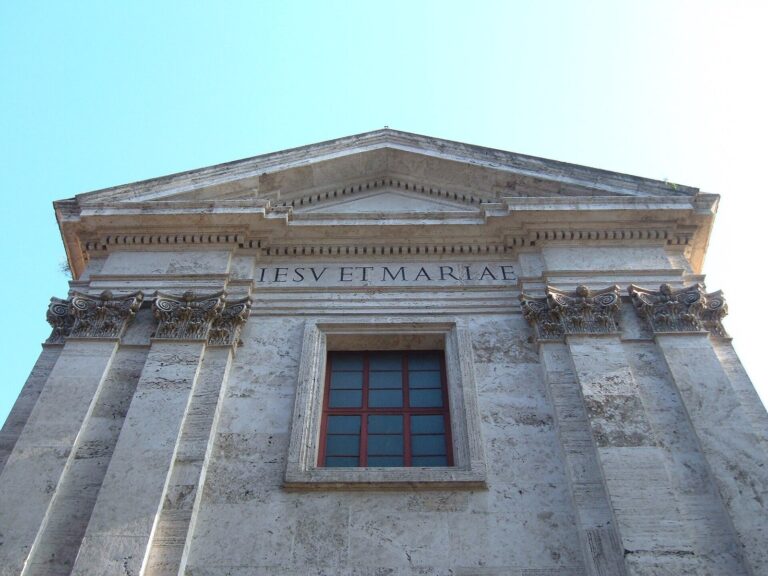
Giuseppe Valadier designed the façade, completed in 1832, drawing on Andrea Palladio’s work on San Giorgio Maggiore in Venice. Paired columns with Corinthian capitals occupy the central range, while shallow attached pilasters with Ionic capitals flank them. A large pediment, the triangular feature above the façade, crowns the design. Pope Gregory XVI’s coat of arms appears above the main entrance. The façade was originally painted with scenes from the life of Saint Roch by Avanzino Nucci.
Obelisk
A 42-foot ancient Roman obelisk, a tall, tapering monument with a pyramidal top, was discovered at San Rocco in 1527. It was later removed because it obstructed cart traffic around the river port and moved to the area of Santa Maria Maggiore.
Tiber flood marker
A column carved with raised reliefs stands on the church’s right side. Installed in 1821, it marked the height of Tiber floods. The original marker had four sections arranged along a staircase, of which the upper section survives. It records the 1598 flood, when the river rose more than four metres above the present street level.