Johanniskirche: An Evangelical Lutheran Church in Scheibenberg
Site at a Glance
- Popularity
- Very Low
- Country
- Germany
- Primary era
- Early Modern
- Eras represented
- Early Modern, Modern
- Civilizations
- Electorate of Saxony, German, Holy Roman Empire, Kingdom of Saxony
- Site type
- Religious
- Remains
- Church
On this page21 sections
History
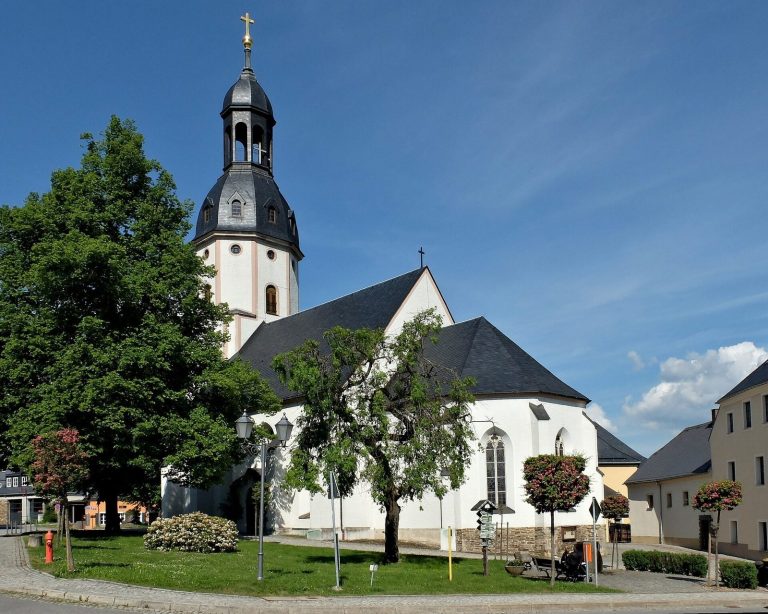
Johanniskirche is a church in Scheibenberg, Saxony, Germany, whose present building was constructed from 1559 to 1571 in the Renaissance, a European artistic period following the medieval era. It belongs to Evangelical Lutheranism, a Protestant tradition associated with Martin Luther, and is dedicated to John the Baptist, the biblical prophet associated with baptizing Jesus.
Foundation and rebuilding
A wooden predecessor was established in 1522, the same year Scheibenberg was founded. The present church replaced it in the sixteenth century. A comprehensive renovation followed from 1754 to 1756, and the building underwent several further restorations during the twentieth century.
Tower and communal use
Johann Georg Pauli and Johann Christian Oelsner began work on the tower in 1697. It was completed and consecrated in 1774. The burial chapel beside the church served mining officials, town judges, their families, and later generations. A memorial to judge and town treasurer Wolf Groschupf, who died in 1611, was donated by his son Theophilus in 1614.
Furnishings and Christmas tradition
The carved winged altarpiece had stood in Lößnitz before 1539. A local chronicle says that a life-size crucifix had been in the church since 1522. The illuminated Christmas arch is associated with a tradition of the Ore Mountains. Its earliest recorded bill dates to 1716, the earliest evidence for the regional tradition. This church example predates the oldest known table-sized arch by 24 years and is thought to have influenced that smaller form.
Richard Kreutzbach built and installed the organ in 1885. Georg Wünning restored it in 1985 and performed maintenance and cleaning in 1995 and 2006. The illuminated arch is displayed annually from the third Sunday of Advent.
War damage and modern repairs
During the Second World War, the church surrendered its bronze bells for wartime needs. Three cast-iron bells were installed after the war. A new set of four bronze bells replaced them in 2010. Cast by the Grassmayr company in Innsbruck, the bells were consecrated on 7 November that year.
Dry rot fungus threatened the tower, prompting comprehensive renovation from 2010 to 2016.
Remains
Exterior and burial chapel
Church exterior and tower
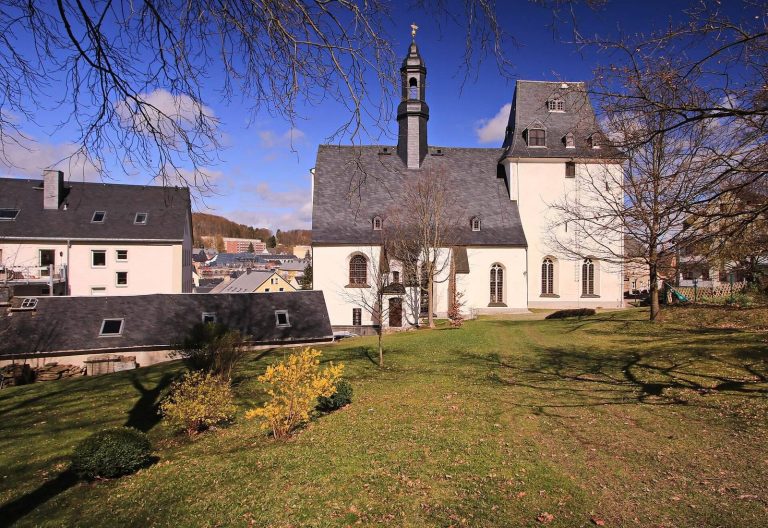
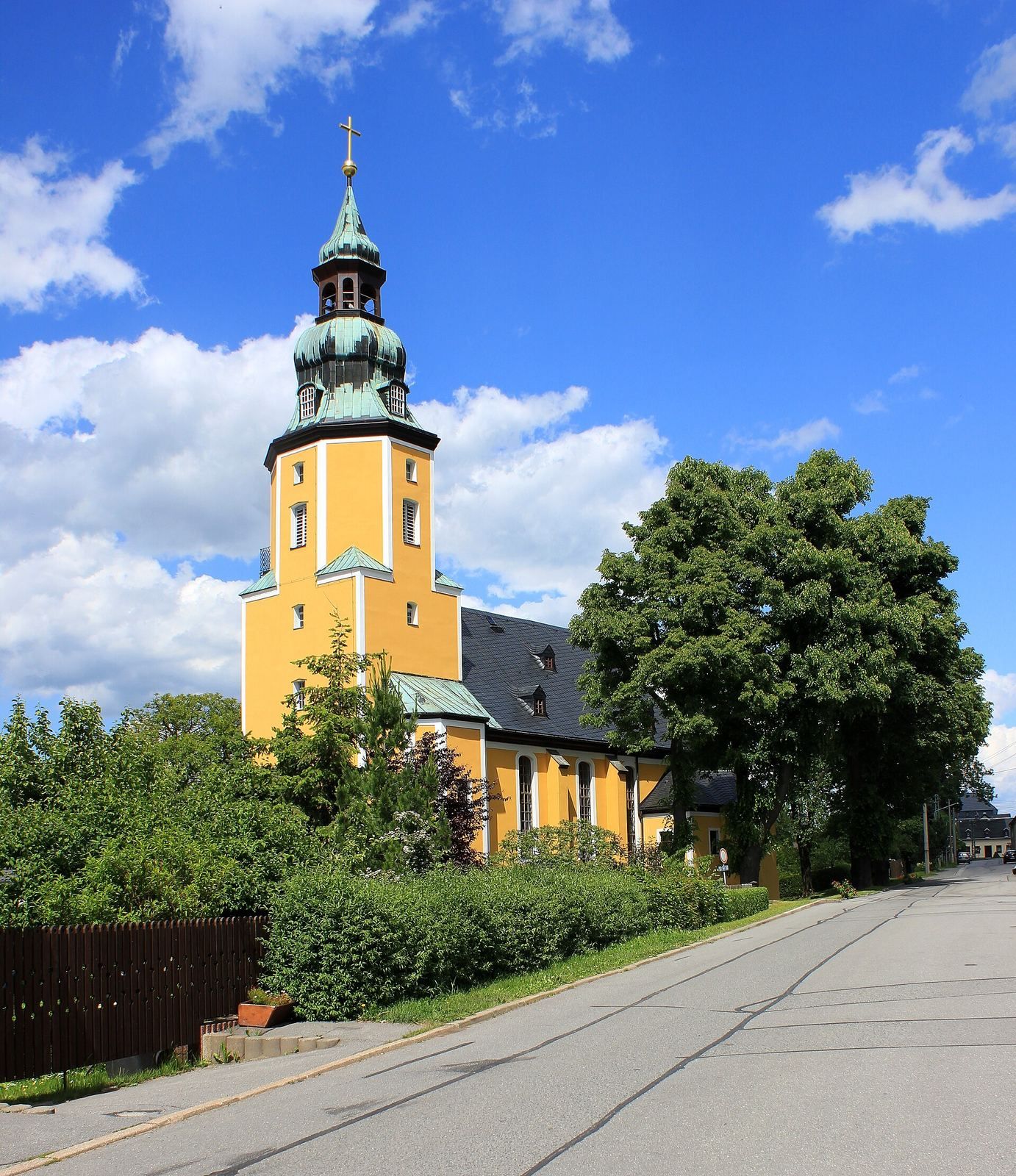
The large church stands on elevated ground and, together with the town hall and its tower, forms a prominent part of Scheibenberg’s townscape. Yellow plaster covers the exterior, with shallow vertical bands resembling columns at the corners. Buttresses on the south side point to plans for a vaulted ceiling in the Renaissance building. The west portal is a moulded round arch dated 1559. The tower rises from a square base to an octagonal upper storey and is crowned by a curved copper dome and a copper lantern, a small structure at the top.
Burial chapel
The small chapel beside the church has shallow vertical strips resembling columns. Its portal bears the date 1626, while its present form dates to 1771.
Interior and furnishings
Interior plan
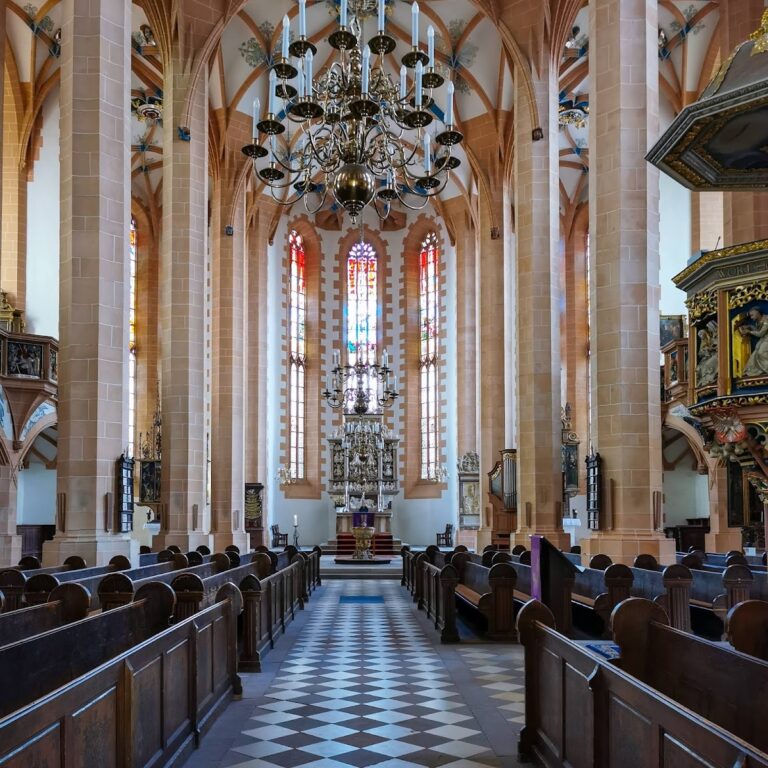
The church is a hall church, with the nave, or main body, and chancel forming one unified space beneath a large flat ceiling. The chancel has a five-eighths plan, with a polygonal end shaped by five sides of an imagined eight-sided form. A sacristy has a curved, barrel-shaped ceiling. On the north side, a two-storey annex contains a church lodge, an enclosed seating area.
Galleries and mining-office pew
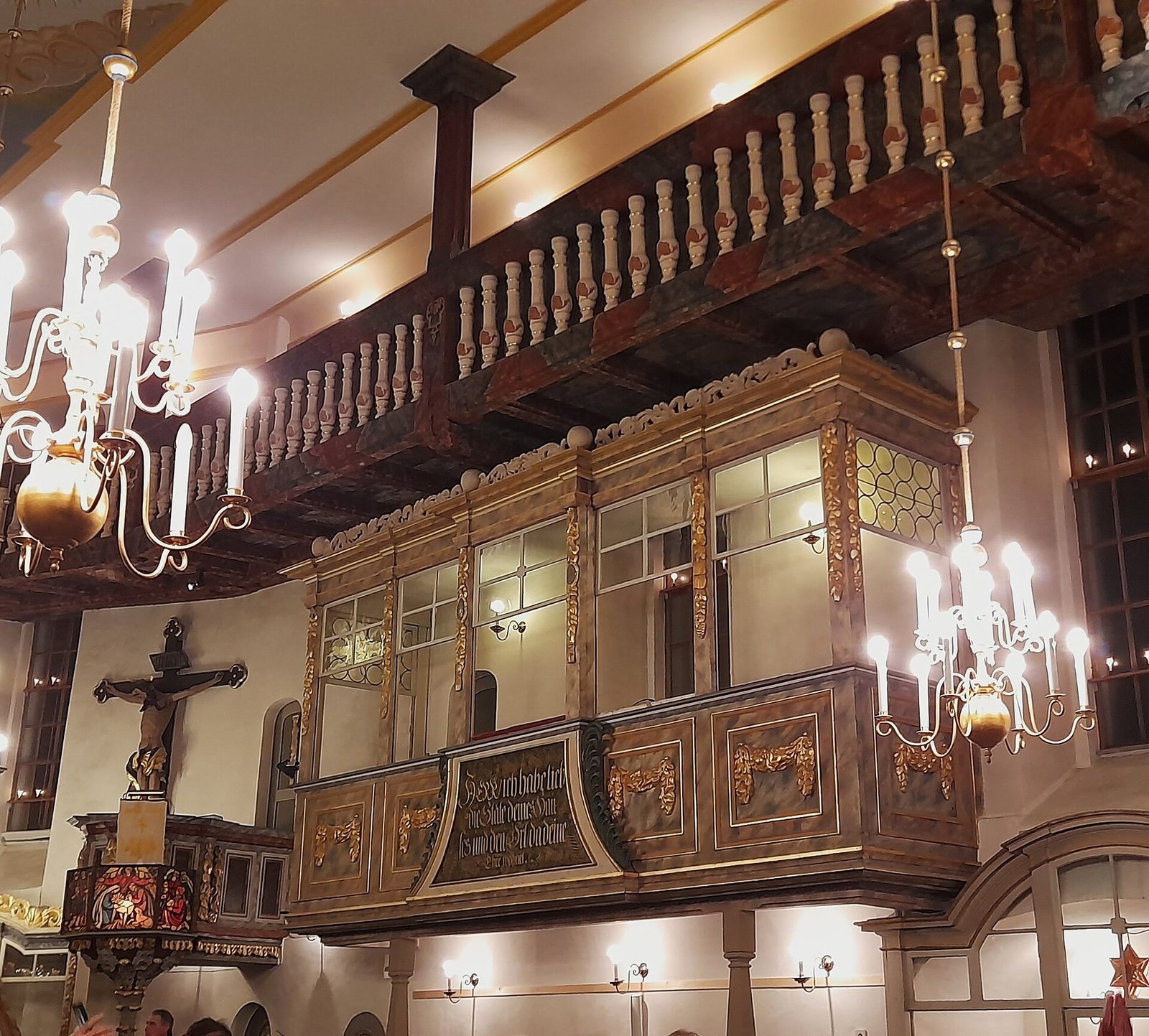
Two-storey galleries in the Baroque style, an ornate European artistic style, extend around the interior. Lodges and prayer rooms were installed between 1698 and 1754. Beneath the north gallery, the mining office’s lodge, also called the mining-office pew, includes two carved miners holding a double coat of arms. Gilded garlands incorporate depictions of tools.
Carved altarpiece
The late-Gothic altarpiece, in a late medieval European style, is carved with the Lamentation of Christ at its centre. Its wings show the Carrying of the Cross and the Entombment. Small figures of the Gospel writers occupy openwork sections, while painted landscapes appear on the shrine and wings. The backs of the inner wings depict the martyrdom of John the Baptist. The fixed wings portray John the Apostle and Evangelist, traditionally associated with the Gospel of John, and Judas Thaddaeus, traditionally counted among the Twelve Apostles. Above them, figures of John the Baptist, Peter, and Paul stand beneath canopies, with a smaller John the Evangelist in the upper section. The altarpiece was made around 1485.
Pulpit and baptismal font
Scheibenberg master carpenter Johann Kaufmann made the wooden pulpit in 1709. Its basket is painted with Christ and the Gospel writers, while a vegetal ornament on its column dates to 1927 to 1928. The restored baptismal font was made from porphyry tuff, a volcanic rock used for building and sculpture, in 1570. Its large tin cover dates to 1767 and was made by local craftsman Carl Gottlieb Müller.
Crucifix and organ
The life-size crucifix is made of wood and is attributed to Hans Witten or his circle. Witten was a late-Gothic sculptor active in Saxony around the turn of the sixteenth century. The organ has 21 stops, sets of pipes selected to produce different sounds, across two keyboards and a pedalboard. Its arrangement is 11, 5, and 5.
Memorials and bells
Lehmann memorial
A colorful memorial made of porphyry tuff commemorates pastor and chronicler Christian Lehmann (1611 to 1688) and his wife Euphrosyna, née Kreusel (1611 to 1686). It depicts them as half-length figures within a small lodge.
Groschupf memorial
The wooden memorial to Wolf Groschupf has a richly carved architectural frame. Its scenes include the donor’s family, Jacob wrestling with an angel, and a figure of the resurrected. The work is in the Mannerist style, a late Renaissance European style.
Plaques and family burial vault
A plaque on the south wall marks the 800th anniversary of the House of Wettin’s rule. Members of this German ruling dynasty governed Saxony for centuries. Another plaque beside the main portal commemorates Christian Lehmann, and a further plaque is on the north side. A hereditary burial vault belonging to the Kellermann family is also among the church’s features.
Mining bell and cast-iron bell
A bell dated 1522, known as the mining bell or silver bell, hangs in the tower lantern. It is considered one of Germany’s oldest mining bells. The largest of the three cast-iron bells removed when the bronze peal was installed stands on the lawn in front of the church.
Illuminated Christmas arch
The illuminated arch is positioned above the organ gallery.