Dolmen de Mettray: A Neolithic Chambered Tomb in France
Site at a Glance
- Popularity
- Medium
- Country
- France
- Primary era
- Stone Age
- Eras represented
- Stone Age
- Civilizations
- Unclassified
- Site type
- Burial
- Remains
- Tomb
On this page8 sections
History
The Dolmen de Mettray is a prehistoric chambered tomb at Moulin de Réchaussé in France, south of Saint-Antoine-du-Rocher. It was probably erected between 2500 and 2000 BCE, during the Neolithic, the later Stone Age associated with farming and polished stone tools. Its Angevin type is a regional form associated with Anjou and the Loire area.
Early references and investigation
A work on Celtic monuments mentioned the dolmen in 1805. In 1865, the Archaeological Society of Touraine, a regional group concerned with archaeology and local history, proposed excavating it, but the plan was not carried out.
Joseph Gaurichon conducted test excavations in 1910 and presented the monument’s first full description at the Prehistoric Congress in Tours that year.
Protection and conservation
The monument received historic-monument classification in 1914, and the Grotte aux Fées site was registered in 1943. The municipality of Saint-Antoine-du-Rocher owns the site. In the mid-1980s, the dolmen was consolidated because stones supporting its roof slabs were leaning inward and repeated fires inside had weakened the stonework.
Remains
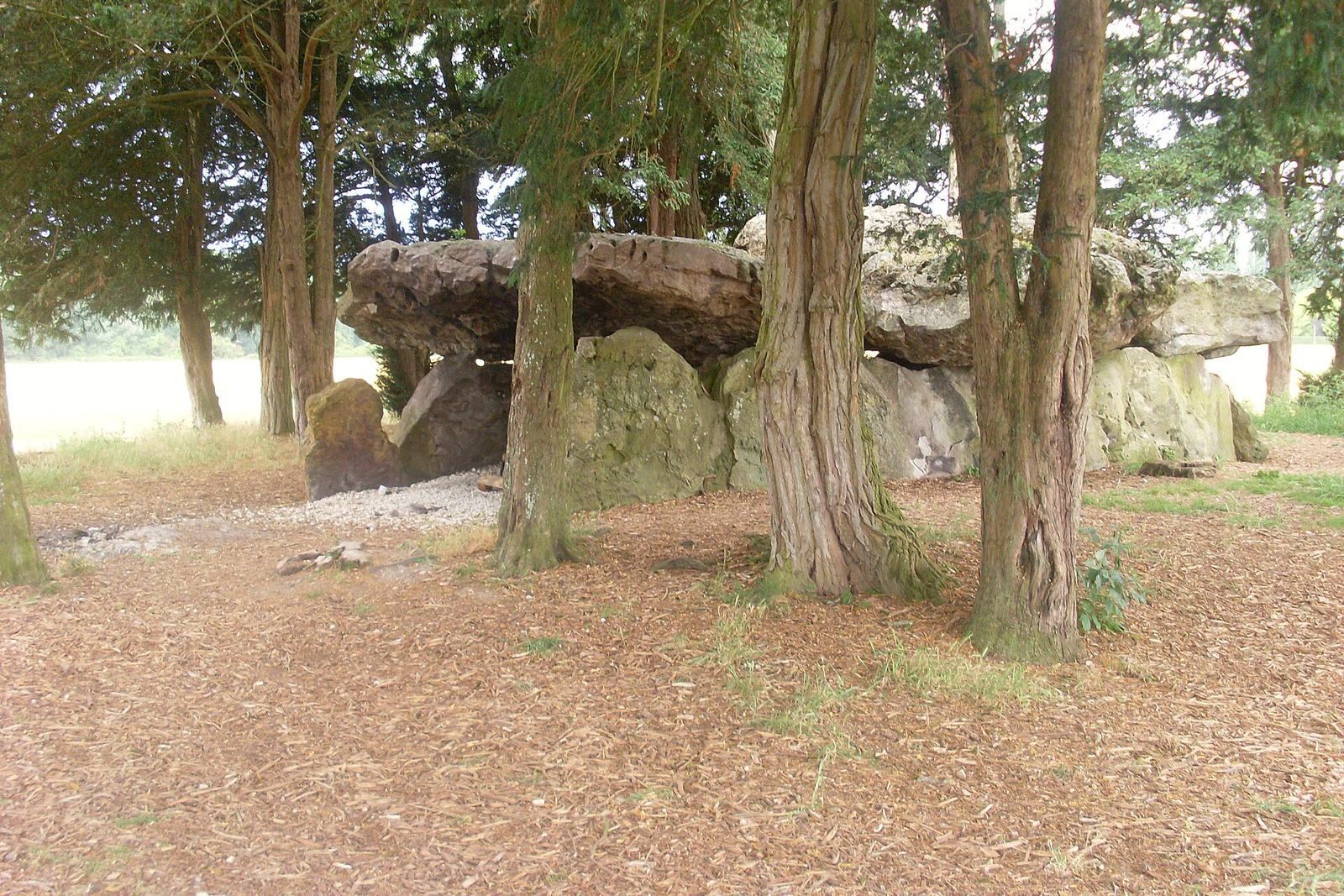
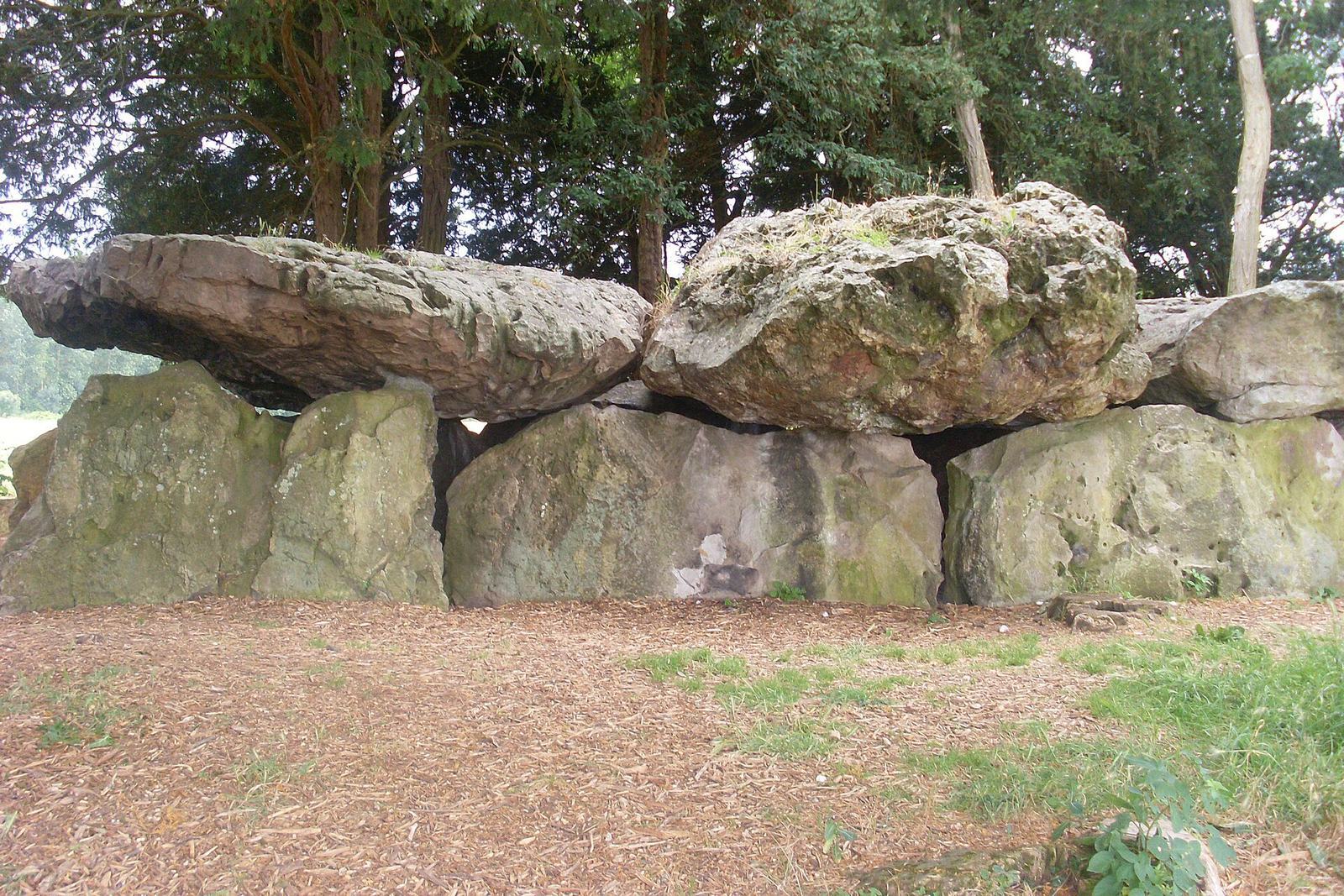
The monument is a large rectangular structure of upright slabs and heavy roof stones. Its chamber is divided into a space for the dead and an entrance area. It stands on a level shelf of a slope that descends east toward the Choisille valley.
Chamber and entrance
The dolmen measures 11 m long, 4.5 m wide and 3 m high. Its chamber is about 10 m long and 3 m wide, with an end slab and three upright stones along each side. A crosswise slab separates the burial space from the entrance area. This slab was used for polishing, but vandalism in the mid-1960s erased the marks left by that work. At the left side of the entrance, a separate block set slightly inward stands 1.2 m high and measures 1 m wide; its function is uncertain.
Capstones and materials
Three massive capstones cover the structure. They measure 4.8 m wide and 1 m thick, 3.2 m wide and 1.8 m thick, and 3.2 m wide and 0.9 m thick; their combined mass is estimated at up to 65 tonnes. The slabs are white sandstone from the Eocene, a geological epoch lasting about 56 to 34 million years ago, except for the central capstone and three upright stones. Those are puddingstone, a rock made of pebbles cemented together.
Setting and related monuments
The dolmen is also called the Dolmen de la Grotte aux Fées and the Dolmen de Saint-Antoine-du-Rocher. It stands on the boundary between the communes of Saint-Antoine-du-Rocher and Mettray, which accounts for its name. A burial mound may once have covered it. A slightly raised platform, 22 m long and 16 m wide, lies above the surrounding ground. The tomb may have been the principal element in a megalithic group that also included another dolmen and two standing stones.
Finds from the test excavations
The 1910 excavations recovered bones, polished flint objects, including an axe described as imported, and pottery fragments with simple decoration. The finds have no established dates.