Blewburton Hill: An Iron Age Hillfort in Oxfordshire
Site at a Glance
- Popularity
- Medium
- Country
- United Kingdom
- Primary era
- Iron Age
- Eras represented
- Iron Age
- Civilizations
- Unclassified
- Site type
- Military
- Remains
- Fort
On this page13 sections
History
Blewburton Hill is an Iron Age hillfort near Didcot in Oxfordshire, United Kingdom, whose history began around 550 BC with a small settlement.
Early settlement and hillfort
The first community lived in a few huts protected by a timber palisade, a barrier of upright posts. This enclosure covered about half the area of the later fort. In the fourth century BC, a hillfort replaced it, enclosing roughly twice the earlier settlement’s area. The fort may have remained in use from the fourth to the first century BC, and its occupation appears to have been comparatively intensive among hillforts in the region.
Refortification and abandonment
After a period when the fort was unused, it was strengthened again around 100 BC. It was abandoned by about 50 BC, possibly in response to the expansion of the Belgae, ancient peoples associated with parts of Gaul and southeastern Britain. The final occupation appears to have ended violently.
Later use and investigation
Roman pottery from the first century AD and the third or fourth centuries AD was recovered from the hilltop. During the Anglo-Saxon period, the early medieval period in England, the fort’s interior was used as a cemetery.
Excavations took place between 1947 and 1953, followed by further work in 1967. Led by archaeologist D. W. Harding, the 1967 investigation examined the ditch and rampart on the fort’s north side. Blewburton Hill is a scheduled monument, a site given legal protection for its archaeological or historic importance.
Remains
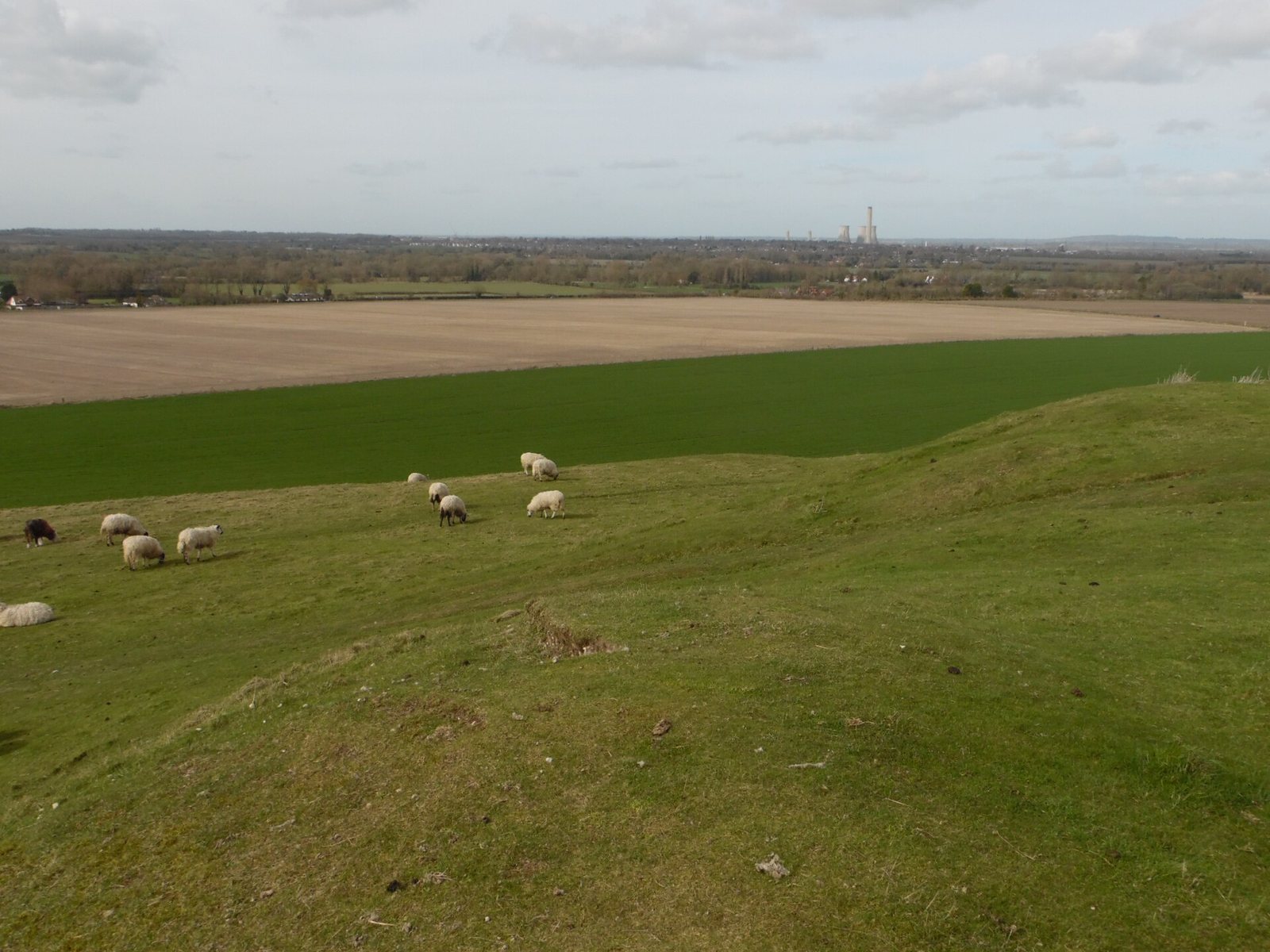
The hillfort covers about four hectares on a hill between Aston Tirrold and Blewbury. Its surroundings are mostly farmland, with small wooded copses to the south and northeast. The enclosure had a single defensive bank, or rampart.
Defences and entrance
Rampart and ditch
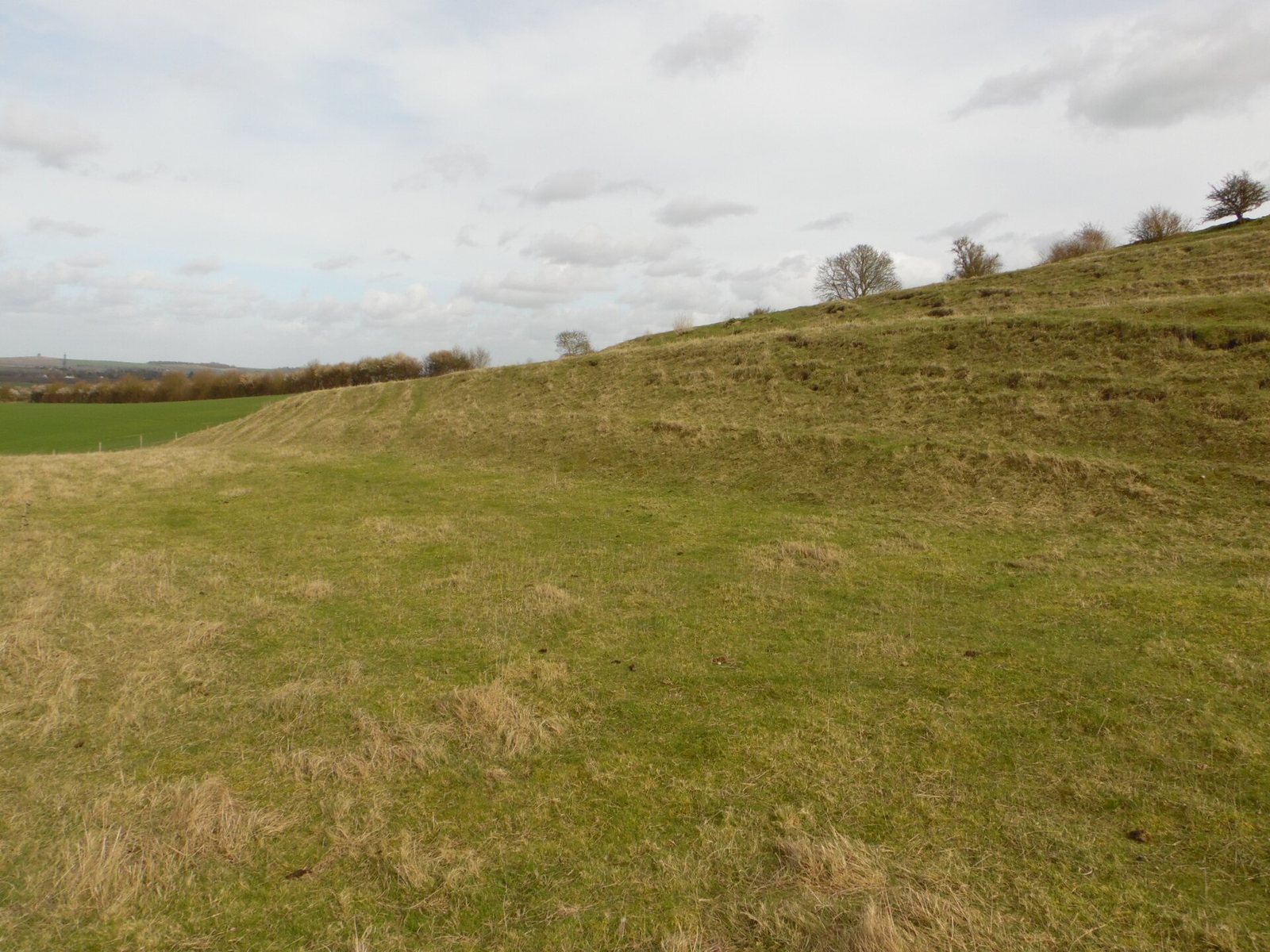
The original bank was made from material dug out of the outer ditch and held in place by timber supports. It was about 6.4 metres wide, with a four-metre gap between its inner and outer supports, packed with chalk. The ditch was about 1.5 metres deep in this phase and reached roughly 4.6 metres when deepened later. The rebuilt bank had a shallow slope at the rear and a steep face toward the ditch, replacing an earlier timber frame packed with fill. Ploughing has badly damaged the eastern rampart, which is destroyed in places. In the west, part of the bank survives as a sunken lynchet, a terrace or earthwork on a slope, while the ditch remains as a flat terrace.
Western entrance
The western entrance is about 11 metres wide and was set back within a corridor through the rampart. During refortification, the opening was narrowed from 20 metres to 7.5 metres. Postholes indicate a double gate in the later phase, and the entrance may have had a walkway overhead. A ditch behind the gateway, which was later filled in, helped protect the approach. The ends of the ramparts beside the entrance were faced with dry-stone walls, built without mortar, using stone brought from elsewhere.
West-side terraces
Several lynchets cross the western slope. Their date and purpose are uncertain, although they are thought to postdate the Iron Age.
Burials and finds
Anglo-Saxon cemetery
The cemetery contained 22 buried individuals and one cremation. Most of the burials had grave goods, including amber and glass beads, a spearhead, two bronze brooches, buckles, knives, and pots.
Iron Age burials
Several horse burials were found within the entrance. A separate burial pit held a man’s remains alongside those of a horse and a dog.
Other excavated finds
Finds included flints from the Neolithic or Early Bronze Age and a polished stone axe recovered from the ditch near the entrance. Iron Age objects included ceramics, two shale pendants, fragments of shale bracelets, and an iron currency bar, a standardized iron bar traditionally interpreted as a form of exchange.